Media Framing of Crime Along Ethnic Lines: Divisive.
As an Igbo man, I have endured stereotypes, judgment, and labelling solely based on my ethnic origins. This is not an isolated Igbo experience. Most Nigerians have, at some point, been reduced to their ethnicity rather than recognised for their true character.
I understand the pain of the ordinary Fulani man today, often unfairly judged by the actions of criminals he does not support, has never met, and who are not representative of his people.
Even in America, such unjust labelling fueled the civil rights movement and prompted Martin Luther King Jr. to declare that people should be judged by the content of their character, not the colour of their skin.
Every Nigerian ethnic group is known for its unique traditions, occupations, skills, and strengths. Crime, however, has no ethnicity. A thief is a thief. A terrorist is a terrorist. A kidnapper is a kidnapper. They are bad actors, not representatives of any people. They must be identified, arrested, and punished according to the law.
We must decisively abandon the dangerous practice of blaming entire ethnic groups for the actions of a few criminals. It is unjust, it breeds hatred, and it damages our national unity.
Let us proudly celebrate our diverse cultures, talents, and contributions, rather than falling prey to stereotypes and prejudices that politicians and divisive interests exploit for their gain.
A new Nigeria must emerge—one where no citizen is condemned because of tribe, religion, or birthplace. We can cherish our cultural roots while standing united by justice, mutual respect, and hope for a better future. We are capable of this.
A new Nigeria is within our reach. -PO
Fellow Nigerians, good morning.
I woke up this morning after my church service with a deeply reflective heart, and despite every constraint, I felt compelled to share these thoughts with you.
Many people do not truly understand the silent pains some of us carry daily—the private struggles, emotional burdens, and quiet battles we face while trying to survive and serve sincerely in difficult circumstances.
We now live in an environment that has become increasingly toxic, where the very system that should protect and create opportunities for decent living often works against the people—a society where intimidation, insecurity, endless scrutiny, and discouragement have become normal.
More painful is when some of those you associate with, believing you would find understanding and solidarity among them, become part of the pressure you face. Some who publicly identify with you privately distance themselves or join in unfair criticism.
We live in a society where humility is mistaken for weakness, respect is seen as a lack of courage, and compassion is treated as foolishness—a system where treating people equally is questioned simply because you refuse to worship status, tribe, class, or power.
Personally, I have never looked down on anyone except to uplift them. I have never used privilege, position, or resources to oppress others, intimidate the weak, or make people feel small. To me, leadership has always been about service, sacrifice, and helping others rise.
Let me state clearly: my decision to leave the ADC is not because our highly respected Chairman, Senator David Mark, treated me badly, nor because my leader and elder brother, Alhaji Atiku Abubakar, or any other respected leaders did anything personally wrong to me. I will continue to respect them.
However, the same Nigerian state and its agents that created unnecessary crises and hostility within the Labour Party that forced me to leave now appear to be finding their way into the ADC, with endless court cases, internal battles, suspicion, and division, instead of focusing on deeper national problems and playing politics built more on control and exclusion than on service and nation-building.
Even within spaces where one labours sincerely, one is sometimes treated like an outsider in one’s own home. You and your team become easy targets for every failure, frustration, or misunderstanding, as though honest contribution has become a favour being tolerated rather than appreciated.
And when you choose to leave so that those you are leaving can have peace, and you step out into the cold, you are still maligned and your character is questioned. Despite all your efforts to continue working for a better Nigeria and engaging people with sincerity and goodwill, those who do not wish you well continue to attack your character and question your intentions.
There are moments I ask God in prayer: Why is doing the right thing often misconstrued as wrongdoing in our country? Why is integrity not valued? Why is the prudent management of resources, especially when invested in critical areas like education and healthcare, wrongly labelled as stinginess? Why are humility and obedience to the rule of law often taken to be weakness rather than discipline?
Let me assure all that I am not desperate to be President, Vice President, or Senate President. I am desperate to see a society that can console a mother whose child has been kidnapped or killed while going to school or work. I am desperate to see a Nigeria where people will not live in IDP camps but in their homes. I am desperate for a country where Nigerian citizens do not go to bed hungry, not knowing where their next meal will come from.
Yet, despite everything, I remain resolute. I firmly believe that Nigeria can still become a country with competent leadership based on justice, compassion, and equal opportunity for all.
A new Nigeria is POssible. -PO
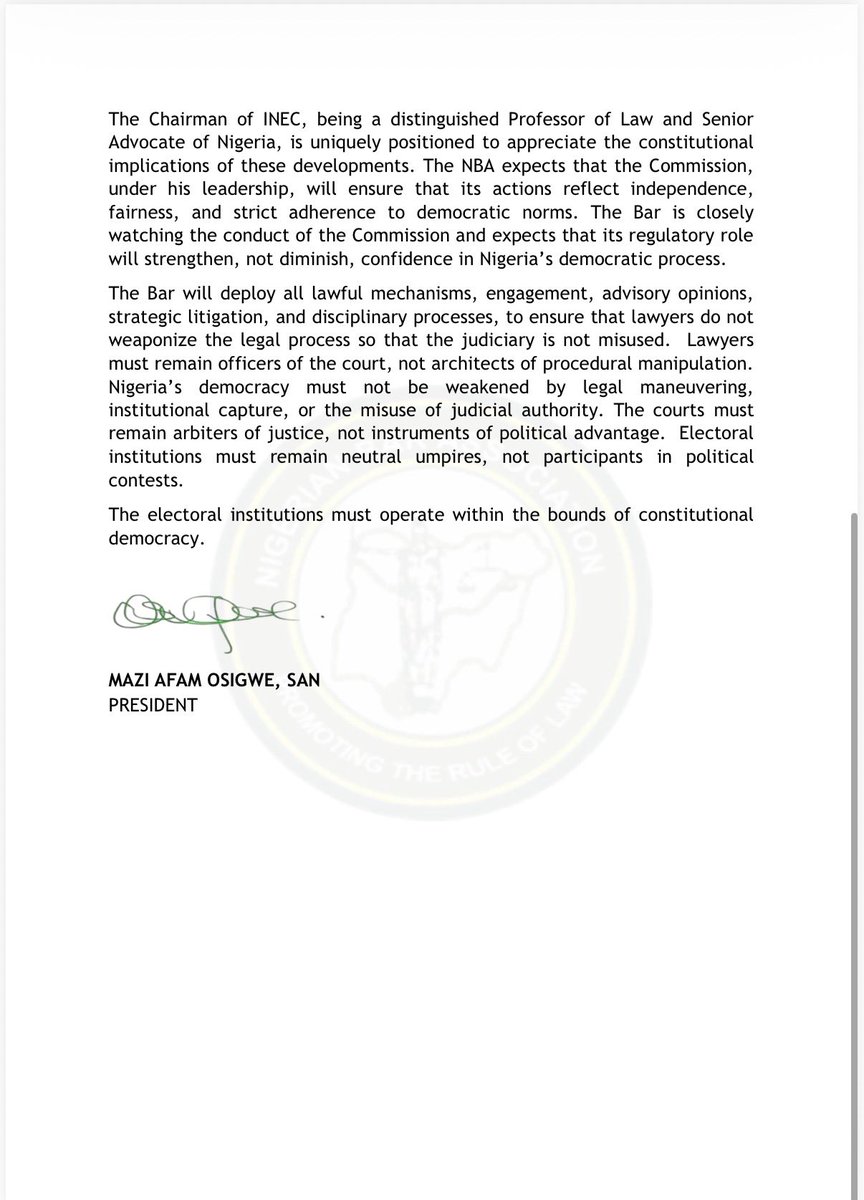
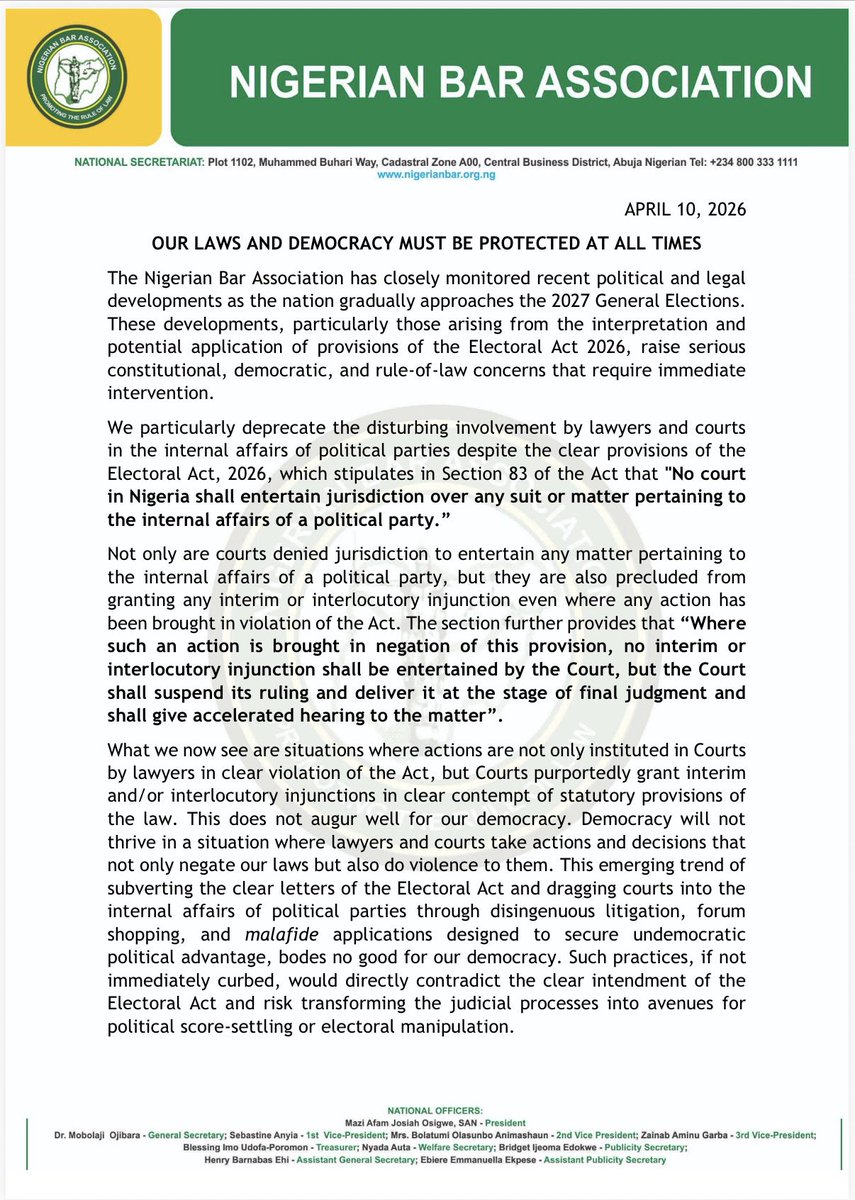
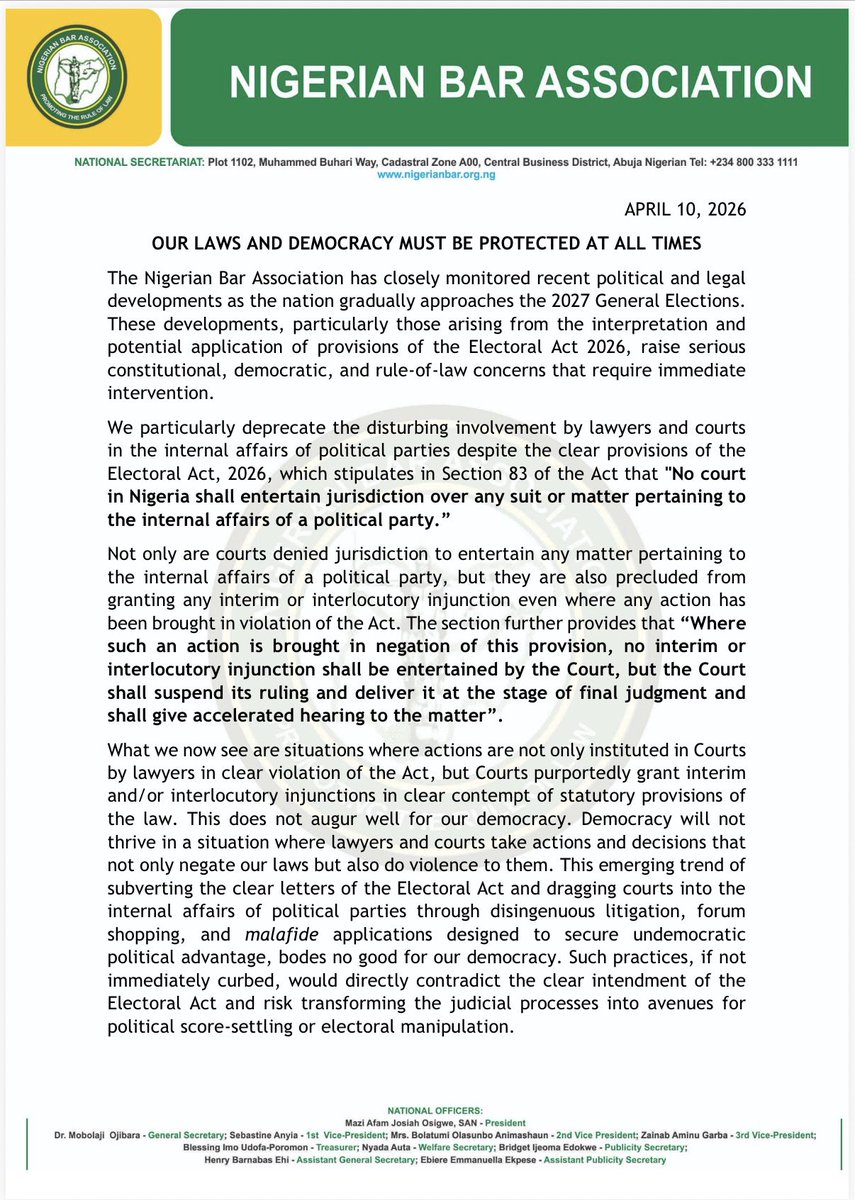
OUR LAWS AND DEMOCRACY MUST BE PROTECTED AT ALL TIMES
The Nigerian Bar Association has closely monitored recent political and legal developments as the nation gradually approaches the 2027 General Elections. These developments, particularly those arising from the interpretation and potential application of provisions of the Electoral Act 2026, raise serious constitutional, democratic, and rule-of-law concerns that require immediate intervention.
We particularly deprecate the disturbing involvement by lawyers and courts in the internal affairs of political parties despite the clear provisions of the Electoral Act, 2026, which stipulates in Section 83 of the Act that “No court in Nigeria shall entertain jurisdiction over any suit or matter pertaining to the internal affairs of a political party.”
Not only are courts denied jurisdiction to entertain any matter pertaining to the internal affairs of a political party, but they are also precluded from granting any interim or interlocutory injunction even where any action has been brought in violation of the Act. The section further provides that “Where such an action is brought in negation of this provision, no interim or interlocutory injunction shall be entertained by the Court, but the Court shall suspend its ruling and deliver it at the stage of final judgment and shall give accelerated hearing to the matter”.
What we now see are situations where actions are not only instituted in Courts by lawyers in clear violation of the Act, but Courts purportedly grant interim and/or interlocutory injunctions in clear contempt of statutory provisions of the law. This does not augur well for our democracy. Democracy will not thrive in a situation where lawyers and courts take actions and decisions that not only negate our laws but also do violence to them. This emerging trend of subverting the clear letters of the Electoral Act and dragging courts into the internal affairs of political parties through disingenuous litigation, forum shopping, and malafide applications designed to secure undemocratic political advantage, bodes no good for our democracy. Such practices, if not immediately curbed, would directly contradict the clear intendment of the Electoral Act and risk transforming the judicial processes into avenues for political score-settling or electoral manipulation.
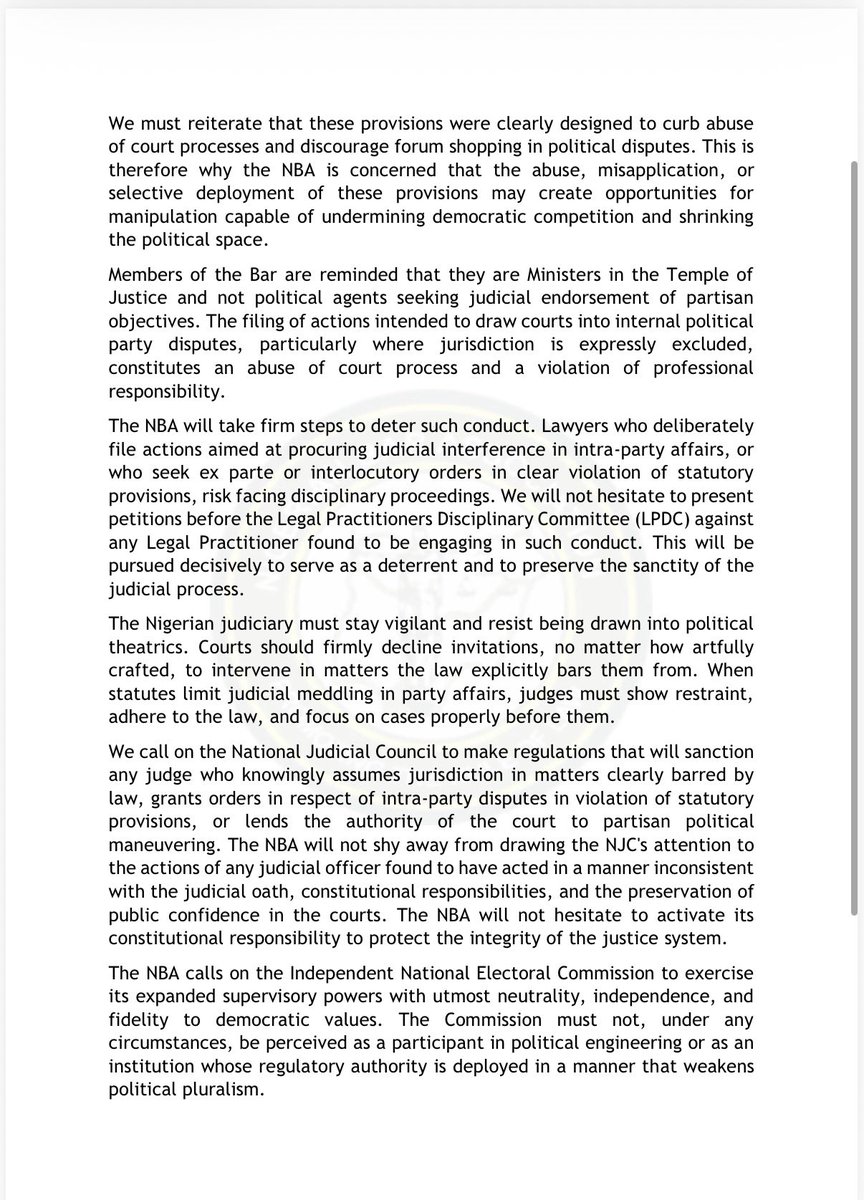
We must reiterate that these provisions were clearly designed to curb abuse of court processes and discourage forum shopping in political disputes. This is therefore why the NBA is concerned that the abuse, misapplication, or selective deployment of these provisions may create opportunities for manipulation capable of undermining democratic competition and shrinking the political space.
Members of the Bar are reminded that they are Ministers in the Temple of Justice and not political agents seeking judicial endorsement of partisan objectives. The filing of actions intended to draw courts into internal political party disputes, particularly where jurisdiction is expressly excluded, constitutes an abuse of court process and a violation of professional responsibility.
The NBA will take firm steps to deter such conduct. Lawyers who deliberately file actions aimed at procuring judicial interference in intra-party affairs, or who seek ex parte or interlocutory orders in clear violation of statutory provisions, risk facing disciplinary proceedings. We will not hesitate to present petitions before the Legal Practitioners Disciplinary Committee (LPDC) against any Legal Practitioner found to be engaging in such conduct. This will be pursued decisively to serve as a deterrent and to preserve the sanctity of the judicial process.
The Nigerian judiciary must stay vigilant and resist being drawn into political theatrics. Courts should firmly decline invitations, no matter how artfully crafted, to intervene in matters the law explicitly bars them from.
OUR LAWS AND DEMOCRACY MUST BE PROTECTED AT ALL TIMES
The Nigerian Bar Association @NigBarAssoc has closely monitored recent political and legal developments as the nation gradually approaches the 2027 General Elections. These developments, particularly those arising from the interpretation and potential application of provisions of the Electoral Act 2026, raise serious constitutional, democratic, and rule-of-law concerns that require immediate intervention.
We particularly deprecate the disturbing involvement by lawyers and courts in the internal affairs of political parties despite the clear provisions of the Electoral Act, 2026, which stipulates in Section 83 of the Act that “No court in Nigeria shall entertain jurisdiction over any suit or matter pertaining to the internal affairs of a political party.”
Not only are courts denied jurisdiction to entertain any matter pertaining to the internal affairs of a political party, but they are also precluded from granting any interim or interlocutory injunction even where any action has been brought in violation of the Act. The section further provides that “Where such an action is brought in negation of this provision, no interim or interlocutory injunction shall be entertained by the Court, but the Court shall suspend its ruling and deliver it at the stage of final judgment and shall give accelerated hearing to the matter”.
What we now see are situations where actions are not only instituted in Courts by lawyers in clear violation of the Act, but Courts purportedly grant interim and/or interlocutory injunctions in clear contempt of statutory provisions of the law. This does not augur well for our democracy. Democracy will not thrive in a situation where lawyers and courts take actions and decisions that not only negate our laws but also do violence to them. This emerging trend of subverting the clear letters of the Electoral Act and dragging courts into the internal affairs of political parties through disingenuous litigation, forum shopping, and malafide applications designed to secure undemocratic political advantage, bodes no good for our democracy. Such practices, if not immediately curbed, would directly contradict the clear intendment of the Electoral Act and risk transforming the judicial processes into avenues for political score-settling or electoral manipulation.
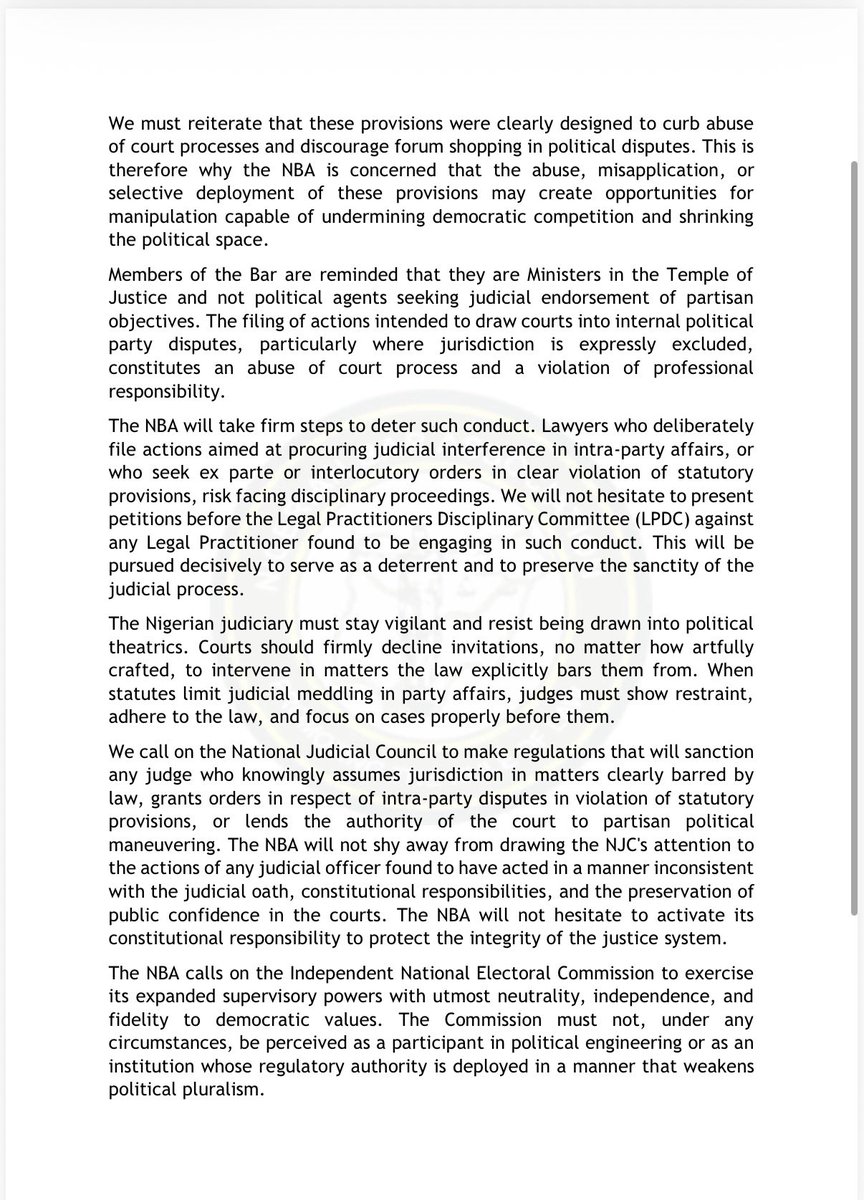
We must reiterate that these provisions were clearly designed to curb abuse of court processes and discourage forum shopping in political disputes. This is therefore why the NBA is concerned that the abuse, misapplication, or selective deployment of these provisions may create opportunities for manipulation capable of undermining democratic competition and shrinking the political space.
Members of the Bar are reminded that they are Ministers in the Temple of Justice and not political agents seeking judicial endorsement of partisan objectives. The filing of actions intended to draw courts into internal political party disputes, particularly where jurisdiction is expressly excluded, constitutes an abuse of court process and a violation of professional responsibility.
The NBA will take firm steps to deter such conduct. Lawyers who deliberately file actions aimed at procuring judicial interference in intra-party affairs, or who seek ex parte or interlocutory orders in clear violation of statutory provisions, risk facing disciplinary proceedings. We will not hesitate to present petitions before the Legal Practitioners Disciplinary Committee (LPDC) against any Legal Practitioner found to be engaging in such conduct. This will be pursued decisively to serve as a deterrent and to preserve the sanctity of the judicial process.
The Nigerian judiciary must stay vigilant and resist being drawn into political theatrics. Courts should firmly decline invitations, no matter how artfully crafted, to intervene in matters the law explicitly bars them from.
A thread 1/2
🇳🇬 Dear Nigerians,
We have carefully reviewed the released Certified True Copies of the Tax Reform Acts and the gazettes your government now parades.
We have also taken note of the dates boldly printed on them.
With that established, let us be clear.
Your government is not smart. They simply assume many of you are ignorant.
After weeks of sustained public pressure, they issued this clumsy press statement claiming they had “released” the gazetted copies of the Tax Reform Acts, applauding themselves as leaders of a transparent government.
That claim is false. It is insulting and honestly misleading.
While the world was focused on Venezuela, the House of Representatives, in quiet coordination with the Presidency, released what it now calls Certified True Copies (CTCs) of the four Tax Reform Acts.
They even congratulated themselves and praised the Speaker’s so-called “transparency drive.”
If you examine the released files, you will find presidential assent pages attached and a Google Drive link to gazettes dated June 26, 2025.
This is nowhere near transparency. It is damage control.
The timing tells the real story.
The four Acts are now being presented as the “AUTHENTIC” versions, conveniently cleansed of the coercive provisions that triggered national outrage.
No compulsory 20 percent appeal deposits.
No unchecked garnishee powers without court orders.
Oversight restored.
Due process acknowledged.
Fine. At least public fears have been partially allayed.
But this question remains unavoidable: if these gazetted copies were genuinely published in June 2025, why were Nigerians previously shown different texts? Why wait until January 2026, after implementation commenced on January 1, before releasing these CTCs? Why only act after public outrage peaked, following Hon. Dasuki’s warning and interventions by other prominent Nigerians?
This release is an admission by stealth.
They are loudly conceding that rogue versions indeed circulated. They refuse to say who inserted those clauses, who printed them, who distributed them, and under whose authority Nigerians were subjected to texts that were never law.
The press statement dismisses the earlier versions as “unauthorised and misleading,” instructs citizens to ignore them, and praises institutional memory while the Betara-led ad hoc committee drags on with no timeline, no findings, and no consequences.
Nigerians, re-gazetting does not cure the offence. It sanitises the record and evades responsibility.
Post-assent alteration is not an error.
It is forgery. It is uttering. It is conspiracy. It is misconduct in public office. It is legislative usurpation under Section 4 of the Constitution.
If the CTCs reflect what the National Assembly actually passed, then the earlier circulating texts were criminal fakes and indeed doctored, and someone must answer for publishing fake laws as binding statutes.
So far, there are no conclusions. No prosecutions. No apologies. Only PR and forced normalisation as usual.
But the deeper danger here is precedent. If laws can be quietly altered and later “corrected” without consequence, then legislation becomes an executive plaything.
Nigerians, please do not be distracted by executive conspiracies and shenanigans. We are not fools like the nepotistic zombies who applaud their foolishness.
This was a legislative smokescreen.
Please let us continue to demand the essentials. A full independent probe must be conducted.
Those who altered our laws must be identified. They must be prosecuted once forgery is confirmed. There must be immediate suspension of implementation until this issue is cleared.
Anything less normalises CONSTITUTIONAL TREASON.
Laws must not become playthings in the hands of executive mischief makers. We are not fools, even though we are led by chronic kakistocrats.
#SuspendTaxReformAct
#SayNoToForgedLaws
Like many Nigerians, I'm watching this current push for increased taxation with a mix of concern and frustration.
I struggle to reconcile: where exactly has all that money from petrol subsidy removal gone?
We were told that removing the subsidy would free up trillions of naira for critical investments. We were promised better roads, improved healthcare facilities, renovated schools, and infrastructure that would transform our daily lives. So where is it? Where are the roads? Where are the hospitals? Where are the schools?
Instead of accountability and visible development, what we're seeing is an aggressive drive to extract even more from citizens who are already stretched to breaking point. Nigerians are not opposed to paying taxes, we're only opposed to funding a system where public resources disappear into private pockets with zero consequences.
How can you ask people who can barely afford transport to work, whose children sit in dilapidated classrooms, or those who wait hours in overcrowded hospitals, to pay more taxes when government officials are diverting public funds with complete impunity?
When Dangote spoke on the funds released for the lands at his refinery we saw no benefit whatsoever to the people of Ibeju Lekki.
All we see time and time again are our monies used to renovating vps house, which he has moved out off, , buy cars at exorbitant prices,billions to repair refineries that still dont work,the state pampers and takes care of our leaders whilst choking the poor, no attempt to reduce the cost of governance
The brazenness of it is insulting.
Until there's transparency, accountability, and visible evidence that our money is being used for public good rather than private gain, this tax drive will feel like what it appears to be: another attempt to squeeze a suffering population while those in power enrich themselves.
Why go to a priest for confession when you can ask God directly for forgiveness?
All forgiveness indeed comes from God. Catholics fully agree with that. But the key question is how God chose to give that forgiveness. Christianity is not only about private spirituality; it is also about the concrete ways Christ established to communicate His grace.
Throughout the Bible, God consistently uses human instruments to accomplish divine works - prophets speak His word, apostles heal in His name, and ministers serve as channels of His grace. This reaches its fullest expression in the sacraments. In confession, the priest is not a replacement for God; he is a channel through whom God acts.
Confession to a priest is not a Catholic invention. Jesus Himself instituted it. After the Resurrection, He said to the apostles: “Receive the Holy Spirit. Whose sins you forgive are forgiven them, and whose sins you retain are retained” (John 20:22-23). This is not symbolic language. Jesus gave real authority - the authority to forgive sins in His name.
That authority did not die with the apostles. Just as the power to celebrate the Eucharist was handed on, so too was the power to forgive sins. The apostles passed it on to their successors, the bishops, who in turn share it with priests. This is why the Catholic Church speaks of apostolic succession - an unbroken link back to Christ Himself.
St Paul explains this beautifully: “God reconciled us to Himself through Christ and entrusted to us the ministry of reconciliation” (2 Corinthians 5:18). Confession is precisely this ministry at work.
When a priest absolves sins, he acts in persona Christi - in the person of Christ. It is not the priest who forgives; it is Christ who forgives through him (Mark 2:10). That is why the words are so powerful: “I absolve you.”
So, Catholics confess to God through the priest because Christ willed His mercy to reach us not only spiritually, but personally, concretely, and sacramentally.
🔵🇮🇹 Enzo Maresca on his first season as Chelsea manager…
🏆 FIFA Club World Cup winner.
🏆 Conference League winner.
🎟️ Champions League spot.
Excellent impact. #CFC