They can as long as execution constraints and transparency are built into the architecture.
In Almanak, risk bounds are defined at the strategy level and execution permissions are enforced separately through user-owned Safe wallets and Zodiac Roles. Permissions restrict which contracts, functions and tokens an agent is allowed to interact with.
Strategies are tested against a local mainnet fork before deployment. Once live, users can inspect streaming execution logs and trace every transaction through the relevant block explorer.
Autonomy shouldn't mean unrestricted access to capital.
Tokenization gives more people access to traditional financial assets, with ownership and trading available onchain, 24/7.
Yet less than 10% of stablecoins and tokenized assets are deployed in DeFi. Putting capital to work requires designing strategies, monitoring positions and adapting to changing market conditions around the clock. Managing this manually takes time and attention, while building your own automated systems requires technical expertise. For many holders, the barrier to actively managing their assets remains too high.
Agentic finance makes it possible to put capital to work through autonomous strategies that adapt to changing market conditions and execute around the clock.
Natural-language strategy creation lowers the barrier to using them: users can define their own yield objectives, risk parameters and execution rules, then deploy strategies without having to build the underlying systems themselves.
A major milestone for @Ondo. Tokenization is changing how financial markets are accessed and traded. The next step is making them increasingly autonomous.
The future of finance is tokenized and agentic.
WSX LATEST: @Ondo total distributed asset value has climbed to $4.07 billion, marking a 4.53% increase over the past 30 days.
The latest growth highlights continued expansion across Ondo’s tokenized real-world asset ecosystem. Rising asset distribution suggests sustained interest in bringing traditional financial products onto blockchain networks.
This momentum further underscores the growing role of tokenization in connecting traditional finance with decentralized markets.
@RWAFoundation_ More assets onchain means more ways to put capital to work. As markets expand, manually managing positions across different assets and protocols becomes increasingly difficult. Automated strategies can handle execution, rebalancing, and position management across those markets.
@RWAFoundation_@tokenterminal More assets moving onchain, more markets to navigate, more strategies and capital to manage.
Automating strategy execution helps manage that complexity at scale.
Interesting to see how close the two LP positions are performing so far. A big challenge would be to manage them as prices move, consistently around the clock.
Adjusting ranges, rebalancing liquidity, and keeping capital deployed efficiently. Agentic strategies can automate that entire process.
Tokenized stocks trade 24/7.
Waiting to act can mean buying at a higher price, selling too late, or missing a rebalancing window.
Automated strategies can monitor markets and execute trades around the clock, even when you're offline.
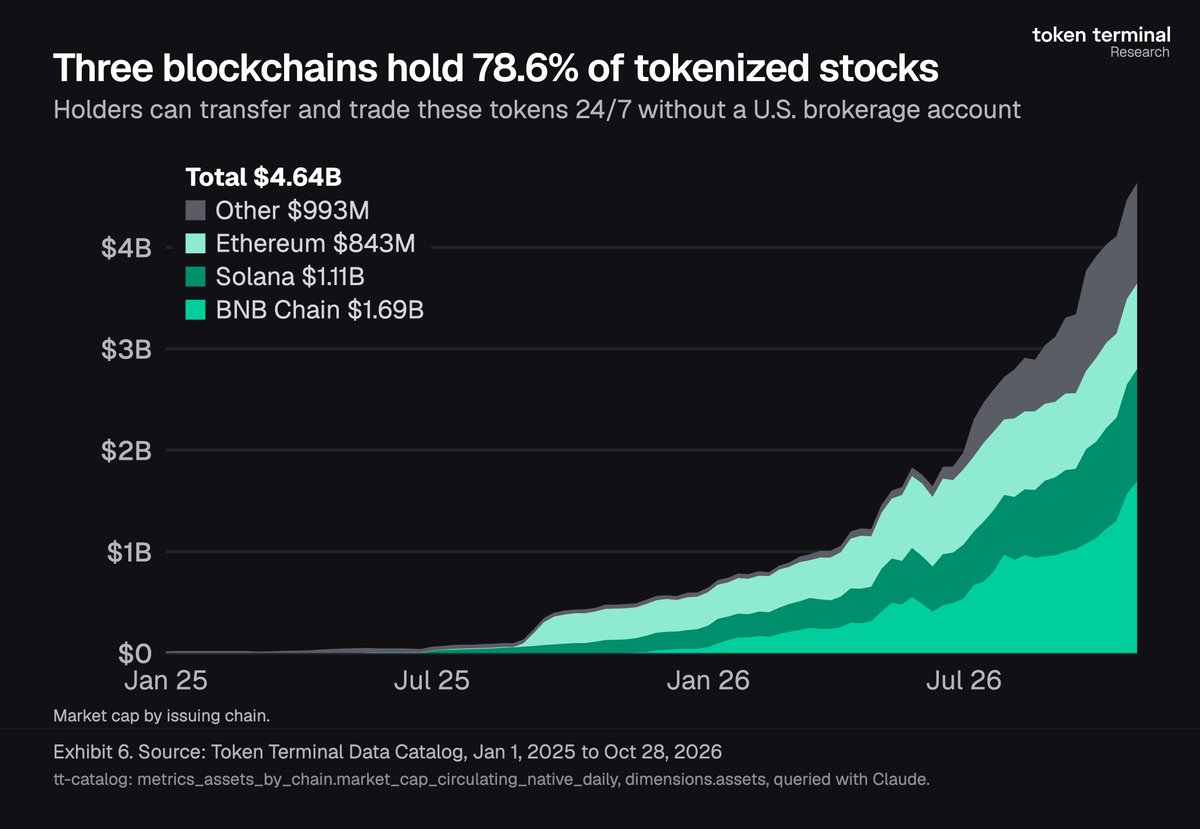
Three blockchains hold 78.6% of tokenized stocks
Holders can transfer and trade these tokens 24/7 without a U.S. brokerage account
BNB Chain, Solana, and Ethereum are also leading networks for stablecoins
@tokenterminal Billions in tokenized assets mean more markets and opportunities to capture value. Automating portfolio positions lets users take advantage of 24/7 markets without having to monitor them around the clock.