Minko just smashed React by showing the Ivy instructions and the react compiler output side by side 😄
Yes, Angular has done a lot of optimizations since v9 with Ivy (we're on v18)
#angular
🔥 See how to leverage the features of different Angular versions to enhance your projects!
In our free ebook,
📚"The Ultimate Guide to Angular Evolution," 🔗https://t.co/kv2d6lFGLA,
we explore the transformations of Angular from version 14 onwards and 🚀 how they can improve your work efficiency.
👨💻 Mateusz Dobrowolski, the principal author of the ebook, describes each new feature, the challenges it addresses, and the benefits it brings.
After reading, you will understand:
👉 The benefits that updating versions brings.
👉 Which version and features best meet the needs of your project.
👉 Whether the lack of a certain feature is holding you back from progress.
🎓 In the end, Google Developer Experts such as @AlisaDuncan, @connieleung404, @puppo9, Artur Androsovych, @abampakos, @uvbrain, @puppo92, @AlisaDuncan, @StefanvHaas, @connieleung404, @DecodedFrontend,@webdave_de, and Balram Chavan offer insights and predictions about what the future holds for Angular.
Don't wait! Download our free ebook and start working smarter, not harder. ➡️ https://t.co/kv2d6lFGLA
𝗪𝗵𝘆 𝗱𝗼𝗲𝘀 𝗚𝗼𝗼𝗴𝗹𝗲 𝗿𝗲𝗰𝗼𝗺𝗺𝗲𝗻𝗱 𝗠𝗼𝗱𝘂𝗹𝗮𝗿 𝗠𝗼𝗻𝗼𝗹𝗶𝘁𝗵𝘀 𝗶𝗻𝘀𝘁𝗲𝗮𝗱 𝗼𝗳 𝗠𝗶𝗰𝗿𝗼𝘀𝗲𝗿𝘃𝗶𝗰𝗲𝘀?
In the last decade, we have seen a massive trend of using microservices everywhere. We were building systems for a few hundred or thousand users and wanted to know how to make a system for millions of users. This was over-engineering and needed to be corrected. Why it was wrong? Because the development lasted long and we created incredibly complex systems, hard to maintain. This is especially true for startups that must go fast and stay simple.
A recent paper by authors from Google found that most of their developers split binaries for one of the following reasons: it improves performance, fault tolerance, and abstraction boundaries and allows for flexible rollouts.
Yet, splitting applications into microservices has its challenges:
🔸 𝗜𝘁 𝗵𝘂𝗿𝘁𝘀 𝗽𝗲𝗿𝗳𝗼𝗿𝗺𝗮𝗻𝗰𝗲. The overhead of serializing data and sending it across the network is increasingly becoming a bottleneck
🔸 𝗜𝘁 𝗵𝘂𝗿𝘁𝘀 𝗰𝗼𝗿𝗿𝗲𝗰𝘁𝗻𝗲𝘀𝘀. It is incredibly challenging to reason about the interactions between every deployed version of every microservice.
🔸 𝗜𝘁 𝘁𝗮𝗸𝗲𝘀 𝘄𝗼𝗿𝗸 𝘁𝗼 𝗺𝗮𝗻𝗮𝗴𝗲. Rather than having a single bi-nary to build, test, and deploy, developers must manage 𝑛 different binaries, each on their release schedule.
🔸 𝗜𝘁 𝗳𝗿𝗲𝗲𝘇𝗲𝘀 𝗔𝗣𝗜𝘀. Once a microservice establishes an API, it becomes easier to change by breaking the other services that consume the API.
So, they proposed the following approach:
𝟭. 𝗪𝗿𝗶𝘁𝗲 𝗺𝗼𝗻𝗼𝗹𝗶𝘁𝗵𝗶𝗰 𝗮𝗽𝗽𝗹𝗶𝗰𝗮𝘁𝗶𝗼𝗻𝘀 that are modularized into logically distinct components. A component is a long-lived agent, similar to an actor.
𝟮. 𝗟𝗲𝘃𝗲𝗿𝗮𝗴𝗲 𝗮 𝗿𝘂𝗻𝘁𝗶𝗺𝗲 𝘁𝗼 𝗱𝘆𝗻𝗮𝗺𝗶𝗰𝗮𝗹𝗹𝘆 and automatically assign logistical components to physical processes based on execution characteristics. So, if both components are in the same OS process, they are called regular method calls, but if they are co-located, calls are executed as RPCs over the network. Runtime decides whether these modules should be collocated or moved to different machines (and scaled, etc.).
𝟯. 𝗗𝗲𝗽𝗹𝗼𝘆 𝗮𝗽𝗽𝗹𝗶𝗰𝗮𝘁𝗶𝗼𝗻𝘀 𝗮𝘁𝗼𝗺𝗶𝗰𝗮𝗹𝗹𝘆, preventing different versions of an application from interacting.
This approach consists of two main parts: a programming model with abstraction that allows developers to write modularized applications and a runtime for building, deploying, and optimizing these applications. They claim that it reduces application latency by up to 15x and costs by up to 9x by simplifying application management and deployment.
If you want to check the framework implementing the approach from the paper, check https:// serviceweaver. dev/.
What do you think about this approach? Does it look like EJBs or CORBA?
#microservices
Hey #flutter devs
Me and @Yash_khattar73 are making ModularUI #opensource
ModularUI is the first ever consistent library of pre-built beautiful customizable and consistent @FlutterDev widgets inspired by material-tailwind/shadcn✨
Checkout the GitHub - https://t.co/KYEnc7Smq7
Angular Dependency Injection Visualization is coming to Angular Devtools 🔥🎉
Debugging DI issues the hard way will be a thing of the past!
https://t.co/YtuGPa11Wi
#angular
🤩 [1/4] Coming soon in @ChromeDevTools - You can overrides API response (Fetch/XHR) and more!
Imagine you can mock APIs in frontend without waiting for the backend changes!
Not only that...
Check out the code below.
This pattern lets you use User interchangeably as a type and a user, same as a class or enum might.
Is this heresy? Or awesome?
(I think maybe the latter)
🎨 CSS tip(3):
`height: 100vh`
is a common way to make your app fit the whole window. It won't do a good job on mobile though 😬
`height: 100dvh`
works way better!
📱 See the difference on your phone:
https://t.co/t7KR7WGsQ6
💻 Play with the demo:
https://t.co/nSq1PuCu0p
One of the things that helps me improve as a developer is polishing my own code. First version of the solution is often hacky but working. Then, once I understand the big picture, I give myself a code review to clean up any hackery. Rinse and repeat this process...
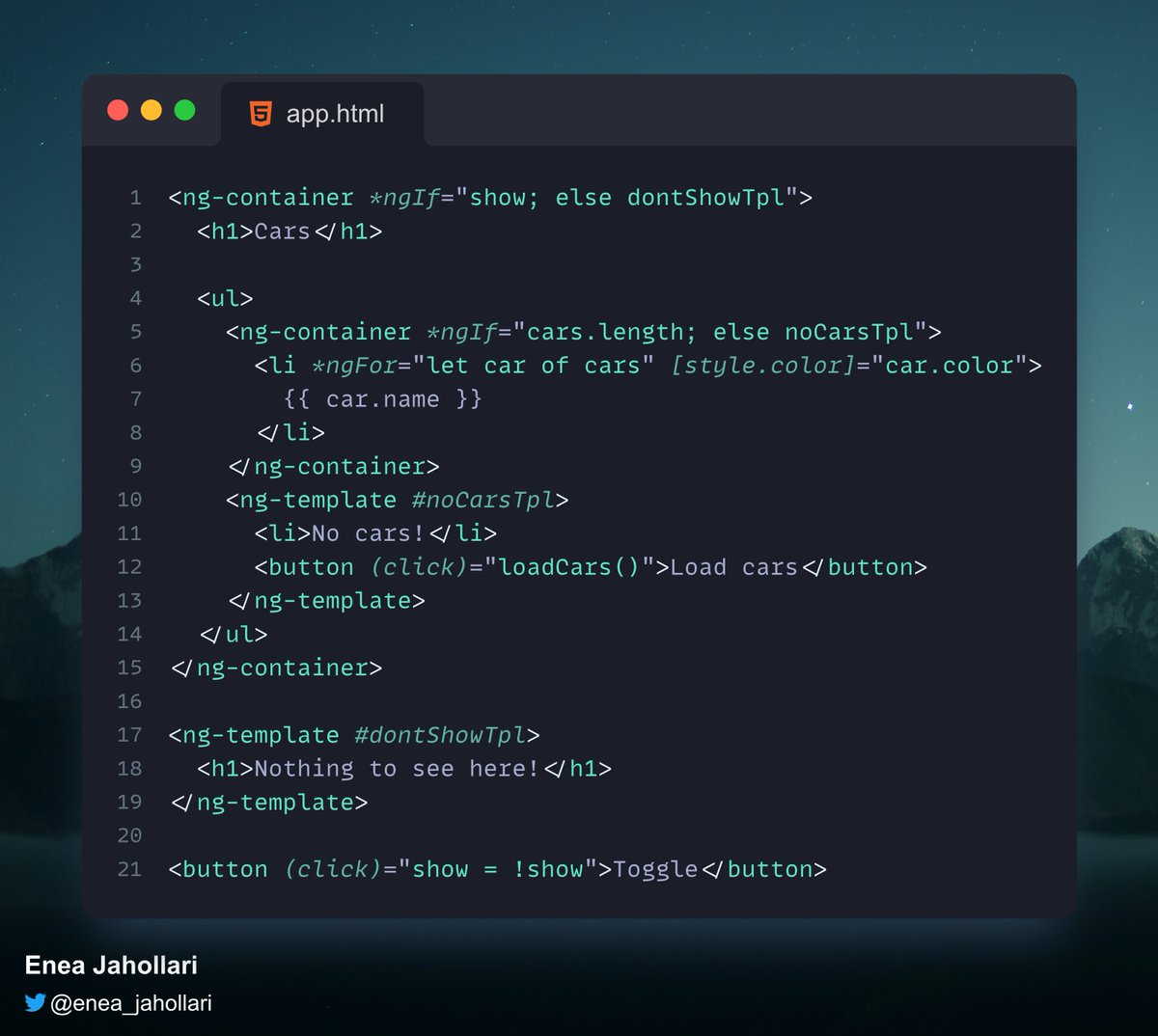
Built-In Control Flow RFC allows us to easily manage the flow of our templates with easy to use new syntax 🎉
It gets inspiration from @sveltejs 🍓
Here's a before and after how it looks like 👇
#angular#svelte
Here are some common #Angular performance issues:
- HostListeners on document or window
- Forgetting trackBy on *ngFor
- Not using OnPush
- Deep-cloning objects
- Running too much in the inner zone
- Not unsubscribing from observables
Have a great evening!🤓🚀🚀🚀
Angular powers SpaceX to throw rockets 🚀 in space 🌌
I think that's amazing! 🤩
Maybe it's frontpage is not built with Angular but every internal app is 🤷♂️
https://t.co/qMIaWO3Yau
#angular










![jecfish's tweet photo. 🤩 [1/4] Coming soon in @ChromeDevTools - You can overrides API response (Fetch/XHR) and more!
Imagine you can mock APIs in frontend without waiting for the backend changes!
Not only that... https://t.co/j7oKop2V5A](https://pbs.twimg.com/media/F3PL45mXMAAkqX6.jpg)