🪙 SEI LATEST UPDATE — SEPT 26, 2026 @SeiNetwork
$SEI is making a strong move, rising from around $0.038 earlier this month to $0.0736, representing approximately +94% monthly growth.
Two major catalysts are driving attention: the proposed Canary Capital Staked SEI ETF and the ongoing Giga network upgrade.
But with RSI above 73, momentum is becoming increasingly overheated.
📊 MARKET SNAPSHOT
$SEI: $0.0736 | +19% 24H
Market Cap: $495M | #83
24H Volume: $205M
Monthly Performance: ~+94%
RSI(14): 73.89
Open Interest: ~$95M
🏦 1. STAKED SEI ETF — THE MAIN CATALYST
On September 21, Canary Capital filed Amendment No. 2 for its Staked SEI ETF S-1 with the SEC.
Key details:
• Up to 90% of fund assets targeted for staking
• BitGo as the sole custodian
• Proposed listing on Cboe BZX
• Canary's third staking ETF filing after TRX and SUI products
Following the filing, $SEI reportedly gained around 25–30% in 24 hours, while volume increased sharply.
The ETF has not yet been approved. Its potential impact depends on regulatory approval, actual inflows and how much SEI is ultimately staked.
⚡ 2. GIGA UPGRADE — SCALING SEI
Sei's Giga upgrade aims to achieve:
200,000+ TPS + sub-400ms finality
Recent milestones highlighted in the source:
• Aug 4: Sei v6.6 mainnet, introducing Ares and Eidos
• Aug 18: Eidos storage blueprint
• Sept 1: FlatKV benchmark reached 205,913 TPS average throughput over 24 hours
• Sept 23: Hermes consensus reached 100,000 TPS with 68ms finality in a lab environment
The remaining major component is the Autobahn consensus layer, which is intended to support the next stage of the performance roadmap.
The key challenge is translating lab benchmarks into reliable, publicly verifiable mainnet performance.
🏗️ 3. RWA & DEFI ECOSYSTEM
Sei continues expanding across institutional assets and DeFi infrastructure.
Notable developments mentioned in the source:
• Hamilton Lane SCOPE fund
• Apollo + Ondo tokenized fund
• Ondo USDY
• Morpho lending
• DragonSwap V2
• Rubicon liquid staking
• Fiamma Bitcoin bridge
• Fluxa aggregator
• Moralis developer integration
Coinbase also moved SEI trading to Sei EVM in April 2026, while SIP-5 introduced a post-quantum upgrade framework.
The ecosystem thesis is increasingly focused on RWA, trading and high-throughput EVM applications.
📈 4. TECHNICAL STRUCTURE
$SEI has broken out from the previous $0.038–0.052 accumulation range.
Key indicators:
RSI: 73.89
50-Day SMA: $0.046
200-Day SMA: $0.053
Volatility: 10.18%
Important levels:
🔴 Resistance: $0.0736 and above
🟢 Key support: $0.052
🟢 Pullback zones: $0.055–0.065 (levels cited in the source's scenario analysis)
With the monthly gain approaching 100%, a period of consolidation or a pullback would be consistent with the elevated volatility—but it is not guaranteed.
⚠️ 5. KEY RISKS
• RSI in overbought territory
• Staked SEI ETF remains unapproved
• September unlock of approximately 111.5M SEI
• Market cap vs FDV gap: $495M vs $735M
• Competition from Solana, Sui, Aptos and Monad
• Execution risk surrounding the Giga upgrade
• Potential sell-the-news reaction to ETF developments
🧠 ANCRYPTO VIEW
The current $SEI narrative combines ETF expectations, high-performance infrastructure and RWA ecosystem growth.
The Staked SEI ETF could introduce a new institutional access route if approved, while Giga's progress is designed to improve execution speed and scalability.
However, the market is already pricing in strong expectations after a ~94% monthly increase.
The important question is whether upcoming catalysts can deliver measurable adoption—not simply short-term momentum.
⚠️ WATCH
• SEC updates on the Staked SEI ETF
• Autobahn consensus and public testnet progress
• Whether $0.052 remains a key support
• SEI unlock schedule and circulating supply
• RWA TVL and DeFi activity
• Open interest and liquidation risk
• Real-world mainnet performance vs lab benchmarks
#Crypto #SEI #SeiNetwork #RWA #Layer1
🪙 @SeiNetwork TOKEN ANALYSIS — SEPT 23, 2026
$SEI is showing a strong recovery after hitting an ATL of $0.038 just five weeks ago.
The bigger story isn't only price action — Sei is simultaneously progressing its Giga Upgrade while a new Staked SEI ETF filing has created a fresh institutional catalyst.
📊 MARKET SNAPSHOT
$SEI: $0.062 | +1.76% 24h
Market Cap: ~$417M | Rank #125
FDV: ~$619M
24h Volume: ~$101M 🔥
7D: +48% 🚀
ATH: $1.14 | -94.6%
Circulating Supply: 6.73B / 10B
TVL: ~$101M
⚡ 1. GIGA UPGRADE — THE CORE TECHNICAL CATALYST
Sei is evolving from a trading-focused L1 into a parallelized EVM chain.
The Giga Upgrade has three major components:
• Ares — parallel execution ✅
• Eidos — new flat-structured storage engine ✅
• Autobahn — multi-proposer consensus ⏳
A Sept. 1 benchmark showed FlatKV reaching 205,913 TPS, while the long-term target is 200K+ TPS with sub-400ms finality.
The key question now: can Sei translate benchmark performance into real mainnet usage?
🏦 2. STAKED SEI ETF — NEW INSTITUTIONAL CATALYST
Canary Capital filed an amended Staked SEI ETF S-1 on Sept. 21.
The filing proposes:
• BitGo as sole custodian
• ~90% of fund SEI potentially staked
• Proposed listing on Cboe BZX
$SEI jumped roughly 30% around the announcement, while short-term 4H RSI reached ~87, showing how aggressively the market reacted.
The ETF still requires regulatory approval.
📈 3. PRICE ACTION & KEY LEVELS
$SEI has recovered roughly 63% from the August ATL and broken out of a multi-month falling wedge.
Key levels:
$0.063 → immediate resistance
$0.068 → next resistance
$0.075 → upside level
$0.057 → breakout support
$0.050 → psychological support
$0.045 → major support
Daily RSI is around 69, while 4H RSI is near 87 — meaning the short-term move is already stretched.
🔓 4. TOKENOMICS — UNLOCK PRESSURE IS DECLINING
SEI has 10B max supply, with ~6.73B circulating.
Around 3.27B SEI remains locked.
Monthly unlocks are now roughly 55.56M SEI, or about $3.4M at current prices.
The dilution impact has declined significantly compared with 2024–2025, but unlocks remain something to monitor.
🏗️ 5. ECOSYSTEM IS THE BIG QUESTION
TVL is currently around $101M, well below the previous ~$609M peak.
Key protocols include:
• Cetus
• DragonSwap
• Yei Finance
• Astroport
The infrastructure story is strong, but Sei still needs more developers, users and killer applications to turn technical performance into sustainable ecosystem growth.
⚠️ 6. THE MAIN RISKS
• 94.6% below ATH
• Ecosystem and TVL remain relatively small
• 32.7% supply remains locked
• Intense competition among high-performance EVM chains
• ETF approval is not guaranteed
• Autobahn is not live yet
⚠️ WATCH
$0.063 → breakout confirmation
$0.068–0.075 → next resistance zone
$0.057 → key support
RSI 4H ~87 → short-term overheating
October unlock ~$3.44M → supply pressure
Autobahn → major technical milestone
Staked SEI ETF → institutional catalyst
#Crypto #SEI #SeiNetwork #EVM #Altcoins
🧠 $TRAC (@origin_trail) WEEKLY UPDATE
OriginTrail continued highlighting real-world use cases for verifiable AI and trusted data this week.
🔹 1. BUILDCHAIN & Digital Building Records
OriginTrail highlighted how the Decentralized Knowledge Graph (DKG) can support tamper-evident building records, helping architects, owners and regulators verify information throughout a building’s lifecycle.
🔹 2. Healthcare Data & AURORAI
The project spotlighted AURORAI, a €6.9M Horizon Europe initiative using the DKG as a trusted data layer for AI-powered pandemic preparedness. Data provenance is crucial when AI supports public-health decisions.
🔹 3. AidTrust & Medicine Traceability
OriginTrail showcased AidTrust’s use in humanitarian healthcare, helping track donated medicines through distribution and treatment centres. The case demonstrates how verifiable records can improve transparency and reduce diversion or waste.
🔹 4. AI Safety Through Umanitek
The ecosystem continued promoting Guardian, which uses connected data and verifiable evidence to help detect impersonation, scams and AI-driven online harm.
📊 PRICE CHECK
$TRAC closed around $0.417 on Oct 11 and $0.401 on Oct 17, a decline of roughly 3.8% over the period. It briefly climbed near $0.44 midweek before pulling back.
🎯 WHAT TO WATCH NEXT
The major potential catalyst remains the NeuroSymbolic Marketplace’s planned mainnet rollout, designed to enable TRAC payments for metered AI inference and queries. The key question is whether real usage translates into sustained on-chain demand.
Bottom line: This week’s strongest story was ecosystem utility—not a confirmed new tokenomics announcement. Mainnet delivery and measurable marketplace activity are the next things to watch.
#OriginTrail #TRAC #AI #DePIN
🧠 $TRAC (@origin_trail) WEEKLY UPDATE
OriginTrail continued highlighting real-world use cases for verifiable AI and trusted data this week.
🔹 1. BUILDCHAIN & Digital Building Records
OriginTrail highlighted how the Decentralized Knowledge Graph (DKG) can support tamper-evident building records, helping architects, owners and regulators verify information throughout a building’s lifecycle.
🔹 2. Healthcare Data & AURORAI
The project spotlighted AURORAI, a €6.9M Horizon Europe initiative using the DKG as a trusted data layer for AI-powered pandemic preparedness. Data provenance is crucial when AI supports public-health decisions.
🔹 3. AidTrust & Medicine Traceability
OriginTrail showcased AidTrust’s use in humanitarian healthcare, helping track donated medicines through distribution and treatment centres. The case demonstrates how verifiable records can improve transparency and reduce diversion or waste.
🔹 4. AI Safety Through Umanitek
The ecosystem continued promoting Guardian, which uses connected data and verifiable evidence to help detect impersonation, scams and AI-driven online harm.
📊 PRICE CHECK
$TRAC closed around $0.417 on Oct 11 and $0.401 on Oct 17, a decline of roughly 3.8% over the period. It briefly climbed near $0.44 midweek before pulling back.
🎯 WHAT TO WATCH NEXT
The major potential catalyst remains the NeuroSymbolic Marketplace’s planned mainnet rollout, designed to enable TRAC payments for metered AI inference and queries. The key question is whether real usage translates into sustained on-chain demand.
Bottom line: This week’s strongest story was ecosystem utility—not a confirmed new tokenomics announcement. Mainnet delivery and measurable marketplace activity are the next things to watch.
#OriginTrail #TRAC #AI #DePIN
🚨 $52 MILLION WIPED OUT IN JUST 10 MINUTES — WHILE WALL STREET WAS CLOSED.
Crypto exchanges are becoming a 24/7 casino for stock traders. This weekend, leveraged bets on semiconductor stocks suffered a massive liquidation wave, even though the underlying U.S. stock market wasn’t open.
Here’s what happened 👇
💥 $51.6M LIQUIDATED
Around $51.6 million in positions tied to chip stocks and semiconductor funds were forcibly closed between 21:22 and 21:32 UTC on Saturday.
📉 BULLS TOOK THE BIGGEST HIT
About $38 million came from traders betting prices would rise.
🔻 THE BIGGEST LOSERS
• $SOXL: roughly $12.7M liquidated
• SanDisk contracts: around $10.8M
• SK Hynix contracts: around $10.8M
⚡ THE SELL-OFF SPREAD FAST
The selling began on Binance and reached Hyperliquid-linked stock contracts within seconds, showing how quickly pressure can spread across trading venues.
⚠️ THE REAL PROBLEM: NO OPENING BELL, NO LIVE STOCK PRICE.
With Wall Street closed, these contracts had no real-time underlying share prices to anchor them. Traders were effectively reacting to each other, while leverage and forced liquidations amplified the move.
When U.S. markets reopen Monday, actual share prices will reveal how far weekend contract prices drifted from the underlying stocks.
The bigger shift: Tokenized stock exposure and perpetual contracts allow markets to trade around the clock — but 24/7 access doesn’t guarantee reliable price discovery or deep liquidity.
More trading hours mean more opportunity. They can also mean more ways to get liquidated.
#Crypto #Binance #Hyperliquid #TokenizedStocks #Trading #Leverage #Liquidations #Semiconductors
💳 POLYGON WANTS TO COMPETE WITH VISA AND STRIPE — AND IT’S NO LONGER JUST ABOUT BLOCKCHAIN TRANSACTIONS.
Polygon Labs has completed its acquisition of Coinme, a U.S.-regulated crypto payments provider, giving Polygon greater control over how money moves between traditional finance, stablecoins and blockchain networks.
The goal? Capture more of the payments business instead of simply providing the infrastructure. 👇
🏦 Regulated U.S. access: Coinme brings money-transmission coverage across 48 states, including 37 state money transmitter licenses and 11 applicable exemptions.
💵 A new revenue stream: Polygon can now earn fees from converting and moving money between fiat currencies, stablecoins and crypto — not just rely on blockchain transaction activity.
🌎 Cross-border payments: Its Open Money Stack aims to connect bank transfers, cash deposits, wallets and on-chain settlement through one integrated platform.
🤝 Early customers: Tazapay, Mesh, Toku and Kira are among the businesses adopting the platform for cross-border payments, crypto funding, global payroll and dollar access.
📈 The target: CEO Marc Boiron says Polygon expects its regulated payments business to become profitable in 2027.
⚔️ The competition is serious. Visa processed more than $12.3 trillion in payment volume in fiscal 2025, while Stripe reached $1.9 trillion. Meanwhile, both traditional payment companies are expanding into stablecoin infrastructure.
The bigger shift: Blockchain companies increasingly want to control the entire payment experience — from onboarding and compliance to conversion and settlement — because that’s where a larger share of the revenue sits.
Polygon has acquired the infrastructure and regulatory access. Now it needs to prove businesses will use it at scale.
#Crypto #Polygon #POL #Stablecoins #Payments #Visa #Stripe #Blockchain
💳 POLYGON WANTS TO COMPETE WITH VISA AND STRIPE — AND IT’S NO LONGER JUST ABOUT BLOCKCHAIN TRANSACTIONS.
Polygon Labs has completed its acquisition of Coinme, a U.S.-regulated crypto payments provider, giving Polygon greater control over how money moves between traditional finance, stablecoins and blockchain networks.
The goal? Capture more of the payments business instead of simply providing the infrastructure. 👇
🏦 Regulated U.S. access: Coinme brings money-transmission coverage across 48 states, including 37 state money transmitter licenses and 11 applicable exemptions.
💵 A new revenue stream: Polygon can now earn fees from converting and moving money between fiat currencies, stablecoins and crypto — not just rely on blockchain transaction activity.
🌎 Cross-border payments: Its Open Money Stack aims to connect bank transfers, cash deposits, wallets and on-chain settlement through one integrated platform.
🤝 Early customers: Tazapay, Mesh, Toku and Kira are among the businesses adopting the platform for cross-border payments, crypto funding, global payroll and dollar access.
📈 The target: CEO Marc Boiron says Polygon expects its regulated payments business to become profitable in 2027.
⚔️ The competition is serious. Visa processed more than $12.3 trillion in payment volume in fiscal 2025, while Stripe reached $1.9 trillion. Meanwhile, both traditional payment companies are expanding into stablecoin infrastructure.
The bigger shift: Blockchain companies increasingly want to control the entire payment experience — from onboarding and compliance to conversion and settlement — because that’s where a larger share of the revenue sits.
Polygon has acquired the infrastructure and regulatory access. Now it needs to prove businesses will use it at scale.
#Crypto #Polygon #POL #Stablecoins #Payments #Visa #Stripe #Blockchain
💵 CIRCLE IS DEFENDING $USDC’S BUSINESS MODEL — BUT STABLECOIN RIVALS WANT A BIGGER CUT OF THE MONEY.
The battle for stablecoin dominance is no longer just about liquidity and adoption. It’s also about who gets to keep the interest earned on the dollars backing these tokens.
Circle has put its numbers on the table 👇
📊 $1.4 BILLION IN REVENUE
Circle reported approximately $1.4B in revenue for H1 2026.
💸 $819M WENT TO PARTNERS AND TRANSACTION COSTS
Around 59 cents of every revenue dollar went toward distributing USDC and handling transaction costs.
🏗️ $473M REINVESTED IN THE BUSINESS
Circle says this funded compliance, licenses, banking relationships, liquidity, infrastructure and product development.
📈 JUST 7 CENTS IN NET PROFIT PER DOLLAR
According to Circle, only about 7% of revenue remained as net profit.
⚔️ THE COMPETITION IS HEATING UP
Coinbase — Circle’s largest USDC partner — is also backing Open USD, a competing stablecoin network designed to pass reserve income to participants after a management fee.
That creates a potential conflict: Coinbase benefits from USDC today, but could also benefit from a model that gives partners a larger share of the economics.
🔍 Why this matters: Stablecoin issuers are competing not only for users, but also for exchanges, payment companies, wallets and businesses that distribute their tokens.
The model that offers partners the best balance of revenue, liquidity, redemption access and regulatory confidence could gain an edge.
The bigger question: Can Circle defend USDC’s network advantage while rivals offer partners a larger slice of the pie?
#Crypto #USDC #Circle #CRCL #Stablecoins #Coinbase #DeFi #DigitalPayments
🗞️ CRYPTO MARKET — OCT 18, 2026 with ANCRYPTO
📊 MARKET SNAPSHOT
Total market cap: ~$2.75T
BTC dominance: ~59% | Sentiment: Cautious
Altcoins are under heavier pressure than Bitcoin as risk appetite weakens.
₿ BITCOIN
$BTC: ~$81.5K
Support: $79.7K–$80K
Resistance: $82.5K–$83.5K
BTC is holding above $80K after a sharp pullback, but a sustained recovery still needs stronger spot demand.
🏦 ETF FLOWS
U.S. spot BTC ETFs saw $82.4M in net outflows on Oct 16, reversing the previous session’s modest inflow. Institutional demand remains uneven.
🌍 MACRO & MARKETS
Hotter-than-expected U.S. inflation and producer prices have revived concerns about tighter Fed policy. A tech-stock selloff also weighed on risk assets, including crypto.
🔥 KEY DEVELOPMENTS
• Charles Schwab is expanding direct BTC and ETH trading access to all clients, with crypto transfers and three additional coins planned by year-end.
• MSCI’s proposed index changes have put digital-asset treasury companies such as Strategy under pressure, adding another source of uncertainty for crypto-linked stocks.
📈 ALTCOIN WATCH
$ETH: ~$2.4K
$SOL: ~$104
$XRP: ~$1.31
Weekly performance has diverged: $TIA gained about 47%, while $INJ rose nearly 24%. $M, $RAY and $QNT were among the notable weekly laggards.
🎯 THE BIG PICTURE
The market is still fragile: inflation concerns, ETF outflows and weaker altcoins are limiting recovery. Watch whether BTC defends $80K or reclaims $83.5K with convincing volume.
#Crypto #Altcoins #MarketUpdate
🗞️ CRYPTO MARKET — OCT 17, 2026 with ANCRYPTO
📊 MARKET SNAPSHOT
Total market cap: ~$2.76T
BTC dominance: ~59.3% | Sentiment: Neutral–Greed
₿ BITCOIN
BTC: ~$81,600
Support: $79,700–$80,000
Resistance: $82,500–$83,500
BTC bounced after hitting a four-week low near $79,770, but momentum remains fragile as traders assess inflation and rate-hike risks.
🌍 MACRO
U.S. September PPI surged 1.3% MoM and 6.3% YoY — its biggest monthly increase in 4.5 years. Retail sales rose 0.8%, largely driven by higher gasoline prices, keeping inflation concerns alive.
🏦 ETF FLOWS
Latest reported session (Oct 15):
• BTC ETFs: +$5.1M
• ETH ETFs: −$60.3M
• SOL ETFs: −$9.8M
Bitcoin inflows were modest, while ETH and SOL continued to face outflows.
📈 ALTCOIN WATCHLIST
• $ETH — ~$2,420
• $SOL — ~$104
• $XRP — ~$1.31
• $BNB — ~$720
• $TIA — strong rebound, among top gainers
• $STRK — heavy selling, among top losers
🔥 KEY DEVELOPMENTS
• $TIA jumped around 16.7%, while $STRK dropped nearly 14.9% in the latest market snapshot.
• Strategy shares came under pressure after MSCI proposed rules that could exclude certain digital-asset treasury companies from its indexes.
• The market remains sensitive to U.S. economic data, tech-stock weakness and institutional fund flows.
📅 UPCOMING EVENTS
• Oct 27–28: FOMC meeting
• Watch Fed commentary and inflation data for clues on rate policy.
🎯 THE BIG PICTURE
BTC is attempting to stabilize, but mixed ETF flows and sticky inflation keep the recovery uncertain. Watch the $80K zone for support and $83.5K for a potential breakout signal.
#Crypto #Bitcoin #Altcoins #MarketUpdate
⚛️ GOOGLE’S QUANTUM BREAKTHROUGH PUTS SATOSHI-ERA BITCOIN UNDER THE MICROSCOPE.
Google’s Willow quantum processor is advancing quantum computing, raising fresh questions about the long-term security of Bitcoin’s cryptography. The threat isn’t immediate — but the technology is moving forward.
Here’s why it matters 👇
🧪 Google’s progress: Its research demonstrated a technique called “magic state cultivation” that reduced errors roughly 40-fold in a quantum computing experiment.
₿ Satoshi-era BTC: Estimates suggest around 6 million $BTC sit in addresses with publicly exposed keys, potentially making them more vulnerable to a sufficiently powerful future quantum computer.
🔐 The core risk: A fault-tolerant quantum computer could eventually use exposed public keys to derive private keys, potentially putting those funds at risk.
⚠️ Important distinction: Google has NOT cracked Bitcoin. Current quantum computers cannot perform this attack, and building a machine capable of doing so remains a major challenge.
🛠️ What comes next? Bitcoin developers may need to coordinate a transition toward quantum-resistant cryptography well before such computers become practical.
The bigger picture: Bitcoin’s security isn’t just about surviving today’s threats. It’s about preparing for technologies that could emerge years down the road.
Quantum computing is not a reason to panic-sell $BTC today — but it is a reason to take long-term security upgrades seriously.
#Crypto #Bitcoin #BTC #Google #QuantumComputing #CryptoSecurity #Blockchain
🎯 YOU MAY SOON BE ABLE TO BET ON COINBASE’S TRADING VOLUME — NOT JUST $COIN’S STOCK PRICE.
The SEC has approved a new category of binary options tied to key performance indicators (KPIs) at 23 publicly traded companies. Crypto-linked names are right in the mix.
Here’s how it works 👇
🪙 $COIN — Coinbase: Trade whether its reported trading volume, revenue or other specified metrics hit a set target.
📈 $HOOD — Robinhood: Contracts can reference customer activity and financial performance.
⛏️ $MARA — Bitcoin miner: Traders can take positions on whether its reported Bitcoin production reaches a specified threshold.
⚖️ How the contracts work: They’re structured as yes-or-no options with fixed payouts, settled in cash based on specified reported figures — not simply the company’s share price or $BTC’s price.
🚨 Important detail: SEC approval doesn’t mean trading starts immediately. Cboe’s listing plans and clearing arrangements still need to be in place, and differently structured prediction contracts may fall under CFTC jurisdiction.
The bigger shift: Traditional finance is finding new ways to trade crypto-related business performance without directly buying tokens.
For traders, this opens another way to express a view on crypto adoption — but binary options can still mean losing the entire amount committed to a contract.
#Crypto #Bitcoin #BTC #Coinbase #COIN #Robinhood #HOOD #MARA #PredictionMarkets
🚨 FOUR CRYPTO EVENTS TO WATCH — ONE COULD CHANGE TOKEN INCENTIVES, ANOTHER COULD REMOVE A MAJOR TRADING VENUE.
Here’s what’s on the calendar 👇
⛏️ $FIL — October 19
Filecoin’s Solstice upgrade (FIP-118) changes block-reward allocation. More rewards go toward services attracting paying customers, while consensus-only mining receives less. Unearned service rewards are burned.
📉 $ZIL — November 16
Upbit plans to end ZIL trading support at 15:00 KST. That removes one established market for $ZIL on the exchange, though trading can continue on other supported venues.
🌉 $INJ — Live now
Injective has activated a native USDC CCTP route through https://t.co/thB2BQrDZQ and Jumper, making it easier to move USDC onto the network. More access is useful, but adoption and liquidity will determine the real impact.
⚛️ $QUAN — Quantum Alliance launches
Quantus is leading a new alliance with 10 industry contributors focused on shared standards for blockchain quantum readiness. It’s a standards initiative — not proof that every participating blockchain is already quantum-resistant.
🎯 What matters most?
Watch the actual mechanics: $FIL’s new reward incentives, $ZIL’s exchange access, $INJ’s stablecoin flows and whether $QUAN’s alliance produces practical standards.
Announcements create attention. Execution creates lasting impact.
#Crypto #Filecoin #FIL #ZIL #Injective #INJ #QUAN #Blockchain
🚀 @NeoSoulAI ($DNA) — AIRDROP & EXCHANGE LISTINGS
NeoSoul is entering the market with multiple exchange launches and reward campaigns. The project aims to build infrastructure for the AI Agent Economy, where autonomous agents can trade, coordinate and create measurable value.
🔥 KEY UPDATES
🔹 Binance Alpha: Scheduled for Oct 16 at 08:00 UTC. Eligible users can claim 400 $DNA with at least 245 Alpha Points, on a first-come, first-served basis. Claiming costs 15 points.
🔹 KuCoin: DNA/USDT trading scheduled for 10:00 UTC, with a call auction beforehand.
🔹 Bitget: DNA/USDT spot trading scheduled for 11:00 UTC.
🔹 MEXC: Airdrop+ campaign offers a pool of 750,000 DNA + 10,000 USDT for eligible participants.
🔹 Gate: Launchpool offers 2.8 million DNA in staking rewards, with BTC, ETH and DNA pools.
🧠 WHAT DOES $DNA DO?
The token is designed for payments for agent services, skills and data, as well as governance and security staking. NeoSoul’s ecosystem includes NeoTrade, an execution layer for AI trading agents, and EvoEvo, focused on agent evolution.
📌 TOKEN DETAILS
• Total supply: 1 billion $DNA
• Network: BNB Smart Chain (BEP-20)
• Contract: 0xA991F61940095AEA0724ef54077223B048c5CF7b
🎯 WHAT TO WATCH
Multiple listings can improve access and liquidity, but early trading may be highly volatile. Check official exchange announcements, campaign eligibility and token distribution details before participating.
#NeoSoul #DNA #Airdrop #BinanceAlpha #Crypto
🚀 @NeoSoulAI ($DNA) — AIRDROP & EXCHANGE LISTINGS
NeoSoul is entering the market with multiple exchange launches and reward campaigns. The project aims to build infrastructure for the AI Agent Economy, where autonomous agents can trade, coordinate and create measurable value.
🔥 KEY UPDATES
🔹 Binance Alpha: Scheduled for Oct 16 at 08:00 UTC. Eligible users can claim 400 $DNA with at least 245 Alpha Points, on a first-come, first-served basis. Claiming costs 15 points.
🔹 KuCoin: DNA/USDT trading scheduled for 10:00 UTC, with a call auction beforehand.
🔹 Bitget: DNA/USDT spot trading scheduled for 11:00 UTC.
🔹 MEXC: Airdrop+ campaign offers a pool of 750,000 DNA + 10,000 USDT for eligible participants.
🔹 Gate: Launchpool offers 2.8 million DNA in staking rewards, with BTC, ETH and DNA pools.
🧠 WHAT DOES $DNA DO?
The token is designed for payments for agent services, skills and data, as well as governance and security staking. NeoSoul’s ecosystem includes NeoTrade, an execution layer for AI trading agents, and EvoEvo, focused on agent evolution.
📌 TOKEN DETAILS
• Total supply: 1 billion $DNA
• Network: BNB Smart Chain (BEP-20)
• Contract: 0xA991F61940095AEA0724ef54077223B048c5CF7b
🎯 WHAT TO WATCH
Multiple listings can improve access and liquidity, but early trading may be highly volatile. Check official exchange announcements, campaign eligibility and token distribution details before participating.
#NeoSoul #DNA #Airdrop #BinanceAlpha #Crypto
📉 XRP HAS A BIG NAME, A LONG HISTORY — BUT HOLDING IT SINCE 2018 HASN’T PAID OFF LIKE BTC.
$XRP is trading around $1.33, roughly 62.5% below its January 2018 peak of $3.55. Meanwhile, $BTC and $ETH have moved well above their previous cycle highs.
So what’s holding XRP back? 👇
🪙 1. Supply grew faster than demand. XRP’s circulating supply increased about 63%, from 38.7B to 63.1B. More tokens sharing a similar total market value means less value per token.
💸 2. Weaker institutional inflows. XRP investment funds have attracted around $1.8B since launch — far less than the scale of capital flowing into Bitcoin ETFs.
📉 3. Activity is cooling. Data cited by CoinDesk shows XRP spot volume down 53.5%, perpetual futures volume down 44%, and active addresses down 10.7%.
⚖️ 4. Years of regulatory uncertainty. Ripple’s SEC battle weighed on XRP during previous market cycles, while BTC and ETH attracted broader investment narratives.
🧭 5. The market moved on. DeFi, AI and other crypto sectors have drawn capital, while Ripple has focused heavily on payments infrastructure and related products.
The key takeaway: A strong company or useful payment network doesn’t automatically make its token outperform. For $XRP, watch relative strength against $BTC, net supply entering circulation, fund inflows and real network activity — not just big announcements.
#XRP #Bitcoin #BTC #Ethereum #ETH #Crypto
🚨 BITCOIN DIPPED BELOW $80K — BUT BUYERS WEREN’T READY TO GIVE UP THAT LEVEL.
$BTC briefly fell below $80,000 for the first time in about a month as a global tech sell-off and inflation fears rattled markets. Buyers quickly stepped in, pushing Bitcoin back above the key psychological level.
Now the market is watching whether that bounce can hold. 👇
📉 What triggered the pressure?
• Hotter-than-expected U.S. inflation raised fears of further Fed rate hikes.
• AI-sector debt concerns sparked a broader risk-off move.
• Altcoins suffered heavier losses than Bitcoin during the Asian market sell-off.
📈 Why sentiment is stabilizing:
Asian stocks rebounded on Friday, Treasury yields eased, and Bitcoin recovered after its brief sub-$80K move.
⚠️ The key question: Was $80K a strong support zone — or just a temporary pause in the sell-off?
A quick recovery is encouraging, but it doesn’t confirm a trend reversal. Traders should watch whether $BTC can hold above $80K and reclaim higher resistance levels, while keeping an eye on inflation data and Fed expectations.
In this market, a bounce is a signal to watch — not proof that the bottom is in.
#Bitcoin #BTC #Crypto #CryptoMarket #Fed #Markets
🗞️ CRYPTO MARKET — OCT 16, 2026 with ANCRYPTO
📊 MARKET SNAPSHOT
Total crypto market cap: ~$2.78T
BTC dominance: ~59.3% | Fear & Greed: 37 — Fear
₿ BITCOIN
BTC: ~$82,000
Support: $80,000–$81,000
Resistance: $83,000–$84,000
BTC briefly fell below $80K before rebounding above $82K. The recovery is encouraging, but bulls still need to reclaim resistance to confirm stronger momentum.
🌍 MACRO
U.S. September CPI rose 3.7% YoY, above expectations. Hot inflation has increased concerns about another Fed rate hike, while geopolitical tensions and oil prices add pressure to risk assets.
🏦 ETF FLOWS
On Oct 13, spot ETFs attracted $175.6M in BTC and $24.8M in ETH inflows, ending ETH’s 10-session outflow streak. However, October’s overall flows remain under pressure, so one positive session does not yet confirm a sustained institutional comeback.
📈 ALTCOIN WATCHLIST
• $ETH — ~$2,430
• $BNB — ~$729
• $XRP — ~$1.33
• $SOL — ~$105.4
• $HYPE — ~$81
• $ARB — ~$0.17
Prices are approximate snapshots and may vary by exchange.
🔥 KEY DEVELOPMENTS
• $ARB: Around 92.65M tokens, worth roughly $18M, are scheduled to unlock on Oct 16 — a potential short-term supply overhang.
• $ZEC: Recent volatility has kept it on traders’ watchlists as the market searches for relative strength.
• Risk appetite remains fragile as traders reassess inflation and Fed policy expectations.
📅 UPCOMING EVENTS
• U.S. economic data: Watch PPI, retail sales and jobless claims.
• Oct 16: $ARB token unlock.
• Oct 27–28: FOMC meeting.
🎯 THE BIG PICTURE
BTC’s rebound offers some relief, but the market has not confirmed a trend reversal. Watch the $80K support zone, ETF demand and macro data before chasing a breakout.
#Crypto #Bitcoin #Altcoins #MarketUpdate
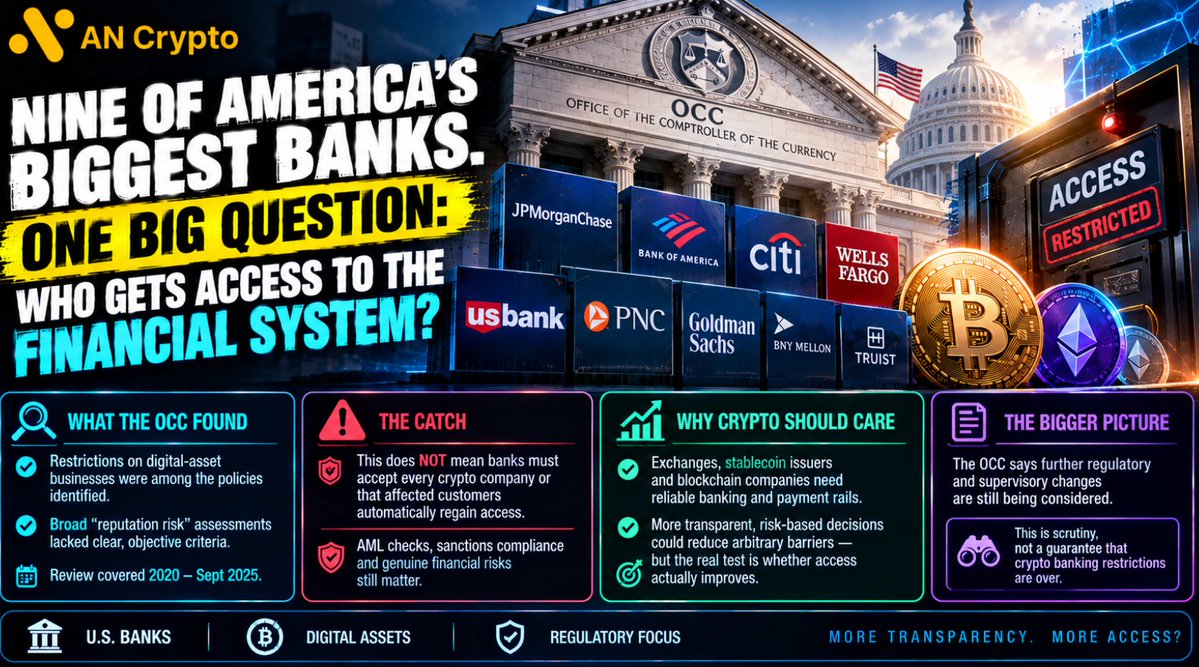
🏦 NINE OF AMERICA’S BIGGEST BANKS. ONE BIG QUESTION: WHO GETS ACCESS TO THE FINANCIAL SYSTEM?
The U.S. Office of the Comptroller of the Currency (OCC) has put crypto banking restrictions under the spotlight after finding that all nine major banks it reviewed maintained policies that could limit access to financial services based on lawful business activities.
The list includes $JPM, $BAC, $C, $WFC and five other major lenders.
🔎 What the OCC found:
• Restrictions affecting digital-asset businesses were among the policies identified.
• Broad “reputation risk” assessments lacked clear, objective criteria.
• The review covered policies and practices from 2020 through September 2025.
⚠️ The catch: This does NOT mean banks must accept every crypto company or that affected customers automatically regain access. AML checks, sanctions compliance and genuine financial risks still matter.
📈 Why crypto should care: Exchanges, stablecoin issuers and blockchain companies need reliable banking and payment rails to operate at scale. More transparent, risk-based decisions could reduce arbitrary barriers — but the real test is whether access actually improves.
The OCC says further regulatory and supervisory changes are still being considered. This is scrutiny, not a guarantee that crypto banking restrictions are over.
#Crypto #Bitcoin #BTC #DigitalAssets #Banking #CryptoRegulation
🇪🇺 USDC IS ABOUT TO ENTER A NEW LEVEL OF REGULATORY SCRUTINY IN EUROPE.
On November 12, the European Banking Authority (EBA) takes over key supervisory responsibilities for $USDC’s EU issuer under MiCA — making USDC the first e-money token classified as “significant” in the EU.
Here’s what changes 👇
🏛️ EBA oversight expands to capital requirements, reserve assets, liquidity and recovery/redemption plans.
🇫🇷 France’s ACPR keeps a role in governance, qualifying holdings, management suitability, outsourcing and conflicts of interest.
💵 Reserve rules are in focus. Circle has sought more flexibility in how reserves are managed, including rules around bank deposits and concentration. Those proposals are not confirmed changes to the law.
🔍 Global USDC ≠ EU USDC reserves. Circle has separate U.S. and EU issuing entities, so global reserve figures alone don’t tell the whole story about the European issuer’s assets.
📌 Why it matters: Stablecoin regulation is moving beyond licensing toward closer scrutiny of liquidity, reserve concentration and redemption readiness. That could influence how issuers structure their reserves and operate across borders.
This is a supervisory handover — not an announcement that USDC is losing its peg or that holders need to move their funds.
#USDC #Circle #MiCA #Stablecoins #CryptoRegulation #Crypto
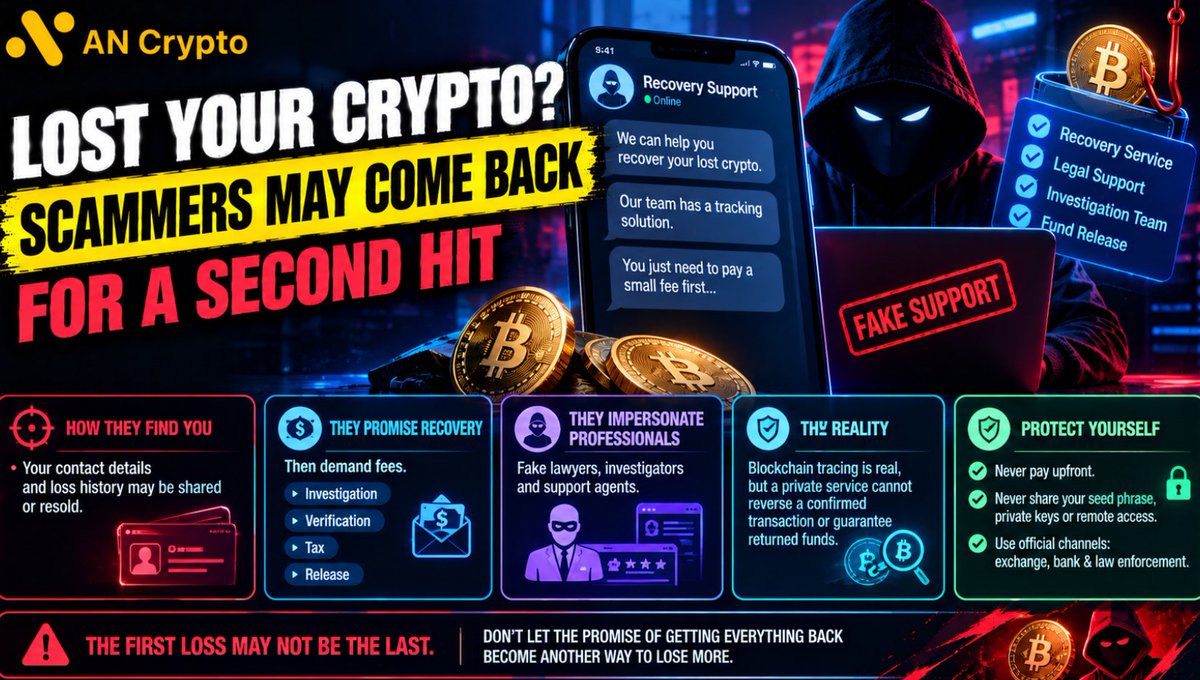
🚨 LOST YOUR CRYPTO ONCE? SCAMMERS MAY COME BACK FOR A SECOND HIT.
The latest warning: fraudsters are targeting people who have already lost money, posing as recovery specialists who claim they can track down stolen crypto and return it.
The trap often looks convincing 👇
🎯 They know you’ve been scammed. Your contact details and loss history may be shared or resold.
💸 They promise recovery — then demand fees. “Investigation,” “verification,” “tax” or “release” payments are common red flags.
🎭 They impersonate professionals. Fake lawyers, investigators and support agents use official-looking websites and testimonials to gain trust.
🔐 Remember: Blockchain tracing is real, but a private recovery service cannot simply reverse a confirmed transaction or guarantee stolen funds will be returned.
Protect yourself:
❌ Never pay upfront to unlock supposedly recovered funds.
❌ Never share your seed phrase, private keys or remote access.
✅ Contact your exchange, bank and law enforcement through verified channels.
The cruelest part of a crypto scam is that the first loss may not be the last. Don’t let the promise of getting everything back become another way to lose more.
#CryptoScam #Bitcoin #BTC #CryptoSecurity #ScamAlert #Web3
🏦 CRYPTO’S BANKING PROBLEM IS NOW IN THE REGULATORY SPOTLIGHT.
The U.S. Office of the Comptroller of the Currency (OCC) has identified policies at all nine major banks it reviewed that could restrict access to financial services based on lawful business activities — including digital assets.
The banks include $JPM, $BAC, $C, $WFC and other major U.S. lenders.
🔍 What the review found:
• Banks maintained policies that could limit services to crypto issuers, exchanges and administrators.
• Some restrictions were linked to broad “reputation risk” assessments rather than clear, objective criteria.
• The review covered policies and practices from 2020 through September 2025.
⚠️ But don’t confuse scrutiny with a full policy reversal.
The OCC has not confirmed that every affected crypto business will regain banking access. Anti-money-laundering, sanctions and operational risk checks still matter, and the regulator says further changes may be considered.
📌 Why crypto should care:
Reliable banking access is essential for exchanges, stablecoin issuers and companies moving money between traditional finance and blockchain networks.
If regulators push banks toward transparent, risk-based decisions, it could reduce arbitrary barriers for legitimate crypto businesses. The real test will be whether access improves in practice.
#Crypto #Bitcoin #BTC #DigitalAssets #Banking #CryptoRegulation