To those who habitually threaten India on the “Chicken Neck Corridor”, should note these facts as well:
1️⃣ Bangladesh has two of its own “chicken necks”. Both are far more vulnerable
2️⃣ First is the 80 Km North Bangladesh Corridor- from Dakhin Dinajpur to South West Garo Hills. Any disruption here, can completely isolate the entire Rangpur division from rest of Bangladesh.
3️⃣Second is the 28 km Chittagong Corridor, from South Tripura till the Bay of Bengal. This corridor, smaller than India’s chicken neck, is the only link between Bangladesh’s economic capital and political capital.
I am only presenting geographical facts that some may tend to forget.
Just like India’s Siliguri Corridor, our neighbouring country is also embedded with two narrow corridors of theirs.
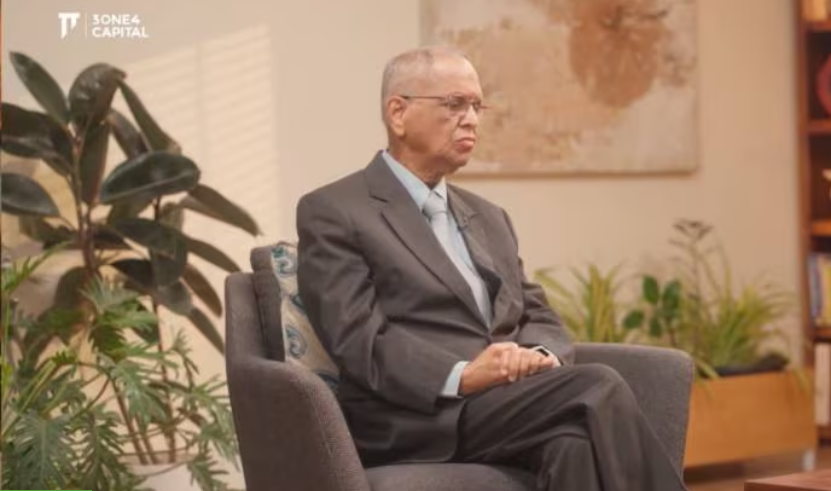
“Young people in India should be ready to work really hard, like up to 70 hours a week.”
The internet is going mad by this highly-controversial comment..
Narayana Murthy, the founder of Infosys, recently talked about this.
And here’s why I believe in it:
Murthy believes that if India wants to move ahead and become a stronger nation, young people need to work more and be more productive.
He said that we should learn good things from other countries, especially from the Western countries. He also mentioned that sometimes we pick up habits from the West that aren't so good, and we should avoid those.
When he talks about working 70 hours a week, he means that young Indians should be ready to put in more time and effort in their jobs. He believes this is a way to help our country grow and become better.
In the past, countries like Germany and Japan rebuilt themselves after World War II. People in these countries worked extra hard, and it made a big difference. Murthy hopes that Indian leaders, both in business and government, will encourage young people to work hard and be disciplined.
He also talked about making the government work more efficiently and reducing corruption. These things can help India become more competitive and successful in the world.
So, what does this mean for us?
It means that hard work and discipline are important for our country's progress.
While working 70 hours a week may sound like a lot, the main idea is that we should be willing to put in extra effort to help India become a better place.
In the end, Murthy's message is about changing our work habits and values. Young people form a big part of India's population, and they can make a big difference in our country's future.
It's up to us to decide how we want to build India.
Will we embrace hard work and discipline to make it better?
@abhipraiy That's a question you should surely ask him. But, that's the twist. As a social worker, if I start questioning my profits - there would be no change in my village. But I want the change so I do it. So, the question is - are you willing to put in the efforts for the nation?
Ambia Begum, a 55-year-old woman entrepreneur, merely studied till class 8th.
She wanted to be independent & generate her own income.
Being a mother of four, it wasn’t easy…
But, her dedication in learning changed her income to more than Rs. 9000 a month.
This is her story:
In 2007, Ambia discovered a vocational training program on weaving to be held in her block and decided to seize this opportunity.
From that point onward, she embarked on a journey of weaving eri and cotton clothes, selling her products independently.
Her entrepreneurial journey began with the crafting of cotton mekhela chadars and gamochas.
However, Ambia's business has since expanded to include various eri products such as eri mekhela chadars, sarees, and shawls.
Besides skill development programs, Ambia had the chance to showcase her creations in exhibitions at the Maniram Dewan Trade Centre in Guwahati and Khanapara Ground in Guwahati.
These experiences taught her the vital lesson that the customer is the ultimate decision-maker. As a result, she began creating products tailored to market demand.
Ambia Begum is grateful to @IIE_Guwahati for providing her with a platform, institutional support, and modern spinning machines to help grow her business.
However, her journey is not without its challenges.
Ambia faces fluctuations in product prices due to raw material scarcity, particularly in the case of eri cocoons, which she must purchase from the market at higher rates.
Her income from weaving is also inconsistent, with monthly earnings sometimes exceeding Rs. 9000 and other times falling short due to a lack of orders.
Balancing her personal and professional life can be challenging, as she manages household duties, cares for her family, and allocates time for weaving.
Financial crises occasionally arise as she uses her weaving income to cover unforeseen household expenses.
Ambia's aspirations to expand her business have been hindered by limited funds for investment, insufficient support from family members, and inadequate market facilities.
Despite these challenges, she remains resilient.
Do you know of any such dedicated women in your village?
After the COVID-19 pandemic, an “entrepreneurial” fever blew over the world.
Globally, 16% of the workforce is now entrepreneurial.
But only 21% of startups survived past their first year.
If you’re thinking about a startup, this simple playbook will help you:
Your Business:
• Try out 2 fresh ideas each month
• Share an interesting story every week
Your Approach:
• Innovate every day
• Plan for the long run
• Turn your interests into products
Your Income:
• Create products based on what you know
That’s it.
You know what to do.
@SpaceX The second one looks so majestic. Like a solar blast or something.
I'm sure Elon would enjoy these sights at dinner knowing he is experiencing something others aren't.
The best of collective consciousness can be seen on Elon's profile.
Believe it or not, some of the tweets are really on-spot like one he shared a few days ago. It was on the lines of we need to think of each other as humans to achieve humanity. And not people of different communities.
@dailystoic Only your problems make you realise of your capability. A safe life teaches you nothing about what life actually is. So, the next time you're into a problem, repeat to yourself - I'm lucky.