And the scream? It may be nothing more than the way his head fell back after death. But that open mouth has haunted visitors for 140 years.
Would a prince who plotted against his father deserve to be forgotten forever?
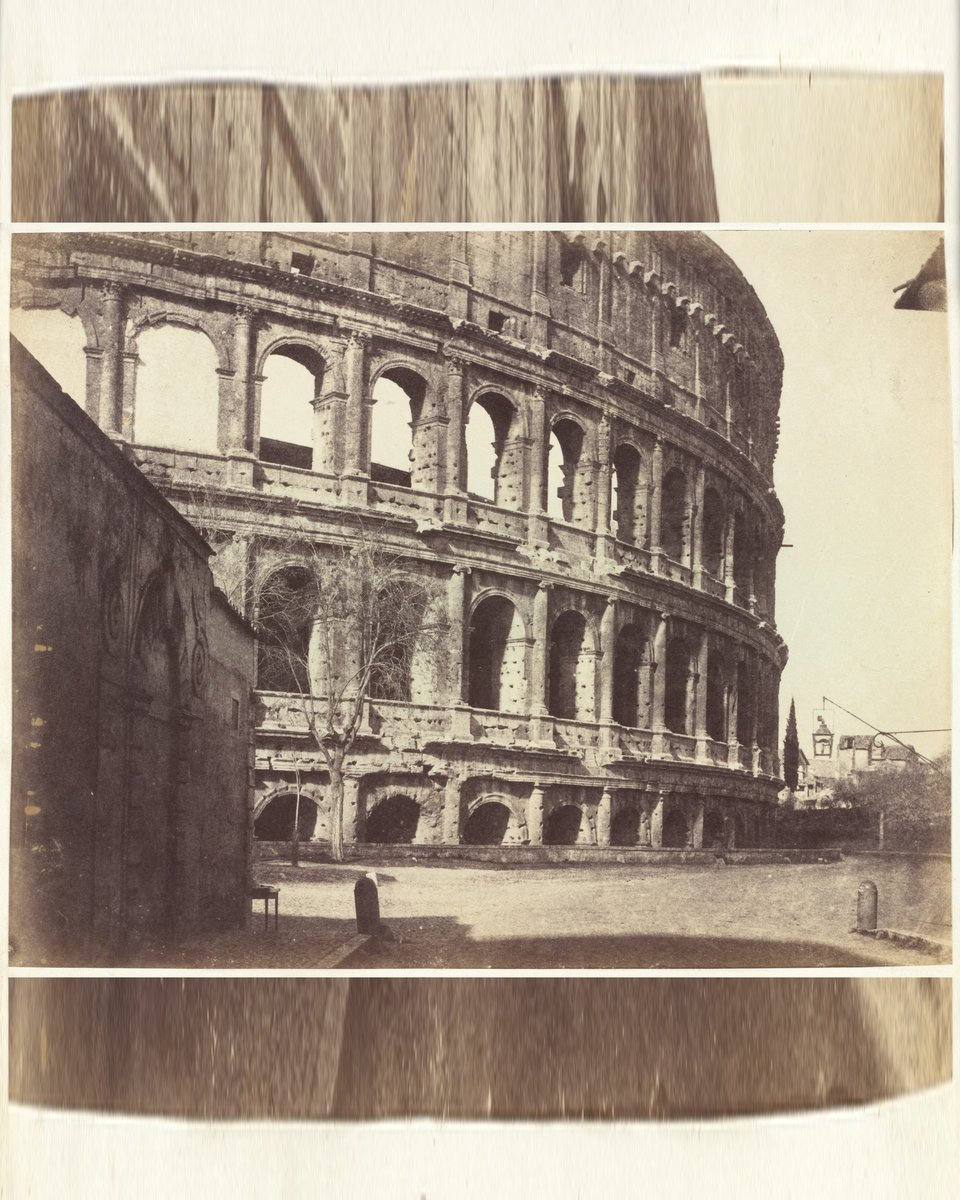
@indianflowered The awning had its own crew, sailors from the fleet at Misenum (Historia Augusta, Commodus 15). Its masts stood in sockets on the top wall, and the stone brackets are still there. The exact rigging is still debated.
WRONG HEADLINE: Vomitoriums were rooms where Romans vomited between banquet courses.
REAL FIND: A vomitorium is an amphitheatre or theatre passage that "spews" the crowd in and out (Macrobius Saturnalia 6.4.3). The banquet room sense is a modern misreading.
Pictured: Colosseum photograph, The Met (public domain).
@FallenEmpiresHQ Deliberate nose-breaking on Egyptian statues is well documented, and Edward Bleiberg of the Brooklyn Museum reads it that way. For the Sphinx, though, the account usually cited is al-Maqrizi's, which blames a Sufi zealot in 1378. Disputed, but medieval, not ancient.
WRONG HEADLINE: Napoleon's soldiers shot the nose off the Sphinx.
REAL FIND: Norden drew it in 1737 with no nose, 61 years before Napoleon reached Egypt. Al-Maqrizi (1400s) blamed a Sufi who defaced it in 1378 (disputed).
Pictured: Félix Teynard, 1851 to 1852, The Met (CC0).