Hers's a tactic I use when Stakeholders come with solutions, NOT problems.
Don't work backwards, work forward.
What do I mean by that?
Commonly when a stakeholder comes w/ a solution we try to get them to work backwards to the problem.
But for some this is a stretch.
Too many claude chats is the 2026 version of too many slack channels.
Making the shift to agent view has helped me dramatically (shared in the video) but I still find that my ability to keep track of what's going on is the limit.
I've heard in talks from engineers at Anthropic say the same thing ~4-5 sessions is their limit.
HBR also published a study into this. They coined it "AI Brain Fry".
What they found was that productivity increased to about 3 AI tools and then decreased beyond that.
It's funny because we often look at these tools like they're going to give us a huge productivity boost, slack included when it came out. But that's only true if we can manage ourselves. It's tempting to spin up 20 agents or have 20 slack threads going. Neither are productive because cognitively you can't manage all that context switching.
p.s. If you've been struggling to find the time to get hands on with Claude Code - or if something like this looks too technical, that's what the AI Build Day on the 26th in Sydney is designed to solve. Take a look 👉 https://t.co/pzLSWRD4xx
Your OKRs probably aren't broken. Neither is your discovery. Nor is your strategy.
The problem is they're disconnected.
Too often this is the missing piece in companies. They have all the puzzle pieces they're just have no idea how to connect them together.
Instead:
→ OKRs are goals set by leaders.
→ Strategy often sits outside, sometimes owned by a different team
→ and Discovery is owned by teams but opportunities aren't linked to either.
They're all owned by different people, on different cadences. It's no wonder it can feel disjointed.
They're meant to be one chain: strategy → OKRs → discovery → experiments → and back again.
Here's how it all connects in practice👇
https://t.co/dwKX2GZn8h
Here's a tactic I use when Stakeholders come with solutions, NOT problems.
Don't work backwards, work forward.
What do I mean by that?
Commonly when a stakeholder comes with a solution we try to get them to work backwards to the problem.
We ask questions like: "What problem are you trying to solve?"
But for some this is a stretch.
We hit a wall, there's resistance.
The Stakeholder can't understand why they need to give a problem, when they have this amazing solution idea (after all it's an awesome idea, right?)
So instead of trying to work against their thinking, go with it.
In these situations I've had a lot of success looking forward, not backwards.
Rather ask:
"If we did deliver this solution, what changes as a result?"
"What does it mean for us? the org? our users?"
"What can they now do that they couldn't before?"
Rather than trying to get them to articulate the problem, get them to think about what would be true if we did deliver their solution.
Here's a real example I did this with:
Idea: Facial recognition tech
Me: "If we had this feature what would it mean for your customers?"
X: "It's quicker! They don't need to take time out from work to visit a nurse. It's less invasive."
Me: "And why does it mean for us if it's now quicker and less invasive?"
X: "Well we actually have data that shows that customers need to reschedule all the time and if we don't convert them within 30 days the conversion rate plummets."
And just like that we've started to uncover real outcomes and problem spaces!
===
Side bar: you can use this to also identify assumptions and start the conversation on discovery. It's not uncommon for this to turn into a full blown assumptions mapping exercise and an initial discovery backlog.
More on this technique 👉https://t.co/h18gJ80LD2
If you're wondering why - it's because they're an enterprise and tooling is locked down. Figma Make is just not the same - I tried and gave up. Went back to the stone ages (aka last year 😅)
I've had to go back to manually updating Figma designs for a client last week after months of using Pencil Dev and I'm struggling 😭 I just want to spin up agents to make the changes for me...
(if you don't know https://t.co/FEhGhAwoSf (there's also https://t.co/FgrPPz3EPi) the gif is a mini demo I did with Pencil)
p.s. if you've been wanting to get hands-on with Claude Code I'm running an AI Build Day for PMs in Sydney on the 26th. Limited spots 👉 https://t.co/pzLSWRD4xx
I'm also co-hosting a product leaders dinner the same week, comment if you're interested and I'll send you the details.
I wish I didn't have to create this video but I continue to see PMs and teams that can't connect everything together. Here's what good product practice looks like 👇
https://t.co/Havf4A70NN
Every morning I get this daily brief sent to me in Slack - and I want to help you build your own!
It runs through;
→ my calendar
→ my emails
→ my todo list
and gives me a <60 second brief on what's happening today.
It also helps me prioritise my tasks based on what I have on that day;
- Lots of meetings = 1-2 quick tasks.
- Lots of focused time = big task that needs the head space.
It will also flag rule violations like when I supposed to have focus time.
It'll also help me prep meeting and for any travel time to locations.
It also gives me a quick heads up on the next two days incase there's something I need to prep.
And you can build something like this for yourself.
Two options I'd recommend:
1. create it as a Claude or Codex Routine.
2. use a tool like n8n or Make - a bit easier since it's GUI but adds costs (low as reference this costs me less than .10 a day to run)
Hit me with questions - happy to answer any you have about the setup.
A great starting point is to describe what you want in the AI tool you use the most (eg Claude/Codex) and have it walk you through it step-by-step.
If you'd rather some hands on help. I've partnered with Wellcome AI to run an AI Build Day on the 26th June where you'll have the day carved out to actually build something like this. Plus you'll have a room full of experts to guide you.
Limited spots. We're down to only 12 seats left 👉https://t.co/pzLSWRD4xx
Not everyone likes having 1-on-1s.
Treating everyone the same isn't the best way to get the most out of them.
Of course there's a element to adapting to organisation so I'm not saying you should bend over backwards to every demand of your team - what I'm saying is blanket rules won't get the best out of your team.
Sometimes you investing in adapting to what brings out their best work might be a worthwhile investment as a product leader.
It's a two-way street.
7 more habits of highly effective product leaders 👉 https://t.co/5d8QlS2osm
Anyone who says you don't need to be technical to work with AI hasn't watched a non-technical person try.
I've been helping my best friend who's an Occupational Therapist get deeper with AI and you really see just how steep the learning curve is.
We take a lot for granted in the tech bubble.
And I'm not referring to using chat-based AI. I'm talking about agents and using tools like Codex/Claude Code.
Of course that doesn't mean you can't learn.
Nor does it mean it won't get less technical over time.
But I think we should acknowledge the complexity today and help people overcome it rather than making them feel bad because they're being told "it's easy, you don't need to be technical" while they struggle.
I see this every day with my clients and the non-technical PMs in the Product Mentorship - I can see them trying to wrap their heads around bash commands, git, PRs, python scripts, MCPs, etc.
This is exactly why Elizabeth Griffiths, GAICD and I are running an AI build day for PMs on June 26th in Sydney. Hands-on, practical, designed to bridge this gap with several experts in the room to pair with you. Limited spots 👉 https://t.co/pzLSWRD4xx
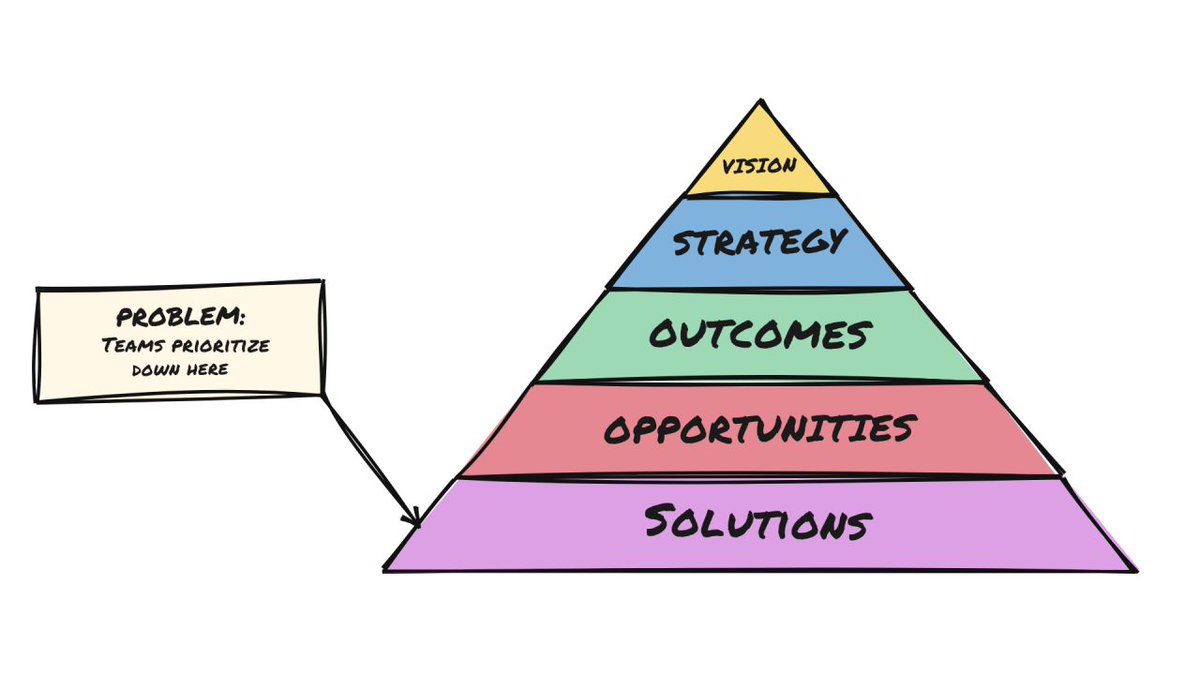
Observation from coaching over 100 product managers around the world; most PMs are stuck trying to stack rank a 200+ item long backlog thinking that's the job. When really it's the final yard. 80% of prioritisation happens upstream through your product vision, strategy, outcomes and customer opportunities.
This plays into other dynamics I see often:
- Roadmaps that are laundry lists of features
- Backlogs that don't include opportunities
- Key results that are also laundry lists of outputs
- Little to no discovery, insight or data.
I get why this happens, so this isn't a "you're doing it wrong" post. There's a lot of inertia in organisations and having conversations at those higher levels is hard - especially when the CEO says "it's all no. 1 priority"
In those scenarios it definitely becomes a skill to influence up.
I share more on this and what to do in my latest newsletter post: https://t.co/jJshVXJdmN
"Sometimes the most valuable thing you can do is stop prioritising the work and start prioritising the logic that determines why the work exists in the first place."
👏👏👏
Full credit to Jason Humberstone from a repost to one of my Linkedin posts.
The best product leaders I know are close to the details. They do this so they can avoid the 'iceberg of ignorance' where only ~4% of frontline problems are known to top management.
This doesn't mean they micromanage. It's about being close to coach, course correct and unblock.
It's hard to make the right decisions if you don't know what's actually happening on the ground, the challenges and constraints.
7 more habits of highly effective product leaders 👉 https://t.co/5d8QlS2osm
p.s. I don't think it'll be 2 years (longer reason why: https://t.co/5WMguo9PXp) but I do think it'll happen.
It might be closer to that time horizon for you given your customers (I assume most of your customers are solopreneaurs and small to medium businesses).
I say that because individuals always adopt things first, then small businesses (startups), then the SME's join, finally 10+ years later enterprises come to the party - and government/institutions.
Now overlay that with the diffusion of innovation, you'l still have laggards and late majority who will still want a UI. I even got it in the comments on my post about not looking at dashboards anymore on LI. But they might not be your customers - but they'll be someone's customers and hence UI/UX will still be around just not so dominate as today.
My 2 cents. I might be wrong though. Can't predict the future.
This is happening real time for my business too - https://t.co/DBF3IkCg0P
I don't look at dashboards anymore for example. I haven't in months. Because I can get a much richer picture in Claude with everything connected. I also have agents set up to push insights and data to me.
If you go back to first principles and ask what job does a dashboard solve, it's either;
a) I have a question I need answering
or b) I'm looking for insights/trends/opportunities
AI has opened the door for new solutions to those jobs - better solutions for me.
p.s. my newsletter is with Kit but I was this 🤏 close to using Beehiiv instead. Been a fan, have followed you and the company for a while. This could be enough to make me make the switch.
I don't look at dashboards anymore.
The dashboards are still there (I have Mixpanel, GA, and have a few other tools that have dashboards) but I haven't opened them in months.
Instead Claude manages it all for me.
If I have a question or want to know something - I just ask;
→ "Which post drove the most sign-ups?"
→ "How are people finding my newsletter?"
→ "What topics are my audience the most interested in?"
And alerts and insights are surfaced to me without needing to open anything.
I share this not because I'm trying to scare you into thinking AI is going to take your job... I share this because it's something all product leaders need to be thinking about right now.
I've been speaking with a lot of product leaders who are worried about the 'SaaSpocolypse'.
A common concern is that AI allows anyone to build their product - so why pay for it.
That's true until it breaks at 3am and the founder is now the one fixing it rather than focusing on their own product. That piece of mind, loss in focus and time is actually the main reason why people pay for products in the first place.
But where I think the SaaSpocolypse is justified is my dashboard example.
Tools today are built for humans.
A dashboard is the perfect example of that. It's visual and everything about it was built for human eyes.
But we're heading to future where it will be humans + agents.
And that's what you should be thinking about.
How do we adapt to a human + agent world.
I haven't cancelled any of those subscriptions because I still need to get the data somehow but if I can't or if there's a better more rich way for my agents to get the data then I'd switch.
===
p.s. if you want to get hands on with Claude Code and build something like this for yourself. I'm running a AI Build Day for PMs in Sydney on the 26th June to help you do just that. Limited spots 👉https://t.co/pzLSWRD4xx
Great product leaders obsess over clarity
They ensure their team are clear on:
- What their role is
- What they’re empowered to do vs not
- Where and how to ask for things
- Their career path
- Values, principles, expectations
- What we mean by certain terms
- The vision, strategy, context
- etc.
This might seem like a no-brainer but I'm sure you've had roles where expectations were fuzzy, promotions vague, or responsibilities unclear - how did that affect your performance?
Low clarity leads to waste, teams spinning their wheels, misalignment and all kinds of issues that could otherwise be avoided.
And don't underestimate the effort that this takes.
There's a lot of time spent communication, clarifying and creating things like role competency matrix's.
Leadership isn’t passive. It’s not about “delegating everything”. It’s active, shaping work through clarity.
“Control, we discovered, only works with a competent workforce that understands the organization’s purpose. Hence, as control is divested, both technical competence and organizational clarity need to be strengthened” ― L. David Marquet, Turn the Ship Around
7 more habits of highly effective product leaders 👉 https://t.co/5d8QlS2osm
Product Discovery has two modes:
1. Exploring
2. Exploiting
Most teams I work with are great at exploiting. They're really good at optimising what they already have/know. eg make the onboarding flow better, improve churn, come up with a solution for X, etc.
But few teams are really good at exploring.
Exploring what's possible. Gathering insights that shape the strategy and uncover untapped opportunities (potentially whole new products!)
More on what this looks like and how👇