AEP is an independent, nonprofit organization devoted to promoting the Consumer Welfare Standard. Visit our site to learn more. Please retweet our posts.
Populist antitrust claims to speak for ordinary Americans against corporate power. Yet when Americans are asked what worries them, they repeatedly identify inflation, groceries, healthcare, gasoline and the cost of living. They worry about prices far more than corporate size. Read our latest here:
https://t.co/nc81nxL3qc
California has decided that one Sherman Act is not enough.
On September 30, Gov. Gavin Newsom signed AB 1776, the COMPETE Act, the most significant change to California antitrust law in decades. Beginning January 1, California will have its own prohibition on monopolization and monopsonization. The Cartwright Act has generally required an agreement between two or more parties, so a single dominant firm accused of monopolistic conduct usually had to be pursued under Section 2 of the federal Sherman Act. The new law closes that gap.https://t.co/AGEJ9hetKB
We’re very grateful to all our readers and subscribers. This battle, for the soul of the GOP and indeed of the country, is important to us as lovers of liberty. Paradoxically Speaking is growing rapidly—and it’s no wonder. Practically no one else on Substack is discussing Big Government from our perspective. We wish we had more competition than we do.
We’re particularly grateful to our paid subscribers. Only because of that slice of our readership is any of this possible. Please do support us if you can.
As a token of our gratitude, we are launching an exclusive weekly feature for our paid subscribers. Our most important articles we will always keep free, in hopes of reaching the widest possible set of open-minded people. But we also want to make sure that our generous paying supporters get something for their hard-earned dollar.
As such, I’ll be writing up my thoughts every week, typically on the news cycle. Enjoy!
https://t.co/flS1EkAGfx
Sellers have always tried to figure out what buyers will pay, and for most of history they weren’t very good at it. The merchant knew his regulars, kept an eye on the shop down the street and adjusted as best he could. Then came market research, then spreadsheets, then pricing models of growing sophistication. Today’s algorithms are the latest step in that progression. Mostly they are better than people at digesting a great deal of information quickly.
That is not obviously bad for consumers, and airlines show why. A seat becomes worthless the moment the plane pushes back from the gate, so carriers adjust fares constantly to fill planes. Travelers grumble, with some justification, when the fare to Orlando doubles over spring break. They rarely complain about the Tuesday fare that drops because the airline would rather sell a seat cheaply than fly it empty. The same system produces both.
Hotels price rooms the same way. Retailers mark down whatever isn’t moving, and ride-hailing apps raise fares when a rainstorm brings out more riders than there are drivers. None of this is mysterious. Prices are supposed to move when supply and demand move, and that is much of what makes a price system worth having. Software speeds up the process. Say a hotel sees that next weekend’s bookings are soft and cuts its rates, and the hotel across the street notices and matches. No one would call the second hotel a conspirator because its manager looked out the window. Replace both managers with programs that read publicly posted rates and respond within minutes, and the economics are unchanged. The response is faster and more precise, which frequently works to the customer’s advantage.
Read our latest article here, at Paradoxically Speaking: https://t.co/b14DNALJQ6
California Attorney General Rob Bonta sued to stop Paramount Skydance’s $110 billion acquisition of Warner Bros. Discovery. Two months later, he agreed to let it proceed. The obvious question is who won. The answer is that both sides won, but they were no longer playing the same game. Paramount gets Warner Bros. without admitting that the merger violates the law. California gets five years of government direction over movie output, theatrical windows, domestic production, labor programs and newsroom governance. Paramount won the company. Bonta won the concessions. Antitrust lost its limiting principle.
The legal dispute began with an unusual disagreement among public enforcers. The Justice Department spent eight months investigating the acquisition. Several state attorneys general participated in that investigation, shared information with DOJ and attended depositions of company executives. After reviewing more than two million documents, the department concluded that the merger was unlikely to harm competition or consumers in streaming, linear television or the development, production and distribution of theatrical films.
The states were entitled to disagree. A month later, California and eleven others sued under Section 7 of the Clayton Act. They alleged that combining two major studios would reduce competition in wide-release and anticipated blockbuster movies and give the new company excessive bargaining power in licensing basic cable channels. The court entered a temporary restraining order. Paramount then agreed not to close while the litigation proceeded. Under the merger agreement, however, Paramount would owe Warner shareholders about $7 million for every day the transaction remained open after September 30. That clock gave Bonta considerable leverage.
Read our latest here: https://t.co/W90MhrtLbL
I thought I knew my father reasonably well. Apparently, I did not, at least not according to the readers of The Atlantic.
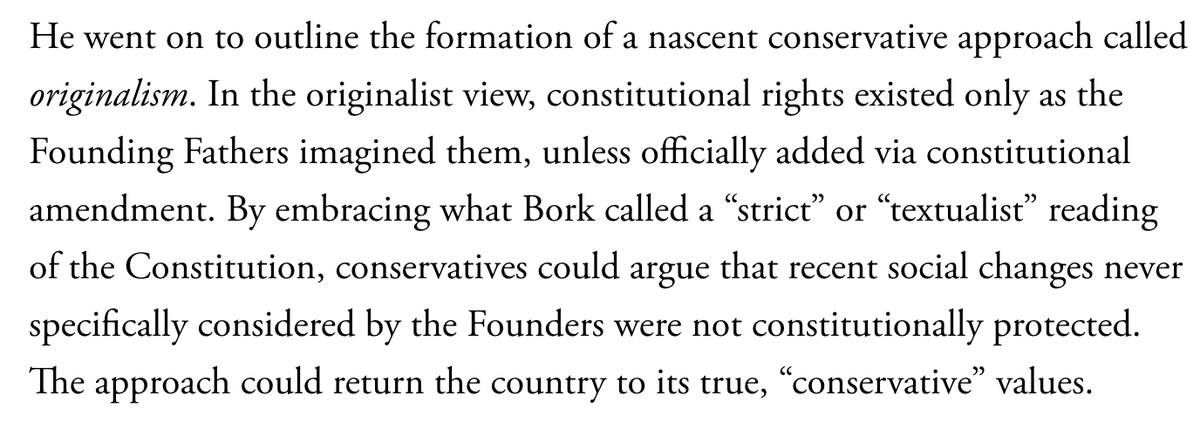
Alex Wagner recently wrote a long article about Robert Bork, originalism, and the beginnings of the Federalist Society. I responded here to what I thought she got wrong. Then I made the mistake of reading the comments, where I encountered a Robert Bork considerably more interesting than the man who raised me: not merely a Yale law professor, solicitor general, federal judge, and unsuccessful Supreme Court nominee, but something closer to the hidden hand of modern American history.
One reader informs us that originalism “was created by the Taney court,” which employed it to produce the Dred Scott decision. Another says Bork and his fellow conservatives sought to build a “Neo-Confederate Constitutional structure.” A third traces the intellectual lineage through the Confederacy, Southern Baptists, Barry Goldwater, the Federalist Society, and Donald Trump. Along the way the discussion touches white supremacy, Christian nationalism, the KKK, and American Nazis.
Dad, it turns out, was busier than I realized.
See our latest here: https://t.co/7MB2ZwarQW
There’s something odd about watching the world’s most powerful artificial-intelligence companies ask Washington for permission to compete a little less vigorously.
https://t.co/zZCr4Kte0e
There’s something odd about watching the world’s most powerful artificial-intelligence companies ask Washington for permission to compete a little less vigorously.
Anthropic CEO Dario Amodei has called for slowing the development of increasingly powerful AI systems and proposed coordination among the leading labs. OpenAI’s Sam Altman and Elon Musk were quick to endorse the idea. The justification is safety, the worry that technology is outrunning our ability to control it.
That worry deserves to be taken seriously. AI isn’t merely another consumer product whose defects can be recalled after they appear. Researchers worry about systems assisting bioterrorism, conducting cyberattacks, manipulating vulnerable people and, ultimately, escaping meaningful human control. More unsettling still is recursive self-improvement: AI increasingly helping to build its own more capable successors.
We don’t know where this leads. That uncertainty is itself part of the problem. AI may turn out to be less like the invention of a new drug than the discovery of fire, a general-purpose technology capable of transforming almost everything it touches.
So, the argument for caution is powerful. But it doesn’t follow that the proper response is to suspend competition.
When competitors agree among themselves to hold back innovation, antitrust lawyers get nervous. FTC Chairman Andrew Ferguson said as much this week at Georgetown University, noting that his “alarm bells go off” whenever companies ask Washington for regulation and an antitrust exemption in the same breath. Regulation of that kind, he warned, can become a barrier protecting whoever already has a foothold.
Mark Zuckerberg unexpectedly gave the clearest answer to why.
Read my thoughts at Paradoxically Speaking: https://t.co/PKAeLpCjpT
When President Trump nominated Adam Candeub to lead the Justice Department’s Antitrust Division, it seemed like a win for conservative legal enforcement. Candeub has an impressive résumé and a serious intellectual pedigree. His Senate questionnaire records a career teaching law and serving at the Federal Communications Commission and the Commerce and Justice departments. He has written extensively about telecommunications, competition and the internet. His work reflects familiarity with Robert Bork, Milton Friedman, Frank Easterbrook and the law-and-economics tradition. He is not a novice who stumbled into antitrust through politics.
But a closer inspection of Candeub’s nomination should prompt more careful scrutiny from conservatives.
https://t.co/lvt1ywROm0
For more than a century, Americans have celebrated the dignity of work on Labor Day. This year, however, the holiday arrives under a cloud. Artificial intelligence can write, code, analyze contracts, diagnose equipment and answer customer questions. If machines can perform work once reserved for human beings, some are asking, what will be left for us?
Is this, in effect, the last Labor Day?
https://t.co/MI1Jz90G3d
"Some comments confused settlement with adjudication. “All those states sued, and they won,” one reader wrote. Another said government had “proved legally” that Meta caused mental illness in children. A third portrayed the settlement as a jury award from neighbors telling injured families, “We hear you.”
That did not happen in this case. The parties settled during trial. There was no verdict on the states’ claims and no finding that Meta caused a general youth mental-health crisis. The agreement says expressly that it is for settlement purposes only and is not an admission of liability, wrongdoing or violation of law. Meta may have settled because it feared catastrophic exposure, damaging evidence, years of litigation or all three. A settlement price tells us about litigation risk. It does not convert disputed allegations into scientific or legal findings.
The same care is required when discussing the money. Readers who assumed that every dollar will vanish into unrestricted state budgets went too far. The agreement identifies youth mental-health services, crisis lines, after-school programs, digital literacy and related remediation as permitted uses, and some states have adopted tighter restrictions. At the same time, it allows broad state-specific discretion, payments into some general funds, reimbursement of litigation and enforcement costs, and other lawful uses. It is not a direct compensation program for the families whose stories drove public support for the case. The public should track where the money goes and what it accomplishes, not merely admire the number in the headline."
"Nvidia did not arise from a royal charter issued by a mercantilist power. It emerged from a meeting between three young engineers at a Denny’s. Nvidia now dominates the upper end of AI chips, but it is not a monopoly. It is engaged in fierce competition with global leaders like AMD, Intel, Google, AWS, and others. It is true that SpaceX has close to a monopoly in heavy-lift launches – partly due to the failure of Boeing and other traditional contractors. But would the U.S. economy and national security be improved if SpaceX were broken up into several separate launch companies? The little SpaceXs might compete on price, but the economies of scale—and likely the competence—needed for this monumental enterprise would be lost.
Google does have a monopoly on search, but this is not the result of a modern version of a royal charter, either. It is simply a function of network effects—everyone uses Google because everyone uses Google.
And besides, who wants to be forced to navigate between 10 Googles?"
Meta’s settlement with state attorneys general is being celebrated as a victory over Big Tech. It may turn out to be something closer to the opposite: a case study in how regulation ends up entrenching the companies it’s meant to restrain.
https://t.co/GGf4HNCtsl