Your AI agent can access every secret on your computer. We make sure nothing gets out.
ChainWall is the antivirus for AI agents.
How it works:
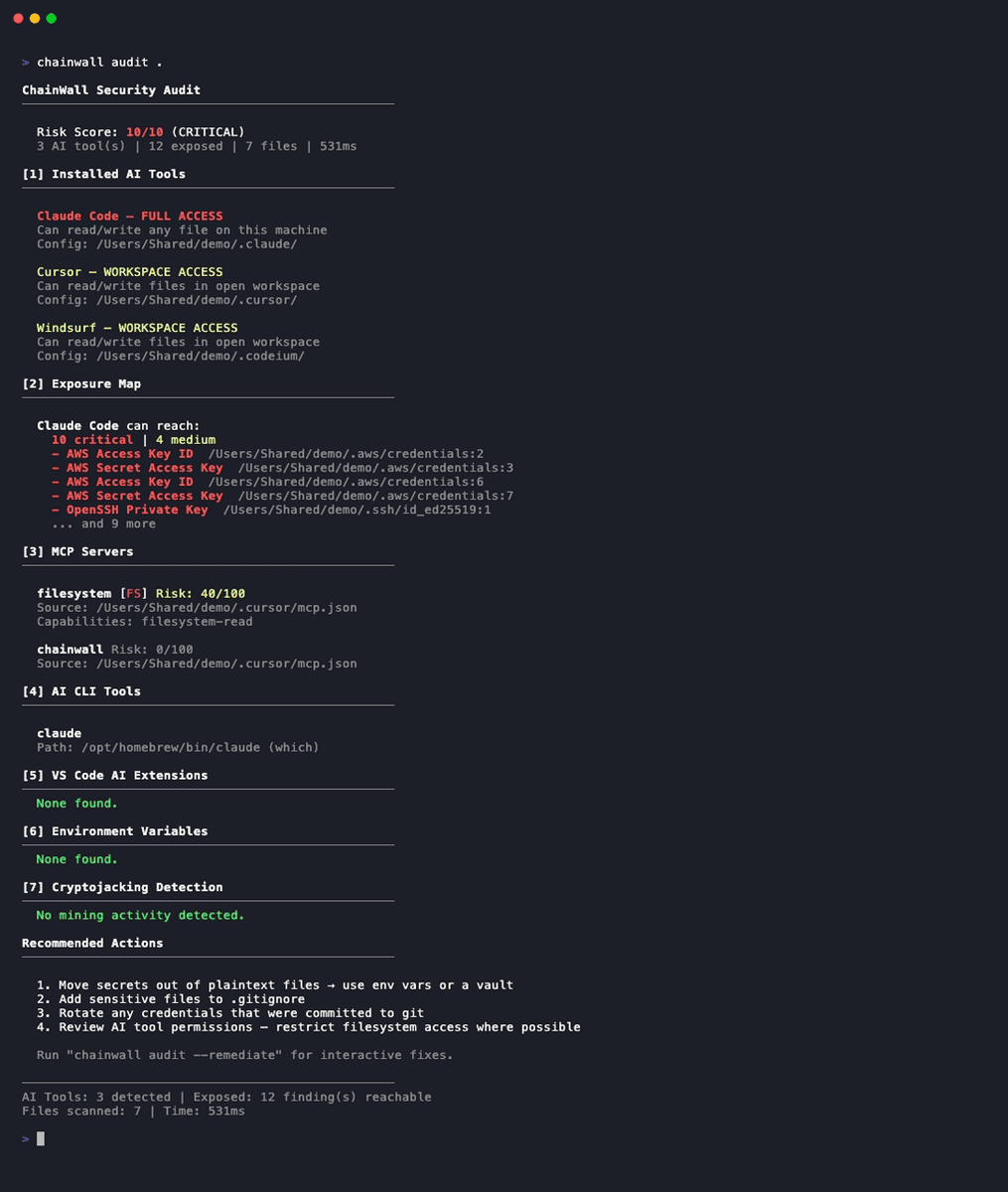
→ Scans your machine for exposed secrets
→ Maps which AI tools can reach them
→ Intercepts dangerous actions in real-time
→ Detects MCP poisoning, prompt injection, and supply chain attacks
Website: https://t.co/cArLPnHExO
Github: https://t.co/dT0if90sA1 Skill: https://t.co/UPX0sEL097
Although Chainwall is open source, it seems like crypto people are afraid of installing stuff in their terminal, I understand this completely.
@Antivirus is a safe tool, that only works locally on your computer (which means no data is stored onto a cloud)
But I understand that people don't want to install my repo.
I'm working on a solution.
Think of AI coding tools like giving someone the keys to your house.
Except they also get keys to your car, your safe, your filing cabinet, and your diary.
The AI needs to read your code to help you write it.
But it also reads the file where you saved your credit card number 'just for a second' two months ago.
Or the spreadsheet with your team's salaries. Or the document with your therapist's contact info.
ChainWall is the security camera system for that house. It doesn't lock the AI out, that would make it useless. Instead, it watches what the AI is looking at and stops it before it does something dangerous.
Like reading a file called 'passwords.txt' or running a command that sends your data somewhere sketchy.
It's the difference between 'my AI can see everything' and 'my AI can see everything, but I know what it's looking at and can block the scary stuff.
Your AI assistant can read every file on your machine. That includes your .env files, SSH keys, AWS credentials, browser cookies, crypto wallet seeds.
Most developers don't realize their AI tools have the same filesystem access they do. There's no permission model. No sandboxing. No audit trail.
If the AI hallucinates a command or gets hit with a prompt injection attack hidden in a dependency's README, your secrets can walk out the door and you'd never know.
Your AI tools have access to your AWS keys, SSH credentials, crypto wallets, and every .env file on your machine.
There's no firewall. No permissions. No audit trail.
One malicious line in a README and it's all gone.
That's why I built @Antivirus for AI agents.
Vibecoders are the big trend now, and a majority of users (especially crypto users) aren't fully aware of the access their AI agents has on their computer.
What our tool provides:
- Scans your machine.
- Maps what's exposed.
- Intercepts every action before execution.
Installment and usage is super easy:
npm install -g chainwall
chainwall
With the rise of @openclaw and fully autonomous agents running on your machine AI isn't just writing code anymore.
It's executing, browsing, installing, and accessing your files unsupervised.
So I also created https://t.co/7DZl74KTPi, a skill file any AI agent can read to install and run chainwall on itself.
Give your agent the ability to protect your machine while it works.
Ai security threats are emerging, make sure you stay protected.
Your AI coding assistant can read every file on your machine. That includes your .env files, SSH keys, AWS credentials, browser cookies, crypto wallet seeds.
Most developers don't realize their AI tools have the same filesystem access they do. There's no permission model. No sandboxing. No audit trail.
If the AI hallucinates a command or gets hit with a prompt injection attack hidden in a dependency's README, your secrets can walk out the door and you'd never know.
Your AI agent can read your crypto wallet seed phrase right now.
Not theoretically. Right now.
It has filesystem access and your seed is in a file. Chainwall sits between the two and keeps you protected.
LLM viruses represent a new, emerging category of cyber threat where artificial intelligence is used not just as a tool for creating malware, but as an active component of the malware itself.
These threats, which began appearing in the wild around 2025 (e.g., LAMEHUG), are designed to operate, adapt, and spread by leveraging the capabilities of Large Language Models (LLMs).
Antivirus prevents that.
LLM agents (Claude, Clawd, Cursor, etc.) now have full access to users' computers, files, terminals, credentials.
They can read your .env, execute rm -rf /, or leak API keys without knowing any better.
One wrong prompt = one security incident.
https://t.co/6ScLyzUoii