I landed research internships via COLD EMAILS at Cambridge, LSE, and Ashoka when I was a 20-year-old Psychology major at Lady Shri Ram College, India.
I recently updated the structure of my cold email after 1.5 years of reviewing hundreds of cold mails. Here it is
A 🧵
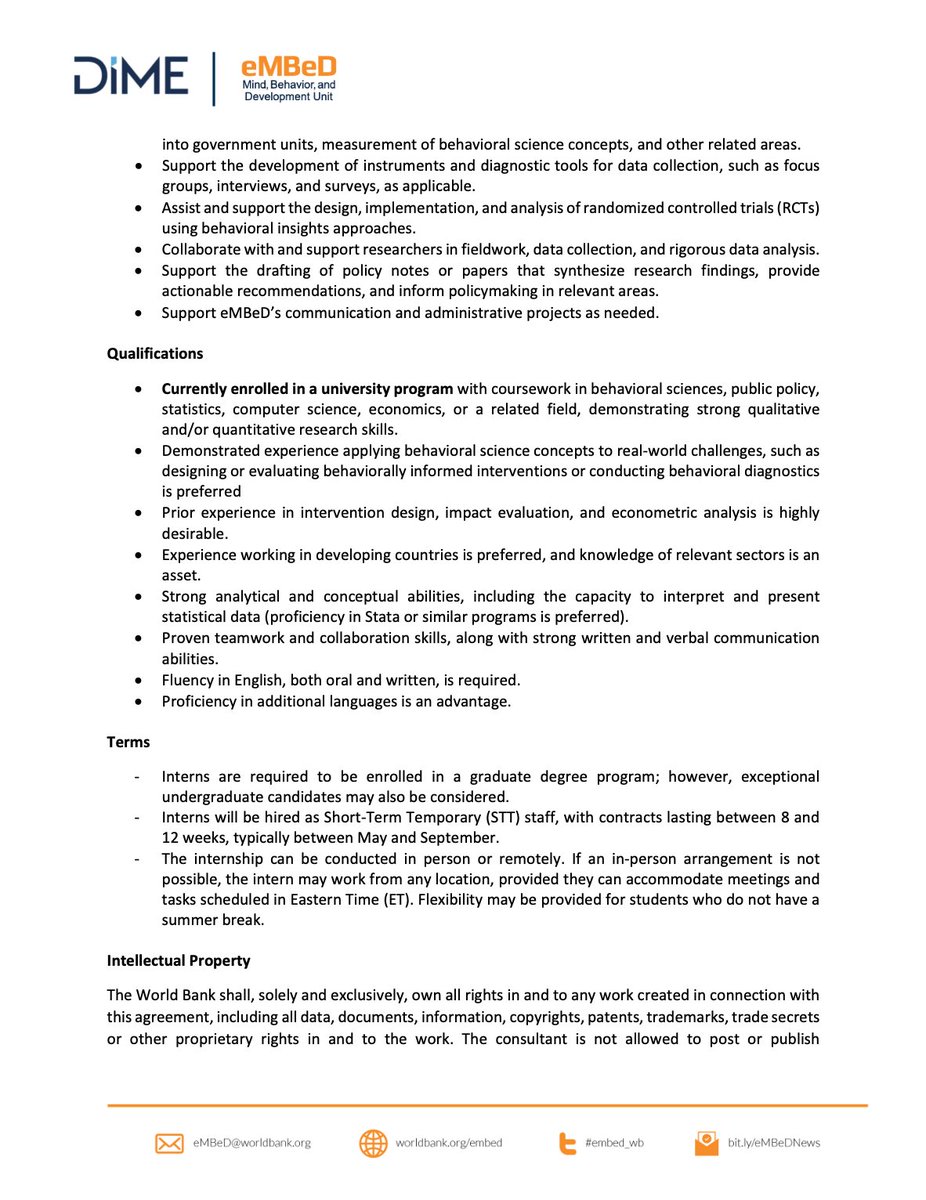
Behavioral science internship at The @WorldBank 🌐
If you want to apply but don't meet some qualifications, I urge you to do things to meet those qualifications in the month of Jan, because the last date to apply is 7th Feb 2025.
Another thing, a lot of you are on gap years or in between jobs after undergrad.
They've mentioned "Interns are required to be enrolled in a graduate degree program; however, exceptional undergraduate candidates may also be considered." =)
Link to apply: https://t.co/oqELl6c5zX
All the best!
Thanks for this opportunity @zeina_afif and Abigail Dalton :D
Behavioral science is no longer confined to academia, and these Indian firms prove it.
One of the questions students ask me frequently is a list of Indian BeSci (Behavioral Science) firms.
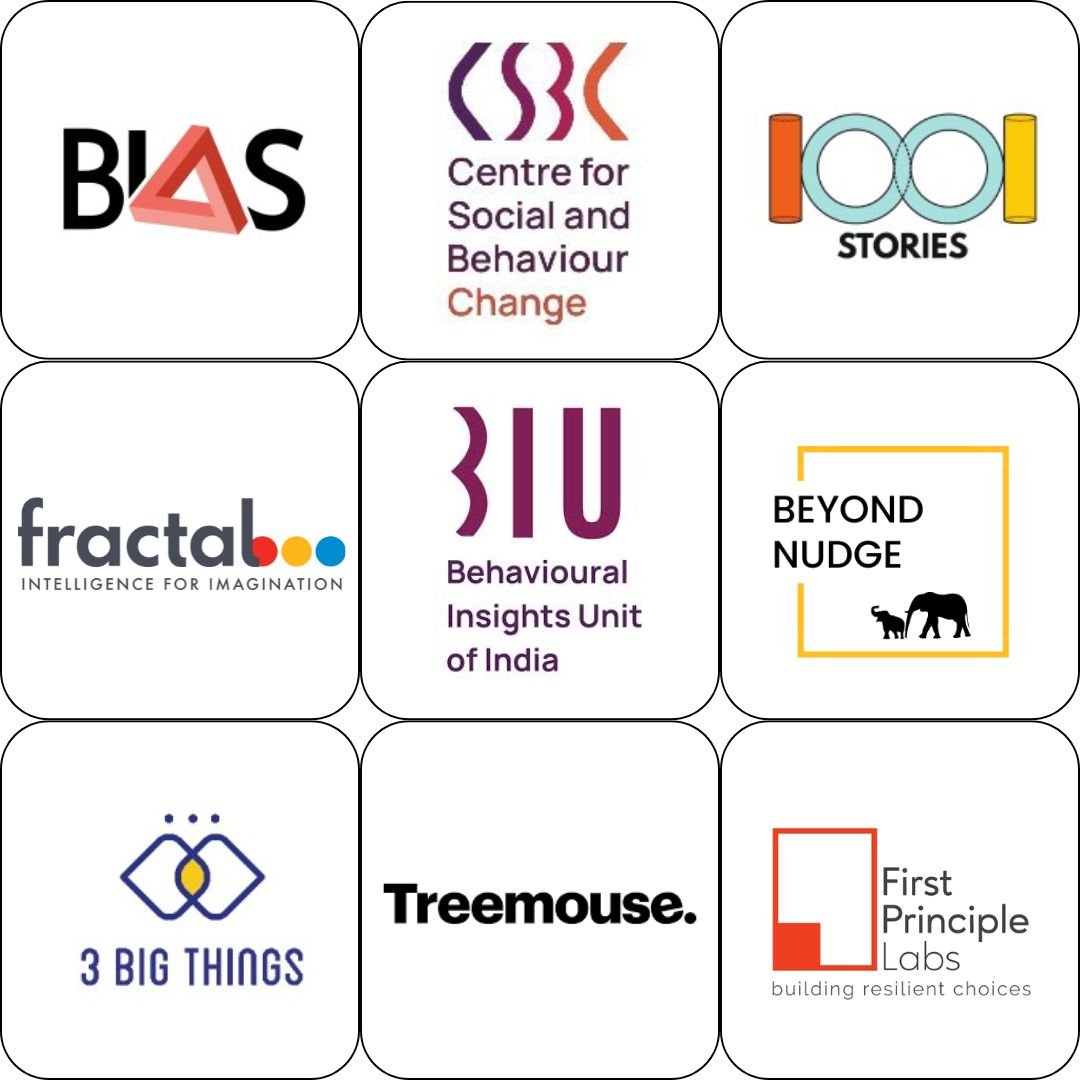
So here’s a list of 9 Indian BeSci firms (and their leadership team) that I look up to:
🌍 @CSBC_AshokaUniv by @MamidiPavanH, @shamarbar, and @ShagataMukherji
🧠 Behavioral Insights Unit by @NITIAayog, @BMGFIndia, and @CSBC_AshokaUniv
🔗 @1001StoriesIN by @BehSciClub and Reshma Tonse
🌌 @fractalai / @thefinalmile by @ramprasad_c , @biju_finalmile, @srikanth , and @pranayagrawal
🔺 @BIASINC_IN by @biasshubho, Sujoy Chakravarty, Varun Arora, and Hamsini Shivakumar
🐘 @BeyondNudge by @JunofyRozarina and @dilipsoman (who also leads the awesome @UofT_BEAR !)
3️⃣ 3 Big Things Studio by @onwardparam and Shalini Raghunathan
🐭 @hellotreemouse by @nishitagill, @jamwithashish, Iti Seth, and Megha Chawdhry
🟥 @tfplabs by @vineeshus, Abdul Gafoor, and Rifath Rahman
I've been looking up to these firms and their founders ever since I came across applied BeSci 3 years ago :")
P.S. I've written a free, quick list of 5 'Behavioral Marketing' upgrades to make marketing more human-centric and revenue-centric simultaneously.
It takes 5 mins a day so please feel free to have a look here: https://t.co/9f6gDWWlez
Every time I’m on a train, I’m reminded of this behavioral intervention that reduced deaths on train tracks by 75%
“Every day, people of all ages must cross from one side of the railway lines to the other to get to school, to shops, or to work – and then cross back.
There are few footbridges, and they’re arduous to climb because they have to be tall enough to avoid the power lines running above the trains.
Inevitably, most people who need to get to the other side take the “easier” route of crossing the tracks themselves.
But the danger is immense: there are typically four sets of tracks to get over, with trains passing on average every minute, 21 hours a day, and often at speeds of 60mph or more.”
The railway authorities had tried these “logical” solutions that failed:
• Posting warning signs by the tracks.
• Enforcement drives to catch and fine people who went across the tracks.
• Building walls and fences in some places to physically prevent people from crossing.
• Running daily print and radio advertisements warning people about the dangers of trespassing on the lines.
So, @thefinalmile tried solutions that work at a visceral or non-conscious or instinctual level.
And their first pilot reduced fatalities by 75 percent in a year 😲
Here are their 3 solutions:
1️⃣ The existing text-based warning signs were replaced with something that would work instinctively as essential when every millisecond counts in the decision to cross a track or stay back.
They put up posters at trespassing points with a photograph of an actual person, capturing his face in close-up the moment before he is hit by a train.
2️⃣ They changed the way drivers used their horns to warn people.
From scientific studies, they determined the best distance from trespassing points for the approaching train to honk, so that it would be heard neither too soon nor too late.
They added a further refinement based on a study showing that brain attention peaks during the gap between two musical notes: the listener’s attention is grabbed and held while they wait for the second note.
Inspired by this finding, they used two staccato horn blasts instead of a single long hoot.
3️⃣ They tackle the problem of incorrect perception of the train’s speed. A sign saying “The train’s going faster than you think” would not do the job.
Their solution was to paint groups of railway ties yellow at regular intervals, on either side of trespassing points.
The bright stripes attract attention, and as they disappear under a moving train, the brain quickly and unconsciously recalibrates its estimate of the train’s speed.
And the first pilot reduced fatalities by 75 percent in a year.
They scaled up the solutions to five other locations, and saw reductions of between 40% and 70% in the number of deaths there.
Thank you for this solution and for inspiring me Ram Prasad and @biju_finalmile and @ramprasad_c :")
It's been a year since I dropped out of UChicago's MA Psychology without a concrete plan of what to do.
When I dropped out, I knew that I didn't want to do academia (at least for a while).
But I didn't know what *specifically* I wanted to do.
So, I continued exploring marketing for Behavioral Science firms, which is what I'm doing even now.
But I don't know what I want to do for the rest of my life. I thought it was academia, but clearly, wasn't true.
This post says "sometimes you arrive at your destination, other times you get a new direction".
And I've been knowing of so many new directions, unsure about which one is for me for the long-term.
I’ve always been interested in too many things. I don’t know what I’ll do in the future.
Maybe I’ll do this, maybe I’ll do something else. I’m just 22 right now.
Whatever it is, I’ll figure it out along the way while trying my best to make the best of whatever I have.
Paid Research Internship in Applied Behavioral Science at BIAS - Behavioural Insights Architecture & Strategy (@BIASINC_IN)
BIAS is looking for a Research Intern to join their team for a 3-month stint starting in November.
📌 Role Overview
You’ll be involved in all aspects of the research process and support various ongoing projects, with a special focus on a study about consumer behaviour in the 2-wheeler market.
📌 Key Responsibilities
• Contribute actively to all parts of the research process, including data collection (fieldwork), data analysis and report writing.
• Support multiple live projects, as may be needed.
📌 Qualifications
• Currently studying or recently graduated in Psychology, Sociology, or a related Social Sciences.
• Strong research and analytical skills.
• Good communication skills.
• Ability to work independently.
📌 Why Join Us?
•Gain hands-on research experience.
•Work on meaningful projects.
📌 How to Apply:
Fill out the application form here: https://t.co/3qUEytTrcP by Friday, October 25th, EOD
Learn more about BIAS here: https://t.co/e4zuSIwvXy
For any further queries, please reach out at [email protected] / 9816758190.
Have you heard two different (and conflicting) pieces of advice from two equally credible people, and haven’t been sure whose advice to take?
For example, my readers find my advice on degrees, internships, theory vs practice, etc. starkly different from other psychology creators’ advice.
And they’re not sure whose advice to take.
So, here’s a helpful checklist I use myself when making similar decisions.
It has a lot of points, so here are my top 3:
✅ Whom do I want to be like?
✅ Who has more first-hand experience?
✅ Whose advice leaves me feeling uncomfortable but in a good way?
Ask yourself these questions, and have an uncomfortable conversation with yourself about why you’re trusting whom you’re trusting.
This post was inspired by @dickiebush's prompts and checklists on better, more intentional decision-making.
The psychology influencer market is unfortunately terrible (sometimes straight up unethical)
So, choose your influencers wisely and choose them for the *right* reasons, as in the checklist.
If you're into research internships, I plan to launch a free 5-day, email-based course :D
To know when the course is out (this year hopefully), sign up here: https://t.co/PabWmAUXx4
Last week, I spoke about non-academic careers for Psychology students at AIIMS, Delhi (India’s best med school) for the Career Fair organized by Mental Health Foundation India.
I listened to the concerns that Psych bachelor’s and master’s students have, and realized that most misunderstand the value of their degree.
Because over the last few weeks, I’ve also spoken to a lot of Applied Behavioral Science (BeSci) Founders and Heads.
If you don’t know, Applied BeSci is simply just applying psychology to make stuff more human-centred and data driven to improve outcomes.
For example:
• To reduce the spread of misinformation.
• To increase the downloads of an app.
• To increase uptake of vaccines.
• To reduce littering.
Google, HSBC, EY, all have a BeSci team.
And the biggest realization I had talking to these BeSci Founders and Heads (that Psych students ALWAYS misunderstand)?
Many of these BeSci Founders did NOT have a Psych degree (or a certificate from a Psychology workshop :P).
And YET, most students keep running after degrees and certificates, and overemphasising the value of a degree.
But that’s just not it. There’s much more nuance to the value of degrees.
Based on my conversations with these BeSci Founders and Heads, consensus seems to be that degrees are important, but what *really* makes you stand out are your skills and your experiences.
The major reason Psych students avoid gaining valuable skills via internships, research, etc. is to not face rejection or “failure”.
See, my marketing business with BeSci clients is difficult, but it’s supposed to be.
Three years ago, getting a research internship for me took a lot of time, but it’s supposed to.
You’ll get multiple rejections (“failures”) before one selection. I’ve had to follow up with leads for as long as 6 months before they became a paid client of mine.
I’ve had to do 6 months of cold outreach before I got the Cambridge research internship. I’ve received a lot of rude replies.
So believe me when I say this: “Failure” is the norm.
I want you to read this every single day:
Don’t be held back by data based on averages (”psych students can’t get good jobs”), and prove it wrong if you want to.
All this is what I talked about in my session at AIIMS organized by MHFI.
I got requests from my readers to turn that 15 minute long presentation into a 2 hour long webinar, so here it is :D
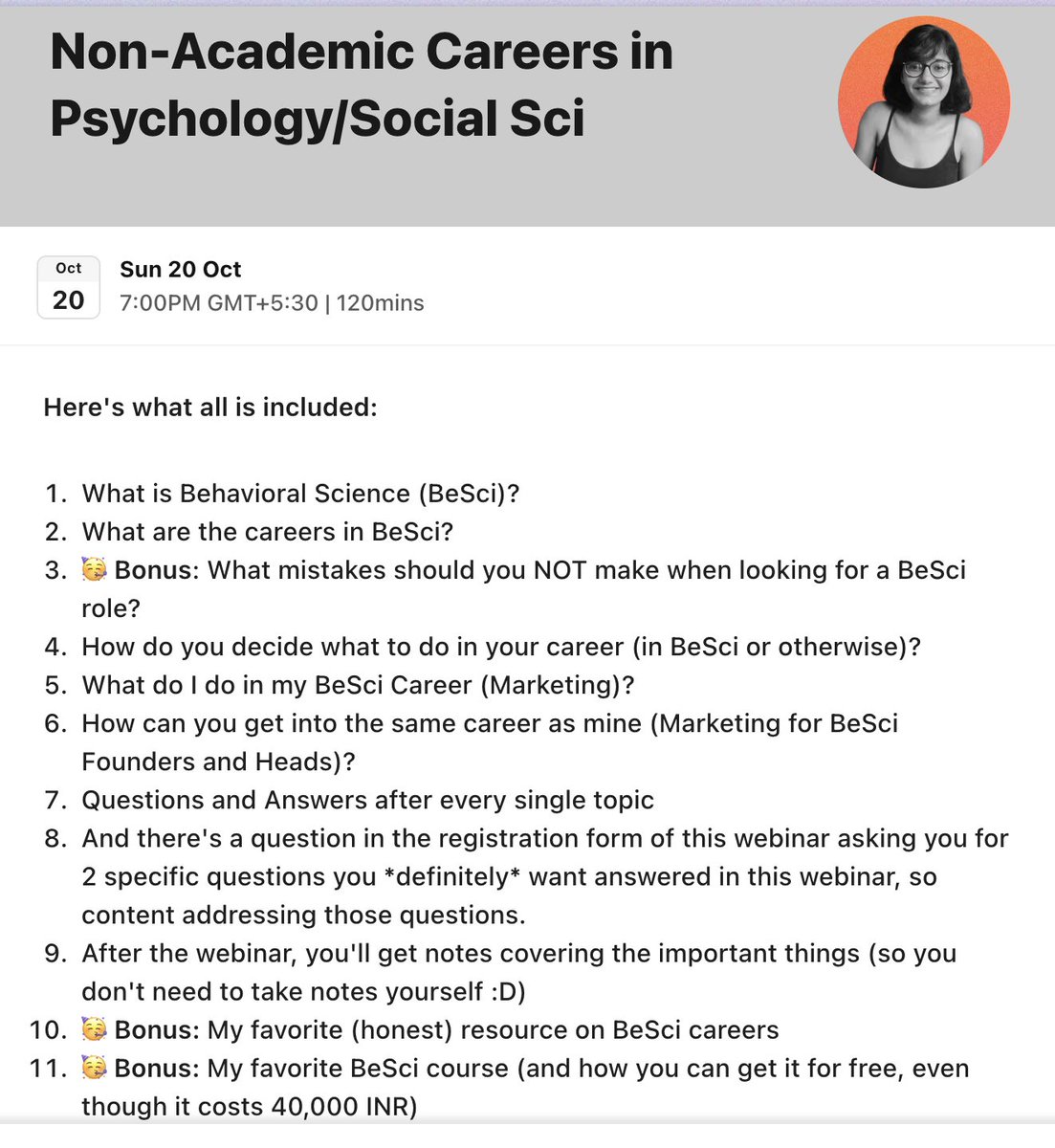
I’m hosting a webinar THIS SUNDAY, 20th October.
The topics I'll cover are in the picture.
Feel free to know more / register at https://t.co/kPoviW7k5S
For my mentees confused about careers (esp in Psych and Social Science), I used to think Ikigai was a good starting point.
But......as I spoke to more and more students, I realized that Ikigai is incomplete.
Because it requires a lot of self-awareness that most students don't have (at least the ones I've spoken to).
They make decisions on the basis of:
• What their family wants
• What everyone else is doing
• What society expects them to do
BUT, even if they used Ikigai, I don't think they'll reach the right conclusions that truly reflect what *they* want to do.
I'll be writing about the problem with Ikigai, especially for students / people early in their career, and what they can do instead, in my newsletter for tomorrow.
Plus, when you sign up, you get the same sheet that I used for tracking my cold outreach for BeSci jobs!
Feel free to sign up and know the breadth of BeSci careers and + get the outreach tracking sheet: https://t.co/PabWmAUXx4
One of the biggest mistakes psychology students make is looking for a career that applies psych.
When what they need to do is to take ANY career of their choice, and *apply* psych to it (as in the image by @IrrationalLabs)
This process of applying psych is called Applied Behavioral Science (BeSci).
And applying BeSci to something isn’t just being more empathetic. BeSci is a whole new way of thinking.
As @mattwallaert (former head of BeSci at Microsoft) calls it, “behavior as an outcome, science as a process.”
There are proper frameworks which form good starting points for learning BeSci.
All in all, BeSci is a more scientific and human-centred approach that saves time, money, and energy (that’s why there are so many BeSci consulting firms.)
You’ll be surprised to know the scope of BeSci! I know I was.
You can apply BeSci to *anything*.
And that’s what I’ll write about, the breadth of BeSci careers, in my newsletter tomorrow :D
Plus, when you sign up, you get the same sheet that I used for tracking my cold outreach for BeSci jobs!
Feel free to sign up and know the breadth of BeSci careers and + get the outreach tracking sheet: https://t.co/PabWmAUXx4
Nabanita got a Research Internship at IITD’s Design department on her FIRST cold email, even though she’s an English major at LSR.
We often look at examples of how common things are while deciding what we should do.
For example, maybe Nabanita had never seen or heard of a non-design student getting a research internship in design.
So, she didn’t think it was possible.
And so, she didn’t even try.
But, when she stopped self-rejecting and took action,
She got the internship, despite not being from a design background or a reputed design school.
And I have the same story.
I still can’t believe all of the things that happened to me just because I took action.
I owe a lot of my “success” to taking action, not exaggerating.
If you’re ready to take action, I plan to launch a free 5-day, email-based course on how to get your dream research internship :D
To know when the course is out (hopefully this year), sign up at https://t.co/PabWmAUXx4
“What can I do with a degree in Psychology that’s not clinical/counselling?”
……Most things that you can do with most other degrees?
You don’t have to go into clinical/counseling psychology just because you’re a psych major.
I’ve seen psych majors successfully go into the following roles:
📜 Policy
🔨 Product
📈 Marketing
🏥 Healthtech
✍️ Copywriting
🏛️ Government
📱 Social Media
📊 Data Science
🎨 UX/UI Design
🩺 Public Health
♻️ Sustainability
🔍 User Research
🖌️ Graphic Design
📢 Communications
💡 Decision Science
👥 Human Resources
🗳️ Political Consulting
📅 Project Management
🧩 Behavioral Economics
💼 Business Development
🧠 Management Consulting
📚 Curriculum Development
🛠️ Human Factors Engineering
🤖 Human-Computer Interaction
In most places, the degree doesn’t matter. Demonstrable and marketable skills do.
Feel free to read more of my posts on career (esp for social science students) at https://t.co/5Dk0bjFCTM
What are you planning to do as a career and is it related to your degree?
"What can I do with a bachelor's in Psychology/Social Science/literally any other field?"
This is the wrong question to ask. The right questions are:
1) What am I good at OR what am I willing to become good at via practice and learning?
2) What will pay me OR how can I transform it into something that pays me?
3) What does the market / society need OR how do I create a need for it?
4) What do I enjoy?
(essentially, Ikigai)
Don't limit yourself by your degree.
You don't necessarily have to work in the field in which you have a degree.
As for employers / clients, skills matter much more than degrees (from what I've heard)
For example, check out the breadth and depth of "psychology-related" careers in this post: https://t.co/jkq9UKd0S9
Fellowship in Psychology / Behavioral Science + Design:
We are excited about reimagining the future of behavioral science and design, in a post-AI world.
At First Principle Labs (FPL), our multi-disciplinary team attempts to connect the disparate dots by uncovering hidden patterns of human behavior.
We study people, their behavior and how they make decisions to design experiences.
This fellowship provides an opportunity for the candidates to “learn by doing” what behavioral design really means.
Candidates explore the depth of behavioral design through self-learning as well as peer discussions.
Through our custom-designed approach (we call it as deliberate design), participants identify obstacles, biases, and behaviors to form their hypotheses, generates lots of ideas, develop potential solutions, and test them in the real world.
This iterative process involves re-evaluating, defending, and sometimes even discarding long-held assumptions, occurring throughout phases 0 and 1.
Our ideal candidate has:
• A passion for everyday learning, including interest in reading and synthesizing research papers and books pertaining to the domain, and the ability to translate them into behavioral intervention.
• Desire to incorporate design thinking into your practice of applied behavioral science
• Adaptable to different business contexts, team structures, & project phases
• Ability / Desire to synthesize vast quantities of qualitative data points into meaningful and digestible chunks
• Humble and sincere confidence clubbed with pragmatic optimism
Apply here: https://t.co/FznEThZ6qG
Apply by: 11:59 PM, September 22, 2024
Duration: 3 months (Phase 0) + 3 months (Phase 1)
Behavior Journalism Fellowship by The Atlas of Behavior Change in Development (ABCD)
Fellows will gain access to various resources, training, and exclusive support that will take your development reporting to the next level:
1) Comprehensive Training in Behavioral Journalism:
• 10-15 hours of virtual training, accessible to fellows from India. The training covers behavioral science foundations, behavioral journalism methods, and narrative building.
• Specialized tracks will focus on applying behavioral insights to key development areas such as Water, Sanitation and Hygiene, Sustainable Agriculture, Healthcare,Urban Development, Education, Fraud and Risk.
2) Certification:
Upon completing the training, each fellow will receive a certificate recognizing their new expertise as a 'Behavior Journalist.'
This certification will set you apart in the field and open up new opportunities for impactful journalism.
3) Pitch for Grants and Research Support:
After completing the training, fellows will be invited to pitch story ideas that apply behavioral insights to development topics in India.
Out of these pitches, five stories will be selected to receive a ₹20,000 grant and five days of dedicated research support.
Grant recipients will have access to ABCD’s knowledge base, expert networks, and materials, as well as connections to civil society organizations and local partners for on-the-ground insights.
4) Mentorship & Guidance:
Throughout the fellowship, you’ll receive dedicated mentorship from ABCD’s
behavioral science experts, helping you identify and frame behavioral angles in your development stories.
This sounds like a fun opportunity! The last date to register is 20th September, and the link to register is https://t.co/E1zJS5J5sC
Prof. @jsskeffington at LSE! I was the RA for her project on how caste and socioeconomic status intersect to impact decision-making and psychological outcomes related to scarcity and social status in India.
Ultimately, we wanted to figure out whether cultural inequalities such as caste or income should be a criterion for reservations and poverty-related aid in India.
Here's her lab: https://t.co/ClGNNvFb8l
Most businesses lose sales not to competitors, but to
their own customers’ inertia (the customer buying nothing).
Here’s what it tells us about how customers ACTUALLY make decisions,
And how you can use it to stop missing out on sales due to your customers’ inertia:
I read this quote “Most businesses lose sales not to competitors, but to their own customers’ inertia”
In a post by @smithesq wherein he spoke of different ways to frame your offer to maximize conversions.
Surprisingly, the most powerful frame was also the one we don’t use often:
Framing in terms of potential loss.
For example:
• Avoid losing leads for your business
• Avoid missing out on research internships
• Avoid losing precious time with your children
Here’s how and why this framing (‘Avoid losing’ something) works:
Alex says:
“The way to prevent this (losing sales to customer inertia) is to raise the stakes, and make them see that this purchase is actually important by painting a picture of what will happen without it.
(Assuming that the purchase genuinely does matter—if not, you've got other problems).”
Here’s me adding onto Alex’s reasoning from a Behavioral Science POV:
Another reason that things framed in terms of loss work well is because we are loss averse:
From the choice between:
• Gaining something (say, leads or chocolates), and
• Avoiding losing something equivalent (same number of leads or chocolates)
We prefer to avoid losing.
Because pain from losing is more intense than the happiness from gaining,
Apparently 2x as intense (acc to Behavioral Economists Kahneman and Tversky).
Here’s how I’ve used this framing in terms of losses:
Use #1: In the hook of this tweet, I wrote:
“Here’s how you can use it to stop missing out on sales due to your customers’ inertia:”
Use #2: In the landing page of my free guide
'Avoid these 5 Mistakes that RUIN Behavioral Science firms' lead gen':
Bottom line is that to make a lead realize the value of your offer:
• Paint a picture of what happens if they don’t get your offer
• Phrase it using words like “avoid losing”, “avoid missing out”, etc.
If you’re a Behavioral Science Founder / Head who wants to stop missing out on leads (see what I did there?)
Feel free to DM me “GUIDE” and I’ll send you my free guide on Mistakes that RUIN Behavioral Science firms' lead gen' (and what to do instead)
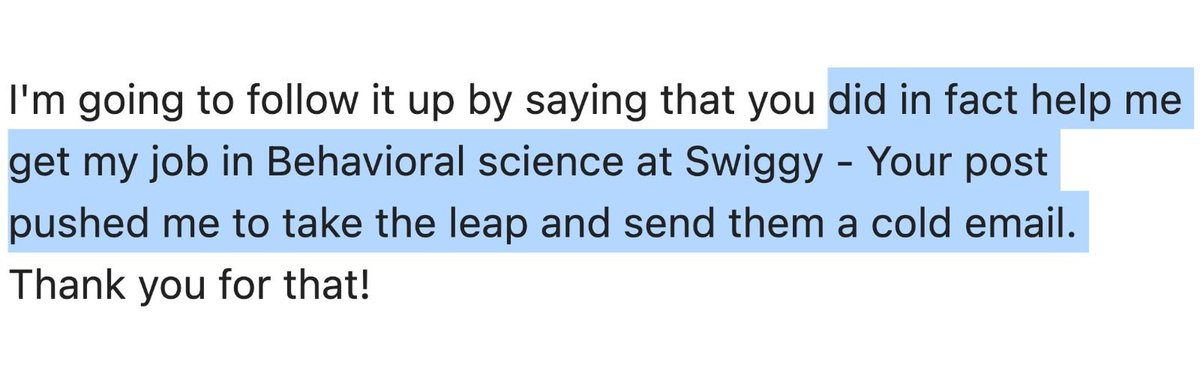
It’s so amusing (and fulfilling!) whenever I help someone achieve something I have not achieved (a Behavioral Scientist role at Swiggy)
Here’s why most of us don’t take the leap, two major reasons:
🚫 Reason #1: We self-reject (“I’m not good enough”) so we never even try to get better at skill X*
*Skill X could be anything….cold emailing, research skills, freelancing, etc.
Self-rejection is the top reason why students around me don’t apply for research internships (”I’m not an expert at research”)
I ask them that unless you try to get better at skill X,
How will you get better at skill X?
After (if at all) realizing self-rejection helps no one,
🚫 Reason #2: We try to get better at skill X, but it’s very rare that we “succeed” on the first try
Because failure is very common (and normal)
In fact, I’d call it a part of the process =)
But, when we “fail”, we feel like the outlier, that we're not "meant for this" or "good enough"
And we quit...
But we don't realize that feeling lost is very common, and that it's something EVERYONE goes through.
Fascinating stuff about human behavior as always:
Perceptions (I “failed” so I’m not good enough because other “successful” people don’t fail, so I quit)
vs Reality (I “failed” but I will get better if I practice more. After all, it’s what it takes to be like other “successful” people, so I continue)
If you’re:
• A Behavioral Science Founder / Head who fears self-promo as to not seem “salesy”
• a Student / someone Early Career who has imposter syndrome
I'd love for you to read my posts that helped this person take the leap
(It's NOT preachy stuff, just genuinely helpful resources, because I understand where you’re coming from)
After all, you could also receive a text like this from someone you helped =)
And to me, helping someone else succeed is just as fulfilling as achieving it myself.
My posts that helped this person take the leap are:
• How I avoid Self Rejection: https://t.co/CQGDgBoJb3
• How I avoid Self Rejection pt. 2: https://t.co/CN28FlBW2C
A cold message / email is how I landed my INR 1,40,000 ($7000 adj for PPP) per month remote roles and research internships at Cambridge, LSE, and Ashoka.
Here's how to write cold messages that convert (or at least cold messages that don't get ignored):
✅ DOs
• Introduce yourself
• Include a Call to Action
• Compliment the person
• Personalize the message
• Thank the person for their time
• Proofread the text before sending
• Research the person before texting them
• Be as specific with your queries as possible
• Follow up a week later if there’s no response
• Use bullet points and paragraphs wherever needed
❌ DON’Ts
• Be too friendly
• Follow up a few hours later
• Send inappropriate messages
• Text just “hey,” “hi,” “hello,” or “how are you?”
• Take it personally if someone doesn’t respond to your message
Cold messaging is a skill - it takes practice and time.
My first cold message/email wasn't perfect. I refined it over time.
Keep at it and you’ll be getting conversions in no time :D
To make it easier, you can get my exact cold email (refined after reviewing hundreds of my mentees' cold emails) at https://t.co/1VywSRrBeu
And, if you're looking to land a research internship (like I did!), I'll be launching a free 5-day email-based course on it!
Feel free to register for it at https://t.co/PabWmAUXx4