Good evening frens
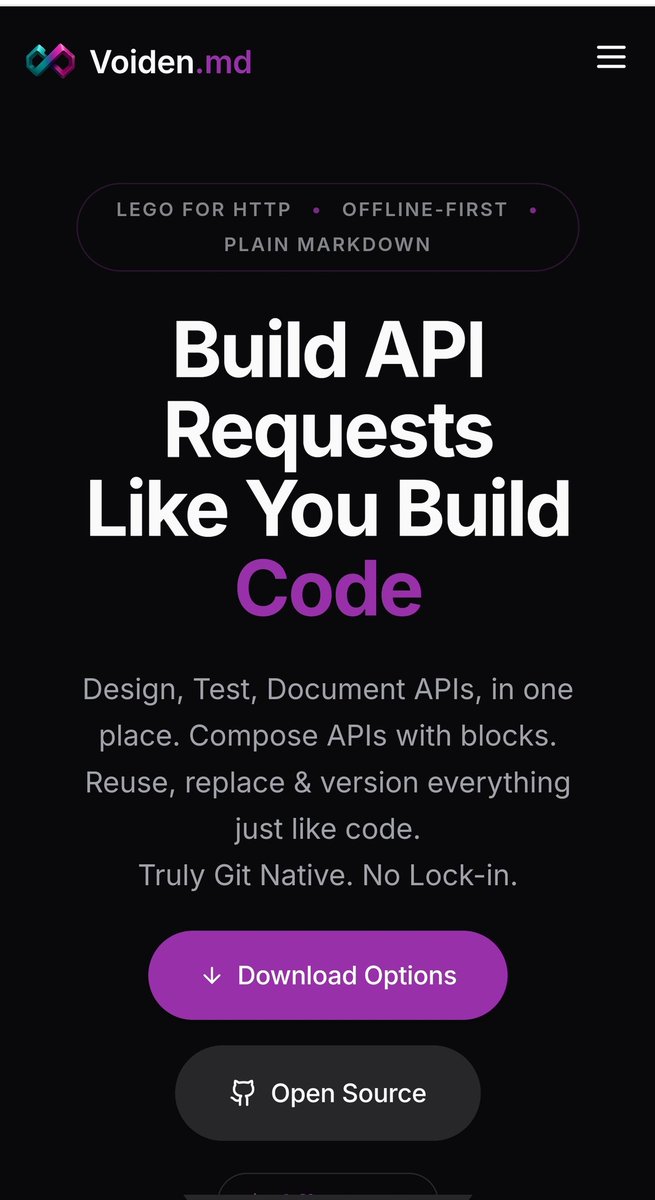
I recently explored @VoidenMD and I really like the idea behind it.
If you build APIs, you probably know the struggle of switching between different tools for testing, documentation, notes, and requests It quickly becomes messy.
@VoidenMD brings everything together in one place.
Instead of keeping your API requests in one app, your docs in another, and your tests somewhere else, Voiden lets you manage them together using simple Markdown files Since everything is stored like code, it's easy to organize, version with Git, and share with your team.
What also stood out to me is that it's offline-first and open source You don't need to create an account or depend on a cloud service just to work on your APIs.
If you're a developer, here's how to explore Voiden:
• Visit the website and understand the main workflow
• Download the desktop app for your operating system
• Read the documentation to learn the basics
• Open the GitHub repository to see the source code and examples
• Create your first API request in Markdown
• Try organizing endpoints, headers, authentication, and parameters into reusable blocks
• Connect it with Git to track changes over time
• Experiment with scripting using JavaScript, Python, or Shell for more advanced automation.
I enjoy discovering projects that solve real developer problems instead of adding more complexity Voiden feels like one of those tools worth checking out. I saw inside @myfanforce Spotlight
I spent some time exploring @apyhub today, and honestly, it’s much more comprehensive than I expected.
A lot of developers end up rebuilding the same things over and over again PDF conversion, OCR, file processing, validation, image analysis… They’re essential, but they rarely define what makes a product unique.
That’s where ApyHub stands out. Instead of stitching together dozens of services, it brings hundreds of APIs under one platform with a single API key. Even better, it’s built with AI agents and MCP compatibility in mind, not just traditional applications.
What caught my attention isn’t simply the size of its API catalog. It’s the philosophy behind it: developers should spend their time building features that create value, not maintaining repetitive infrastructure.
With over 200 APIs and 1,000+ endpoints, ApyHub already offers a solid foundation. Combine that with enterprise grade security, a unified subscription model, and an AI first vision, and it becomes a platform that’s hard to ignore.
As AI continues to evolve, I believe platforms that simplify integrations instead of adding more complexity will become increasingly valuable.
ApyHub is definitely one I’ll be keeping an eye on.
👉: https://t.co/UKZs82HpAc
This month, @apyhub turns five. 𝗪𝗲 𝗮𝗿𝗲 𝗺𝗮𝗿𝗸𝗶𝗻𝗴 𝗶𝘁 𝘄𝗶𝘁𝗵 𝘁𝗵𝗲 𝗯𝗶𝗴𝗴𝗲𝘀𝘁 𝗿𝗲𝗹𝗲𝗮𝘀𝗲 𝗶𝗻 𝗼𝘂𝗿 𝗵𝗶𝘀𝘁𝗼𝗿𝘆, the one that takes us beyond a traditional API marketplace. 🎂
Software is still written, but increasingly, it's composed. Assembled from existing capabilities, integrated by developers, and called by both applications and agents.
We founded @apyhub on that belief.
Today we are shipping our biggest release since day one. And it moves the platform in two directions at once: diversity and maturity.
🔹 𝗗𝗶𝘃𝗲𝗿𝘀𝗶𝘁𝘆. @apyhub is now open for providers to publish.
Point at your endpoint, review the docs we auto-generate, and publish. Raw API to monetized, discoverable product in under 10 minutes.
And through our native #MCP server, #agents don't get a static tool list, they search for the exact capability they need and call it at runtime.
🔹 𝗠𝗮𝘁𝘂𝗿𝗶𝘁𝘆. A platform others build on has to behave like infrastructure and infrastructure meets its users where they are.
So we added a US region alongside the EU. Your calls can now run closer to your apps, no plan change.
And we rebuilt the #apigateway for real workloads :spiky, parallel, one task fanning out into hundreds of calls. Those bursts now get absorbed, not rejected.
⭐ What hasn't changed is why we started:
- #Developers should spend their time shipping great software, not rebuilding the same plumbing over and over.
- #APIProviders should spend theirs building great capabilities, not running the business machinery around them.
200+ services. 1,000+ APIs. One subscription. All continuously monitored and maintained.
This is where modern software comes to call the capabilities it's built from. And it gets deeper every week.
Go see it. We think you'll feel the difference.
A big thanks for all the developers, users and customers who have been using @apyhub from day one. Their ideas, insights and suggestions have always been the main inspiration for whatever we build! 💛 💛
https://t.co/ylpTxec1XI
Most teams don't need more AI models.
They need fewer APIs to stitch together.
That's why platforms like @apyhub are interesting:
→ File conversion
→ Data extraction
→ PDF tools
→ Utility APIs
→ AI-ready workflows
Less time building plumbing. More time shipping products.
What API do you wish existed but doesn't yet?
10 open-source repos I’d test for marketing, content, and AI-product growth.
Not a random GitHub dump. The filter is simple: can this repo remove a real workflow pain or create a content angle people understand fast?
1. generalaction/emdash
https://t.co/ZxTvyLlRsC
Why: multiple coding agents need orchestration, not eight terminal tabs and hope
2. keploy/keploy
https://t.co/OtjRLyxkTb
Why: API tests are painful when mocks, traffic and real behavior live in separate worlds
3. rerun-io/rerun
https://t.co/ubFAkiXBdm
Why: robotics and multimodal systems need visual logs people can actually understand
4. VoidenHQ/voiden
https://t.co/u1IVhG9xhS
Why: API documentation and testing get messy when they are not versioned like code
5. langgenius/dify
https://t.co/U3ZtDIZRRh
Why: AI apps need workflows, data and evaluation, not just one more prompt window
6. Fincept-Corporation/FinceptTerminal
https://t.co/t8GT2ZLxSG
Why: internal dashboards should be faster to ship than a full custom app
7. lightdash/lightdash
https://t.co/HhYIrrVOyg
Why: business dashboards become slow when every metric needs a custom analyst pass
8. metabase/metabase
https://t.co/gllikXmtqf
Why: teams need answers from data without turning every question into a data-team ticket
9. koala73/worldmonitor
https://t.co/cu334Jf6Pm
Why: news and global signals become hard to track when everything is scattered across random feeds
10. usebruno/bruno
https://t.co/2ODCUUrgwO
Why: API testing should not turn into a whole separate SaaS universe
Which one should I break down first?
one thing I've stopped doing is rebuilding utility features that already exist
Recently I was working on a small tool that needed to generate PDFs from dynamic data
my first thought was the usual route: find an open-source library, deal with dependencies, spend time fixing formatting issues and hope it works consistently across environments
instead, i tried @apyhub's PDF Generation API
a single API call turned structured data into a ready-to-use PDF, and I was back to building the part that actually mattered
that's what i like most about ApyHub
it doesn't try to be another all-in-one platform
it's simply a curated collection of APIs for the boring but necessary tasks every developer eventually runs into, PDFs, QR codes, data formatting, image utilities and dozens of other common workflows
those features rarely make your product unique
they're just things you need to ship
i'd rather spend my time building the product's core experience than debugging utility code for hours
it's a small mindset shift, but it makes a huge difference when you're trying to move fast
if you're building side projects, internal tools, or SaaS products, ApyHub is worth checking out. less time reinventing utilities means more time shipping
I used to think generating PDFs was one of those small features I'd "build later."
Then I actually tried doing it from scratch.
Templates, formatting, edge cases... it quickly became one of those tasks that steals hours from the work that really matters.
Instead of reinventing it, I tried ApyHub's PDF Generation API.
A few API calls later, I could automatically generate clean PDFs for reports and documents without maintaining another custom solution.
That meant less time debugging formatting issues and more time building the features users actually care about.
TL;DR: Sometimes the fastest way to ship isn't writing more code, it's using the right API for the job.
If you're building apps or automation tools, ApyHub is worth exploring: https://t.co/jGTJ2PRp4s
@apyhub
Curious to see how else I can simplify repetitive backend tasks with their APIs.
link preview cards look like a frontend feature.
they're not. it's your server downloading whatever strangers paste into a text box. internal IPs included, if you're not careful.
we built an endpoint that does the fetching for you, metadata plus a flag if the URL's been reported malicious. one POST, render the card, your infra never touches the link.
available at @apyhub