Creator of ACKS and Ascendant. Amazon #1 bestselling author & DriveThruRPG #1 bestselling game designer. Founder and ex-publisher of The Escapist (2005-2017).
Playing Call of Cthulhu and all of the PCs are avoiding reading any in game material in order to avoid SAN loss. “Knowing is half the battle so by not knowing we bypass half the battle…”
As a lifelong fan of the books and movies, I am pleased with this choice. There were many far worse options being fielded. Pattinson is a fine actor who looks like Bond as described in the books.
Seriously, waiting for the campaign to end is Adventureless, Conquerorless, and Kingless... and that makes @archon sad. 😢
Back it now instead!
https://t.co/BtvcT14pQY
It’s my opinion based on my observation. I see them as commonplace in our system, and think most can’t be easily fixed. A specific example would be energy infrastructure where EROEI has declined to where we need the complex energy infrastructure to be sustained because there’s little easy energy left to rebuild it with if it breaks down.
I'm about to propose a term for a dangerous failure mode that every software engineer should be thinking about today. And another for its consequences.
Hot-state dependency: A condition in which a system's ability to function depends on organizational relationships, accumulated state, or operational knowledge that exists only in its current running configuration and cannot be reliably reconstructed following interruption.
Yes, I'm thinking about the Microsoft cloud outage that's going on right now. It could be recoverable, still most likely is, but it could also be the harbinger of a new category of systemic disaster.
Heat death: What happens when a system with hot-state dependency crashes and can't be recovered.
The obvious next question is: how do you engineer systems so as not to have any hot-state dependencies?
I don't have a complete answer to this. But I can think of a necessary part of the answer that I don't think we're taking seriously enough: unitary, replayable modification logs analous to version-control change histories.
It should be impossible - it should be an invariant of your system design - to change the state of the system without leaving a sequenced record of the change that can be audited by human and replayed in a future restart sequence.
This doesn't solve the whole problem. In particular, in a cloud-service infrastructure you don't have the option of resetting all your physical wiring changes and hardware deployments to a zero state and then replaying them.
But I guarantee you that in any sufficiently large or complex software system, you will eventually develop a hot-state dependency purely on the software level if you don't have replayable logs. So that's the minimum you have to do. The absolute dead bare minimum.
We haven't known this before because it took some time for our systems to evolve into the complexity regime where heat death is a critical risk.
But we are here, and the time is now. Be appropriately warned.
Please join Baen in congratulating Baen cover artist Larry Elmore!
Each year the Kentucky Arts Council coordinates the presentation of the Governor’s Awards in the Arts, which recognize individuals and organizations who have made extraordinary and significant contributions to the arts in Kentucky.
Larry Elmore was awarded the National Award at the ceremony held November 10, 2026. He is an internationally acclaimed fantasy artist and illustrator whose imaginative work has helped define the visual landscape of fantasy literature, gaming, and popular culture. A native of Grayson County, Kentucky, Elmore is best known for his iconic illustrations for Dungeons & Dragons, including the celebrated Dragonlance series, which introduced his distinctive art style to audiences around the world.
Throughout his career, Elmore has created artwork for books, games and publications, bringing fantastical worlds and memorable characters to life through his detailed paintings and storytelling. His work has inspired generations of artists, writers, and gaming enthusiasts, earning him a lasting place in the history of fantasy illustration. Through his extraordinary creativity and artistic achievements, Elmore has brought international recognition to Kentucky’s rich tradition of visual storytelling.
Read more at: https://t.co/uSup20xjVd
#BaenBooks
Thanks to everyone who is Liking, Sharing, and Donating to, Luke's fundraising project.
The fundraiser for the family is going strong and about half way there.
We're praying and sending good energy their way as they work through a tough time.
For those who do not know who Malia and Luke are, Malia is Dave Arneson's daughter, Luke is her husband. They've been together since they were teens.
These are good friends of ours.
Thank you so much for Sharing the links to the Fundraiser, and also for making Donations.
I know some of you can't donate a lot. Yet, you took the time to go read and donate what you could - You made a difference. ❤️
Thank you everyone!
Chris and Griff
https://t.co/C7V5k4LkcE
@esrtweet You have done a great job at it. Your essay on Gramscian Damage is another example where you named something that was real but unidentified before you. (Longtime ESR blog reader.)
@Messerschmied14 What?! don't have any reason to believe Discord member JenseniusH is an insider trader, he's just a loyal member of the Auran Empire as evidenced by his Auran name
A guy on my ACKSII discord shorted NVIDIA shares two weeks ago. I can't fathom how many gp he earned. Some people are Venturers for one session a week but for others it's a 24/7 LARP...
There exist about 50 years of surviving accounts from the Medici Bank. The average return was ~22 percent. The Medici had a privileged position with the Papacy, but even when their profitable Roman branch is excluded, they do still ok: ~15% in an economy growing at a rate of 0.0.
A faster way to get to the same understanding is to examine interest rates. For a venture to be worthwhile it should bring at least the same return as lending. Before the 13th century European rates were 20-25%; by the standards of many early modern Asian countries that was low.
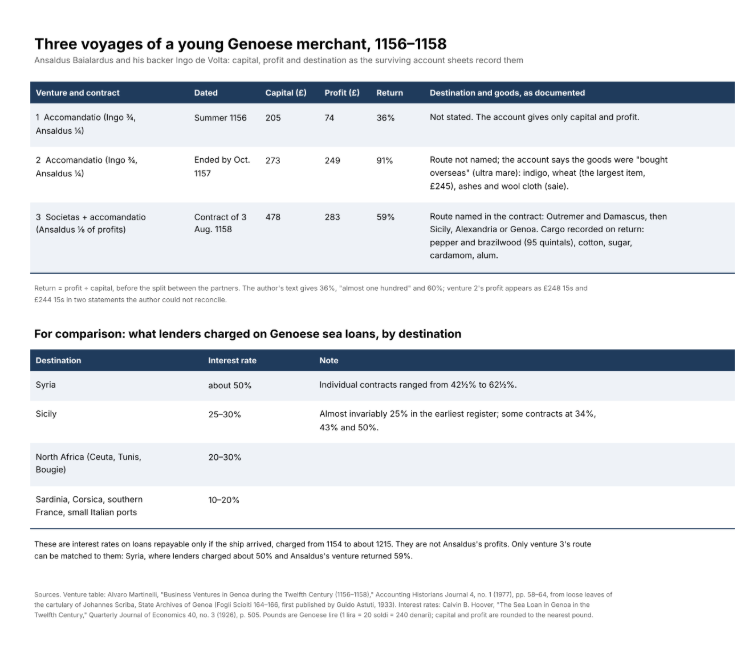
The earliest Genoese notarial records show three minimum profits for a merchant: 36, 91, and 59%. The repayment given for sea loans are another clue to expected profit: in good weather it took only a week to go from Genoa to Sardinia, but lenders expected at least a 10% return.
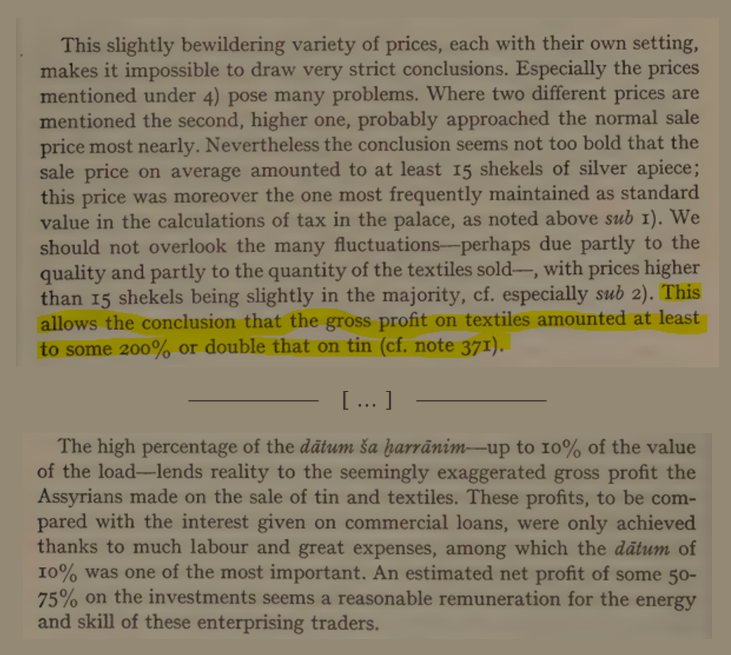
But surely these figures are cherry picked? What if we go hunting for profit margins in random firms? The earliest surviving merchant records anywhere concern Assyrians exporting textiles and tin to Anatolia, a distance of ~700 miles. Their net profits were ~ 50-75%.