Our bi-annual roadmap update is here.
H1 2026 highlights: stack-too-deep is fixed in the SSA-CFG pipeline (under --experimental), debugging infrastructure work has ramped up significantly, and both act and Fe shipped their first releases after extensive rewrites.
More detail below ↓
Ethereum security cannot only depend on finding bugs after the fact.
This Thursday, TheDAO’s Ethereum Security Space is back to talk formal verification, and how proving critical code behaves as intended can help make Ethereum safer.
Join us ↓
https://t.co/8LcX4MjD9d
Fe 26.3 is here! 🧵
First-class memory pointers, new array and ERC-20 helpers, important compiler fixes, and foundations for source-level debugging.
Here’s what’s new 👇
Onchain security is everyone’s problem and nobody’s job.
ETHSecurity Initiatives is how we are changing that.
Propose the work. Fund the work. Build the work.
https://t.co/3uj1FmFLNb
Onchain security is everyone’s problem and nobody’s job.
ETHSecurity Initiatives is how we are changing that.
Propose the work. Fund the work. Build the work.
https://t.co/3uj1FmFLNb
I'll be presenting some of the exciting things we're working on for Solidity at @CryptoCanal on Saturday.
If you're hacking there and want to try some bleeding-edge things, let me know, and I'll set you up!
L2BEAT has verified ~1000 smart contracts on @SourcifyEth 🤝 The biggest Solidity contract open database just became richer with actual contracts used in L2 projects and bridges.
Do I know anyone here working on any Ethereum wallet?
We are working hard on ERC7730 Clear Signing. We need more eyes and feedback on what we are working on and see how it fits your wallet. Software or Hardware.
RTs and interactions appreciated 😇
If you want to get more insight into the work they've been doing on Clear Signing watch the full talk from BBW 2026 hosted by @BerlinMeetup here ↓ https://t.co/Ypf5ayYMPB
Time for a Sourcify update because @SourcifyEth has been busy!
Over the past months the team has turned into a true Swiss army knife, touching multiple corners of the Ethereum ecosystem at once.
Throughout the first half of the year they have been supporting the Clear Signing working group by building an SDK to help wallets fight blind signing, collaborating with @growthepie_eth on making ecosystem value flow easily visible, and more recently they've been supplying @ethlabs_org with data to assess how 'Quick Slots' would impact deployed contracts.
All of this builds on their consistent work of verifying and maintaining an open source database of currently 43.5M+ contracts across 260+ EVM chains.
Who will we meet in Amsterdam?
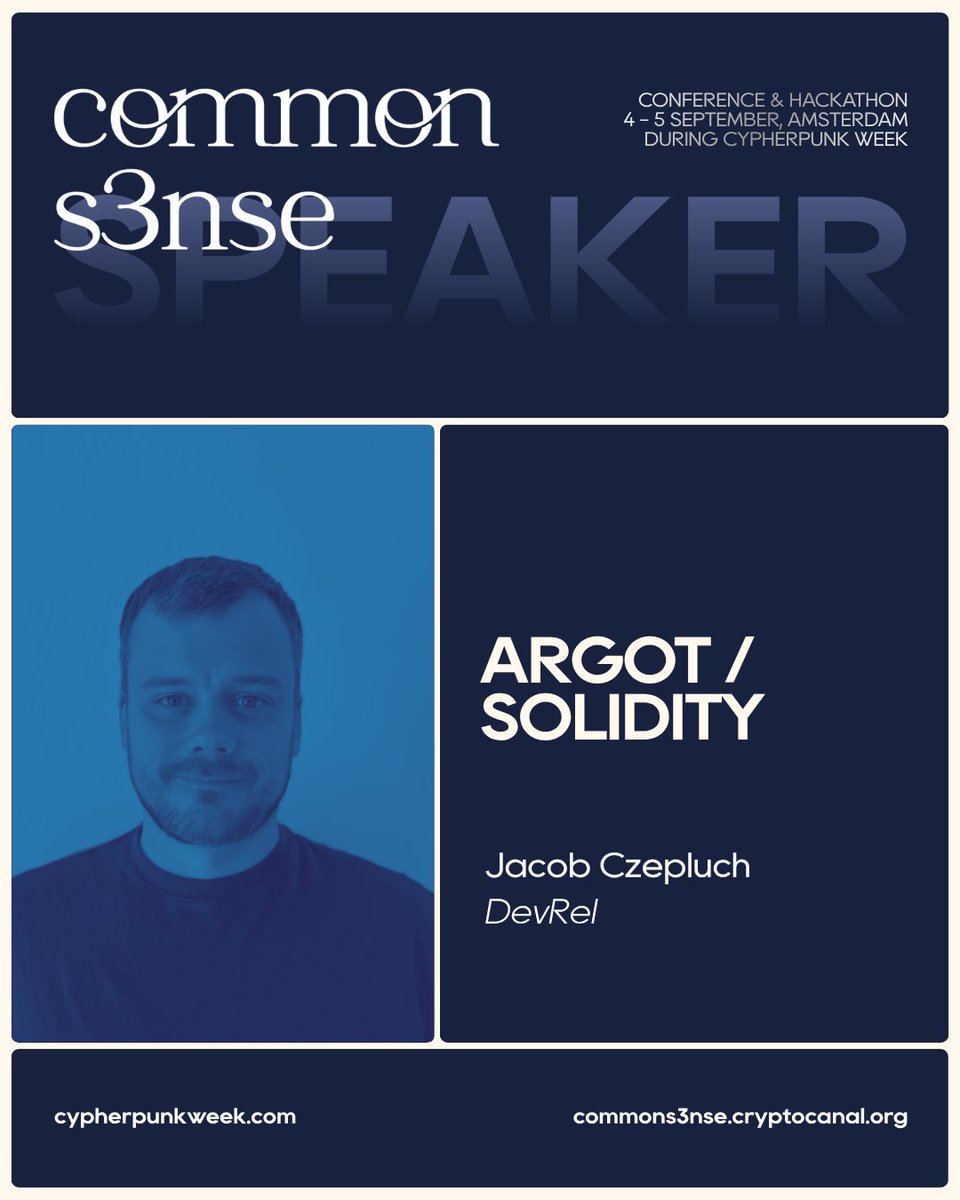
@_czepluch will talk all things @solidity_lang during Cypherpunk Week in Amsterdam in September and hopes to see many of you there! ↓
What's next for Solidity?
@_czepluch from @solidity_lang, joins the Common S3nse stage to walk us through where the language has been and what's coming next.
Privacy • Security • DeFi
📍 Amsterdam
📅 September 4-5 (during Cypherpunk Week)
Formal verification is getting a lot of attention and there are many ways to approach it. Alongside the recent EquiVM release, there's other FV work happening at Argot, including act.
act is a formal specification language with a range of capabilities, one of which is proving that EVM bytecode matches a human-readable spec. Think of it as a way to mathematically guarantee that a contract does exactly what it claims to do.
Building under one umbrella means our work streams reinforce each other. We collaborate across teams from the start and apply our tools wherever they add value. Two recent cases with @solidity_lang and @official_fe show what that looks like in practice.
Example 2: Fe
Since Fe encodes storage similarly to Solidity, act can verify Fe compiled bytecode directly. We wrote a simple contract containing mappings and wanted to verify it against its act spec. act flagged a discrepancy in how Fe handled those mappings: dynamic sized copies were adding unnecessary complexity. The Fe team resolved it in their 26.2 release. Bytecode and spec are now equivalent.
🔗 https://t.co/S6LBBUZMN6
You still don't know what formal verification is and at this point you're too afraid to ask?
Anja has got you covered. At @EthPrague she gave a workshop explaining what FV is and how she and the rest of the act team approach it.
Full talk in the link below 👇
EVM formal methods are hot right now🔥just added multiple bangers here:
- equiVM by @argotorg
- evm-asm by @pirapira@dhsorens
- evm-sail by @TauLepton_
- {evm,yul}-semantics & verified yul-c by us @powdr_labs
https://t.co/Z7cjvSv7dd