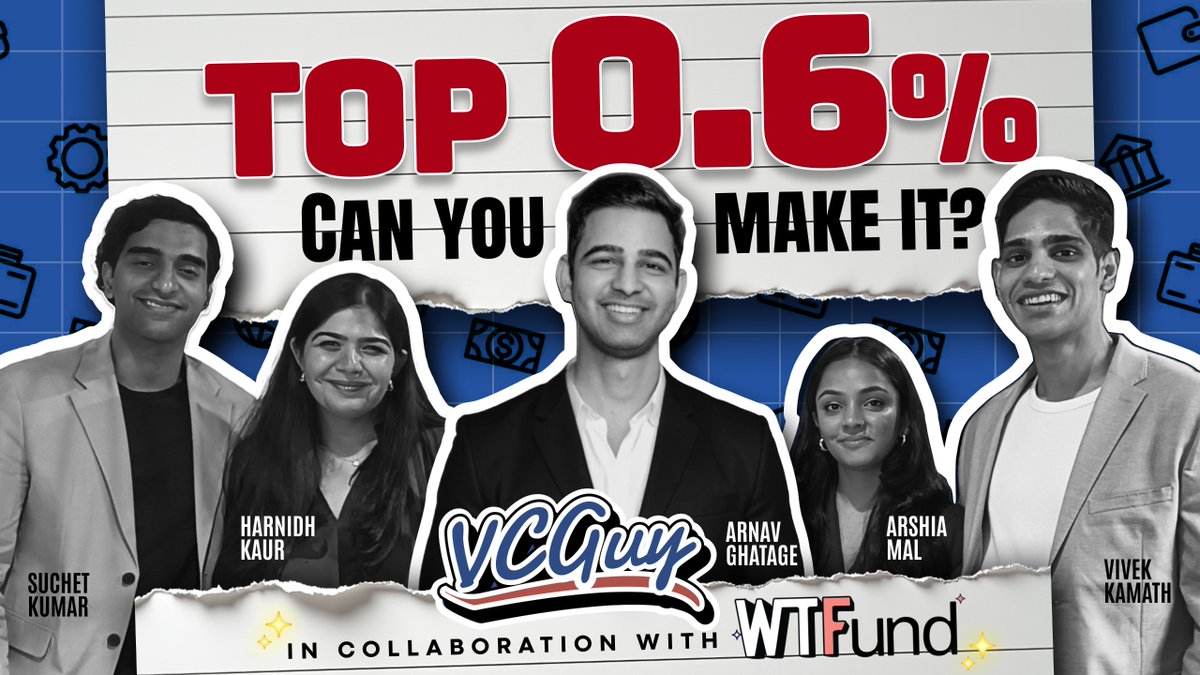
A few months ago, @nikhilkamathcio launched India’s first non-dilutive grant for founders 25 and under: WTFund.
1,500+ applications. 160 shortlists. 15 founders. 9 companies. That’s cohort 1.
Applications for Cohort 2 are live now, with the deadline on Oct 15th.
I had a super discussion with the WTFund Team to understand what they’re really looking for. We’ve also discussed some of the common questions founders like yourself may have.
@Suchetkm@harnidhish
Let’s take a look 👇🧵
A close friend is hiring and it's a genuinely good seat.
30-year-old Pune broking firm. 31k clients, NSE/BSE, real regulatory weight. Plenty to own, not just learn.
Experience: 6-10 years
Location: Pune
Check out the JD below⤵️
Email Sarthak directly - [email protected]
Why should America sell chips to China?
Came across this very interesting debate in which Jensen advocates about why NVIDIA should sell chips in the 2nd largest market in the world and forcing China into building an alternative ecosystem for their stack would be a huge mistake.
Apple charges ₹5k for a silicone case. Samsung's official covers are ~₹3-4k.
Most people aren't paying that, esp. in India.
Spigen gave people the same protection, better designs, at ₹1-2k.
They found the 'sweet spot'. Premium quality without the premium phone brand tax.
Even if you can sell only in India, there's a good business to be built.
⏭️Premiumization is real. More people buying expensive phones = more people willing to pay for good protection.
Millions of iPhones, Samsung, and OnePlus devices are sold in India every year.
But the phone accessories market - covers, screen guards - is dominated by two foreign players: Spigen (South Korean, listed, $350 M revenue) and ESR (Chinese).
India is the world's second-largest smartphone market, yet we don't have a single large Indian brand in accessories.
Opportunity seems 'very real' to me → Build a global phone accessories brand from India. Made in India, for India and the world ⤵️
If you look at Amazon/Flipkart, most brands are just white-labelling Chinese products.
But someone dropping ₹50k-₹1.2L on a phone likely isn't going to cheap out on ₹1-2k for a decent cover.
That's exactly where Spigen and ESR sit.
For delivery, only two metrics matter: ratings and prep time (give you a better placement/ranking on Swiggy and Zomato).
Bert's POV was 'I can either pay Swiggy/Zomato for visibility, or pay my staff for performing on those two metrics. We chose the latter.'
Both metrics improved overnight. Attrition dropped significantly.
⏯️Elevation Capital put in ₹120 Cr at a ₹500+ Cr valuation. CB also has Ajay Kaul (ex-Domino’s India CEO) as an advisor and backing from Kumar Vembu (Zoho founder’s brother).
Aiming for 300 stores by 2030.
A 22-year-old American music student moved to India with $250,000 to sell Mexican food.
In 2012, we barely had any Mexican food joints.
At present - the business operates 100+ outlets across 5 cities with ₹196 crore in revenue.
Elevation Capital just invested ₹120 crore, and Jubilant (Dominos) almost bought them over.
Here's the fascinating story behind California Burrito⤵️
The founding team didn't last. After, Hollywood actor Gaelan Connell left in 2014, Second co-founder Dharam Khalsa left in 2020 to start his own venture.
Bert became sole owner and committed: 'India feels like home. I'm staying.'
CB's strategy has been very selective and focused -
⤷ Duplicate successful stores in the same city before expanding to new locations.
⤷ Franchise requests poured in, but they have consciously stayed company-owned (maintain quality + customer experience)
⤷ Very particular about the real estate they choose
In a talk at Mesa Business School → Bert spoke about giving every employee true ‘skin in the game’ and his approach was very different ⤵️
⏯️Fun story: Sunil Gavaskar had a weakness for Parle-G, often carried Parle-G on overseas cricket tours. His family even sent more packets via travelers when he ran out.
Indians consume 4,500 Parle-G biscuits every second.
Parle did ₹17,223 crore revenue with Parle-G alone contributing ₹8,000 crore - nearly half their business from one product.
The Chauhan family turned a ₹60,000 investment in 1929 into the World's largest biscuit brand by volume.
Parle-G’s 25-year price freeze for it's ₹4 pack is well known, but there's more to the business than meets the eye⤵️
Parle has a multi-generational capture strategy, simply meaning -> there's a biscuit for all ages.
Parle-G: The grandfather's chai companion - simple, trusted, unchanged since 1939
Monaco: Tea-time favorite for grandmothers - 'multipurpose biscuit' marketed since 1958
Marie: Digestive biscuits for health-conscious mothers
Hide & Seek: Premium cream biscuits targeting teenagers and young adults
KKR's India CEO Sanjay Nayar is super bullish on Indian healthcare, and the numbers back him up:
a). Top 9 listed hospitals are doing 22-23% operating margins in FY25. That's better than most developed markets (mid-teens).
b). Specialty services like Oncology and high-complexity treatments drive up both revenue per bed and occupancy.
⏯️India's healthcare is underpenetrated, margins are structurally higher than global peers, and there's clear exit visibility. Classic PE playbook in a growing market.
Indians spend $282 per person on healthcare vs $13,433 in the US.
4.2x the population, 1/47th the spending per capita.
With healthcare spends likely to rise, KKR has deployed $1.1 billion across India's hospital sector, building the country's largest PE healthcare portfolio.
India also became the largest PE healthcare market in APAC last year. A few takes on KKR's India healthcare thesis ⤵️
KKR's has a strong track record in this section -
→ Max Healthcare: 5.6x return in 4 years, $1.6B exit value
→ JB Chemicals: 3.4x return, $1.4B exit to Torrent
A growing consistent portfolio in healthcare
a). HealthCare Global (HCG): Controlling stake for ~$400M; oncology platform expansion approved by CCI
b). Baby Memorial Hospital (BMH): ~70% controlling stake; Kerala platform anchor
c). Meitra Hospital: Majority stake via BMH; ₹1,000–1,200 Cr valuation; KKR’s 3rd Kerala deal
d). Manipal Group: $600M financing to support expansion of hospitals and education assets