Reading through the @arrayfire source code to learn how to juggle between multiple compute backends and I'm having a blast. Code is well-formatted and well-documented and it's quite easy to just 'follow along'. Bravo @arrayfire team!
Today, we are celebrating 10 years of open source!
Thank you to all the ArrayFire developers and users over the years. It's been an incredible ride. And we're working on our best release yet, coming soon :-)
QF Foundation's first paper explores GPU acceleration for primitive operations in Substrate-based blockchains, marking the completion of phase 1 for team 2's roadmap.
Key findings:
-Implemented GPU acceleration using WebAssembly and arrayfire-rust
-Achieved 2-3x speedup for basic arithmetic on large datasets (1M float operations)
-GPU: 0.38-0.50ms vs CPU: 1.15-1.85ms average execution time
This research lays groundwork for GPU-accelerated smart contract execution and introduces potential for dynamic CPU/GPU operation balancing. It aligns with our broader goal of revolutionizing blockchain performance through advanced parallel processing.
Next steps include exploring more complex GPU-accelerated operations. Our work with PolkaVM promises even greater efficiency gains beyond WASM.
Want to explore the code or dive deeper?
Read the full study: https://t.co/pTihxqu9B3
Run the code yourself: https://t.co/GqsrDvtJFT
See what was implemented: https://t.co/frmN8kIIML
With over 500 papers on Google Scholar using ArrayFire, here are some of the amazing things you have built because GPU programming is a little easier with a higher-level array API,
https://t.co/lfV7ENynOx
An exciting step towards open standards and ecosystems in GPU computing.
Download ArrayFire v3.9 today, which includes a new SYCL (oneAPI) backend, https://t.co/urRS4E3KNY
We are thrilled to announce the launch of the UXL Foundation, a cross-industry group committed to delivering an open standard accelerator programming model that simplifies development of performant, cross-platform applications.
Announcement: https://t.co/dHOVkkrFxC
#uxl#oneapi
**New ArrayFire v3.9.0 Release**
We are excited to announce a major release to ArrayFire, including a new oneAPI backend for greater flexibility and commitment to open GPU and XPU computing standards.
Binaries and source code are available for download.
https://t.co/CA8C1vm7CQ
With big data comes big resource usage. Natan Biesmans & G²CPU bring high-performance computing directly to your #LabVIEW environment and GPU or CPU. Learn all about the parallel might of @arrayfire, #CUDA and #OpenCL at #GDevCon next month in Glasgow! https://t.co/tNWWYxL1u4
*New Blog Post*
"Reconstruction of 3D Phase Contrast Atomic Electron Tomography using ArrayFire"
by researchers from UC Berkeley and Lawrence Berkeley National Laboratory.
Enjoy!
https://t.co/gwB5sOL1BK
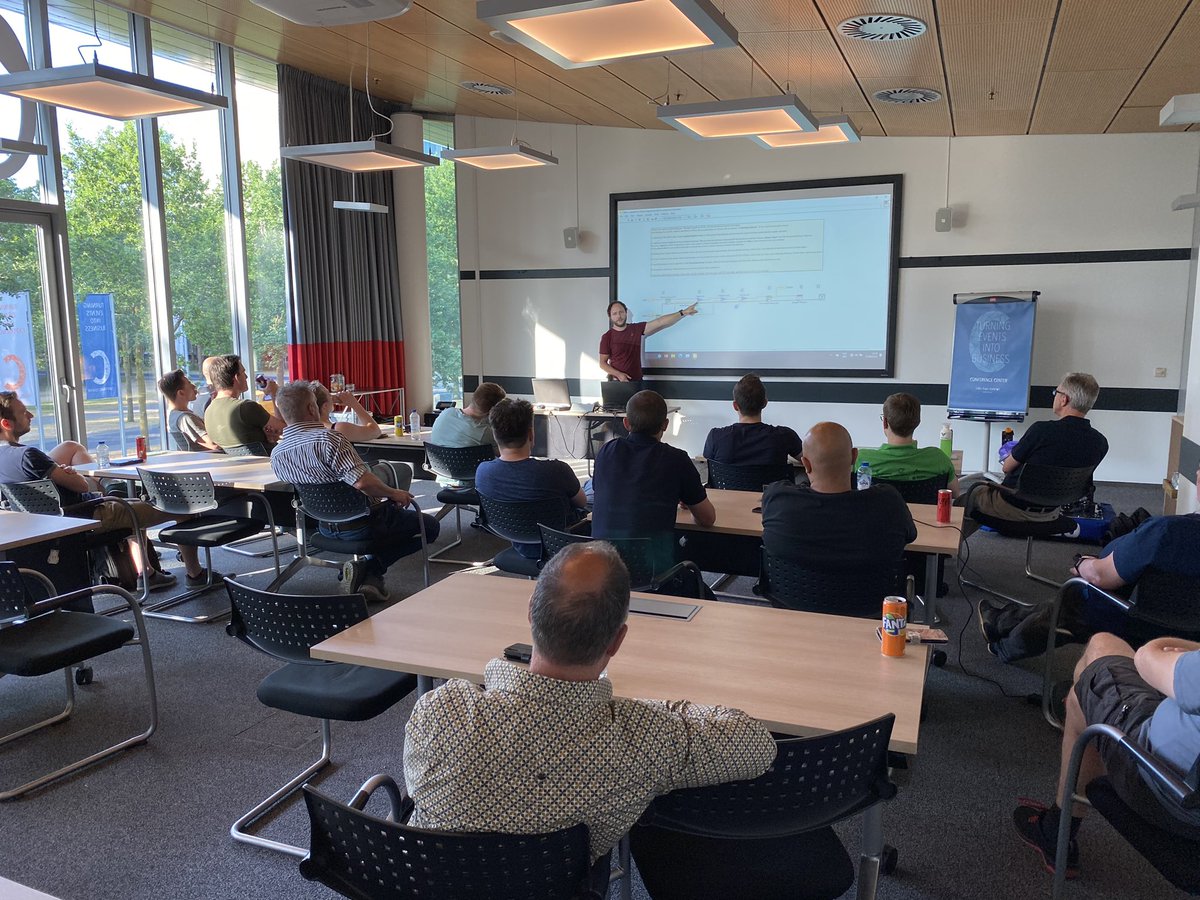
Getting an update on #G2GPU from Natan Biesmans at the Dutch LabVIEW User Group meeting today. A library in the making to make using ArrayFire in #LabVIEW a breeze!
#dutlug#labviewfriends
*New Blog Post*
Parallelization of FOAGDD (First-order Anisotropic Gaussian Direction Derivative) Point of Interest Extraction
by Gustavo Stahl from São Paulo State University in Brazil.
Enjoy!
https://t.co/AtBHk20X3W
Previous blogs in this series include:
1) What is a Quantum Computer?
https://t.co/g9ZfhI5pHI
and
2) Quantum States vs. Classical States
https://t.co/0zUVlRQjwM
Thanks to Edwin for these posts!
New blog post today from our series on quantum computing:
"How does a Quantum Computer work?"
These are related to the ArrayFire Quantum Simulator.
Enjoy!
https://t.co/IRuMNp7UdG