Observers representing a large panel of space instruments involved in dust observations and modelers working on the major climate models sat together to discuss current challenges, actions to be taken and recommendations to support to improve our understanding of the Martian dust
This week we got the pleasure to organize an international workshop on the radiative properties of Martian dust aerosols at @IRAP_France in Toulouse. Thank you to the 20+ researchers that came to exchange on this topic in a round-table format!
#Mars#workshop#science#dust
A very nice week at EPSC 2024 in Berlin ! 🪐🥨🇩🇪 Full of planetary science and amazing people! 😊
Thanks for giving me the opportunity to prensent my work on Martian nighttime CO2 frost observed with EMM/EMIRS 🛰
@europlanetmedia@epec_epn@HopeMarsMission@IRAP_France
I'm happy to announce that my last paper on the OMEGA-Py module has just been published in the @JOSS_TheOJ : https://t.co/zc2QzLoeHO
🥳
This is a new complete Python solution to access data from the OMEGA instrument onboard Mars Express spacecraft @esa#mars#science#python
Une grosse pensée aux équipes de DORN de l'@IRAP_France et du @CNES pour le décollage dans quelques minutes de Chang'E6, direction la face caché de la lune. 🤞
Le lien pour suivre le décolage : https://t.co/8f153sX88m
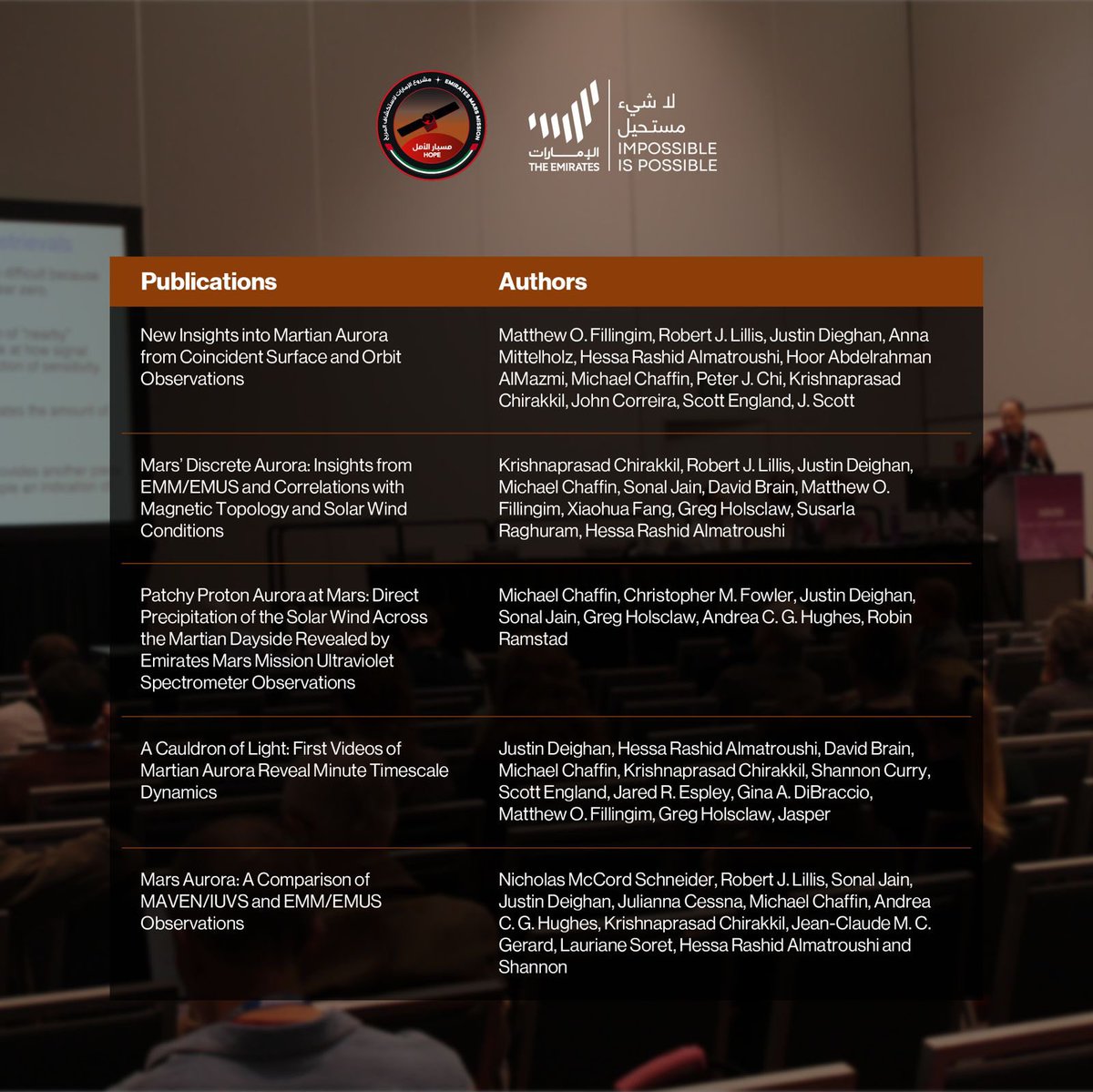
Thrilled to be part of this scientific journey, the Emirates Mars Mission proudly contributed to the 2023 Annual AGU Meeting, garnering 22 submissions.
#HopeProbe#AGUFallMeeting
The AGU (American Geophysical Union) Fall Meeting, a premier platform for advancing Earth and space science, brings together over 25,000 participants from diverse corners of the globe.
Using the unique temporal coverage provided by the specific orbit of the EMM Hope probe, we have been able to monitor for the first time the apparition and disappearance of low-latitude nighttime CO2 frost as a function of the Martian local time.
EMM’s science team held the annual Fall Science Team meeting in Dubai with the participation of faculty & students from UAE universities on Nov. 6th - 8th with the aim of sharing updates on the status of the mission’s instruments, science, & data, & fostering closer collaboration
Plus, from this version 3, the module has been officially validated by the instrument team and is now part of the OMEGA/MarsExpress ecosystem! 💫 @esaoperations@esascience @IASorsay
I'm happy to announce that OMEGA-Py v3.0 is now available on GitHub and PyPI at https://t.co/1mj7E6vZhd! 🥳
And it comes with a new and complete online documentation at https://t.co/74wNCKZffq 😎
#OMEGA#MarsExpress#Mars#Python#software
Using the unique temporal coverage provided by the specific orbit of the @HopeMarsMission probe, we have been able to monitor for the first time the apparition and disappearance of low-latitude nighttime CO2 frost as a function of the local time 👇
@NAU @NAUResearch
My last paper has just been published in Geophysical Research Letters @theAGU: "Diurnal and Seasonal Mapping of Martian Ices With EMIRS" using data from @HopeMarsMission! 🥳🛰️❄️
It's open access, check it out here: https://t.co/m00WrNWXIi
#Mars#Surface#ice#research#article
#OTD 1 May 1682, the Paris Observatory was inaugurated by Louis XIV @Obs_Paris is one of the largest (and THE oldest still active 😉) astronomical centres in the world 🔭 @ESA_fr 👉 https://t.co/YJOOwZb9wy
Very nice week at the #EGU23 in Vienna! 😊 Second time presenting in this conference, last time it was in 2019 during my 1st year of PhD. Still a pleasure to be there.
Amazing science and EMM special session, and so nice to see some colleagues and friends again. 😃💫👨🏫
@HopeMarsMission science team has unveiled a series of unique and ground-breaking observations of Mars’ smaller moon, Deimos, using all three of its science instruments to ‘advance our fundamental understanding’ of Mars’ most mysterious moon.