I often see Nik Airball needling players for being tight. That got me thinking.
Streamed cash games have a weird incentive problem. The structure of the game typically rewards tight play, but an entertaining show demands action. So players are socially pressured to give up EV and play looser to preserve their invite.
But that's dumb. Don’t guilt players into punting. Instead, build a game where the optimal strategy is splashy.
So how does one design a splashy game?
First, toss the rake. Timed rake or no rake will obviously play wider than a traditionally raked game.
Second, toss the blinds. Contrary to popular belief, adding blinds makes optimal strategy tighter, not wider. So throw out the straddles. In fact, throw out the SB while you're at it. One blind is all you need.
Lastly, add a FAT ante. One player posting 1bb + 3bb ante is more than enough to make the optimal strategy very splashy. Plus it preserves stack depth (compared to straddles), so you get deeper more interesting battles.
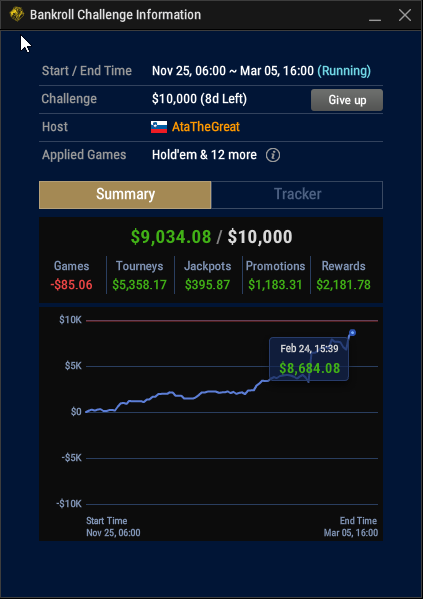
The $1k → $10k challenge ran from November 25, 2025 to February 25, 2026, with a total of 106,000 hands played.
97,000 hands came from NLH cash games between 10NL and 100NL
9,000 hands were played in tournaments with buy-ins ranging from $8 to $108
WSOP Super Circuit Online schedule is now live.
$180,000,000 USD Guaranteed. 18 Rings. One series.
Event Schedule: https://t.co/zbp4yO9Flm
Full Series Details: https://t.co/6QCxjg0R1i
The “poker as academics/math” frame = suicide (literally)
Poker isn’t a math hobby. It’s a high variance money game that psychologically destroys anyone who can’t deal with variance. Most nerds are neurotic and can’t handle the swings, even if they understand variance logically. So you end up recruiting a bunch of nerds who aren’t built to gamble and they end up in a padded room if they don't off themselves first. No bueno.
If we want poker to grow, education probly comes later. First target people who can survive variance.
That’s basically two groups:
1. People rich enough that the swings don’t matter.
2. People with legit high risk tolerance.
And most of those people don't care about the math.
Before I play, I run a quick check-in: sleep, feeling, motivation, cognition.
Even when it’s sleep 10/10 and cognition 10/10, I don’t assume I’ll play great.
It just means the tools are there, the only question is where I spend my attention.
Sometimes this happens: you finish a week and can’t even tell if you improved.
The reason is usually simple - no specific plan on how to improve.
Ok, it happened. Next week, fix the plan instead of hoping progress just shows up. 🚀
My best sessions have a specific vibe: no distraction and emotional resilience.
Nothing upsets me.
I accept mistakes, and I keep trying to play my best, hand after hand.
Exploitative players tend to have better A-games but much worse C-games compared to GTO players.
Pure exploit players struggle with consistency because they don't have a good autopilot to fall back on when they're read-less or not locked tf in. Without a decent baseline strategy, most people just button click aimlessly.
The only way to solve this is to build a systematic (non-GTO) framework for beating your player pool, but that requires a level of study and discipline that most players simply aren't willing to commit to.
I’ve learned the hard way: feeling “very good” can still produce B-game poker.
Mood can be high while decision quality is low.
The real test is what happens inside the tough spots.
🚨 LIVE NOW ON TWITCH! 🚨
Grinding the $1K to $10K Bankroll Challenge – highs, lows, and big plays incoming! 🔥💰
Come watch the action, chat, and root me on!
👉 https://t.co/6eK9qArFZc
#TwitchStream#Poker#BankrollChallenge#LiveNow
Streaming poker taught me:
- You can’t fake emotional control.
- Every bad beat is public.
- Every decision is recorded.
Growth starts when you stay disciplined even while everyone’s watching 🙏
I’m entering 2026 with fewer expectations and higher standards.
I don’t need every session to be good. I need my process to be solid.
Studying more. Tilting less. Quitting sessions earlier when focus fades.
That’s where real money is made.
Every session feels important, but almost none of them matter alone.
Poker is won in aggregates, not moments.
The players who understand this last the longest and win the most.