The Atlas public testnet is now live!
Atlas is the blockchain for verifiable finance.
It’s built for financial applications that need the performance of traditional finance and the transparency of DeFi.
Atlas has best-in-class tooling for an improved developer experience.
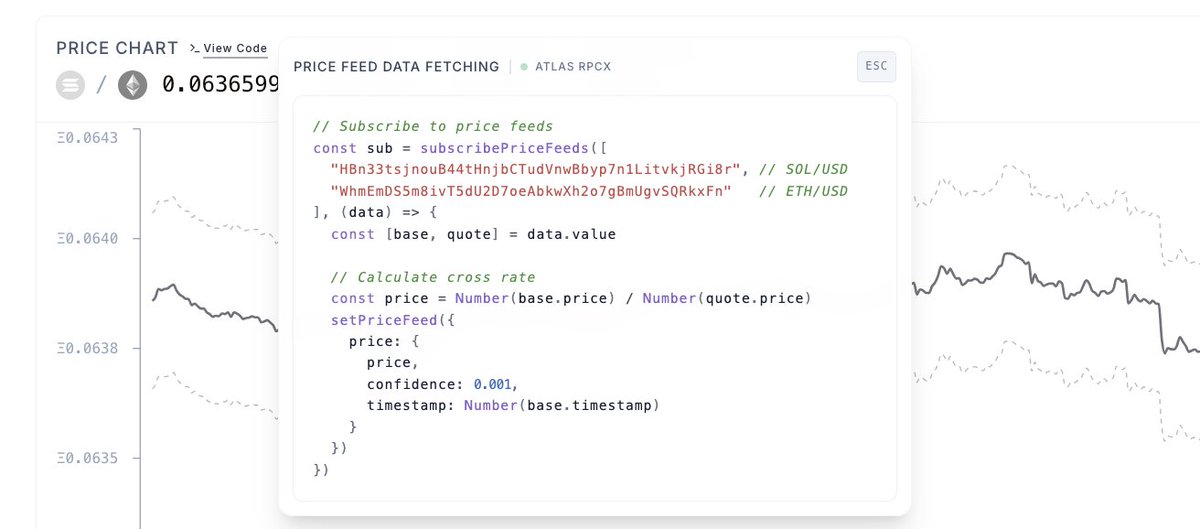
JSON-like RPC responses on Atlas simplify how developers interact with on-chain data.
Here is how the Atlas RPC (rpcX) works 👇
3. If an rpcX package exists for the price feeds, RPC nodes can parse the updated bytes before sending the update to the subscriber.
4. Subscribers receive useful JSON, instead of raw bytes they'd need to parse themselves.
Slow oracle updates on perpetual exchanges can create bad debt.
When prices move faster than oracles update, the protocol may not be able to process liquidations in time.
Atlas prioritizes oracle updates to eliminate this vulnerability, making it ideal for perpetuals.
Public and private liquidity are both important for healthy markets.
Public liquidity creates transparent price discovery while private liquidity smooths the market impact of large trades.
Both displayed (public) and hidden (private) liquidity play important roles in market structure.
Displayed liquidity allows prices to converge. When market makers compete, a reasonable matching engine will ensure that users get filled at similar, fair prices. Public information is then emitted through the public orderbook, trade list, or both.
Hidden liquidity can emerge in 2 ways:
1. A market for Widgets shows a bid at 100 and an offer at 101. Alice places a limit order to buy at 100.60 and immediately gets filled. There was hidden liquidity to sell at 100.60, but no publicly displayed limit order.
2. Bob asks for a quote to trade 100 Foos for Bars (RFQ). He can sell 100 Foos for $1000 and use that $1000 to buy 499 Bars on the open market. This implies an exchange rate of 4.99, post transaction fees. Instead, he receives a quote of 499.5 Bars for 100 Foos. Because there is no public Foo-Bar market, the market maker who filled his request put no capital at risk. However, the hidden liquidity for this asset pair allowed Bob to receive a more favorable exchange rate.
In a well-functioning market, public price information ensures that users get competitive prices on liquid, public trading pairs. The public signals then enable price improvement for hidden liquidity.
There is clearly a role for both; there's an open problem of which structures facilitate the most positive-sum activity while leaking the least amount of extractive value.
Abstractly, this reduces to a graph where the nodes are assets and the edges represent different asset markets. Global liquidity (displayed + hidden) is a measurement of how well-connected the graph is.
@metaproph3t If you're cloning and redeploying, you can skip the middle command since you'd have the keypair from initial deployment. For new program IDs, you will need to recompile your program before deploying on Atlas.
The Case for Opinionated Financial Infrastructure
Atlas design decisions reflect the opinion that financial substrate should be built for specific use cases.
Atlas is infrastructure for perpetual futures exchanges, spot exchanges, and derivatives exchanges.
In short, the Atlas design decisions are:
1. Permissioned sequencing. Permissioned sequencing enables opinionated ordering rules that favor market makers and overall market quality. The sequencer prioritizes market maker cancellation requests, ensuring critical market operations execute when needed.
2. Clean, formatted data. Custom server-side data handling with rpcX delivers JSON-formatted data directly from RPC nodes, moving parsing complexity from clients to infrastructure.
3. Larger transaction sizes. Transaction sizes 10x larger than Solana's handle sophisticated financial operations in full, enabling multi-asset operations to execute as one atomic unit and eliminating the need for address lookup tables.
These aren't isolated optimizations—they're thoroughly considered decisions that compound. When market makers can manage risk effectively, developers can build without artificial constraints, and all participants can trust their market data, the whole ecosystem is elevated.
Read the full article. Link in the comments👇
Every millisecond matters for financial applications.
That's why rpcX transforms data server-side, eliminating unnecessary bandwidth and parsing overhead.
General-purpose blockchains are useful for many things from remittances to NFTs, but they are not designed for high-frequency trading.
Atlas is specialized infrastructure that prioritizes the specific needs of complex financial applications.
Join @rahuuuuuljain on Wednesday, 3:15PM EDT at @ThePortMiami Ship Week.
He'll be running a workshop on how @atlasxyz rpcX is fixing the Solana read layer.