In Madhya Pradesh, 925 "forest villages" remain under the tight administrative control of the Forest Department rather than the Revenue Department.
Originally established during the British Raj to secure forced tribal labour for scientific forestry, these settlements have largely remained unchanged, leaving generations of residents without rights and services available in regular villages.
Check out the article in Hindi, by Satyam Shrivastava from ATREE, using the link.
https://t.co/L7K0wqqMB1
We are looking for a highly motivated Senior Research Assistant to join our Water and Society programme in Bengaluru!
In this role, you will lead field plantation activities, develop ecological restoration plans and collaborate with local communities and stakeholders to bring a peri-urban lake back to health.
Know more using the link.
https://t.co/NfjNuK4K0y
ATREE alumnus Hassan Shahnowaz Islam reflects on his visit to Kuttanad, the rice bowl of Kerala, for the 18th Vembanad Fish Count, sharing the many perspectives and experiences that shape conservation in the region.
He illustrates the landscape's changing ecology, especially after the Thanneermukkom barrage was built across Vembanad Lake to benefit paddy farming, which has significantly impacted the lake’s depth, bird migration and fish diversity.
Read the full article here: https://t.co/M2TrqToifP
Despite their diversity, the genomic data for gastropods, particularly those from South Asia, remain limited. This study addresses the gap by presenting a high-quality genomic assembly of Indrella ampulla (Ariophantidae), a land snail found only in the Western Ghats.
To read the paper “Nuclear and Mitochondrial Genome Assemblies of Indrella ampulla, a Terrestrial Gastropod Endemic to the Western Ghats” by Gopi Krishnan, Maitreya Sil, Neelavar Anantharam Aravind (ATREE), Govindhaswamy Umapathy and Aniruddha Datta-Roy, https://t.co/bxzek7lXtG
From Nipah and Ebola to COVID-19, the world’s most devastating health crises share a common origin: they cross from animals into humans. Today, zoonotic diseases account for over 60% of all infectious diseases.
But while the pathogen itself is biological, the reason it spills over – and why it devastates certain communities over others – is deeply social and structural.
Check out the Down To Earth article by Chaithra Bhagavathi Parambu, a doctoral student at ATREE, using the link below.
https://t.co/Wbkoeu0wB2
We are looking for a highly motivated Senior Research Assistant to join our Water and Society programme in Bengaluru!
In this role, you will lead field plantation activities, develop ecological restoration plans and collaborate with local communities and stakeholders to bring a peri-urban lake back to health.
Know more using the link.
https://t.co/NfjNuK4K0y
Mark your calendar for the talk titled “How I became a butterflypreneur”, where Dr V. Shubhalaxmi R. will take us through her journey into the fascinating world of butterflies and other insects.
An entomologist and educator, Dr Shubhalaxmi’s work spans ecological restoration, urban biodiversity and nature-based learning spaces. She is widely acclaimed for her pioneering contributions to the study of Indian moths.
We hope to see you there tomorrow!
Date: 28 May 2026
Venue: ATREE Auditorium
Time: 3:00–4:00 PM
Zoom link : https://t.co/PgL2jgXuoE
We are thrilled to share that Anirban Roy, a recent PhD graduate from ATREE, has been awarded the prestigious Humboldt Research Fellowship to pursue his postdoctoral research.
This highly competitive fellowship is recognised globally for enabling outstanding early-career scientists to conduct independent, cutting-edge research at leading German institutions.
Through this fellowship, Anirban will continue his socio-ecological research at the University of Göttingen, focusing on selected areas of northwest Africa and northeast India.
@EcoAnirbanRoy
Chhattisgarh became a pioneer in distributing land titles, especially ones filed under the community forest resource rights or CFRR which gives ownership rights over forests to gram sabhas (village assemblies). But now the scenario is different.
Read the full article featuring Sharachchandra Lele, Distinguished Fellow at ATREE, using this link: https://t.co/FzJYUteP9G
We are excited to announce that Dr V. Shubhalaxmi will be delivering a talk at ATREE titled “How I became a butterflypreneur”.
An entomologist and educator, Dr Shubhalaxmi’s work spans ecological restoration, urban biodiversity and nature-based learning spaces. She is widely acclaimed for her pioneering contributions to the study of Indian moths.
Join us to hear her speak about her journey into the fascinating world of butterflies and other insects.
Venue: ATREE Auditorium
Date: 28 May 2026
Time: 3:00–4:00 PM
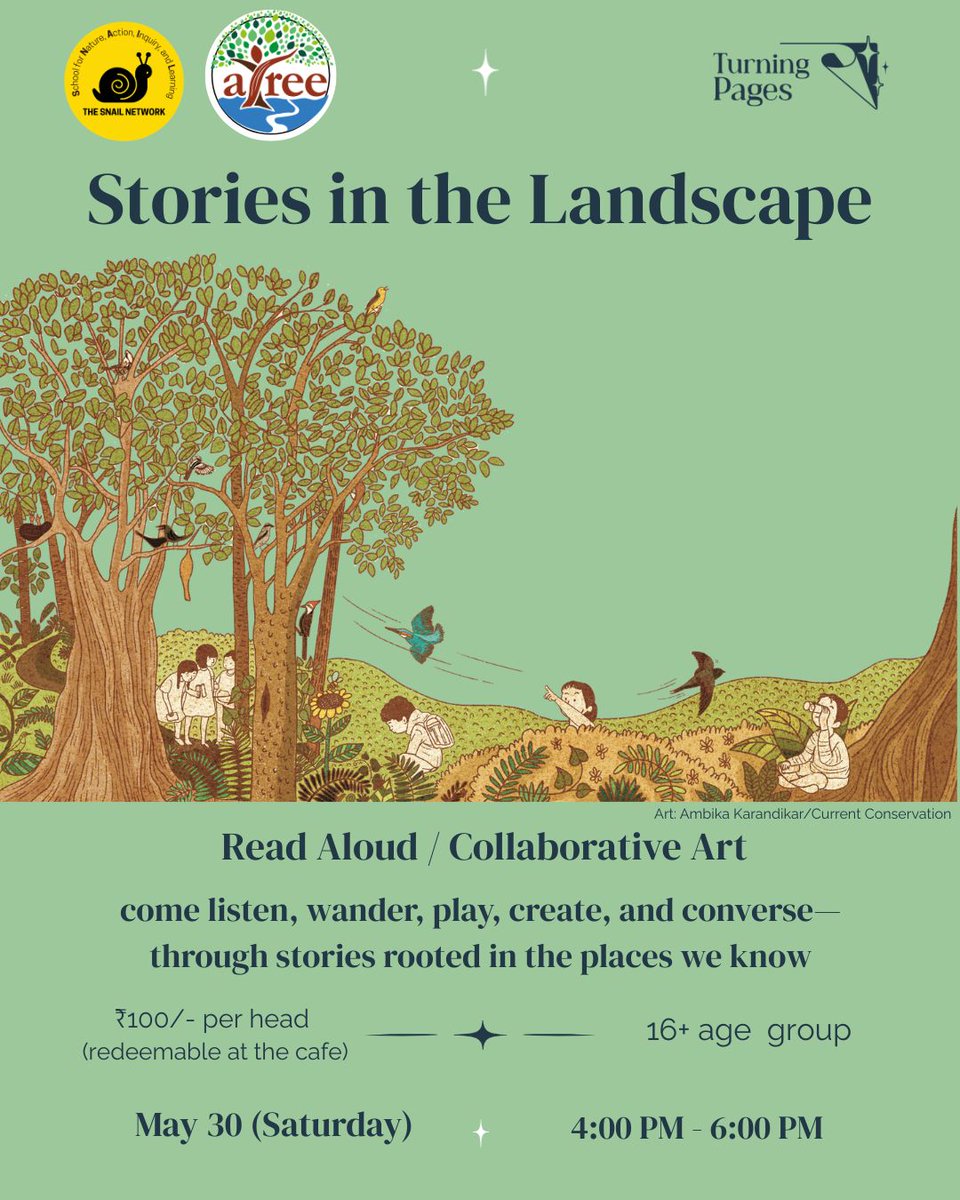
To mark the upcoming World Environment Day, the S.N.A.I.L network, ATREE's Environment Education initiative, is hosting a book and art event on 30 May, in collaboration with Turning Pages, a bookshop at Jakkur.
Find nature-themed books recommended by S.N.A.I.L, participate in a book reading and some art, and take back ideas, stories, and more! If you are looking to reconnect with the environment through a creative lens, this is for you.
Cockroaches may be pests in houses but they come there because of how we keep our spaces: garbage-filled and messy. In nature, where most of these insects are found, they play a crucial role in nutrient cycling in ecosystems.
Read the article featuring Priyadarsanan Dharma Rajan, Senior Fellow at ATREE, through the link in bio.
Every species we know today in the web of biodiversity first entered science through a name and a description.
But the process goes beyond simply “discovering” a species. It involves careful exploration, collecting specimens, documenting and analysing their traits, comparing them with other known organisms and finally describing them in scientific detail.
This work forms the foundation for understanding biodiversity, from how species evolve and interact with ecosystems to how we conserve them.
On this International Day of Biological Diversity, we asked our scientists why this process remains so important.
Here’s what they had to say.
Hearty congratulations to Soumya Swaminathan, eminent physician-scientist and board member of ATREE, on being elected a Fellow of the Royal Society (FRS) – one of the world’s most prestigious honours in science.
With this remarkable achievement, she creates history alongside her late father, M. S. Swaminathan, who was elected FRS in 1973.
She is only the second Indian woman scientist to be elected to the Royal Society in its 365-year history.
Read more about her historic achievement here.
https://t.co/QsmbNsHTwA
ATREE is looking for a motivated, field-oriented Project Coordinator to support the implementation of grassland and watershed restoration activities in rural Karnataka!
In collaboration with the Watershed Development Department, this role focuses on integrating native grassland restoration with watershed interventions, such as gokattes, check dams and nala bunds. The Project Coordinator will work closely with local village institutions, pastoralists and Self-Help Groups (SHGs).
https://t.co/IUccdenJSw
"Bridge Over Troubled Waters” premieres tomorrow!!!
This year, the Vembanad Fish Count will have an added attraction with the official release of our film “Bridge Over Troubled Waters”.
Shot along Kerala’s largest wetland, the film captures the intricate relationship between the local community and their watery habitat.
It chronicles ATREE’s model of working with communities, blending scientific expertise and traditional knowledge to restore and sustainably manage the Vembanad Kol.
For the last 19 years, ATREE has been working in this Ramsar site through its community conservation centre, helping enhance local capacities and strengthen institutional networks for conservation.
Last winter, Gangtok faced a crisis it could not ignore. With rainfall stopping by September, the city’s main water source, the Ratey Chu River, saw its discharge drop by nearly 50%.
However, emerging from underground aquifer networks beneath the town, Gangtok's freshwater springs have been silently sustaining residents long before and long after crises.
The commentary draws from fieldwork in Gangtok by Sailendra Dewan, Fellow at ATREE, and Niharika Bindal, who worked as an intern in ATREE and its The Himalaya Initiative.
Read the full article here: https://t.co/EmJVNjT90q
The bird was confirmed to have been ringed as a juvenile in Rajasthan in 2019 by researchers from ATREE's HarrierWatch project, establishing a rare and verifiable long-distance migration link.
With various other migratory birds having established the Nemmeli wetlands as their winter refuge, there is increasing evidence for the need to conserve this landscape.
Read the full article, published in the New Indian Express, here: https://t.co/zaxrX3fXoG
AT ATREE, we run a citizen-science initiative for studying these cavity-nesters in urban spaces. We also help people set up bee hotels right on their balconies or in their yards.
If you would like to provide homes for these little bees and volunteer in studying them, contact us at [email protected].
Happy World Bee Day!
We rarely picture a bee outside its hive. But a majority of the bees around us live solitary lives.
Expert “buzz-pollinators”, they play an essential role in our lives by helping propagate plant diversity around us.