Simul Justus et Peccator | Husband to Ashton | Assistant Pastor at Bethlehem Bible Church | Texas A&M ‘21 | RTS ’25 | Marrow Man | Natural Law Justice Warrior
Evangelista: The Bible teaches that we are saved by grace alone through faith alone in Christ alone. Our works or the quality of our faith do not save us.
Nomista: OH SO YOU THINK SINNING IS OKAY?!?!?!?!
I would also add:
Scandinavia, New Zealand, etc are all post-CHRISTIAN countries still riding the wave of an assumed general Christian morality.
Pinker is living on borrowed capital.
Does a more religious society make a better society?
@SAPinker says no: Would you rather live in Afghanistan or Scandinavia? “The more religious the society, the worse the problems are.”
@DouthatNYT disagrees: You can balance the best of faith and modernity. “What we should wish as Americans is to be neither Afghanistan nor Scandinavia—but to be the United States of America.”
First mistake of lay historical theology:
The silo-ing of history.
Just because theologians come along and articulate doctrines and interpretations more clearly, more precisely, more comprehensively doesn’t mean they are not building off the work of others who came before them.
On divine and human authorship of Scripture:
The human author is a prophet. The prophet speaks the Word of God. When the prophet speaks, God speaks.
Therefore, true literal, historical-grammatical exegesis attempts to submit to the divine author’s Word.
Systematic theology and biblical theology in hermeneutics:
ST studies how the whole of Scripture contributes to our understanding of one part of Scripture.
BT studies how this one part of Scripture makes a unique contribution to the whole of Scripture.
Both are necessary.
The old covenant was a covenant “of promise” not because it is substantially the same as the new covenant, but because it supplied the necessary details of how Christ would save His people from exile by his active and passive obedience.
The new exodus results in the new covenant
Much of the recent critique of Kline and R2K misses the level at which Kline is actually operating. His project was never a political theory. It was an exegetical architecture— an attempt to read the covenants, the canon, and redemptive history with eschatological integrity.
Kline’s central concern was always the structure of Scripture: the relation of creation and consummation, the works/grace antithesis, the typological uniqueness of the Mosaic economy, and the covenantal scaffolding that holds the canon together. If you misidentify the level of his work, you will misinterpret every conclusion that flows from it.
1. Intrusion ethics is not a political maneuver; it is an exegetical necessity.
Holy war, cherem, land sanctions, and the judicial presence of the Glory‑Cloud are not “civil norms” but eschatological intrusions. They belong to the typological kingdom, not the common order. Kline’s point is simple: you cannot universalize what God Himself restricted to a temporary, typological administration.
2. The Noahic covenant is not a secular charter but a stabilizing covenant for history.
Genesis 9 is not “neutral.” It is non‑redemptive in structure, not in origin. It preserves the world for the unfolding of redemptive history. Kline’s distinction between Genesis 6 (proleptic, redemptive) and Genesis 9 (universal, preservative) is not an innovation—it is a recognition of covenant form and audience. The covenant with “all flesh” cannot be collapsed into the covenant with the seed.
3. Kline does not deny the moral law; he denies the re‑application of typological judicial law.
The Westminster divines themselves distinguished moral law from expired judicial law. Kline simply takes that distinction seriously. “General equity” is not a backdoor for reintroducing Mosaic penology; it is the abiding natural‑law substance of the Decalogue. The critics conflate categories the Confession keeps distinct.
4. Christ’s mediatorial reign is not diminished by distinguishing common and redemptive kingdoms.
Kline’s architecture preserves the universality of Christ’s rule and the eschatological nature of His kingdom. The church is the embassy of the age to come; the civil order belongs to the common grace era. This is not dualism. It is covenantal sequencing. It protects the gospel from being collapsed into civil administration.
5. Kline’s system is not a retreat from Christian influence but a protection of redemptive clarity.
When theocracy is treated as a normative model, the works/grace distinction collapses, typology is flattened, and the gospel’s eschatological structure is obscured. Kline’s architecture safeguards the integrity of the new covenant by refusing to resurrect a typological order that Christ has fulfilled and retired.
The irony is that Kline’s critics often accuse him of novelty while proposing a political theology that reintroduces the very typological structures the Reformed tradition said had expired. Kline’s architecture is not a departure from the Reformed tradition— it is a retrieval of its covenantal and eschatological core.
If we want a political theology that is truly Reformed, it must begin where Kline began: with covenant form, canonical structure, and the eschatological architecture of Scripture. Everything else is downstream. #Kline #TwoKingdom
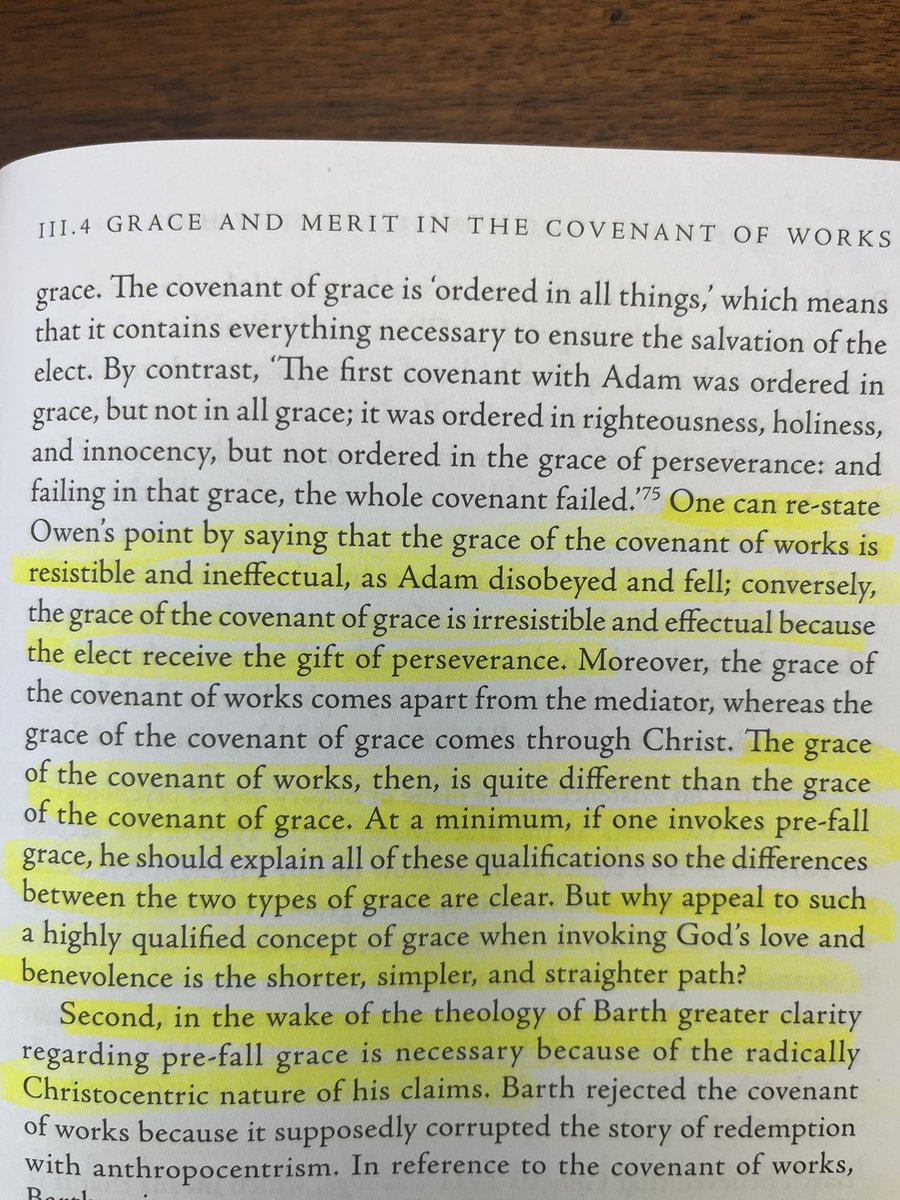
Being cute and saying there was “grace” before the fall when you mean something very different from what Paul means here is not clear.
Ephesians 2:8 is the ordinary usage of grace that virtually everyone understands. Let’s be pastoral, theologically precise, and not confuse ppl.
“For by grace you have been saved through faith. And this is not your own doing; it is the gift of God,”
Ephesians 2:8
This is the ordinary usage of “grace.”
Under the covenant of works, eternal life is by works.
Under the covenant of grace, eternal life is by grace.
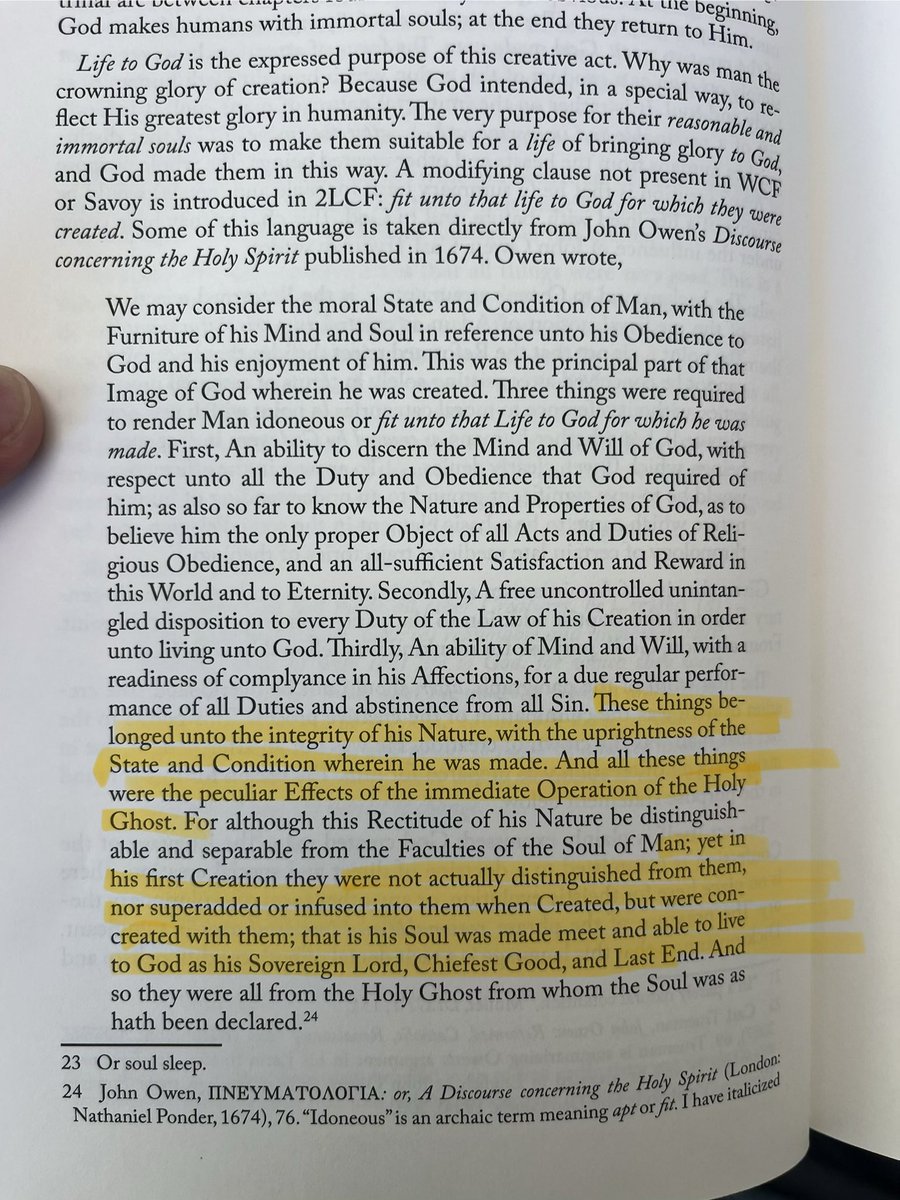
@MichaelCarlino Okay help me understand. This is Renihan’s commentary on 4.2 with an Owen quote. When Owen’s affirms that the rectitude of his nature was concreated with the faculties of his soul, he seems to deny that they were superadded or infused. He is saying this was natural to man.
@jonathanramont@MichaelCarlino Aren’t the virtues of faith, hope, and love all components of what it means to be made after the image of God in true knowledge, righteousness, and holiness?
@jonathanramont@MichaelCarlino Okay. So no superadded grace needed to keep the covenant of works? Adam, according to his natural constitution in the image of God, in which God graciously created him, had the ability to keep the law, correct?
@MichaelCarlino@jonathanramont My concern is that what was communicated prior is that grace simply restored to Adam’s original estate, being able to sin and fall.
If you could lose grace in the beginning, then you can lose it again. That’s my concern.
More clarity on the distinction between nature and grace
@MichaelCarlino@jonathanramont Excuse me, 4.2.
I’m concerned about this comes to too closely to the Romanist superadded gift.
So, would you say that God (graciously) created Adam with the ability to keep the covenant of works?
@MichaelCarlino@jonathanramont “The gracious, supernatural aspect of the image of God was lost at the fall and is regained through regeneration and sanctification”
Problematic because Adam fell from the estate wherein he was created. If he could fall, then so can we.
Also contradicts 2LBCF 2.1.
I don’t know who still needs to hear this, but The Gospel Coalition is neither a trustworthy nor biblically sound resource for conservative Christians anymore. And hasn’t been for a long time.
If you see a pastor sharing anything from TGC, that’s a red flag 🚩 🚩🚩
The pope apparently didn't have enough of a "deep concern" to say anything about the destruction, suffering, and death that the Iranian regime inflicted on its own people, Israel, and American people in the past.
But now he's deeply concerned.
Uh huh.