Modern Innovative Saas for Professional Luxury Car Service Driver training & service providing w/ 10+ years of Experience from Atlanta to major cities in the US
These are the top 5 US trucking markets in terms of marketshare:
1. Houston
2. Ontario, California
3. Atlanta
4. Detroit
5. Dallas
Of those markets, since 2018, Detroit has grown the fastest, while Atlanta has struggled the most.
To understand why, consider the industries that make up their local economies:
Houston (oil & gas, imports, and trade with the Americas)
Ontario (distribution centers for imported products)
Atlanta (shifting from a manufacturing & distribution economy to a services one. Distribution moving to other parts of the South. Intermodal taking more share)
Detroit (auto)
Dallas (diversified, center of the country, trade with Mexico)
Most dealers are overpaying at auction—
Meanwhile, buy center reps with close to zero sales experience are sourcing 50+ cars a month from private sellers.
@longd4, Executive General Manager of @hanselautogroup, explains how structure—not talent—is scaling used car acquisitions.
"It usually comes down to about the eighth contact before a customer converts."
"I've got guys out there buying 50, 60 cars a month individually from party sellers."
" That's how quickly you can take somebody from Starbucks to buying cars."
-
Thank you to our partner @lotlinx! Check them out by visiting https://t.co/Msl6w6B8PX
[NEWS] Top 5 auto industry stories from the week:
1. Jeep parent Stellantis selects insider Antonio Filosa as New CEO
Filosa has been at Stellantis for 25 years and was already running North America as COO since December 2024.
2. Paul LaFontaine grows Michigan footprint with CDJR acquisition
LaFontaine has already added a used lot to the location, repaved the entryways, and retained most of the existing staff.
3. No auctions, no problem: How Sutherlin Auto uses service lanes to source 350 used cars every month
Every night, an automated system pulls VINs from the next day’s service appointments, appraises each vehicle, and adjusts the offer based on inventory needs and retail performance.
4. Oklahoma dealer embraces higher-mileage used cars: 'we had to change our mindset’
At Classic OKC, dealer principal Dorian Jimenez isn’t worried about having the cleanest used car inventory. He’s focused on getting more margin out of the supply he already has.
5. Ford recalls 1M+ vehicles over software glitch in rear cameras
Software-based recalls are becoming the norm. A decade ago, just 12% of U.S. recalls involved software. Now, it’s nearly 25%.
Read the The Weekly here, together with @widewailers : https://t.co/vZzFEtajxq
[NEWS] Consumer sentiment just had its strongest gain in months, up 6.1% in May:
That lift came as used prices dipped, wholesale values fell 0.8%, and retail sales stayed ahead of last year.
Sure, inventory is building. And rates are rising.
But buyers? They’re still in the game…
Big picture: Seems like demand’s holding for now, but Q3 could bring the kind of price pressure that tests just how long consumers stick around.
Read today’s top automotive stories, presented by @Uber_Business : https://t.co/qwEYvFOLrp
(Data source: Morning Consult / Cox Automotive)
The trucking market has been in the longest and deepest downturns in history. It started in March 2022 and has put many trucking companies out of business.
The goods economy has been sluggish, but the primary cause has been way too much capacity.
There was an explosion of new companies into the industry during COVID, attracted to good paying rates and fueled by government stimulus/cheap credit.
Unfortunately, the industry overcorrected and way too much capacity was added, causing a collapse in market rates.
To fend off bankruptcy, trucking firms found the only way to survive was to cut costs. The number one expense for truckers is driver labor. It's hard to cut the wages of experienced truck drivers with proper documentation, so a large number of small trucking firms resorted to hiring drivers without work permits.
These workers were able to secure CDLs in the US, without ever passing a CDL test in the U.S. Many states honored CDLs from other foreign countries, without verifying that the driver was experienced and qualified. In other words, they never demonstrated that they could drive an 80,000 lb truck safely. Not only that, but many of the folks couldn't speak or read English.
Trucking became a lifeline for many immigrants. It offers steady work, a decent living, and since most truckers live out of their truck, a place to live. For most immigrants, it is a significant improvement over the abject poverty in their home countries.
These undocumented workers would often work for wages below their American counterparts while tolerating poor working conditions and junky, unsafe equipment.
The DOT officials, the ones that are charged with enforcement, were told to ignore the driver's CDL qualifications and not to inspect for proper work permits. They were also instructed to accommodate drivers who didn't speak English. This happened in 2016.
In other words, a truck driver without proper documentation or work permit, could not be placed out of service, even if the DOT official knew the driver lacked the proper credentials.
This flood of unqualified and undocumented truck drivers created a flood of capacity and has kept trucking rates in the gutter, bankrupting many companies that were in full compliance and had qualified US truck drivers. It has also made our highways far more dangerous, as the fatality rate increase involving heavy-duty trucks demonstrates.
The Trump Administration has issued new guidance to reinforce the labor, CDL, and language capabilities of truck drivers. Anyone who is caught driving a truck without proper documentation or English comprehension will be put out of service and risk being deported.
While I have an enormous amount of empathy for the plight of immigrants, I recognize that this is a major safety and fairness issue for the trucking industry.
I would love to see the trucking industry thrive once again and hope the executive order accomplishes that.
[NEWS] The average vehicle on U.S. roads is now 12.8 years old:
That’s the second year in a row it’s climbed by two months—
- Passenger cars now average 14.5 years.
- Light trucks sit at 11.9.
- And even BEVs are creeping up.
Simply put, fewer buyers are going new—and it’s creating huge opportunities for fixed ops as more buyers roll into service for tires, brakes, and batteries.
Looking ahead: With new car prices still high, I don’t expect this trend to reverse anytime soon.
Read today’s top automotive stories, presented by @mialabsinc : https://t.co/NdIo1S1NHF
(Data source: S&P Global Mobility / Austin Conroy, regional fixed ops director for Rohrman Automotive Group / Tully Williams, fixed ops director at the Niello Company)
[NEWS] We Auto doesn’t give used cars a second chance:
Once a unit hits 65 days on the lot, it’s a write-off.
No discounts. No transfers. No exceptions.
Dealer Principal Michael Speigl has enforced that rule for over a decade, through every market twist—from chip shortages to tariff swings.
But why so strict?
Because aging inventory drags performance, and emotion slows decisions.
Which is why every unit is bought with the exit already in mind.
That said, with tariffs and supply swings muddying the outlook, they’ve pulled back on sourcing and are holding steady through Q2.
Until then, no chasing. No swaps.
Speigl’s POV: “That could be the total wrong [sourcing] strategy. But the million-dollar question is nobody really knows what the future's going to look like…”
Read today’s top automotive stories, presented by @mialabsinc : https://t.co/ojZZ1EjBWR
(Data source: Michael Speigl via Daily Dealer Live)
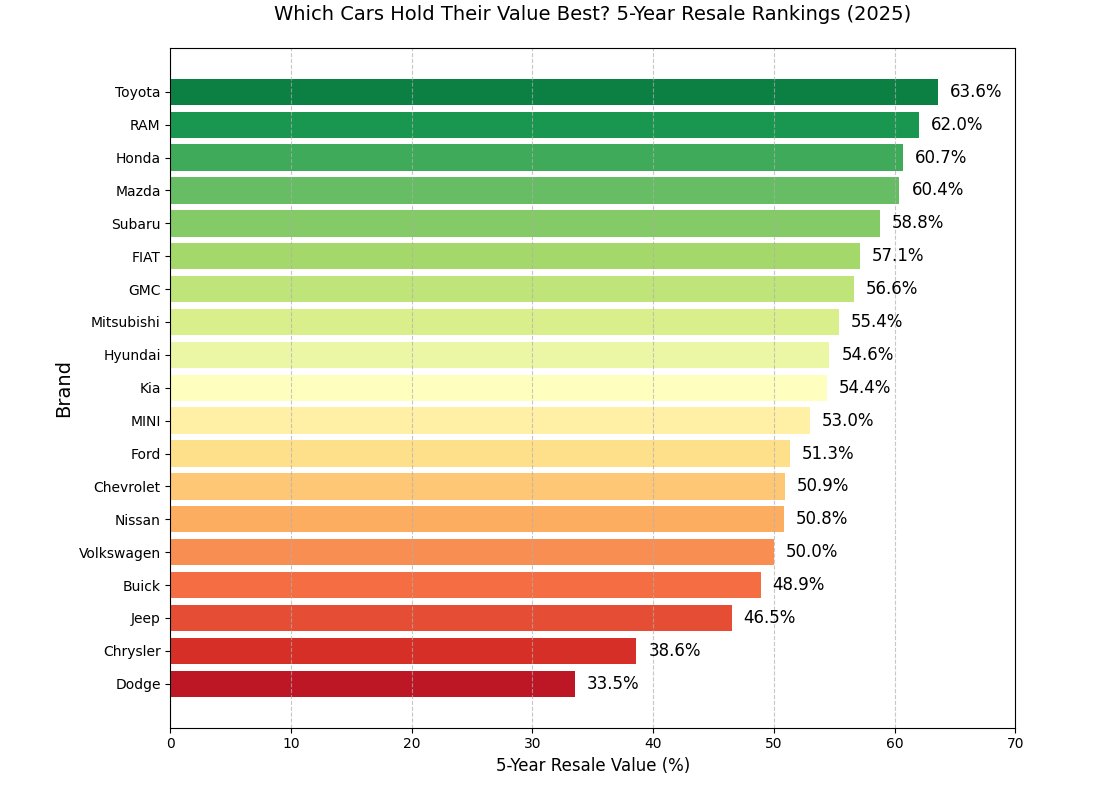
Resale values are revealing some hard truths about brand strength:
After 5 years, top performers like Toyota and Ram are holding nearly double the value of the bottom performers like Chrysler and Dodge.
It’s a reminder that total cost of ownership typically starts with the exit—not the sale.
*Tesla not included due to limited historical data.
(Data/graph source: CarEdge / CDG analysis via Joe Cecala)
You can't make this stuff up even if you tried.
One of the addresses featured in this article, which has nearly 700 trucking companies registered to it, (500 of them with the same phone number) sits at the start of a 'No truck zone.'
[NEWS] Slate Auto is currently racking up more than 100K reservations:
And that’s after coming to market just 2 weeks ago.
Turns out, there’s real appetite for a simple, customizable EV that just works—
Especially when the price lands under $20K with credits.
Which is exactly the bet CEO Chris Barman placed:
Strip the extras. Ditch the screens, radios, and bloat.
But keep the utility—
Like the ability to flip from a pickup into an SUV.
Zooming out: Barman believes her team can redefine value in the EV age. And now they’re racing to deliver 150K units a year by 2027.
Read today’s top automotive stories, presented by @DLRdmv : https://t.co/ykUFQzhXhQ
(Data source: CEO Chris Barman via CDG’s Daily Dealer Live)
Freight is a capacity constrained commodity. It’s one of the most volatile markets on the planet.
Capacity and rates can literally flip overnight.
The tariffs caused a sharp drop in demand, the pause on China tariffs will cause an even sharper increase in demand.
This is how the freight market works.
First famine, now feast.
Boeing's growing incompetence can be traced from its abandonment of Seattle (its traditional design/manufacturing base) for Chicago, where it began to prioritize financial shenanigans over building good planes, to its move to DC - where it focuses on lobbying and corruption.
The Second Cold War is here, and supply chains are the front lines.
I had the chance to join Forward Guidance to discuss what we are seeing on the ground, whats next in the goods economy, and how this plays into a much bigger theme that will drive geopolitics for decades.
West Texas is the epicenter of water recycling technology.
Just like Texas has exported its oil knowledge across the world, it will solve the world's water challenges as well.
[NEWS] The biggest loyalty killer in fixed ops isn’t price, wait times, or even quality:
It’s the phone.
40% of service customers say calling the dealership is a frustrating experience.
Missed calls, long holds, endless transfers—
They’re dragging Net Promoter Scores down by 30+ points in some cases.
And if no one answers?
Scores crater to 26.7—less than half the industry average.
However, AI tools are helping—51% of Gen Z already prefers them.
But the real win comes from a blended approach (tech + training) to meet rising customer expectations.
Bottom line: The phone is the first impression. Nail it, and earn trust. Fumble it, and potentially lose the customer before the sale even starts.
Read today’s top automotive stories, presented by @OPENLANEnews : https://t.co/q5B5aGGrAT
(Data source: CDK Global)
Most public dealership groups are holding F&I gross per vehicle above $2K:
But not all of them…
Q1 results (% are YoY):
Group 1 Automotive: $1,955 (-3.2%)
AutoNation: $2,703 (+3%)
Lithia Motors: 1,881 (+2%)
Asbury Automotive Group: $2,261 (~0% change)
Sonic Automotive Group: $2,439 (+4%)
How does your dealership’s F&I department compare?
(Data source: public earnings statements)
Tariffs are splitting the auto industry like never before.
Depending on which dealer you ask, the profitability outlook for 2025 sounds wildly different.
Back in February, most dealers were somewhat optimistic:
- 58% of dealers expected profits to remain the same or higher for 2025
Then came the tariffs.
Now?
- 48% of dealers are bracing for a hit to their bottom line (!)
But interestingly, a growing camp of dealers sees opportunity ahead.
With the tariff details still shifting almost daily, forecasting has turned into a moving target — and it’s getting harder for domestic businesses to plan for what’s next.
Which camp are you in? Let me know in the comments.
Data via @HaigPartners check out their latest Haig Report for profitability insights for all the major auto manufacturers here: https://t.co/uzJKiGNzPq