Axis is officially LIVE on @base. 🔵
Axis is scaling Physical AI for the real world, contributed by everyone.
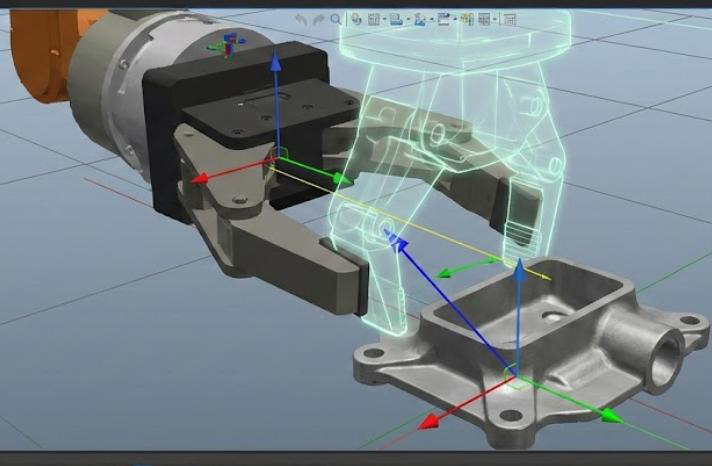
You can control robots in a virtual world, generate training data at scale, and help build the brain behind tomorrow's robots. All from browser. No hardware needed.
Start building robotics intelligence today: https://t.co/xeQnZzV2WM
GAxis (✱,✱)☀️
New week. New challenges. New access.
We’re giving away 10 BitRobot access codes over the next 72 hours.
Winners will get access to SN/04 and start earning rewards from both Axis and BitRobot.
To join:
1. Follow @axisrobotics & @BitRobotNetwork
2. Like + repost this post
3. Comment with a screenshot or photo of where you’re training right now
Grinding tasks? Climbing the leaderboard?
Show us your journey.
Announcing our collaboration with @BitRobotNetwork!
Axis is launching SN/04 on BitRobot, the open robotics lab on Solana that coordinates distributed contributors to accelerate Physical AI research.
SN/04 is a teleop-in-sim mission where contributors complete web-based robotics simulation tasks, generate valuable training data, and earn rewards from both ecosystems.
Together, we’re scaling human demonstrations for Physical AI — powered by everyone.
Rules and details below ↓
Axis Weekly
This week was about making the AXIS loop more scalable end to end: automating data-to-model workflows, testing recovery-driven training, expanding TaskGen coverage, and preparing the dataset and model stack for release.
Key updates:
- Data-to-model automation: We used scripts to speed up and standardize several repetitive but critical workflows.
- Continuous-growth training: We completed multi-data-scale training and success-rate comparisons across several failure tasks.
- Failure task expansion: A new batch of failure tasks has been pushed to test, expanding the evaluation range for ablations across data scale, data quality, and randomization.
- TaskGen: Articulated-object generation is now merged into the automatic generation pipeline.
- Model and release prep: We finished the first round of fine-tuning, evaluation, and benchmarking, completed the dataset’s conference submission, and are now improving experimental results for release.
Details below 🧵
Axis Weekly
This week was about trust and transfer: making community data cleaner, generated tasks broader, and trained policies more robust as they move from simulation to real robots.
Key updates:
- Data quality: We completed a suspicious-user audit script to detect abnormal collection behavior using user statistics and replay/verify failure reasons.
- Webapp and simulation: We improved key gripper and asset interactions, including penetration, heavy-object grasping, and IK flexibility.
- Recover-from-failure: We tested Failure Task 892 and collected 300+ failure initial states, with the next round moving to repaired and more randomized tasks.
- TaskGen: Articulated-object generation is now merged into the automatic generation pipeline, covering cabinets, dishwashers, drawers, and existing randomization workflows.
- Model and real-world stack: We completed the first round of fine-tuning, evaluation, and benchmarking, merged the π0.5 evaluation pipeline into the real-world stack, and started bringing a new embodiment into the loop.
A closer look at this week’s progress 🧵
On the model side, we finished the first round of fine-tuning, evaluation, and benchmarking, and are now adjusting the data recipe for better performance.
The π0.5 evaluation pipeline has been merged into the real-world stack, while web policy inference can now load model checkpoints for online deployment.
We also completed the dataset’s conference submission and are now improving experimental results for the upcoming release.
Next, we will continue batch ablations, generate checkpoints and failure tasks at scale, and land model visualization in the hub.
We are also starting to connect the stack to new real-world embodiments. More on this soon.
For example, the images below show a real on-site deployment scenario at one of our manufacturing customers.
If we want to help them achieve a scalable, end-to-end “pick-anything” solution, the process is non-trivial. We need to collect large-scale data across their diverse SKUs and part geometries, train a model that can generalize across variations, and then deploy it onto the real production line.
From there, we continue collecting real-world feedback data to fine-tune the policy in production. The goal is to progressively improve stability, cycle time, and accuracy — ultimately delivering a system that is faster, more reliable, and production-ready.
5/6
From a product and strategy perspective, Axis’s data capability is expanding in two directions at the same time.
On one hand, we continue to improve data diversity by covering more scenes, assets, layouts, and visual variations.
On the other hand, we are also increasing task complexity, pushing the data toward longer-horizon, higher-level behaviors that require more reasoning, coordination, and recovery.
6/6
In short, we are building a more valuable data distribution: from single-step actions to multi-stage tasks, from single-arm manipulation to bimanual coordination, and from a single robot embodiment to cross-embodiment adaptation.
This direction brings us closer to a data infrastructure capable of supporting more complex, realistic, and generalizable robotic intelligence.
4/6
Cross-embodiment tasks further expand the value of the data. By supporting bimanual teleoperation and adaptation across different robot embodiments, Axis is moving from single-robot datasets toward a multi-embodiment, multi-control-mode data system.
This is critical for training more general robot models, because a true robot foundation model should not be tied to one specific arm or control interface. It should be able to learn shared task structures and manipulation strategies across different embodiments.
3/6
Axis’s task system also supports continuous success detection and staged checkers. A complex long-horizon task can be decomposed into multiple well-defined subgoals, such as grasping an object, moving it to a target region, placing it correctly, or closing a container.
Each subgoal provides explicit supervision signals and structured labels, meaning the collected data contains not only full trajectories, but also intermediate task semantics that are useful for training and evaluation.
2/6
Long-horizon tasks are especially well-suited to simulation-based data collection. In the real world, once a long-horizon task fails midway, resetting the environment, restoring object states, and restarting the collection process can be costly and time-consuming.
In simulation, however, save states, resets, and rollback mechanisms allow us to quickly return to key task states.
This significantly lowers the cost of collecting long-horizon demonstrations and enables more fine-grained data collection around important intermediate stages.
We recently launched a new set of robotic data collection tasks, with a focus on long-horizon tasks (LH) and cross-embodiment tasks (Multi Embodiment). These include bimanual teleoperation and task adaptation across different robot morphologies.
Why this matters:
1. Axis is moving toward more complex, real-world robotic tasks.
2. Long-horizon tasks make complex data collection more scalable in simulation.
3. Staged checkers turn long tasks into clearer training signals.
4. Cross-embodiment tasks help Axis support multiple robot forms and control modes.
5. Axis is improving both the diversity and complexity of data.
6. The goal is not just more data, but more valuable data.
Details below. 🧵
1/6
This marks a shift in what we collect.
Compared with earlier manipulation tasks, long-horizon and bimanual tasks involve more stages, stronger temporal structure, and higher demands on planning, coordination, and recovery.
This is not only an expansion in data volume, but also a meaningful increase in data complexity and learning value.