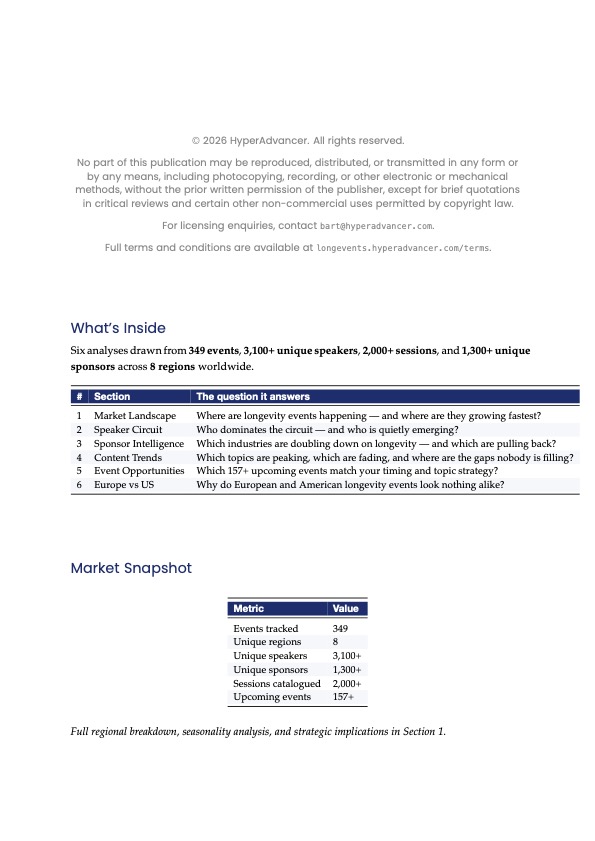
The Q1 2026 Longevity Events Intelligence Report is live.
349 events. 3,100+ speakers. 6 analyses. New this quarter: Europe vs US Regional Analysis.
Three findings:
1️⃣ EU peaks June + October (academic-led); US spreads year-round (C-suite-heavy)
2️⃣ 70 speakers active on both sides of the Atlantic
3️⃣ 66 events this quarter; North America 56%, Europe 23%, Asia 12%
https://t.co/9QJ24HWEKY
China just approved the world's first commercial brain implant. NEO, a coin-sized BCI from NeuraMatrix and Tsinghua, sits on the membrane around the brain and lets paralysed patients control a glove with their thoughts. Neuralink, meanwhile, is still years from FDA commercial clearance.
Half of what makes this work is AI: hardware reads the signals, models decode them in real time. Which raises the question nobody's pricing in yet: what's the token bill on a brain? Streaming your motor cortex through a decoder all day makes a chatbot subscription look like a rounding error.
And what happens when you hit your monthly cap? "You've reached your usage limit. Your hand will resume grasping on the 8th." Getting dumber because your subscription ran out used to be a metaphor.
Behind the joke, real questions: who owns the data a brain implant collects? Can a government compel access to your neural signals? And when does treating a disability become upselling a healthy brain to the premium tier?
The WEF report projects 170 million new roles appearing by 2030, against 92 million displaced: a net gain of 78 million. The growth clusters almost entirely in technology. The losses cluster almost entirely in clerical work.
The AI jobs story is almost always told wrong: either catastrophe or no big deal. The actual data sits somewhere more interesting.
The WEF surveyed 1,000+ employers covering 14 million workers. Net result by 2030: more jobs created than lost. But 22% of roles change in some way, and required skills shift by roughly 39%.
What strikes me is where the pressure lands first: entry-level and clerical roles. Not dramatic sci-fi displacement. Quiet erosion at the bottom of the ladder, exactly where people build early career capital.
If judgment, relationships, and oversight are what survive, how do you develop those without the entry-level reps that are disappearing?
As AI agents begin to act, payments move into the background — at machine speed and massive scale.
Today we’re introducing Mastercard Agent Pay for Machines — bringing structure, governance, and trust to this new class of payments.
Launching with 30+ partners to bring this to life from day one.
This isn’t just more payments. It’s a new operating model for commerce.
👉 Learn more: https://t.co/TeS6Lj8jLO
The tell shows up even at the frontier: when OpenAI and Anthropic wanted enterprise AI adoption in 2026, they partnered with McKinsey and Deloitte. The tech wasn't the blocker. The internal buy-in process was.
Most B2B partnerships don't fail because you picked the wrong partner. They fail on the inside, before anyone signs.
The deal gets announced, the CEO endorses it on a quarterly call, the press release goes out. Then nothing changes internally. Sales is still on individual quota. Finance never allocated budget. The partner asks how to move forward and gets routed to someone who's never heard of the deal.
The joint doc sits at version 0.3 forever.
The killer isn't partner fit. It's internal architecture. What would move in your org the day a partner said yes?
i hooked my whoop to my work calendar to find which coworker gives me the most stress 🚨
thanks to fable, I reverse engineered whoop to pull per minute heart rate. nd matched spikes with cal events and attendees
I now have a leaderboard and I think about it daily.
few info masked for obvious reasons ;)
Two hikers meet a grizzly bear. One calmly starts tying his shoelaces. "You can't outrun a bear." "I don't need to outrun the bear. I just need to outrun you."
That parable is the clearest version I know of why upskilling has become a competitive weapon, not an HR programme.
Ash Maurya calls speed of learning the new unfair advantage. The durable edge is not having the most talented people; it is having an organisation that gets good at new things faster than its competitors do.
Most companies treat upskilling as a budget line. The ones pulling ahead treat it as operating tempo.
Which kind of organisation are you in?
IKEA rolled out AI literacy company-wide: not an optional module, but a default expectation for how people work. The distinction matters more than it sounds. Optional signals nice-to-have. Mandatory signals this is how we operate now. Most organisations have not made that call yet.
Mythos / Fable is unbelievable.
Was on a customer call today and had Claude transcribing in the background.
As they were telling me about the features they wish their current software had, Claude was building the features in real time.
By the end of the call I was able to show a fully working product, with the exact workflow they mentioned 15 minutes earlier.
Autonomous looped building triggered from a customer call. 🤯
On https://t.co/tOqTY2ZA6h, you can see Mythos 5 getting beaten by a 4B open-source model on CharXiv, a popular chart understanding benchmark
A tiny model that is freely available on @huggingface, that you can deploy anywhere!
@AI_4_Healthcare Good read. Also one of the reasons i started #careandcode , giving clinicians the agency to build their own tools https://t.co/zIx6Mmdee7