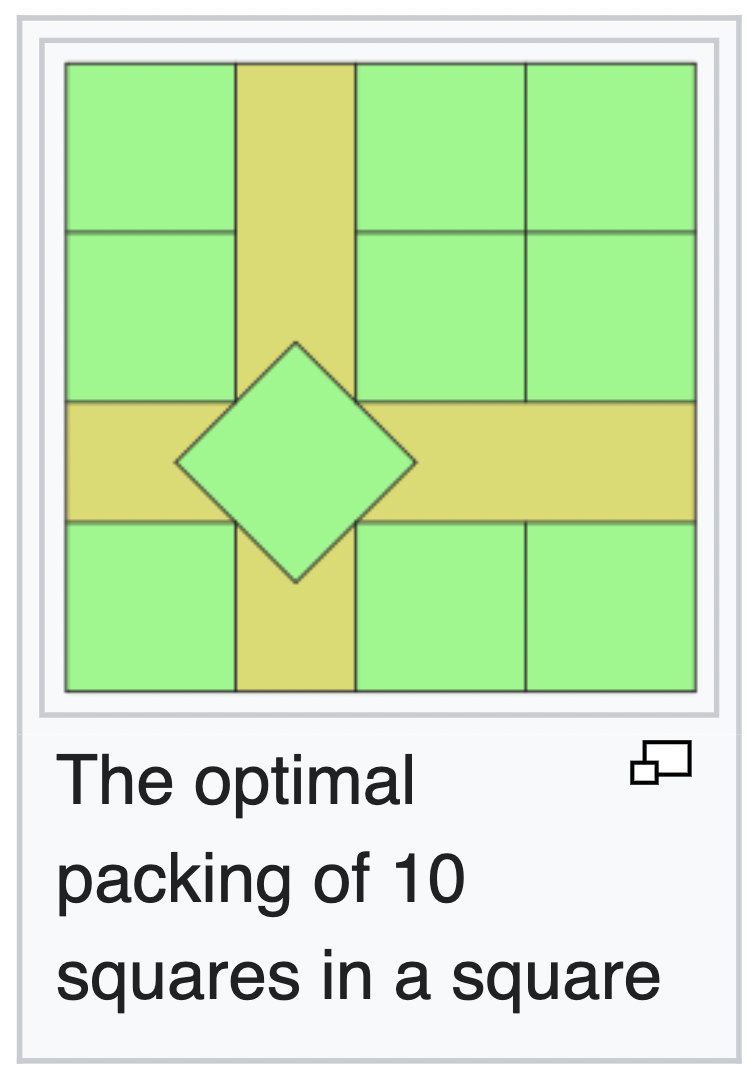
@DrHughJaction This is not a square-counting brain teaser. You have 10 identical squares (green) and the goal is to pack them into the smallest sized square domain (of any size), which is the "11th square" from the counting perspective.
@BrianScipioni@solidangles@math_vet How does this work for the real exponentials in the Laplace transform specifically? Fourier transform is more straightforward because plane waves form an orthonormal basis.
@balopat Teleportation error correction (Knill-style) is the best way to fix errors on rotation codes (such as cat codes), because otherwise the recoveries are too complicated.
More on that idea in our 2020 paper on quantum computing with rotation codes.
Eat at a local restaurant tonight. Get the cream sauce. Have a cold pint at 4 o’clock in a mostly empty bar. Go somewhere you’ve never been. Listen to someone you think may have nothing in common with you. Order the steak rare. Eat an oyster. Have a negroni. Have two.
@MWalschaers @SubhashishB19@Quantum_137 It's not clear that infinite stellar rank is a necessary condition for fault tolerance. Approximate GKP states with finite (but sufficient) stellar rank should do the trick.
The question (I think) we are both asking is: how much stellar rank is enough?
@MWalschaers @SubhashishB19@Quantum_137 In the sense that a cat state itself is also a low-quality GKP state, this isn't really meaningful wrt quantum computing directly.
But it's a huge advance for optical generation of better quality states towards fault tolerance (~10bB GKP states)
@MWalschaers @SubhashishB19@Quantum_137 The key advance is a demonstration of the breeding protocol producing a state that exhibits 3 peaks in its quadrature distribution and 2 blobs of negativity in the Wigner function.
As far as GKP states go, it's a "step up", but it's not high enough quality for fault tolerance.