La plupart des grandes boîtes sont des organisations zombies. Voici pourquoi.
Dans League of Legends, ton rang n'est pas un titre. C'est une mesure continue. Tu es Master parce que tu joues comme un Master cette semaine. Si tu arrêtes de bosser, tu redescends. Diamond. Platine. Gold. Le système ne te doit rien : ton rang reflète ta compétence à l'instant T, pas celle d'il y a trois ans.
Maintenant regarde une entreprise classique du S&P 500. Un type devient VP parce qu'il a été excellent à 35 ans. À 50 ans, il est toujours VP. Entre-temps, il a peut-être arrêté de produire, arrêté d'apprendre, arrêté de challenger ses modèles mentaux. Aucune importance : le titre est acquis. La hiérarchie pyramidale fonctionne comme un cliquet — tu montes, tu ne redescends pas. Ton elo organisationnel est gelé au pic de ta carrière.
C'est une aberration darwinienne. Ces structures distribuent l'autorité selon la compétence passée, et la compétence passée est un très mauvais prédicteur de la compétence présente — surtout dans un monde qui change vite.
Les jeux compétitifs ont résolu ce problème il y a vingt ans. Le elo se recalcule à chaque partie. La hiérarchie reflète la performance réelle, pas le souvenir d'une performance. C'est brutal, et c'est précisément pour ça que ça marche : les meilleurs joueurs sont vraiment les meilleurs joueurs, pas ceux qui ont été bons en 2008.
L'IA rend cette aberration létale. Quand une équipe de 12 personnes avec les bons outils peut produire ce que produisait un département de 200, le coût d'un VP qui ne produit plus n'est plus seulement son salaire — c'est le delta entre ce qu'il bloque et ce qu'une organisation méritocratique débloquerait. Ce delta explose chaque mois.
Regardez le marché. Le S&P 500 n'existe plus vraiment. Il y a le S&P 7 (Nvidia, Microsoft, Apple, Google, Amazon, Meta, Tesla) qui capte la quasi-totalité de la création de valeur, et 493 zombies qui maintiennent leur cap par inertie comptable. Les zombies partagent une caractéristique : la compétence n'y circule pas. Elle s'y cristallise en titres, en territoires, en process de protection.
Les boîtes qui vont émerger dans les dix prochaines années auront une propriété structurelle nouvelle : l'autorité y sera révocable en continu. La compétence présente sera la seule monnaie. Plus de rentes de titre. Plus de comités. Plus de "j'ai mérité ma position en 2015". Tu produis maintenant ou tu sors du ladder.
C'est pas une question d'idéologie. C'est juste que dans un environnement où l'IA divise par 50 le coût d'exécution, les organisations qui protègent l'incompétence acquise se font oblitérer par celles qui ne la protègent pas.
Tout est à réinventer. Et c'est exactement ce qui rend le moment fascinant.
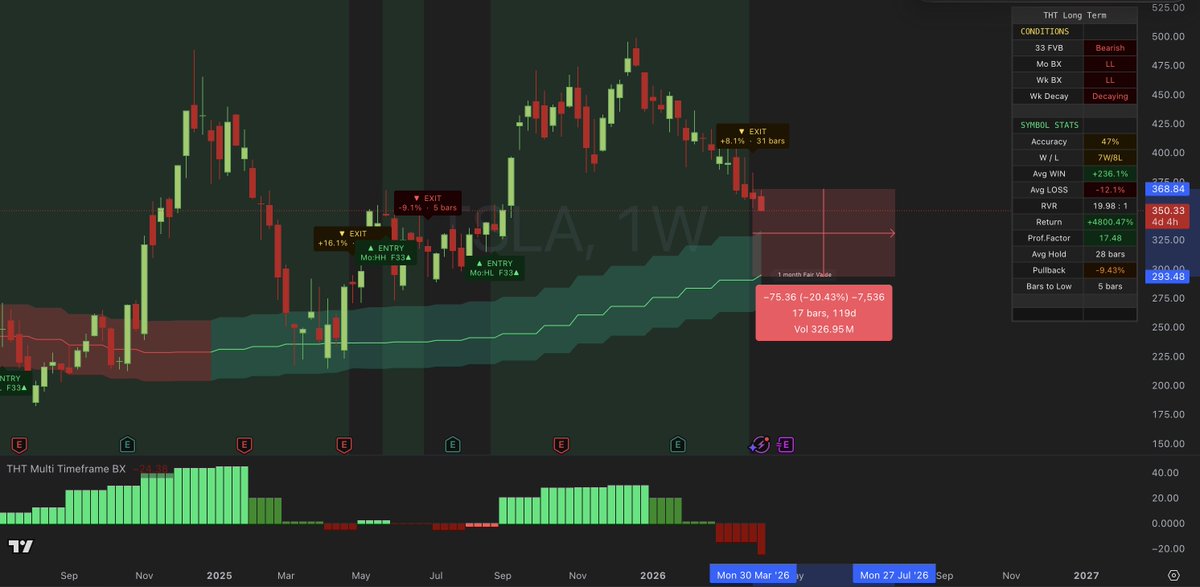
As of last week, I’m no longer bullish on $TSLA ❌
My system is showing bear cycle criteria, so I have to respect it.
As always, I hope I'm wrong.
Base case is a move back into Monthly Fair Value around $300.
When my criteria flip long again, I’ll get bullish again.
I said $TSLA would be at $550 by March 2026. I was wrong 🔻
Both of my models are still bullish, but it has taken much longer than expected.
Even with a solid system, you will be wrong at times.
In this video I break down the current state of $TSLA and what I expect from here.
One of my highest‑weight signals for major corrections triggered $QQQ $SPY 🚨
I break down the entire market + every MAG7 name ( $NVDA, $TSLA, $AAPL, $AMZN, $MSFT, $META, $GOOG) and how I’m positioned.
If you’re long tech, watch this before your next trade ⬇️
I’m selling all my $NVDA Monday 🔻
Monthly BX just flipped dark red after months of chop.
Historically this setup often leads to 20–30% corrections or months of dead money.
Details in the video
One of my biggest bear signals just fired on $QQQ 🚨
When this hits, $QQQ drops 10–15% or chops for ~90 days about 80% of the time.
Monthly BX just closed dark red and I’m exiting my bullish thesis.
Full breakdown in the video ⬇️
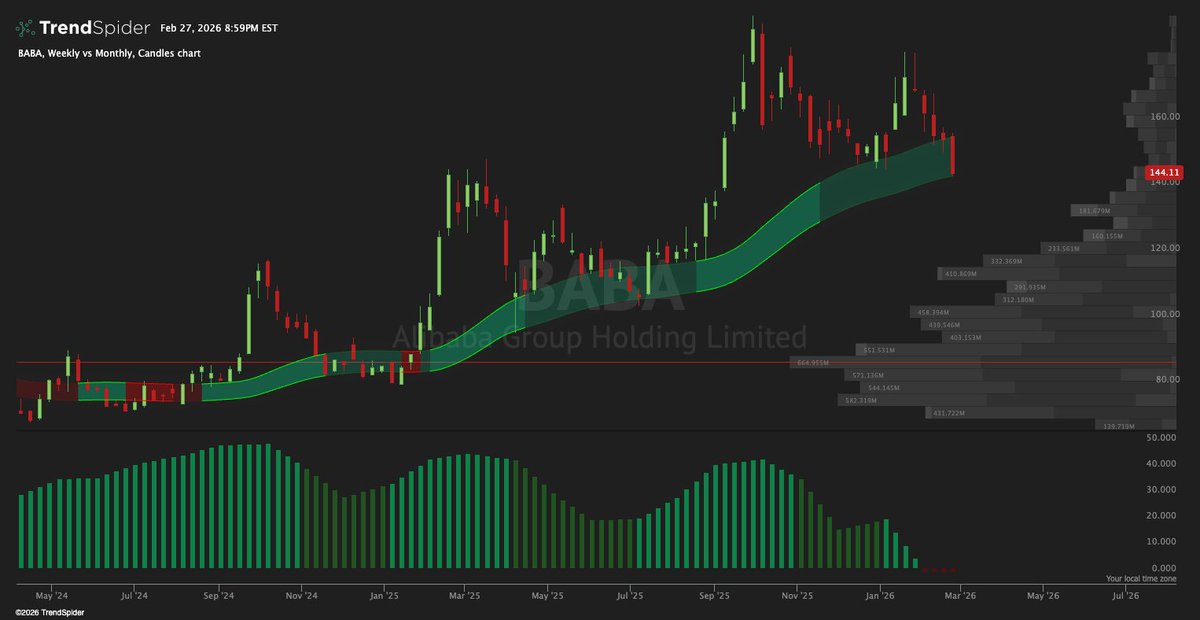
$BABA ripped 20% off the lows but that move is now fading.
Monthly BX just closed dark red, which usually signals a coming correction.
I’m removing my bullish thesis and stepping aside here.
Plenty of big tech just printed dark red Monthly BX, but $TSLA is still in Bull Cycle.
March needs to bounce or we likely get a sharp correction.
System is green so I’m still bullish, but I’m not married to this name.
If Bear Cycle confirms, I’m out and the thesis is gone.
$NVDA has a very real chance of a 20%–30% correction in the next 2–3 months.
Monthly BX just closed dark red for the first time since Feb 2025.
That setup has led to a deeper pullback about 80% of the time.
I hope I’m wrong. 💯
But rules > hope. I’m closing all bullish positions Monday.
QQQ just flashed a dark red, lower low on the Monthly BX. Historically, that usually means a 5%–10% correction before a real bounce. 🚨
No, I’m not shorting.
We’ll just rotate: weak tech falls off, stronger sectors (including DOW names) come in.
I’d rather miss an ugly bounce than ride a 10% burn.
Is now finally the time to buy $MSFT after a 20% drop?
Price just hit a massive long‑term support zone that usually marks major bottoms… but my Monthly BX is still dark red, which is not a buy in my system.
In the video I break down whether this dip is worth taking or not.
Everyone’s asking if this $MSFT dip is a buy or the start of something bigger.
Price is sitting on a major long‑term support + smart money zone… but my main signal (Monthly BX) is still not bullish.
Let's go over my outlook for the next couple months ⬇️
$BTC todos dicen "compro bitcoin" o cualquier variante de comentario de aca se compra etc
Saben cual es el problema, los boluditos del bitcoin me llenaron tanto las pelotas que dije no voy a poner nunca mas el grafico en el momento clave solo despues
Enjoy... la bombilla de cuero en sus culos
Una linea como siempre, pero no de mercad de analisis pelotudos
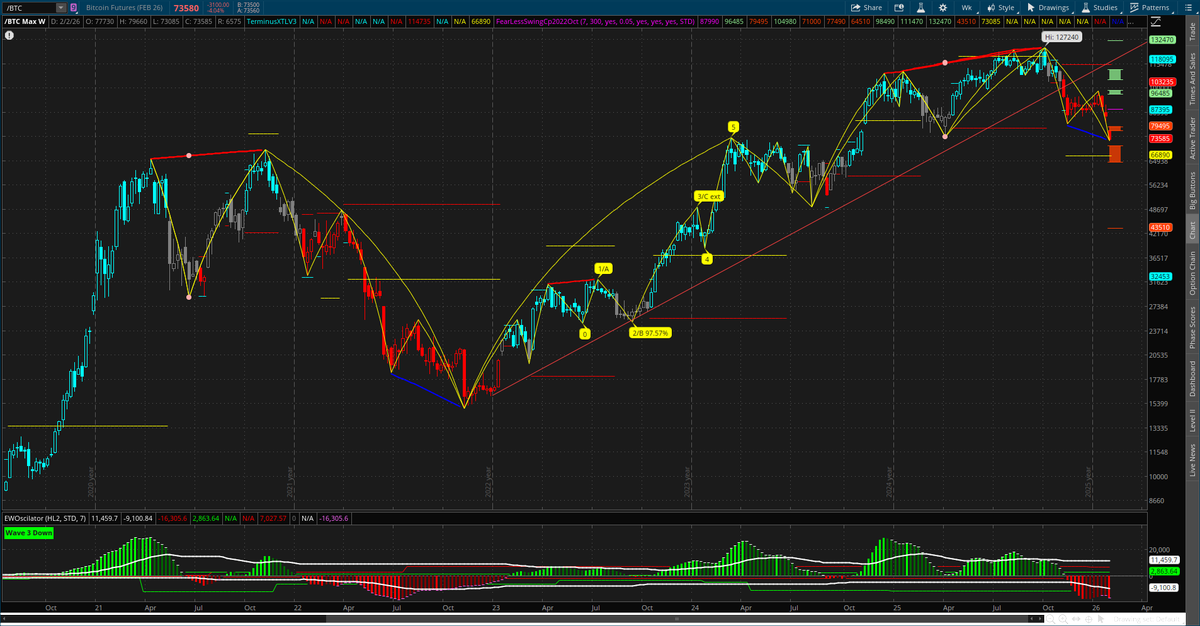
Bitcoin isn’t “on sale” to me. It’s doing exactly what my November warning mapped out. 🚨 #BTCUSD
Monthly BX flipped red, 100K broke, and we’ve now flushed into the 70–75K zone I flagged months ago.
In the video I break down why I’m still not buying this dip.
Sector Spotlight: Semis 🚨
$NVDA $AMD $MU $TSM $INTC have been some of the biggest winners.
I’m not bullish on all of them from here.
New video breaks down which I’m still betting on, which are holds, and which I’m avoiding.