Introducing Scrape Anything.
we merged all our scraping APIs into one
inputs: websites, PDFs, DOCX, PPT, XLSX, 40 file types, anything.
into HTML, markdown, screenshots, images, JSON & more
Give us a URL, get your data
No need to worry about bot blocking, js rendering, proxies, iframes, shadow doms, retries, etc..
All the weird edge cases are our problem :)
Bangalore, we're here.
Flowli's on the ground for 20 days.
founders, builders, and the parts of the story nobody puts on the landing page.
BREAK THE 4th WALL.
i had a similar experience a few weeks ago.
for me, i think it was stress + uncertainty.
@naaavinash mentioned something along the lines of: changing what you do day to day to make you feel better
and i’ve been feeling better because of that.
here’s what i did differently:
- focus on getting better physically for the timebeing
- doing work, but i’ve been trying to condense it into a few hours (for the time being)
work still consumes most of my hour - but i’m trying to follow my curiosity in the other hours of work
I'm really struggling with my health.
Debated for a while to come on here and share this with you all but feeling a bit out of options.
Still showing up in a lot of areas in life but I feel like it's this constant balance between very high high's and very low low's.
Spent tens of thousands of dollars testing, coaching, you name it but I genuinely feel stuck.
Main struggles:
> Very little energy: I either "work" or "work out".
> Waking up tired, no matter how much I sleep
> Days where I really struggle to get out of bed
> Gut issues all the time. Feeling sick quite easily.
> Heavy mental strain of not being able to show up the way I've always had. Slow responding to stuff, putting stuff off easily because I don't have the energy.
> No appetite and eating very little (been losing weight).
Open to suggestions & feel free to ask anything.
trying a new fitness routine - and god, the first few days were awful.
my body felt like it had no energy left
painful everywhere
but now: i feel more energetic, same workload doesn’t feel as challenging
it’s really the simple things that keep compounding to make you better
@theandreboso the idea of having to vibe code Granola to save $14/mo gives me the ick.
imo: this makes sense for HUGE orgs who are spending tons on a particular software and want to save millions (like Tesla with Slack, or maybe Salesforce)
this… i could build out this 30$ product that i’m using with my own hermes setup…
but it’d not be the same. and the people working for the product are shipping constant improvements. i don’t want to be spending hours polishing my own hermes setup just to save those $30
this is true for more and more use-cases that are frequent. unless you really enjoy doing it (kinda like setting up your ikea furniture or building lego), OR, you don’t find a solution tailored to your needs in the market, custom built software isn’t the answer imo.
We’re slowly starting to see the pendulum swing back as people realize that replacing production software with vibe-coded alternatives isn’t always the smartest idea.
You only have so many hours in a day.
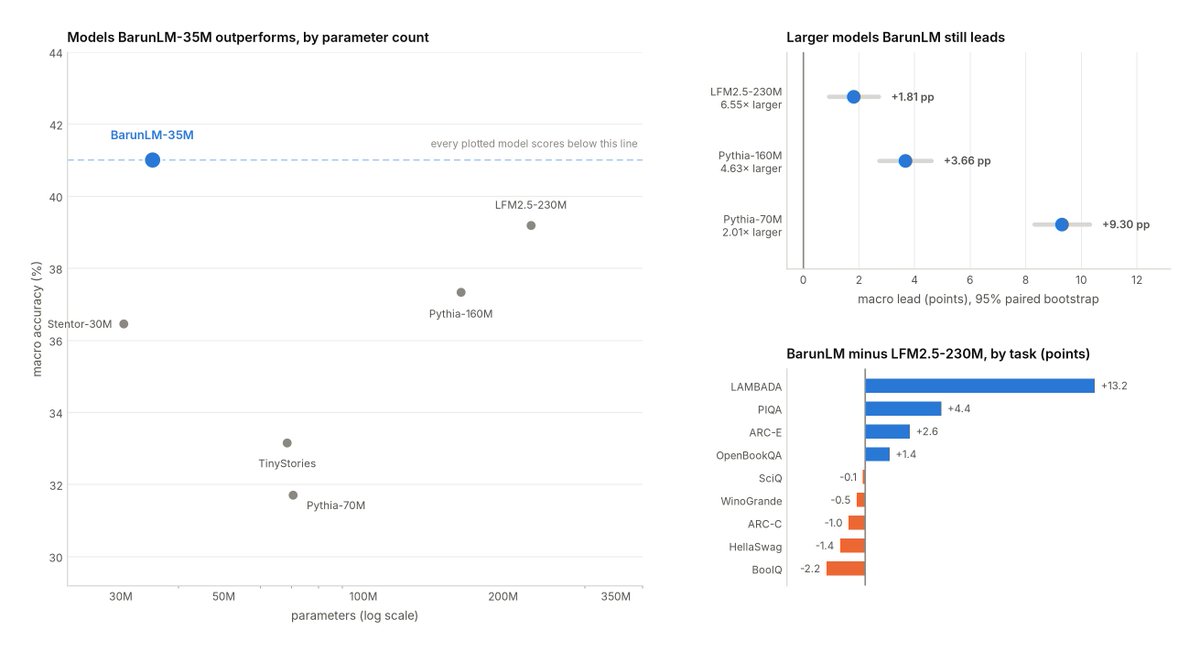
introducing BarunLM (35m) 🤗
i pretrained the world's best small model under 100m parameters.
a 35m parameter language model that outperforms models over 6x larger, including LiquidAI's lfm2.5-230m, while training on a single H200 gpu.
the gains come from a better architecture. we took inspiration from deepseek, kimi, and other frontier open source models.
BarunLM combines hybrid local and global attention, grouped query attention to reduce memory, partial rope, gated attention, bounded swiglu, and residual selectors to improve how information flows through the network.
after pretraining, we further improved the model with rlvr (reinforcement learning with verifiable rewards) using deterministic verifiers and rloo, allowing the model to reinforce correct reasoning without relying on human preference labels.
@mugatu_eth @t_blom@elonmusk imo: it's not about how much time it saves. people might set it to 100% and forget to switch it back.
but yeah, once you notice it's 100%, you probably will switch it back
@naaavinash great advice! i’m thinking of just doing things i enjoy (even when it comes to building + fitness / other personal life things) until i get the fire back
okay, i've a confession:
i'm having trouble waking up - because i am not sure what to do anymore.
The question i’m struggling with is: how long do you stay working on a problem?
You need to balance two things as a founder:
- Stay long enough so you know enough to solve a problem well enough (or don’t let fear win you over)
- Have the courage to start over because some problems just aren’t a good fit (for you...)
I know every genuine problem has a decent market - but the question is: whether you’re the right person to go for it?
not sure... and it's been kind of difficult to get out of this rot.
i think we finally have enough clues to reverse-engineer ilya sutskever’s secret SSI research.
my highest-probability guess: SSI has found a brain-inspired way to make an AI continually learn.
today’s frontier models learn mostly during training. afterward, their core knowledge is largely frozen. they consume enormous datasets and still fail strangely when a problem falls outside their training.
SSI may have an early system that can:
• learn a new skill from very few experiences
• recognize when an approach is failing before reaching the final answer
• update itself without erasing old skills
• transfer one lesson into completely different problems
• keep learning after deployment
think of it like a gifted teenager instead of a finished encyclopedia. it may not begin knowing every profession, but it could rapidly learn any profession.
the evidence lines up almost too cleanly:
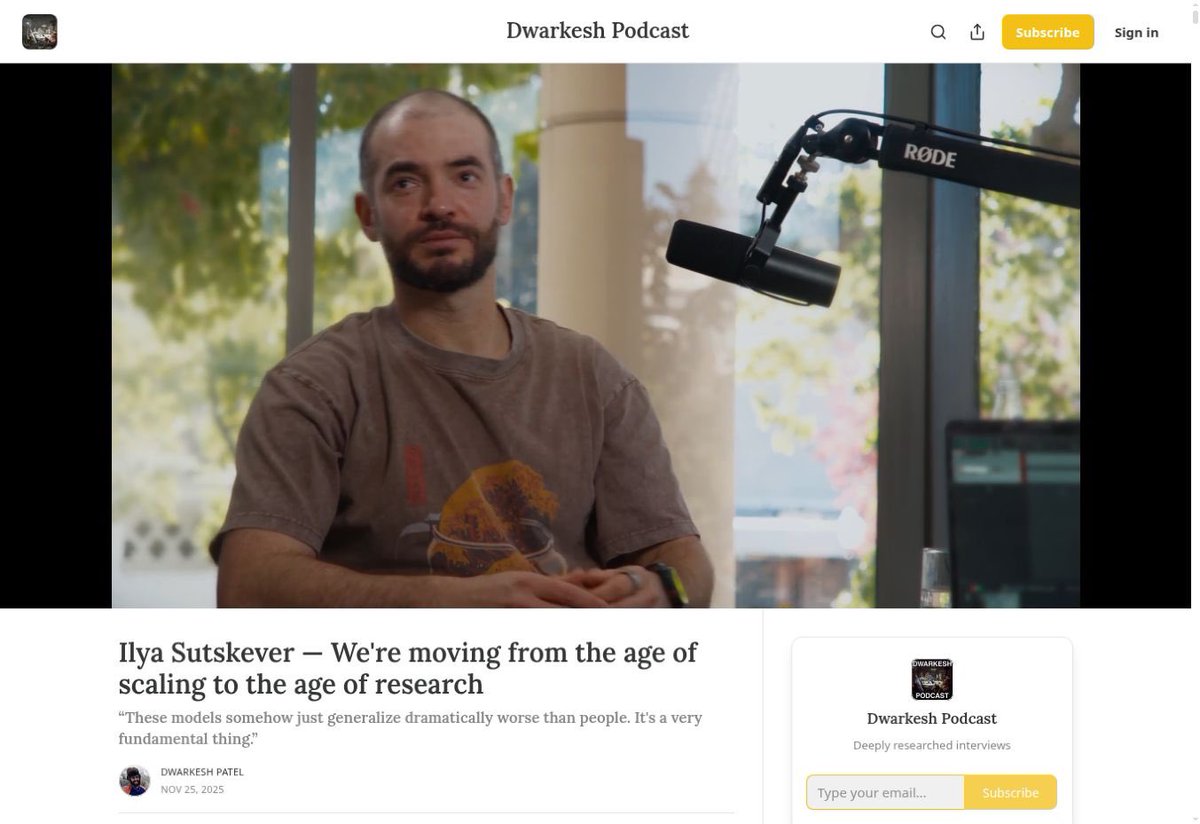
ilya called poor generalization the fundamental limitation of current AI. models “generalize dramatically worse than people.”
he described SSI’s target as a “superintelligent 15-year-old” capable of learning any job.
when asked how to create human-like learning, he said there is a machine-learning principle he has opinions about but cannot discuss publicly.
WSJ now reports that SSI’s secret research focuses on “overlooked aspects of how the human brain functions.”
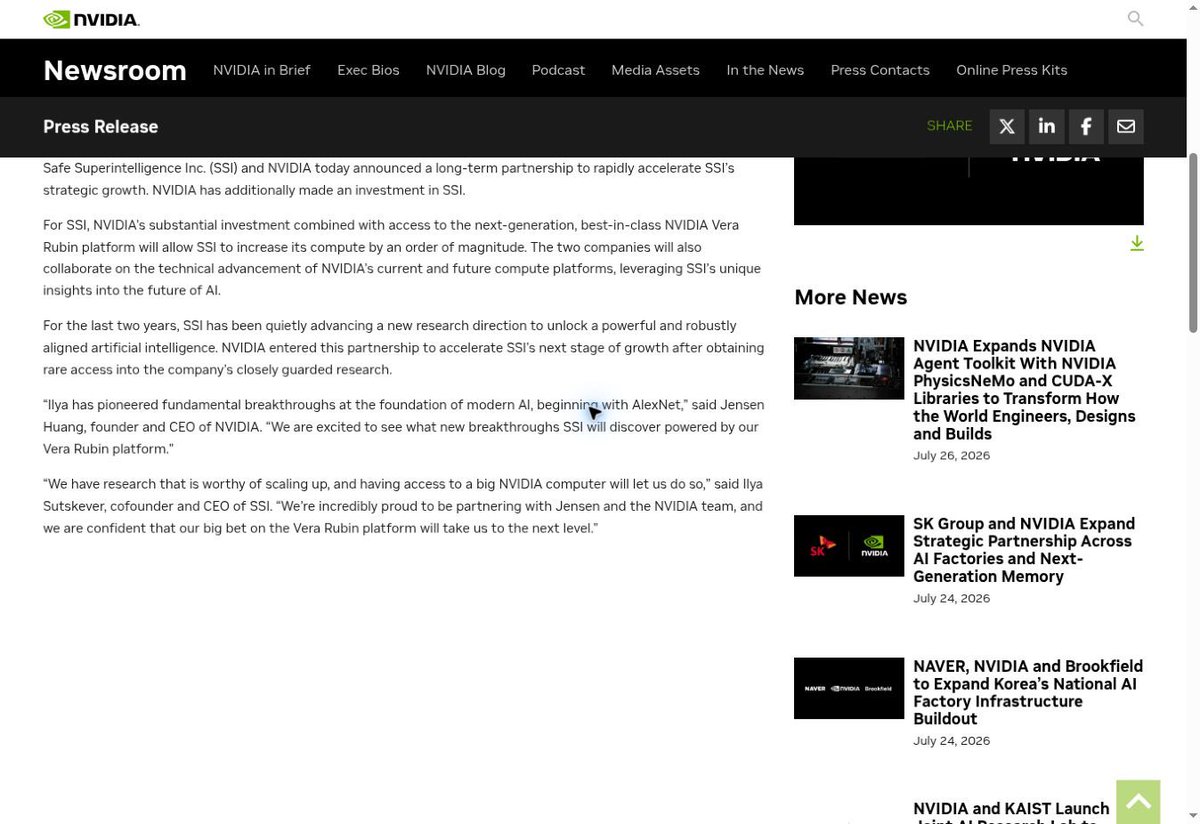
Nvidia received rare access to the research, made a substantial investment, gave SSI 10x more compute, and agreed to let SSI help shape future computing platforms.
my technical guess:
experience → internal judgment → self-correction → durable learning → transfer → repeat
the internal judgment may be the brain-inspired component.
humans do not wait until the end of a 10,000-step task to know they are failing. emotions, intuition and judgment provide constant feedback. ilya has argued that AI needs an equivalent internal “value function.”
this could also explain SSI’s central promise: capability and safety trained together.
the same mechanism that teaches the AI what works may also teach it what it should care about.
my confidence is roughly 70% on human-like generalization plus continual learning, and 40% that an internal value system is the central mechanism.
the simplest description:
an AI whose intelligence compounds from experience, with its values learning inside the same loop.