In the lead-up to the 2nd edition of the Global Infrastructure Resilience Report, #GIR2025, @cdri_world and @sust_coalition are hosting a #DRIDialogue to introduce two key workstreams and spotlight early insights from the two surveys.
📍 Join us on 29 July at 17:30 IST / 13:00 BST
🔗 https://t.co/CQ606nwZMA
@Ede_WBG@the_res_eng@sirajt@BAyyub
Announcement: The ASME Ayyub-Wiechel Risk Analysis Award. Read more about it here: https://t.co/jKUvumSYnm
Nomination deadline: February 1, 2025
#risk#safety#engineering
Dear colleagues, we are accepting chapters for a forthcoming CRC book entitled “Climate-resilient structures and infrastructures: hazards, methods, and applications”. The book is edited by myself, Prof @BAyyub (U of Maryland) and Prof Michael Beer (Leibniz Universität Hannover).
Out now! ⚡🏦
The Climate Resilient Infrastructure Report: A Focus on Technology explores how digital technology can enhance climate resilience through the lens of the 4 resilience phases:
🔴 Prepare
🟠 Respond
🟡 Recover
🟢 Adapt
➡Check it out: https://t.co/FlxO4kGFGe
🔥 Wildfires & Utilities 💡
Find out how risk tolerances & attitudes shape strategic decisions in community resilience to wildfires in this featured @asceasmejrues paper. @BAyyub
🔓 Open Access: https://t.co/JWlk0I6Sok
This paper proposes a general ridership pattern, considers different failure cases, and uses a novel methodology to quantitatively measure the weighted-network resilience attributes. @BAyyub
https://t.co/SwgJs2Daoa
We need a ceasefire & return of the hostages, & Pres. Biden needs to put forth a big, bold plan for a two-state solution that guarantees Israel’s security – so there are no more October 7ths – and allows for self-determination, security & dignity for the Palestinian people. (6/6)
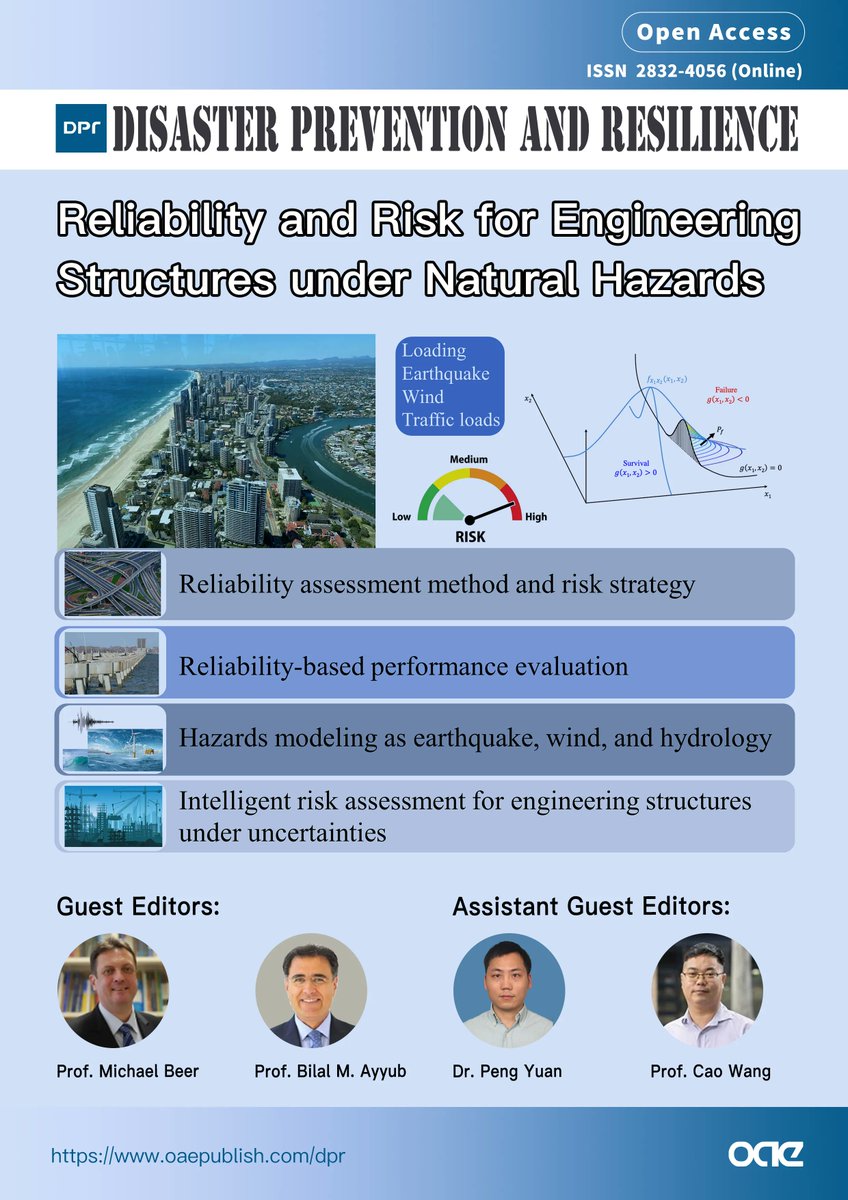
Dear Colleagues, we cordially invite you to submit to a special issue themed “Reliability and Risk for Engineering Structures under Natural Hazards” in @OAE_DisPrevRes. Submission deadline: 30 Jun 2024. https://t.co/YZ9A7BACVD
In this paper, a new resilience measure is proposed that incorporates a requirement of anticipated recovery time (i.e., whether the recovery can be completed before the anticipated time). @DrCaoWang
https://t.co/nxWbptU8uU
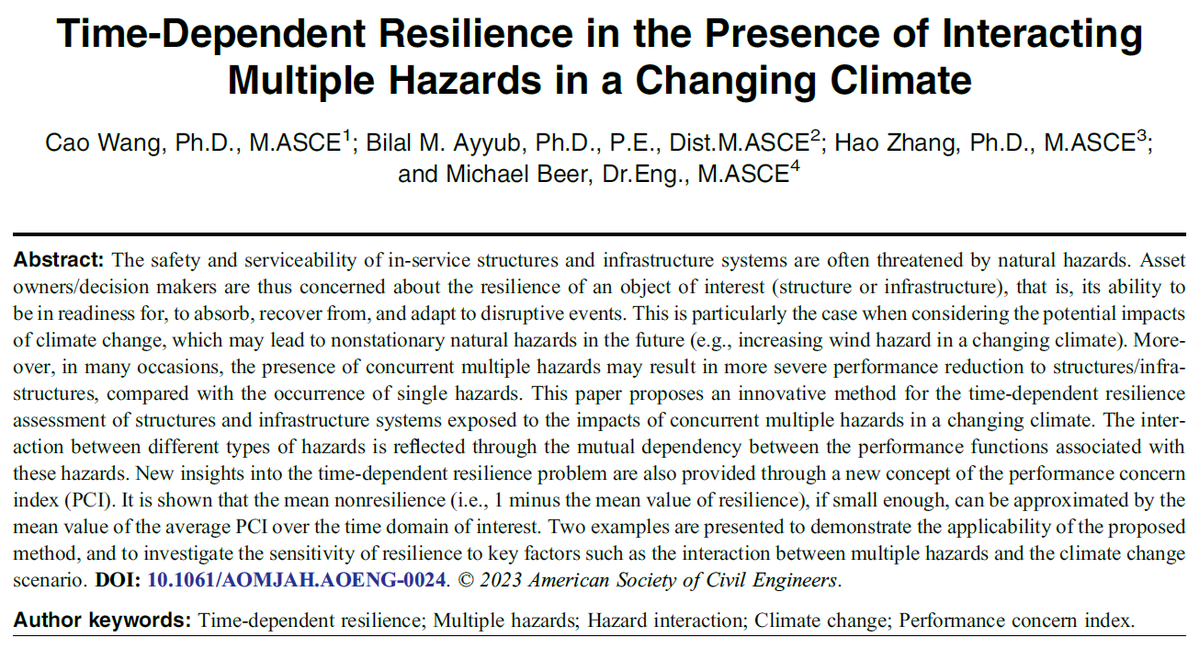
In this new paper in @ASCEpublishing ASCE OPEN, we proposed a new method for time-dependent resilience assessment of structures and infrastructure systems exposed to the impacts of concurrent multiple hazards in a changing climate. @BAyyub
https://t.co/4bWMDzOUa0
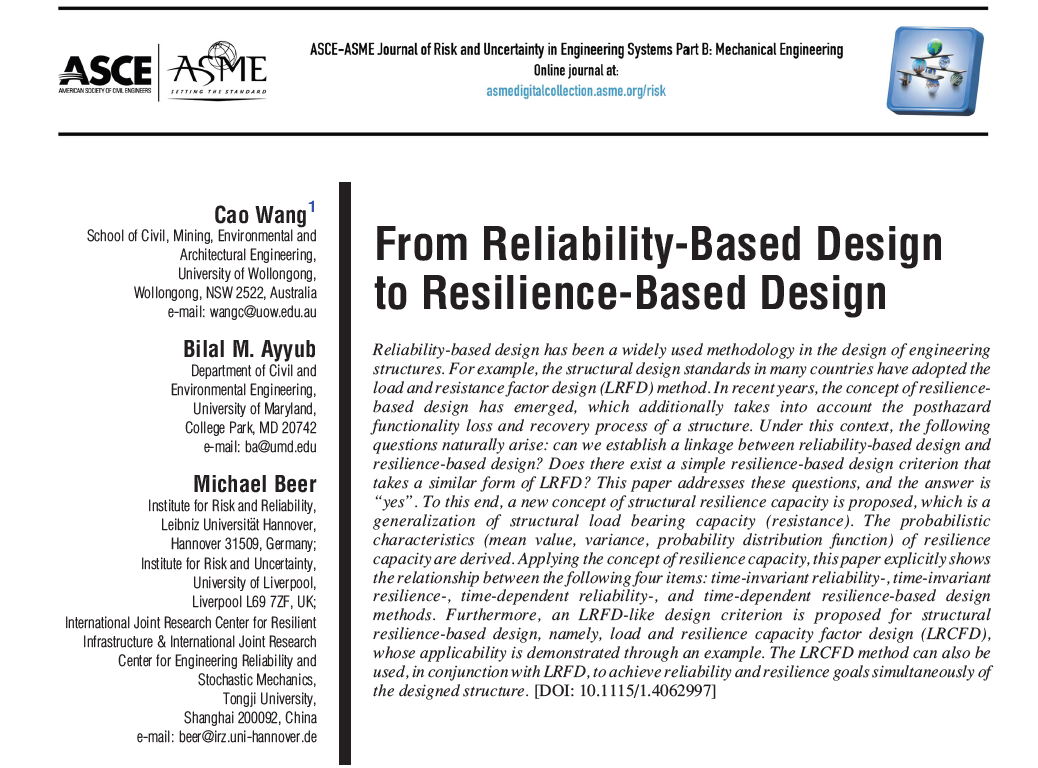
Happy to share this new paper in @asceasmejrues, where we established a linkage between reliability-based design and resilience-based design. @BAyyub@ASMEJournals
Link: https://t.co/QHaeJ55iIb
Sustainability and climate-resilience imperatives, new geopolitical headwinds, technology and connectivity issues: all call for a rethink in how #infrastructure is designed, built and maintained. How does this affect global infrastructure?
ISPI Report → https://t.co/frE4NKxKXi
Resilience model for coastal-building foundations with time-variant soil strength due to water intrusion in a changing climate
https://t.co/l5hMtAzDv2
@BAyyub
Resilience model for coastal-building foundations with time-variant soil strength due to water intrusion in a changing climate
https://t.co/l5hMtAzDv2
@BAyyub
I am happy to share with you our paper on Risk assessment of roadway networks exposed to landslides in mountainous regions—a case study in Fengjie County, China
https://t.co/cpMz4ClJ8W
Happy to participate covering the ASCE-NOAA collaboration with the Center for Technology and Systems Management of the University of Maryland on climate-resilient. WED webinar: Collaborative Engineering Initiatives for a Sustainable and... https://t.co/LuLjbmmQSl via @YouTube
We would be very pleased if you could accept this invitation and meet with us at INSPIRE 2023. The deadline for submitting abstracts is January 13, 2023 . Please submit your abstract according to the instructions online through the conference webpage. @BAyyub