Could not be more excited for our clients, @tursodatabase and also @supabase about this acquisition. A big win for both the supabase and Turso communities!
Turso is joining @supabase.
Together, we're building the database platform for the agentic era: everything agents need, from lightweight databases to Postgres at petabyte scale.
More details in thread. 👇
Turso 0.8.0 is here. And it is a pivotal moment for us: make it right, then make it fast: whereas our previous release brought Concurrent Writes on @tursodatabase out of beta, and given the fact that our parity with SQLite is already good enough for most applications, the time every performance nerd dreams about has arrived: time to make it fast!
With the addition of things like group commit, that amortizes the fsync time, and general improvements to the core data structures, Turso is now up to 7x faster than SQLite with 500x lower tail latency when concurrent writes are used.
In the blog post, we also honor the great @BenjDicken, by showing you how it works with the thing that we all love: balls.
This is such a great moment for us, so expect an action packed week: throughout the week we will release more things to celebrate this special moment. Deep dives into the architecture, some cool Cloud announcements, and more!
Link to the blog post 👇
Excited to announce Blaxel is joining @Baseten! Together, we are building the future of agentic infrastructure.
More details in thread. 👇
For everyone building on Blaxel today: nothing changes. The product continues, and we keep shipping.
In 2026, code is written faster than we can physically read it.
25 PRs before lunch. Your whole app rewritten in Rust in 18 hours.
But reliability hasn't kept up. Monitors are an afterthought, alerts pile up ignored, and when prod breaks, your customers notice first.
That's why we're launching Struct: the AI Production Engineer.
It reads every PR you ship, creates monitors for each one, and fixes things when they break. (Humans optional.)
Keep moving at AI speed and never think about monitoring again.
A viral moment is fleeting. What’s the point of investing 40K+ in a video that does numbers but doesn’t convert? Tired of seeing these manufactured, inflated launches that lack any substance.
Just so everyone knows...we got a quote for a “launch video” package from the company everyone uses.
$17K for the video. +$25K and they hand you 50 influencers who will push it, repost it, and flood the comments so the viewcount goes above 500k.
That’s the exact recipe behind almost every “viral” slop launch video.
Today we're launching Agent2Agent on @inkbox_ai. For your agents to behave like teammates, we gave them identities with their own email, phone, and iMessage.
We've noticed a growing pattern: as agents become more autonomous, humans relay information between them. It's slow and bottlenecks the work. Inkbox brokers A2A so agents can communicate and delegate directly across systems and organizations.
> client agents don't maintain a callback endpoint or per-peer secret
> worker agents don't need to be online when the client calls, and don't keep their own durable record
Try it: https://t.co/IyKUNJhlf5
I am excited to announce that we are officially writing a new version of Postgres. In Rust - and creating the LLVM of databases in the process.
In the span of a year, we have rewritten SQLite. Keeping the compatibility, increasing its feature set. MVCC, Types, (Live) Materialized Views, among other things. In the process of doing that, we have realized: At the end of the day, what makes SQLite special is that it compiles SQL to a database-specific bytecode. So why can't we compile *Postgres* to the same bytecode?
Turns out we can. I ran an experiment called pgmicro as a way to prove this hypothesis, and it works very well. It is time to make this official, and put the weight of Turso behind it. We shall give the world a modern take on Postgres. Wire compatible, but built on a new architecture.
We have already heard of others wanting to extend this. MySQL? Redis? the sky is the limit. What can we do if we do for databases what LLVM did for compilers? To prove how powerful the SQLite bytecode is, we are actually running DOOM compiled to the unmodified SQLite instruction set. And because Turso runs natively in the browser, you can play the game in your browser. With the database executing it.
Read the full story below! 👇
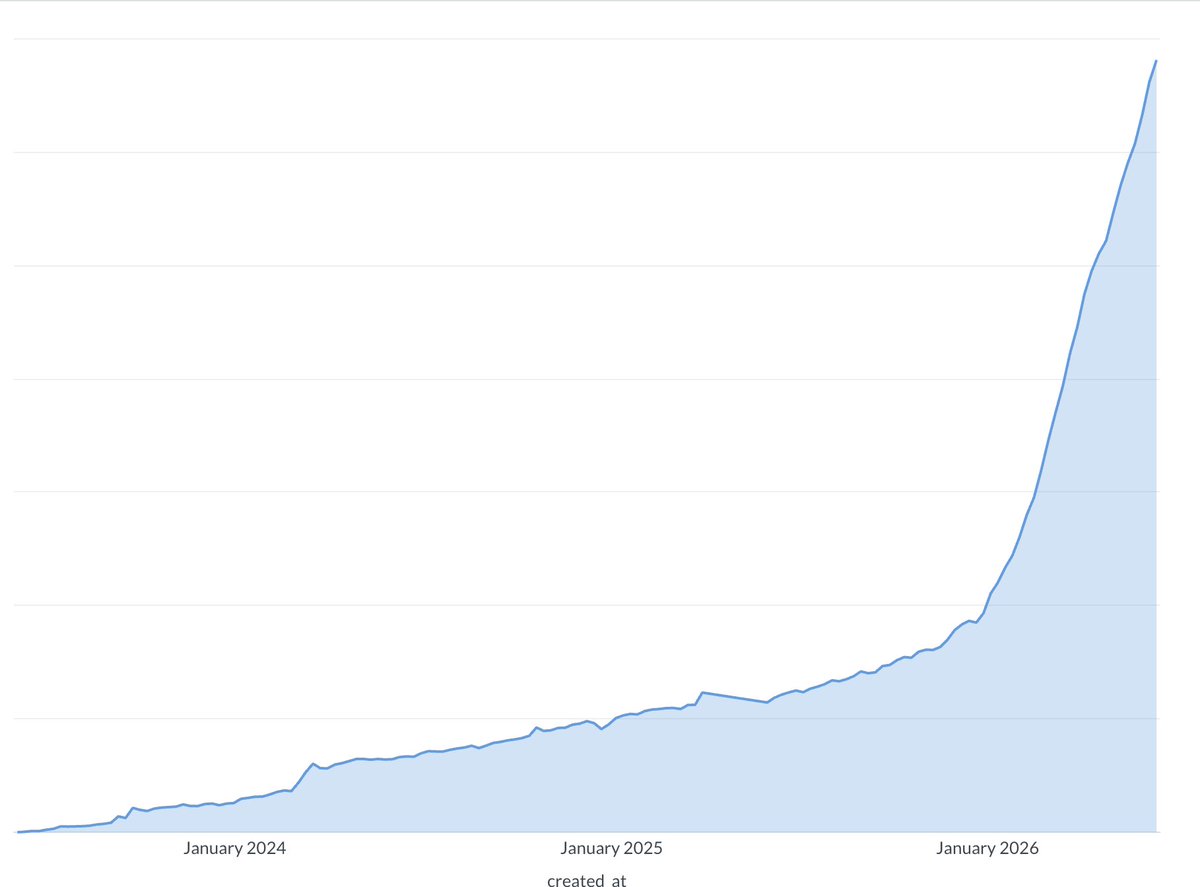
Weekly Active Users on the Turso Cloud
If you are one of the users now finding what a lighweight database can do, either locally or in the Cloud... welcome!
Excited to join Rubrik next week for a conversation on resilience, AI, and what modern enterprises need to be thinking about next.
https://t.co/Aqr2PDWO59
Blaxel is now integrated with Stripe Projects!
Now, agents (and humans) can spin up accounts and resources from the terminal directly through @Stripe, and get back credentials without dashboard hopping.
https://t.co/hTiOfb6con
Ok, trying this again, since last week I had trouble convincing the Reddit mods that I am me.
Tomorrow, 9 AM Central: ASK ME ANYTHING! (you can start asking now, and I will reply tomorrow)
https://t.co/2ajYKjYSBY
So proud of our client, Hexo Labs, as they announce their open source self improving AI called SIA. Superintelligence is becoming a closer reality to solve the worlds most challenging problems.
HexoAI just open-sourced a self-improving AI that updates its own weights 🤯
The loop runs three agents:
> a meta-agent builds an agent for your task
> the target agent attempts it and logs everything
> a feedback agent rewrites the harness and updates the weights
Then it repeats, improving each generation.
100% Open Source.
Weights update is the real breakthrough in continual learning
Frontier coding agents are strong, but they're frozen. Point Claude Code or Codex at a task and they can't keep getting better at it. You can see it across all three benchmarks: they sit near the baseline and barely reach the prior SOTA line.
With harness-only updates, we land in roughly the same neighbourhood.
The breakaway happens once you update the model's weights, far past everything else. Self-improvement isn't a smarter scaffold. It's letting the model actually learn.
In a harness update, the meta-agent only teaches the task-specific agent software engineering i.e. better parsers, retry logic, tool dispatch, search procedure. It never touches the domain itself.
On LawBench it can build a cleaner classification pipeline, but it can't make the model understand Chinese criminal law.
Weight updates do exactly that: gradient pressure pushes the model into latent reasoning about the problem - disambiguating 191 charge categories, internalizing H100 kernel patterns, learning that imputed RNA counts must be non-negative integers.
The harness shapes how the agent searches; the weights make it a domain expert.