Some news… I’m very excited to say I have been appointed the new political editor at The Sunday Times!
It will be a wrench leaving the Telegraph. I’ve been here 14 years (a third of my life!) and owe a lot to the editors who have supported me during that time.
I’ve admired The Sunday Times’s dogged, agenda-setting journalism all my career. Their political coverage has a reputation for being fair, incisive and revelatory - values more important now than ever in these uncertain times in Westminster.
I’ll be starting in September. Who knows where politics will be by then? Can’t wait to get stuck in.
Worth noting one thing that didn't happen yesterday. "Bond yields barely moved in response to the chancellor's measures," the FT editorial notes. So a tick from the markets on day one.
Useful chart in the FT on fiscal headroom.
Reeves nearly doubled it, believing tax hike speculation by keeping headroom so small was damaging.
In some ways she's been proved right: £12bn of the £24bn she left was wiped out by the US-Iran conflict impact in the last 6 months.
But Healey (who's left £15bn) is now nearly back to where Reeves was after her early fiscal events. Plus there's now big spending pressures next year.
So... prepare for 6-12 months of heightened tax rise speculation to come...
Interesting knotty problem coming on devolution...
As the IFS briefing points out, letting mayors keep more of their tax receipts that means either...
A) Scotland / Wales / Northern Ireland getting less in Barnett Formula as those tax receipts aren't going into the Treasury then back out again any more
--OR--
B) Ensuring devolved nations still get the money... which means other parts of England not getting money from, say, a booming London and Manchester but Scotland / Wales / Northern Ireland regions benefitting.
Both can't be true. So either devolved nations lose out or other parts of England lose out.
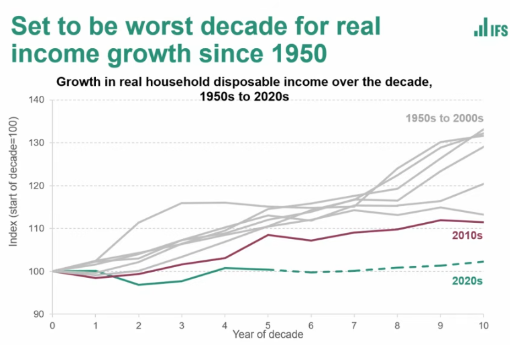
The wider picture, via the IFS: The 2020s will be the **worst** decade for real income growth since 1950.
(NB: Tories and Labour of course both in power during that decade)
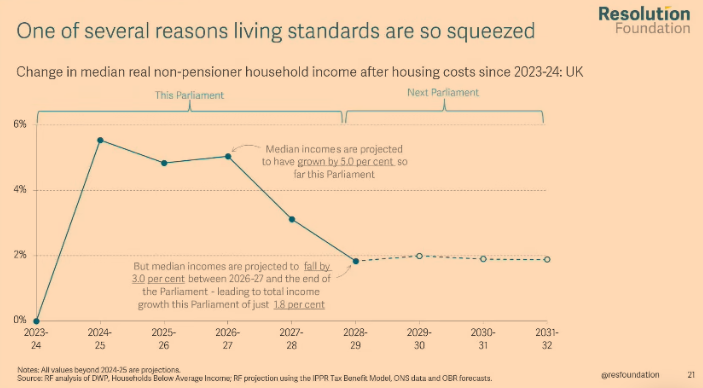
This utterly bleak line from the Resolution Foundation on living standards in their overnight Budget analysis.
"Between now (2026-27) and the end of the Parliament (2028-29), typical incomes are forecast to fall in total by £1,050 (3 per cent)."
In other words: On average we'll be getting poorer in the run-up to the next election.
Here's the chart that explains it. Living standards have actually jumped 5% in start of the parliament. But look at that line dropping markedly from now to 2029.
It means, on current forecasts, Labour will be going to the country seeking a second term as people are getting poorer. (Historically, not a great platform for re-election.)
It seems to me impossible to underestimate how much Donald Trump and his Iran conflict overshadows the next year's public finances.
The OBR on page 1 of its proper analysis says higher energy prices (ie from Iran) than expected could mean borrowing is £17bn more next year than expected... or if lower than expected, £12bn less...
Given the headroom is now £15bn, that is essentially saying 'all this could be wiped out if the US-Iran conflict escalates'.
Stephanie Flanders, Bloomberg economist and ex-Beeb, reports in Res Foundation briefing just now that the Pentagon assumption is Iran conflict will last **all the way** through Trump's presidency (ie to end of **the end of 2028**).
At the same briefing, the OBR chief (Jonathan Haskel) suggests economic growth forecasts would need to be downgraded if Iran war does indeed escalate.
In other words: The most significant unknown in the UK public finances right now appears to be whether Trump will launch fresh bombing raids (possibly alongside Israeli PM Netanyahu still in post) after the midterms.
Can anyone confidently predict that will not happen?
Hidden amid the Budget fallout lines in the Politico Playbook email, this significant moment...
"The Conservatives have overtaken Reform UK to enter second place in POLITICO’s Poll of Polls for the first time since December 2024."
Kemi Badenoch on the Budget:
"Most people in the country listening to this Budget will be thinking to themselves: 'Is that it, really? Is that it?!'
"The Prime Minister came in promising to reverse 40 years of neoliberalism. Instead, we got 4p off gherkins."
Great stat by Ed Conway: this Budget has a record high number of measures (98) but the average value of each scorecard measure is a record low. Lot of fiddling...
That felt to me like a small, defensive Budget, with the big decisions punted.
Political imperative appeared to be protecting the Burnham bounce by avoiding a third massive tax hike.
Tax only raised by £7bn, compared to £40bn and £26bn in Reeves’s two budgets. Chancellor made merit of no raise on workers. Popular targets hit: Banks, bookies, vape shops, landlords.
Focus from spending on taking the edge off cost of living in a targeted way. £100 quid off for council tax bands A-D. Zero biz rates for 70k more high street firms. But v limited: Just £6bn extra spending.
No path to 3% GDP defence spend by 2030 laid out (though ‘target’ now publicly adopted). No overhaul of welfare yet. No big change to departmental spending. All punted to 2027.
Meanwhile economic numbers are bleak. Growth down to 1% next year (down from 1.5%). Inflation heading to 4% early next year. Real living standards now falling rather than rising. And all fundamentally out of Downing Street’s control: Trump’s Iran conflict defining the weather here.
Treasury pointing to “radical” devolution, handing over tax receipts to mayors, and non-tax moves like encouraging AI growth and tax cut for entrepreneurs.
But in scale it felt small. The big qu: Can this government afford to be small given the scale of challenges faced?
(NB: George Osborne just called it “the least consequential budget that I can remember” on tax and spend).
If you have time / interest / need of distraction please do read this long write-up of four interviews I’ve done with Andy Burnham since he became PM.
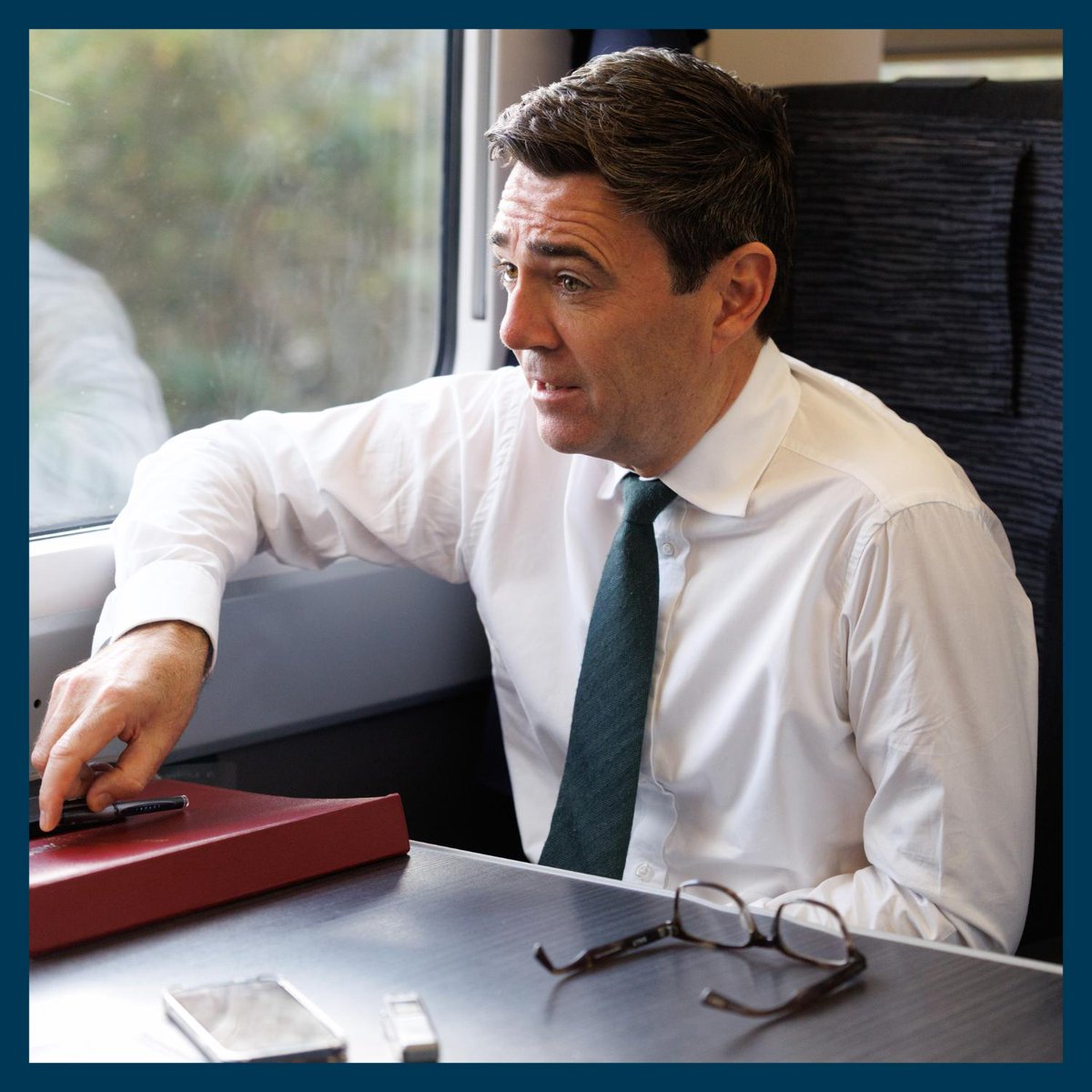
Port Talbot in August at the steelworks… Liverpool in Sep the day after his Labour conference speech… Manchester in October on his NW roots… then this week on a train to Paddington.
The 100 day project has been at attempt to understand who Burnham is, what drives his politics and what he intends to do with power.
Full page spread in tomorrow’s Sunday Times on it all… or read it below first…
https://t.co/Sts8O8XquF
Ahead of Tuesday’s election, I spent the past week driving across Israel and the West Bank, from Lebanon to the gates of Gaza.
This is the country I found, frenetic, divided, angry, joyful, messianic and anxious. Its future is up for grabs.
https://t.co/ap8eRUTfBN
Tomorrow is Burnham’s 100th day in office. To mark the occasion, the prime minister sat down for a series of four interviews with The Sunday Times.
🎧 Listen to The Story podcast with @benrileysmith and @rosiewright99: https://t.co/WgEoxkzLMw
🔺 EXCLUSIVE: Britain’s new PM has fought impostor syndrome, ended Labour’s Brexit omertà and spent more time on foreign affairs than he expected.
The Sunday Times accompanied Andy Burnham at points throughout his first 100 days in office. He discussed family connections, personal motivations and the contours of a project now shaping all our lives.
What emerged was a man driven by an outsider’s energy and liberated by his surprise second coming; a leader trusting instincts and determined to set the political weather on his terms.
🔗 Tap here to read more: https://t.co/6MTFnUS4BL
🧵On debate about free movement, think there are a couple of reasons to think that it may have less potency than in 2016 as main battleground of EU debate. But also that polling could be downplaying it's potency in the debate