I'm a campaigner and facilitator who cares about social justice, peace and people's empowerment and participation. We can make a difference! (pronouns: he/him)
Lift broke on 23/6. 29/6 received letter from person responsible for lifts at @Clarion_Group with explanation. As a wheelchair user I've been trapped at home for 6 days. Clarion did not return my calls or offer alternative arrangements. Not treated as emergency. Dreadful service.
.@elonmusk says that no one can name a person who died from his aid cuts. In fact, I've met the kids who are dying, and I've talked to the families who lost children. In my columns, I've cited many, many names of people who have died because of Musk's aid cuts. A few examples:
*Yamah Freeman was a 23-year-old woman who died in childbirth because Musk cut funding for the diesel for ambulances in her part of Liberia. She couldn't get to a hospital and died as people were carrying her there. I talked to her parents and sister in their village.
*Gbessey Kiadu, age 1, died of malaria because of his cuts to malaria medication in Liberia. I talked to his mom in her village.
*Ibrahim Koroma, an infant, died of AIDS in Sierra Leone after he interrupted HIV supplies. I talked to health workers who cared for him.
*Achol Deng was an 8-year-old girl with HIV in South Sudan who died when Musk cut funding for the health care worker who provided her medicines. I talked to the healthcare workers.
I could go on and on. In almost every village you go to in South Sudan, Uganda, Liberia, Sierra Leone or other countries I reported in, you find people dying because of aid cuts. I challenge Musk: Come with me on a reporting trip, and we'll talk to these moms and dads, and you'll see the dying children themselves. I think if you see the kids whose lives are at stake, maybe you'll change your mind.
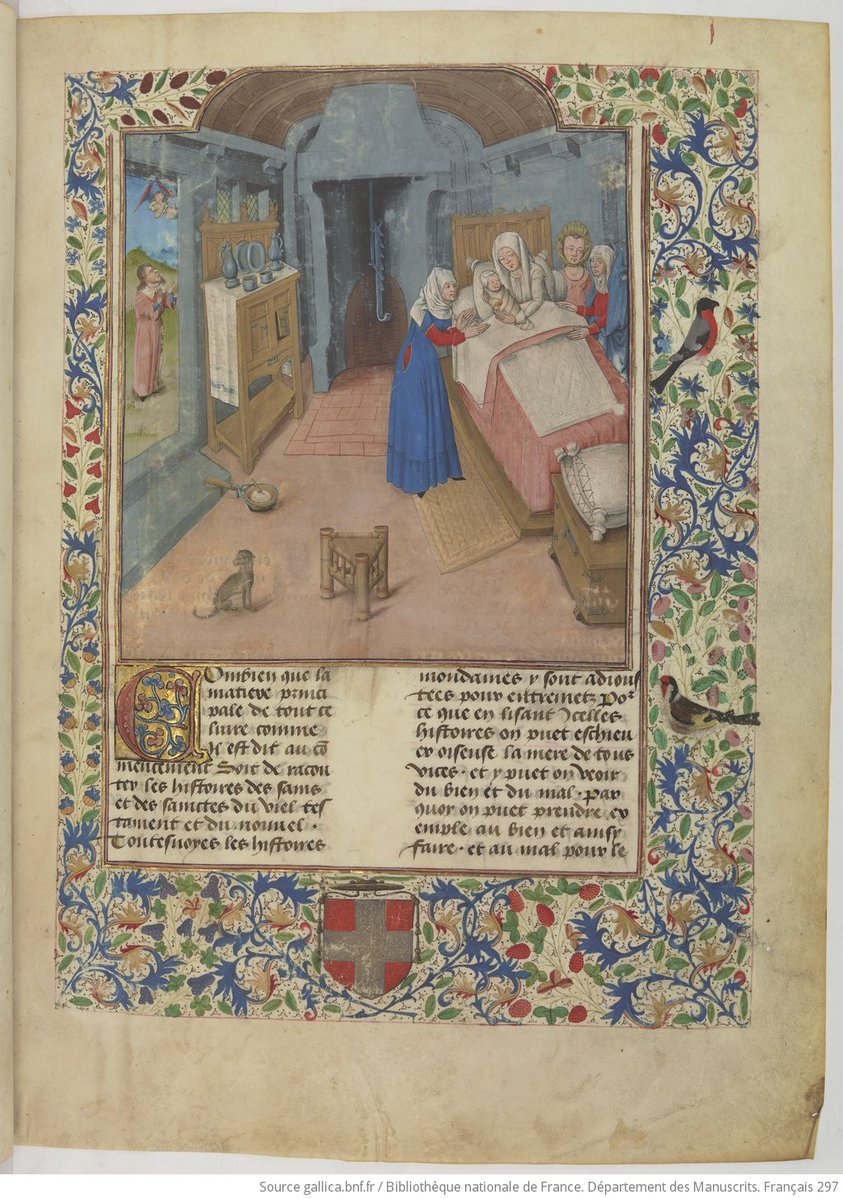
Lovely drawing of the birth of Mary in 'Fleur des histoires', 15th century.
Completely historically inaccurate, people didn't look or live like that in AD0 ;)
Sorry, couldn't resist, but let's do a mini thread looking at some details.
https://t.co/a7qerVZlzP
I don’t know who needs to hear this, but … when you have your require people to read scripture so you can indoctrinate them it means first, that your faith is a cultural plank not devout praxis. Second, it means your lived witness is pathetically weak.
There will be no nature restoration
There will be no climate change mitigation
There are no public goods because no one wants to pay for them
These are massive problems but they aren’t farmers responsibility alone
And the state just washed its hands of them - remarkable
So this is how an unchecked local rumour in a local Facebook group grows to become national misinformation. Read more about the rise of local misinformation and what we can do to tackle it in our report here.
https://t.co/Um6aig5gey
This government hasn’t done any of these things… in fact they’ve made doing almost all of them harder
And it goes on and on blithely unaware that choices have to be made… these things don’t all happen together by fairy magic
Seems like we need this vocabulary lesson again.
Normal, Norm & Typical.
Suppose you have 100 ppl & you ask them all if they like tacos & 92 say yes.
Ppl liking tacos is TYPICAL.
If you label people who DON'T like tacos "Weird", then liking tacos is NORMAL.
1/3
Of course we need a lot of food
I run a productive farm
But we have massive nature decline in the U.K. - and legal obligations to address that
And seemingly government that thinks it’s all going to be fine
It is staggering in its agricultural and ecological illiteracy
DEFRA and Natural England seem never to ask the right questions
How much would we have to spend to get nature restoration at scale?
What would we spend it on?
If you can’t answer these two questions you can’t create scaled up nature recovery and are bumbling amateurs wasting £
How can we “unlearn” & “relearn” as a response to disruptive change in the workplace?
It’s an important question because, in times of profound change, knowledge that was once correct, useful or effective can become a liability. In a world where the pace of technological, social & environmental disruption keeps accelerating, the ability to continuously unlearn & relearn moves from a useful organisational capability to a survival one.
I’ve been reading "Unlearning, relearning, & reactivation in times of rapid change & crisis: the case of electric utilities" by Hanna Björner Brauer & Sara Willermark. Its lessons from the Swedish energy sector are highly relevant to health & care & other services.
I pulled out six key points for leaders of change:
1. Periods of crisis, disruption or rapid change are pivotal moments for organisational learning: but are only productive if leaders treat them as opportunities to question long-held assumptions & develop new ways of working.
2. Learning during disruption is fundamentally relational & social: it does do not happen inside individuals in isolation. It’s shaped by relationships - with colleagues (intra-organisational), with other organisations in the same sector (inter-sectoral), with stakeholders across sectors (cross-sectoral), & with citizens & service users (citizen-organisational).
3. "Reactivation" is a distinct & important form of learning: Standard learning theory focuses on letting go of the old & adopting the new. This paper introduces "reactivation" as a third option: mobilising knowledge & practices that exist but have been deprioritised or forgotten. When disruptive change happens, some of the most valuable responses come from rediscovering & updating what organisations already knew, rather than starting from scratch.
4. Efficiency/performance-driven cultures create learning barriers: they actively undermine preparedness & learning capacity when disruption arrives. Leaders need to build in slack, routines & space for reflection & learning, even when conditions feel stable.
5. Unclear role boundaries & lack of trust block relearning: when responsibilities between stakeholders are ambiguous, teams become paralysed about what they are permitted to learn & do. When public trust in an organisation is low, employees are constrained in how they can engage, communicate & adapt.
6. Leaders & policymakers need to actively create conditions for learning: Organisations need stronger analytical capacity to understand the people they serve. Collaboration across stakeholder boundaries needs to be structured, not left to chance. Policymakers need to examine whether the regulatory & structural conditions they create help or hinder the learning that the scale of change needs.
To summarise: disruptive change creates the conditions for deep learning, but that learning is never automatic. It depends on relationships, trust, leadership intent & organisational routines & systems that make learning possible.
The article: https://t.co/InMjDewkS8
Linkedin post from John Whitfield that sparked my interest in the article: https://t.co/Buc1UtyeVg
Good news! Ministers have finally given green light to new #NaturalHistory GCSE. Big hats off to tireless advocate Mary Colwell 🙌 Now young people will be able to get to know & love the natural world & gain vital skills to protect it @curlewcalls🌷🌳 🦅🦡 https://t.co/UZ9jvqHGaH
This is the kind of thing that was said about the Jews in the 1930s.
It is not hyperbolic to say that degrading an entire culture leads us to a very dark place. Reform are playing with fire right now trying to stop themselves being outflanked by the extremists of Restore.
People never argue that inequality has gone too far
Yet they’re quick to say equality has
Where’s the evidence?
Are wealth, power, leadership, safety, health, and opportunity now distributed equally?
Discomfort with change is not evidence
The Gaslighting is Off The Charts
NEW. The woman who was strangled, beaten and raped by Paul Quinn in Salford in 2003 is a "hero", said Mr Justice Bright.
His remarks at the start of the sentencing hearing at Manchester Crown Court must be read. I don't think I've read anything like them before from a judge in a Crown Court: