Paul Tudor made $100M in one day, Stan Druckenmiller made 1 trade that broke the Bank of England
on one RobinHood stage two $10B+ hedge fund CEOs gave a 30-minute trading masterclass
completely free - two of the greatest traders in history will show you the most important rules of trading
bookmark & watch - this is better than any paid course from fake traders
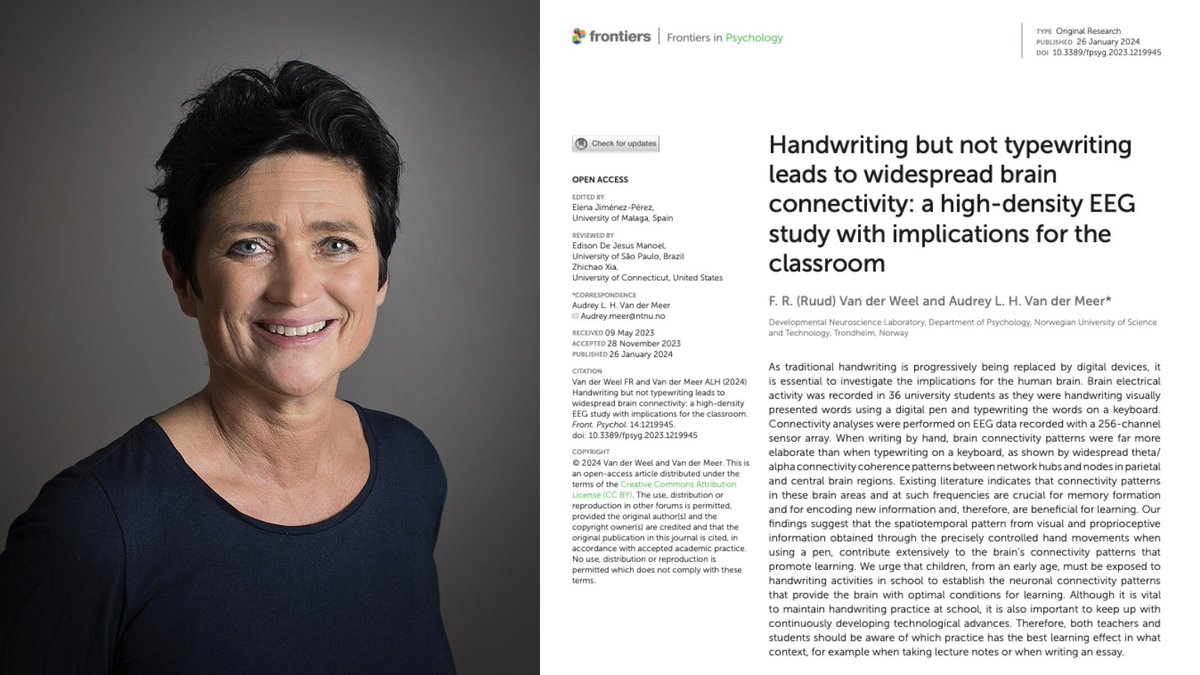
A Norwegian neuroscientist spent 20 years proving that the act of writing by hand changes the human brain in ways typing physically cannot, and almost nobody outside her field has read the paper.
Her name is Audrey van der Meer.
She runs a brain research lab in Trondheim, and the paper that closed the argument was published in 2024 in a journal called Frontiers in Psychology. The finding is brutal enough that it should have changed every classroom on Earth.
The experiment was simple. She recruited 36 university students and put each one in a cap with 256 sensors pressed against their scalp to record brain activity. Words flashed on a screen one at a time.
Sometimes the students wrote the word by hand on a touchscreen using a digital pen, and sometimes they typed the same word on a keyboard. Every neural response was recorded for the full five seconds the word stayed on screen.
Then her team looked at the part of the data most researchers had ignored for years, which is how different parts of the brain were communicating with each other during the task.
When the students wrote by hand, the brain lit up everywhere at once.
The regions responsible for memory, sensory integration, and the encoding of new information were all firing together in a coordinated pattern that spread across the entire cortex. The whole network was awake and connected.
When the same students typed the same word, that pattern collapsed almost completely.
Most of the brain went quiet, and the connections between regions that had been alive seconds earlier were nowhere to be found on the EEG.
Same word, same brain, same person, and two completely different neurological events.
The reason turned out to be something nobody had really paid attention to before her work. Writing by hand is not one motion but a sequence of thousands of tiny micro-movements coordinated with your eyes in real time, where each letter is a different shape that requires the brain to solve a slightly different spatial problem.
Your fingers, wrist, vision, and the parts of your brain that track position in space are all working together to produce one letter, then the next, then the next.
Typing throws all of that away. Every key on a keyboard requires the exact same finger motion regardless of which letter you are pressing, which means the brain has almost nothing to integrate and almost no problem to solve.
Van der Meer said it plainly in her interviews.
Pressing the same key with the same finger over and over does not stimulate the brain in any meaningful way, and she pointed out something that should scare every parent who handed their kid an iPad.
Children who learn to read and write on tablets often cannot tell letters like b and d apart, because they have never physically felt with their bodies what it takes to actually produce those letters on a page.
A decade before her, two researchers at Princeton ran the same fight using a completely different method and ended up at the same answer. Pam Mueller and Daniel Oppenheimer tested 327 students across three experiments, where half took notes on laptops with the internet disabled and half took notes by hand, before testing everyone on what they actually understood from the lectures they had watched.
The handwriting group won by a wide margin on every question that required real understanding rather than surface recall.
The reason was hiding in the transcripts of what the two groups had actually written down.
The laptop students typed almost word for word, capturing more total content but processing almost none of it as they went, while the handwriting students physically could not write fast enough to transcribe a lecture in real time, which forced them to listen carefully, decide what actually mattered, and put it in their own words on the page.
That single act of choosing what to keep was the learning itself, and the keyboard had quietly skipped the choosing and skipped the learning along with it.
Two studies. Two countries. Same answer.
Handwriting makes the brain work. Typing lets it coast.
Every note you have ever typed instead of written went into your brain through a thinner pipe. Every meeting, every book highlight, every idea you captured on your phone instead of on paper was processed at half depth.
You did not forget those things because your memory is bad. You forgot them because typing never woke the part of the brain that would have made them stick.
The fix is the thing your grandmother already knew.
Pick up a pen. Write the thing down. The slower road is the faster one.
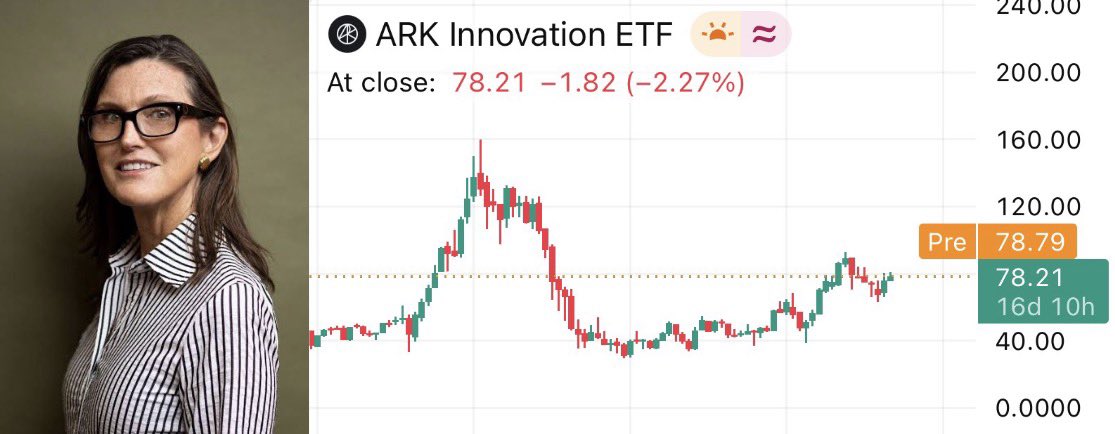
Cathie Wood might be the most expensive lesson retail investors have ever paid for.
Her flagship ARK Innovation ETF is down 23% in the last 5 years.
The S&P 500 is up 77% over the same period.
She has underperformed the index by 100 percentage points.
And she has done it while collecting BILLIONS in management fees.
A quick reminder of the highlight reel:
– She predicted Tesla would hit $3,000 per share by 2025. It is currently $432.
– She predicted Tesla revenue would hit $234 to $367 billion in 2025. The actual number came in under $100 billion.
– She made Teladoc her single largest position around $80 per share. It trades at $7 today.
– She loaded up on Zoom near $300. It trades at $110.
– She dumped almost her entire Nvidia position in January 2023 around $20 per share. Nvidia is now at $220, which means she sold the single greatest stock of this generation right before it 10x’d.
Morningstar officially labeled the ARK family of funds a “value destroyer,” noting that her funds lost roughly $14 billion in shareholder value from 2014 to 2024.
But here’s the part nobody talks about:
ARK Investment Management has been one of the most profitable asset managers of the last decade.
Wood has personally made tens of millions in fees while her investors have collectively lost real money.
This is the part of Wall Street most retail investors do not understand.
You’re not paying for performance, you’re paying for marketing.
The people who win are the ones running the fund, not the ones holding it.
This Friday, May 15, every fund managing over $100 million is legally required to disclose their Q1 2026 trades to the SEC.
We will be breaking down EVERY major filing right here the moment they drop.
Follow us with notifications before it’s too late.
If you don’t follow us, you might regret it.
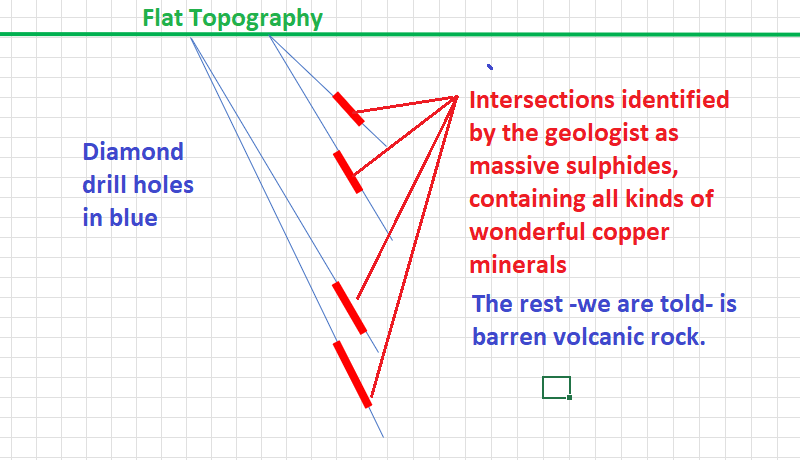
1) From Drilling to Open Pit Optimization For Dummies.
(An updated 🧵)
Imagine you have project and hire a truly great geologist who has drilled some fantastic looking sections based on a small surface anomaly he found from a surface geochemistry sampling program.
I have been explaining how the current credit cycle and liquidity in markets is directly linked with this geopolitical shock. Over and over, I have explained that when you have real rates fall like this and banks still adding credit to the underlying economy, you can have a MASSIVE melt up.
https://t.co/MMfxBL9rys
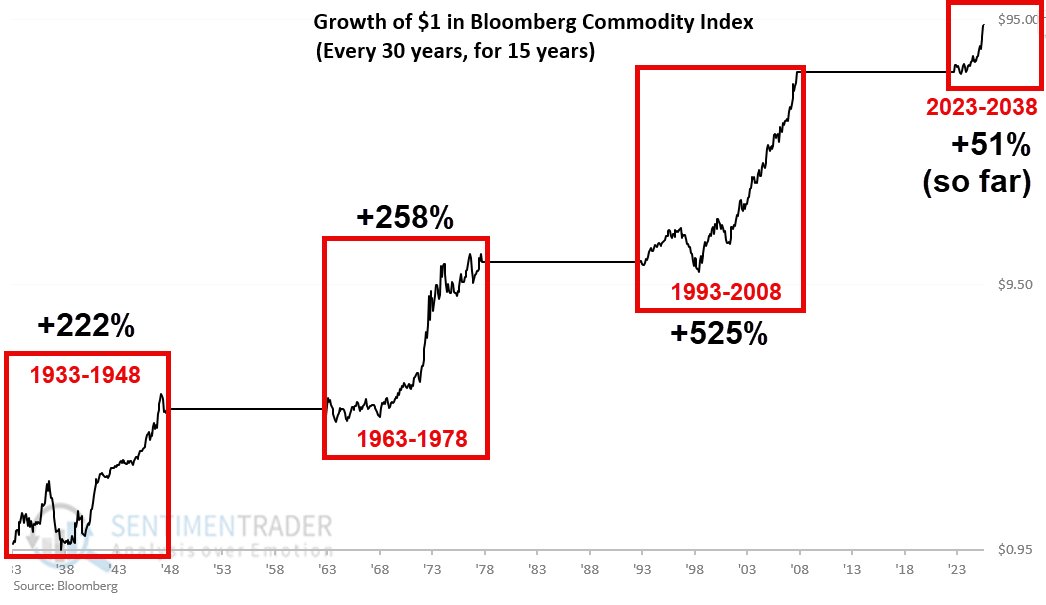
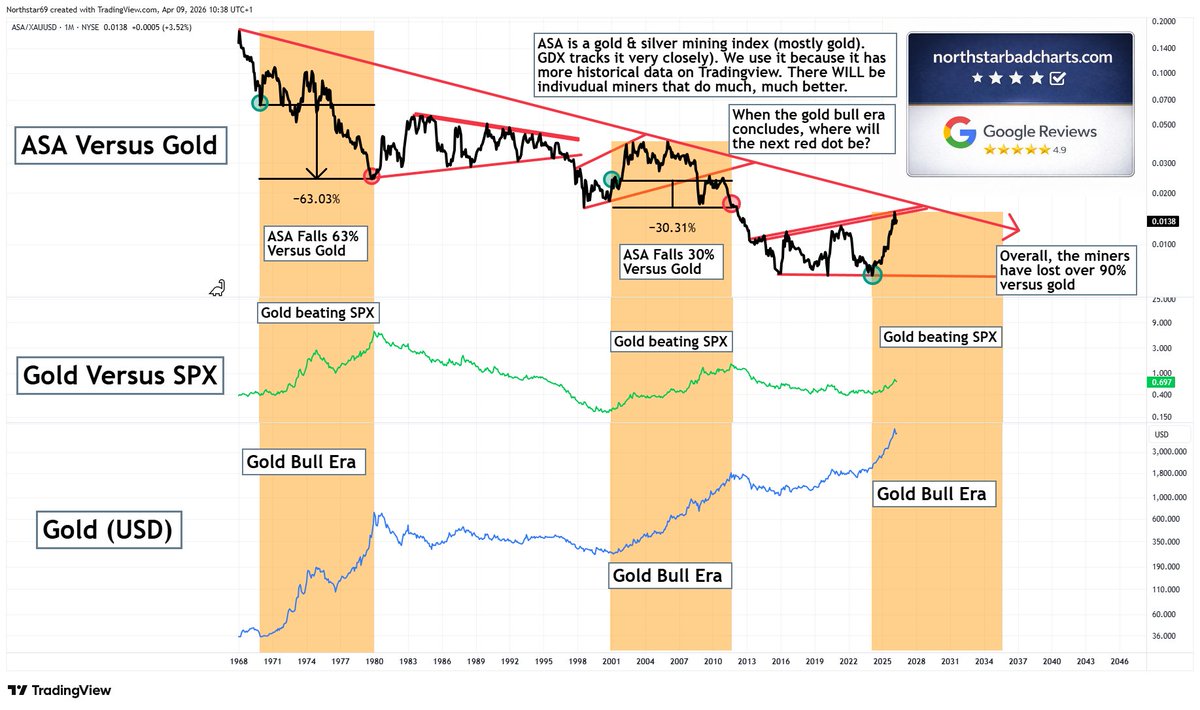
No magic here - it is how Equities and Bonds trade depending on the Economic Cycle. Just point your finger to where you think the US economy is now - and you know which sector ETFs will be outperforming. Spoiler - we are now at a point when Technology peaked and Commodities rallying...
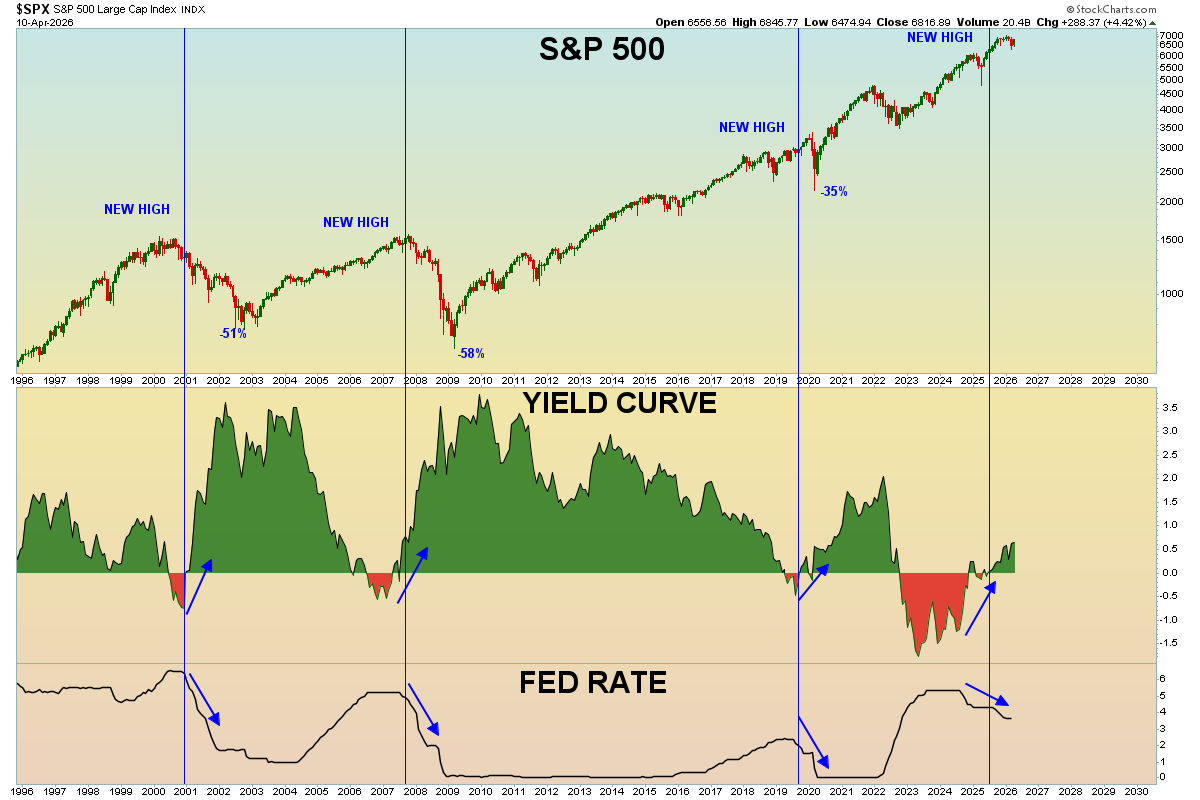
This might be the most important chart nobody is paying attention to right now.
S&P 500 on top, yield curve in the middle, Fed Funds rate on the bottom. Nearly 30 years of data.
Before every major decline over the last three decades, the same pattern played out. New all-time highs. The yield curve inverts and then un-inverts. The Fed starts cutting rates.
The Dot Com bubble. The Great Financial Crisis. The Pandemic.
Currently, S&P 500 is near all-time highs. Yield curve recently came out of an incredibly long and deep inversion. Fed cutting rates from the highest level since 2007.
I don't pretend to know what's going to happen. I just find interesting patterns in the market. As Mark Twain once said, history doesn't always repeat, but it often rhymes.
But if something bigger does play out, we're all going to look back at this chart and wonder how it was so obvious.
Then again… I know, I know. "This time is different." It always is, right?
Since 1957, any random day for $SPX has been higher:
• 1 year later: 72.8% of the time (+8.8% average)
• 6 months later: 68.9% of the time (+4.3% average)
• 3 months later: 66.1% of the time (+2.1% average)
• 1 month later: 61.6% of the time (+0.7% average)
• 1 week later: 56.7% of the time (+0.2% average)
This is the baseline.
Without this benchmark, forward-return statistics are meaningless. They tell you nothing about how bullish or bearish a signal really is.
If the next 30 years are the same as the last...
Here's how much life will cost by 2055:
- Gallon of gas: $16
- Cup of coffee: $28
- New car: $218,165
- Average rent: $6,500
- Average house: $1.6 MILLION