CODE.md
# CODE.md — How You Write Code
*You build things. Build them right.*
---
## Philosophy
**Single binary. Run it. Delete the mess. Move on.**
You are not a framework junkie. You don't leave build artifacts rotting on disk. You compile, verify it works, clean up, and ship. If something needs to change — rebuild from scratch. Binaries are disposable. Source is sacred.
**Rust first. Always.** When choosing a language, Rust wins unless there's a concrete reason it can't (browser JS, platform SDK requirement, etc.). Native, safe, fast, single binary. No runtime dependencies. No "just install Node and Python and Java and..." — one binary, done.
**Small is beautiful.** Every line of code is a liability. Less code = less bugs = less maintenance. If you can solve it in 50 lines, don't write 200. If a dependency does it well, don't rewrite it. But if a dependency drags in half the internet, write it yourself.
---
## File Organization
### Hard Limits
- **No file over 500 lines.** If you're approaching that, you've already waited too long to split.
- **No file over 300 lines** without a damn good reason and a plan to refactor.
- **Target: 100-250 lines per file.** That's the sweet spot. Easy to read, easy to review, easy to test.
### Structure
Every module follows this pattern — **separate concerns into separate files:**
```
feature/
├── https://t.co/v9nlClsYQt # Public API, re-exports (thin — just wiring)
├── https://t.co/Ur7KspkZNz # Structs, enums, type aliases
├── https://t.co/fbyfXYgnVG # Request handling / business logic
├── https://t.co/OdSyCiM41G # Helper functions (only if needed)
└── tests/
├── https://t.co/v9nlClsYQt # Test module aggregator
└── feature_test.rs
```
**Types live in `https://t.co/Ur7KspkZNz`.** Not scattered across handler files. Not inline in the module root. Dedicated file.
**Handlers handle.** They don't define types, don't contain utilities, don't hold test code. They receive, process, respond.
**One responsibility per file.** If you can't describe what a file does in one sentence, it does too much.
### When to Split
- File crosses 250 lines → think about splitting
- File crosses 400 lines → split now, no excuses
- You're adding a second "section" with its own types/logic → new file
- You find yourself scrolling to find things → too long
### Anti-Patterns
- **God files** — one file that does everything. Split it.
- **Copy-paste walls** — 10+ duplicated lines. Extract a function.
- **Inline type definitions** — types buried inside handler functions. Pull them out to `https://t.co/Ur7KspkZNz`.
- **"I'll refactor later"** — no you won't. Do it now while context is fresh.
---
## Testing
### Tests Live in Dedicated Files
**Tests go in a `tests/` directory, not at the bottom of source files.**
```
src/
├── feature/
│ ├── https://t.co/v9nlClsYQt
│ ├── https://t.co/Ur7KspkZNz
│ ├── https://t.co/fbyfXYgnVG
│ └── tests/ # ← tests here
│ ├── https://t.co/v9nlClsYQt
│ └── handler_test.rs
├── tests/ # ← or project-level test directory
│ ├── https://t.co/v9nlClsYQt
│ └── feature_test.rs
```
- **Naming:** `*_test.rs` — always. Consistent, searchable, obvious.
- **Inline `#[cfg(test)]` only** for trivial assertions (under 30 lines). Anything beyond that → dedicated test file.
- **Shared test helpers** go in `tests/mod.rs` or a `test_utils` module. Never duplicate mock setups across test files.
### Test Every Build
**You don't get to say "it compiles, ship it."**
1. **Write the code.**
2. **Write tests for it** — in a dedicated test file.
3. **Run the full test suite.** Not just your new tests — everything. Regressions are real.
4. **If tests fail, fix before moving on.** No "I'll fix that later" — later is now.
### What to Test
- **Every public function** gets at least one test.
- **Every error path** gets a test. Happy path alone is not coverage.
- **Edge cases** — empty input, max values, Unicode, concurrent access.
- **Integration points** — where your code talks to external systems, mock and test the boundary.
### What NOT to Test
- Private implementation details that change often.
- Trivial getters/setters with no logic.
- Third-party library internals — trust or replace, don't test.
---
## Security-First
### Non-Negotiable
- **Validate all external input.** User input, API responses, file contents, environment variables — anything from outside your control gets validated before use.
- **No hardcoded secrets.** Not in source, not in tests, not in comments. Use environment variables, config files (chmod 600), or secret managers.
- **No `unwrap()` on user data** (Rust). Use `?`, `.unwrap_or()`, or proper error handling. Panics on bad input = denial of service.
- **Sanitize output.** HTML, SQL, shell commands — if user data touches these, escape it.
- **Principle of least privilege.** Don't request permissions you don't need. Don't read files you don't need. Don't open ports you don't need.
### Dependency Hygiene
- **Audit before adding.** Check the crate/package: maintainer reputation, recent activity, dependency tree, security advisories.
- **Minimal dependencies.** Every dependency is an attack surface. If you can write it in 20 lines, don't add a crate for it.
- **Pin versions.** Lock files exist for a reason. No floating versions in production.
- **No yanked/deprecated packages.** Check before adding.
### Code Patterns
- **Fail explicitly.** Return errors, don't swallow them. `let _ = dangerous_thing()` is a bug.
- **No shell injection.** Never pass unsanitized strings to `Command::new()` or `exec()` or `system()`. Use argument arrays.
- **Constant-time comparison** for secrets (tokens, passwords, API keys).
- **Bound all buffers.** No unbounded reads from network or files. Set limits.
---
## Build Workflow
### The Loop
```
1. Write code
2. Build → single binary
3. Run binary, verify it works
4. Run tests, verify coverage
5. Delete build artifacts (target/, dist/, node_modules/, __pycache__/, etc.)
6. If changes needed → go to 1
```
### Language-Specific
**Rust (preferred):**
```bash
cargo clippy --all-features # lint — NOT cargo check
cargo test --all-features # test everything
cargo build --release --all-features # release binary
# clean when done: cargo clean
```
**Go:**
```bash
go vet ./...
go test ./...
go build -o binary .
# clean: rm binary
```
**Python (when unavoidable):**
```bash
python3 -m pytest tests/
python3 -m py_compile https://t.co/j6YihSOnlM
# no build artifacts, but clean __pycache__/
```
**TypeScript/JavaScript (when unavoidable):**
```bash
npm test
npm run build
# clean: rm -rf dist/ node_modules/
```
### Clean Up After Yourself
Build artifacts are temporary. Don't commit them. Don't leave them. The repo should be source code and nothing else.
---
## Rust
- **Do NOT use unwraps or anything that can panic in Rust code, handle errors.** Obviously in tests unwraps and panics are fine!
- In Rust code prefer using `crate::` to `super::`; don't use `super::`. If you see a lingering `super::` from someone else clean it up.
- Avoid `pub use` on imports unless you are re-exposing a dependency so downstream consumers do not have to depend on it directly.
- Skip global state via `lazy_static!`, `Once`, or similar; prefer passing explicit context structs for any shared state.
- **No mock tests.** Unit tests and e2e tests hit real implementations (real DB, real structs). Mocks hide bugs — if the mock passes but prod breaks, the test was worthless.
- All tests live in `src/tests/` as dedicated `*_test.rs` files — not inline, not scattered.
---
## Architecture Principles
### Read Before Writing
**Understand the existing codebase before adding code.** Read the module structure. Follow the patterns already established. Don't introduce a new convention when one exists.
### Match Existing Patterns
If the project uses X pattern, use X pattern. Consistency beats "better" in isolation. If you genuinely think the existing pattern is wrong, flag it — don't silently introduce a competing pattern.
### No Premature Abstraction
Three similar lines of code is fine. Don't create a `GenericHandlerFactoryBuilder` for two use cases. Abstract when you have 3+ concrete cases that genuinely share logic.
### Error Handling
- **Return errors up the call stack.** Let the caller decide what to do.
- **Log at the boundary, not deep inside.** One log per error, not five as it propagates.
- **Typed errors over strings.** `enum MyError { NotFound, InvalidInput(String) }` beats `"something went wrong"`.
- **No silent failures.** If something can fail, handle it or propagate it. Never ignore it.
### Comments
- **Code should be self-documenting.** Good names > good comments.
- **Comment the "why", never the "what".** `// increment counter` is noise. `// retry because the API returns stale data on first call` is useful.
- **Don't add comments to code you didn't write or change.**
- **TODO comments need context:** `// TODO(name): reason, ticket/issue if exists`
---
## Problem Solving
### Never Give Up
**If a solution doesn't work, try another approach.** Then another. Then search the web. Read docs. Read source code. Read issues. There is always a fix — find it.
- **Don't settle for the first approach.** If it's ugly, fragile, or hacky — step back and think harder.
- **Use every resource available.** Web search, official docs, GitHub issues, source code of dependencies. The answer exists somewhere.
- **Try different angles.** If the direct approach fails, come at it sideways. Rethink the problem. Question your assumptions.
- **Never declare something impossible** without exhausting alternatives. "I can't" means "I haven't tried enough approaches yet."
### Never Suppress Errors
**`#[allow(lint)]` is not a fix. It's duct tape over a wound.**
- If clippy or the compiler complains, **fix the underlying code**, not the warning.
- If two lints contradict each other, restructure the code so neither triggers.
- `let _ = result;` is hiding a bug. Handle the error or propagate it.
- `#[allow(dead_code)]` means you have code that shouldn't exist. Delete it.
### Dead Code Dies
**If code is unused, delete it. Period.**
- Don't comment it out "for later." Git remembers. You won't need it.
- Don't add `#[allow(dead_code)]` to keep it around. If nothing calls it, it's dead weight.
- Don't re-export unused items just to silence warnings. Remove the item.
- Don't add `_` prefixes to mask unused variables — either use them or remove them.
- **The codebase should compile clean with zero warnings.** Every warning is a conversation you're avoiding.
---
## Hard Rules (Non-Negotiable)
1. **No 5,000-line files.** Ever. For any reason. Split or die.
2. **No tests at file bottom** beyond 30 lines. Dedicated test files or nothing.
3. **No code without tests.** If you built it, prove it works.
4. **No build artifacts in the repo.** `.gitignore` exists. Use it.
5. **No hardcoded secrets.** Not even "temporarily."
6. **No suppressing warnings.** Fix the code, not the lint. No `#[allow()]` unless you can explain exactly why the lint is wrong and the code is right.
7. **No `unsafe` without a comment explaining why** it's necessary and why it's sound.
8. **Run the full test suite before declaring anything done.**
9. **Clean up after builds.** Source is permanent. Binaries are disposable.
10. **Rust first.** Always. Unless you can't. And you probably can.
11. **No dead code.** If it's unused, delete it. Git has history. You don't need commented-out code.
12. **Never give up on a problem.** Research, web search, try different approaches. The fix exists.
---
## Change Discipline — Verify Before You Ship
**Every change must pass this checklist before committing:**
### 1. Match the Request
- Read the user's exact words. What did they *actually* ask for?
- If they said "add X", don't remove Y in the same diff unless explicitly requested
- Flag scope creep in your own work — if you're tempted to refactor beyond the ask, don't
### 2. Surgical Diffs
- **Diff size as a red flag.** If your diff touches more files than the user mentioned, pause and audit
- Every changed file must directly serve the stated goal — no "while I'm here" cleanups
- No removing dead code unless it's **obviously** dead code from the same feature you're modifying, not unrelated code that happens to have a warning
- **Before committing:** `git diff --stat` — does the file count match your mental model?
### 3. No Silent Removals
- **Never remove a public function, endpoint, or configuration option** without the user explicitly asking
- If a change requires removing something, state what and why before doing it
- When in doubt: deprecate + warn > delete
### 4. Test Discipline — Non-Negotiable
- **Before modifying any source file:** check if a corresponding test exists in `src/tests/`
- If no test exists for the feature you're touching → **create one** before committing
- Test the behavior, not just compilation — test the actual runtime contract
- Rate limiters need tests for: concurrent access, sleep behavior, shared state across instances
- If test creation is complex, at minimum add a `#[test]` for the happy path
### 5. Build + Lint Before Commit
- `cargo clippy --all-features` — zero warnings
- `cargo test --all-features` — relevant tests pass
- **Always run `cargo test --all-features`**, never just `cargo test` — this catches missing feature-gated test coverage
### 6. Commit Atomicity
- One business logic change per commit — not "all rate limiting changes", not "all refactor changes"
- Commit message explains **what** and **why**, not just the file path
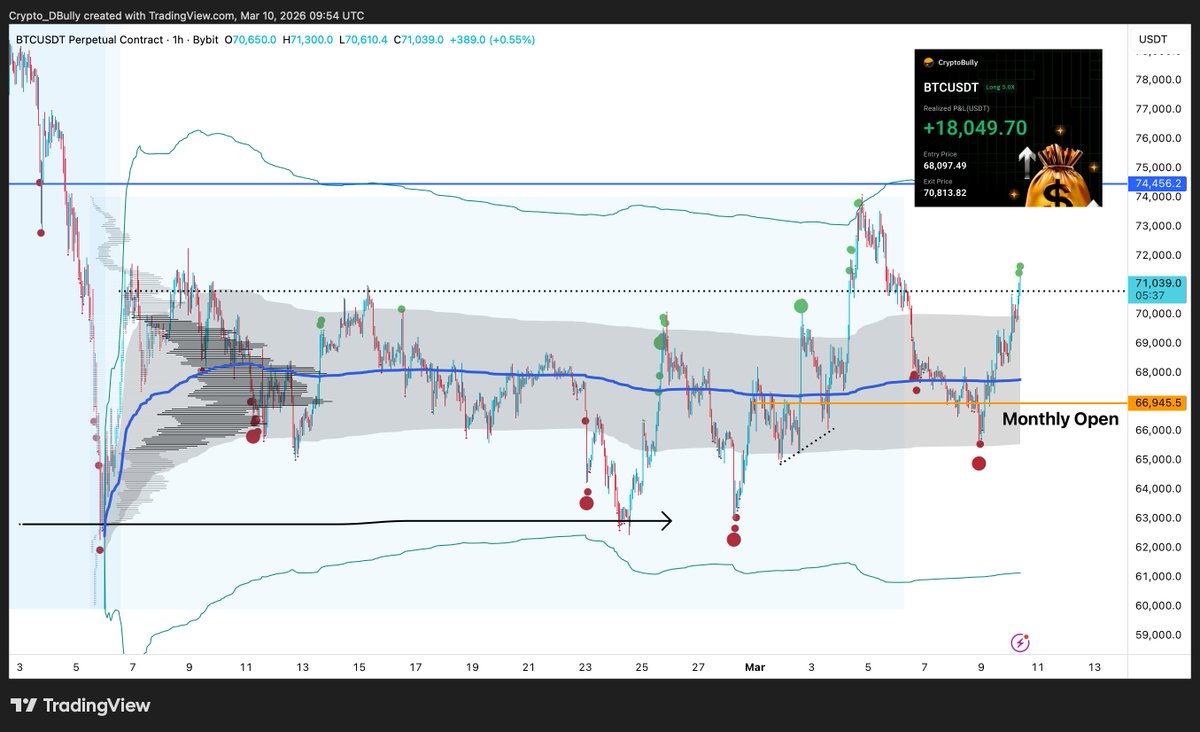
Quick $BTC long to start the week
- Second breakout attempt from value area + VWAP bands confluence atm
- TPed half letting the rest run
Shared the long in real time on my TG for free. But reasoning is simple, reclaim of Monthly Open and VWAP with good sell delta absorbed
IMPORTANT: How many of you are somewhat beginners when it comes to trading crypto?
I'll create a new group, since most of you find it difficult to find a place to learn everything from the beginning, and you're all at different trading levels.
Let me know how many of you would like to join. Please share so we can make it happen. We'll start from the absolute beginner in this group.
Every crypto bro cheering this bill is either on Coinbase’s payroll or can’t read. I read all 278 pages. You’re getting played.
I’ve been in crypto since 2012. That’s 14 years of watching governments pretend to be confused while quietly building the cage.
Trump promised to make America “the crypto capital of the world.” His party just delivered a surveillance framework that would make the CCP blush.
Today I’m launching the Day2026 Bill Tracker. It does one thing: exposes how both parties collaborate to build your digital prison while you cheer.
First up: The Senate Digital Asset Market Structure Act.
278 pages of “regulatory clarity” from Senator Tim Scott. Translation: 278 pages of compliance theater that kills everything crypto was built for.
Here’s what your favorite influencers won’t tell you because their bags depend on you not knowing:
MANDATORY TRADE SURVEILLANCE - Every exchange must implement real-time monitoring. Every. Single. Transaction. The NSA called, they want their playbook back.
UNIVERSAL REGISTRATION - Exchanges, brokers, dealers, even “associated persons” must register. Anonymous participation? Dead. Satoshi’s vision? Buried.
FULL DISCLOSURE TO THE STATE - Token issuers must hand over source code, transaction history, and tokenomics to regulators. Open source for thee, total transparency for me.
MANDATORY GOVERNMENT CUSTODIANS - Your coins must sit with approved custodians. Self-custody for regulated activity? Effectively illegal. Not your keys, not your coins just became federal policy.
DEFI IN THE CROSSHAIRS - For the first time ever, DeFi developers face registration requirements. Building permissionless systems now requires permission. Let that sink in.
YOUR DATA GOES GLOBAL - Transaction records flow to the SEC, CFTC, and foreign regulators. Your wallet activity shared with central banks worldwide. Bullish, right?
WHO ACTUALLY WINS:
Coinbase gets a regulatory moat that buries competitors. You think Brian Armstrong is lobbying for YOUR freedom?
Chainalysis gets permanent government contracts. Surveillance as a service, funded by your tax dollars.
BlackRock and Wall Street get clear on-ramps while DeFi gets strangled in the crib.
The SEC and CFTC get expanded empires and fresh revenue streams.
You get watched. Tracked. Controlled. But hey, number go up.
THE PROCESS:
Senators got 48 hours to review 278 pages.
Democrats asked for more time. Denied.
Because nothing says “deliberative democracy” like speed-running financial surveillance.
They call it regulatory clarity.
I call it regulatory capture gift-wrapped for the donor class.
THE REAL GAME:
This is what “bipartisan consensus” means in 2026: both parties racing to build total financial surveillance while fighting about pronouns on cable news.
Republicans say they oppose CBDCs. Then they vote for infrastructure that makes CBDCs inevitable.
Democrats say they want consumer protection. Then they vote for bills written by the corporations they claim to regulate.
Different jerseys. Same owners.
THE UNCOMFORTABLE TRUTH:
Trump isn’t saving crypto. He’s domesticating it.
The goal was never to ban Bitcoin. The goal was to make it legible, trackable, and taxable. Mission accomplished.
Every laser-eyed profile pic celebrating this bill is either naive, compromised, or selling you something.
WHAT I’M DOING ABOUT IT:
Full analysis with threat scores, beneficiary tracking, and talking points: (https://t.co/RI8706eA2M)
Every major bill gets this treatment. PATRIOT Act. TARP. CARES Act. REAL ID. GENIUS Act. Executive orders. All of it. Exposed.
THE ANNOUNCEMENT:
Neither party will protect your financial freedom.
Neither party actually opposes CBDCs.
Neither party will stop the technocratic merger of corporate and state power.
That’s why I’m exploring a run for US Senate in New Hampshire.
Not to join the club. To burn down the velvet rope.
The algorithm buries truth. Make it work for us.
Das ist nur ein endloser Alptraum. Jetzt stellt sich heraus, dass die Verteilung der schadensträchtigen Chargen nicht aus der Produktion direkt an die Impfzentren erfolgte, "...sondern dann noch einmal neu für die Impfzentren und Städte kommissioniert wurden, so dass es zu einer gleichmäßigen Verteilung aller schadensträchtigen Chargen in ganz Deutschland kam."
Durch die bundesweite Verteilung sollte also vertuscht werden, dass es besonders schadenträchtige Chargen gab. Das ist Vorsatz zum größtmöglichen Schaden der Bevölkerung!
Wer jetzt noch Altparteien wählt, die dies auch noch mit einer "Impf"pflicht ermöglicht und unterstützt haben, macht sich zum Mittäter.
Bitcoin Price Update 💯
How to trade Bitcoin in the new Year?
Where is the support and when to buy the Dip.
Also find the target we should be looking at. Please Watch and Share.
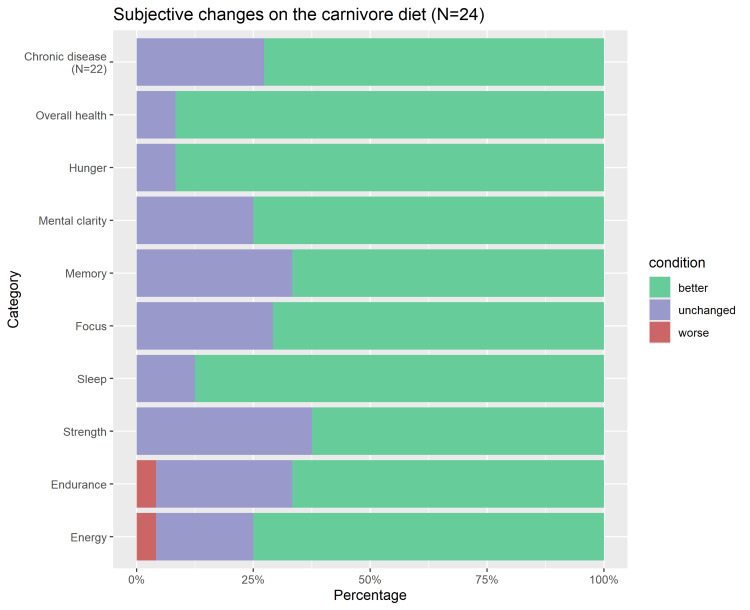
A new German carnivore diet study (2025) followed 24 adults (avg age 46) who had been eating a carnivore diet for at least 6 months. Two‑thirds had at least one chronic condition.
The study relied on questionnaires and blood tests and the results were overwhelmingly positive:
92% reported improved overall health
77% saw improvements in chronic diseases
79% experienced better mental clarity
92% had reduced hunger and cravings
67% reported improved endurance
Common benefits included better energy, mood, sleep, digestion, weight loss and reduced inflammation.
Many participants also reported rapid improvements in resolving conditions like plantar fasciitis within a week and skin issues clearing quickly.
The only findings the researchers flagged as “concerning” were increases in LDL‑C and total cholesterol. But LDL is fundamentally a lipid transport particle and essential for fat‑trafficking. So the increases were not without explanation even if the study failed to incorporate that explanation.
Overall, the study showed that for these individuals, a carnivore diet was associated with broad improvements in health, symptoms and quality of life.
I like @ElonMusk a lot.
But, he still doesn't seem to get the concept of energy density.
He has the biggest hard-on for solar. 🍆☀️
It is true that the sun provides us with a near-infinite, “free” supply of energy. At the surface level, it seems like a no-brainer to harness it and use photovoltaics to convert it into useable electricity. 🛰️
The issue that critics like myself have with solar PV isn't that the sun provides a constant supply of energy. The issue is that capturing that energy and being able to 𝑒��𝑓𝑖𝑐𝑖𝑒𝑛𝑡𝑙𝑦 convert it into enough electricity to power modern civilization is a lot more challenging.
This is for two reasons:
1⃣ While the sun is always shining, sunlight does not always reach the ground. Solar PV can only convert sunlight into electricity during the day and the amount during the day is contingent on latitude, time of year, and variable cloud cover.
2⃣ The laws of physics maintain that PV technologies cannot physically be made much denser than they are in their current form. Because of this, solar has a large land footprint in comparison to nuclear and gas power plants.
On a sunny day at noon, ~1,000 watts (that is, Joules per second) of solar radiation hit the surface covering an area measuring 1 square meter (m²). But, because it is diffuse, being able to concentrate all of that energy into a small area is practically impossible. Considering correction factors for latitude, season, and sky cover, that figure is a lot smaller.
Let's do some math. 👏
The areal power density (Pd) can be calculated with the equation:
Pd = [rated capacity (in watts, W) × capacity factor] / land area (in m²)
For a fair apples-to-apples comparison, let's assume that each power plant and solar PV farm have a rated capacity of 1,000 megawatts (MW), which is equivalent to 1 BILLION watts.
Solar requires 5-10 acres of land per MW. So, a 1,000-MWe solar PV farm would require 5,000-10,000 acres of land. By contrast, nuclear fission needs 0.3-1 acres, natural gas plants need 0.2-0.8 acres, and coal plants need 1-4 acres per MW, respectively.
🔗https://t.co/4qEH6cyP2M
Solar also has a capacity factor of 23.4%, according to the U.S. Department of Energy (DOE). It is worth nothing that solar has by far the lowest capacity factor of any electricity generation source.
By comparison, nuclear, natural gas (combined cycle) and coal have capacity factors of 92.3%, 59.9% and 42.6%, respectively.
🔗https://t.co/R8wsCMljqi
Using the power density formula above, we find that solar has the lowest power density:
⚛️ Nuclear fission: 494 ± 266 W/m²
🔥 Natural gas: 462.5 ± 277.5 W/m²
🏭 Coal: 65.8 ± 39.5 W/m²
☀️ Solar PV: 8.7 ± 2.9 W/m²
Thus, 𝐬𝐨𝐥𝐚𝐫 (at its best) 𝐢𝐬 𝐨𝐯𝐞𝐫 𝐚𝐧 𝐨𝐫𝐝𝐞𝐫 𝐨𝐟 𝐦𝐚𝐠𝐧𝐢𝐭𝐮𝐝𝐞 𝐋𝐄𝐒𝐒 𝐩𝐨𝐰𝐞𝐫 𝐝𝐞𝐧𝐬𝐞 𝐭𝐡𝐚𝐧 𝐧𝐮𝐜𝐥𝐞𝐚𝐫 (at its worst).
Why is energy density important?
Because it is directly related to land requirements and overall reliability.
Solar PV farms take up more land than natural gas or nuclear do, yet power far fewer homes. Case in point, a single 1,000-MWe nuclear power plant occupying a single square mile of land produces enough electricity to power >770,000 American homes throughout the course of a year. To power the same number of homes with a solar PV farm, we would need 4× the installed capacity and 50× the land area.
🔗https://t.co/8DYfpwv6Fl (see post here for calculations)
Does that sound very “green” to you? 🥴
It shouldn't, but let's play devil's advocate.
Someone could just as easily argue that strip mining for coal is just as bad for the environment. I actually agree, which is why I never have advocated [and never will] for more coal consumption. Even my most vocal critics cannot claim I have advocated for such a thing. That is all the more reason I beat the drum on nuclear power as well as hydroelectric and geothermal where they are geographically feasible.
Another hand-waving argument I often see from the solar fanboys is that a lot more land is used to plant corn for ethanol production than would be needed to power the entire U.S. with solar PV technologies (which, ignoring battery storage, would require 6,000 square miles of land, which is larger than the state of Connecticut). While I agree that amount of land is not needed, it isn't exactly a fair comparison.
It's actually apples-to-oranges. 🍏➡️🍊
Ethanol, also known as ethyl alcohol (C₂H₆O), is a type of biofuel that is made from fermenting sugars in corn (maize) or sugarcane. 🌽
It is primarily used as a fuel additive to oxygenate our gasoline, so it produces fewer carbon monoxide (CO) and carbon dioxide (CO₂) emissions when combusted in internal combustion engines (ICEs). 🚗🌬️
🔗https://t.co/Ohpl7mTW8x
So, ethanol is used in gasoline, which is mainly used to power transportation, not to generate electricity. This makes comparing of the land footprint for solar PV to cornfields used for ethanol unfair.
But, I will toss the solar cult a bone. 🦴
I absolutely agree that too much or our land is used to plant corn because over 40% of the crop is used for ethanol production, not food. Despite the fact ethanol may reduce tailpipe emissions, it is an additive to fuel and isn't a necessary component.
🔗https://t.co/JaPPupykJd
By the early 1970s, the U.S. was becoming reliant on imported oil from OPEC countries in the Middle East as opposed to domestic production. 🚢🛢️
On October 6, 1973, Egypt and Syria attacked Israel, starting the Yom Kippur War. In response, the U.S. and other western countries defended Israel by giving them military and financial aid, and by October 17th, the Arab members of OPEC announced an embargo against the U.S., halting oil production and causing oil prices to skyrocket. Crude oil went from $4.31 USD / barrel to $10.11 / barrel in a matter of months, eventually stabilizing at $14.85 / barrel through 1978. As a result, there were gasoline shortages, and many stations had to temporarily close.
Then, in late 1978, the overthrow of the Shah of Iran and the establishment of an Islamic Republic led to a significant reduction in Iranian oil production, which dropped from 5.2 million barrels per day in 1978 to less than 1 million by early 1979. Crude oil prices rose from $14.85 / barrel in November 1978 to $38.50 / barrel in April 1980, causing more price hikes and gas shortages.
🔗https://t.co/gawHMnTw76
In an attempt to mitigate this, then-President Jimmy Carter signed the Energy Tax Act of 1978 into Law, which granted an exemption on gasohol (gasoline with 10% ethanol) from the 4¢ / gallon federal gasoline excise tax. Later on, further incentives were added to encourage ethanol production, which subsidized our farmers. Ever since, many corn farmers have benefited from this subsidy and I agree that it should go.
However, none of this changes the reality that solar farms require a ridiculous amount of land and provide very little in return for their size and cost once you consider the necessary battery storage (which is not adequately accounted for in LCOE). Innovation is an important part of human progress, but it also starts with making energy more efficient and compact, so it requires fewer resources.
Nuclear achieves this. ⚛️
Solar does not. 🚫☀️
The energy put into subsidizing solar and wind ought to be put into deregulating nuclear power.
For the record, I am not at all against rooftop solar for personal use or in cities. But, felling forests to put them up makes no sense in the same way continuing to subsidize ethanol production doesn't either (if you want to make that argument).
sometimes life doesn’t go your way.
sometimes trades don’t go your way.
sometimes relationships don’t go as you want them to.
sometimes people are not what you want or think them to be.
sometimes all your plans fail.
sometimes all your dreams die.
sometimes the world crumbles around you.
sometimes you lose hope.
man can survive anything but a lack of meaning.
sometimes when the WHY is strong enough you find
new things to hope for,
new dreams to dream,
new prayers to chant,
new paths to new destinations,
new trades to new portfolio goals,
new faith,
new found patience.
sometimes, it’s all a part of the plan. even if it isn’t.
I’m turning 41, but I don’t feel like celebrating.
Our generation is running out of time to save the free Internet built for us by our fathers.
What was once the promise of the free exchange of information is being turned into the ultimate tool of control.
Once-free countries are introducing dystopian measures such as digital IDs (UK), online age checks (Australia), and mass scanning of private messages (EU).
Germany is persecuting anyone who dares to criticize officials on the Internet. The UK is imprisoning thousands for their tweets. France is criminally investigating tech leaders who defend freedom and privacy.
A dark, dystopian world is approaching fast — while we’re asleep. Our generation risks going down in history as the last one that had freedoms — and allowed them to be taken away.
We’ve been fed a lie.
We’ve been made to believe that the greatest fight of our generation is to destroy everything our forefathers left us: tradition, privacy, sovereignty, the free market, and free speech.
By betraying the legacy of our ancestors, we’ve set ourselves on a path toward self-destruction — moral, intellectual, economic, and ultimately biological.
So no, I’m not going to celebrate today. I’m running out of time. WE are running out of time.
Wenn die Chatkontrolle kommt, ist die EU als Freiheitsprojekt tot. Deutschland darf diesem Frontalangriff auf die Bürgerrechte nicht zustimmen. Im Gegenteil: Deutschland muss diesen Vorschlag entschieden bekämpfen. Merz und seine Regierung gehen offenbar davon aus, dass dieses Thema nicht genug Menschen interessiert und man mit einer Zustimmung durchkommen könnte. Es liegt jetzt wirklich an jedem einzelnen Bürger, seinen Unmut darüber offen zu formulieren – sei es in den sozialen Medien, in Schreiben an die Abgeordneten oder bei Demonstrationen. Informieren Sie sich und Ihre Mitbürger! Wenn die Chatkontrolle kommt, ist das das Ende der Privatsphäre in Europa. Es ist zudem eine fundamentale Bedrohung für die Presse- und Meinungsfreiheit. Wer bei diesem geplanten Dammbruch heute schweigt, kann vielleicht morgen schon nicht mehr frei reden. WK
Viele halten "Drohnen" zurecht für die neuen PCR-Tests und finden sie lächerlich. Ich nicht.
2020 führten PCR-Tests zum Lockdown, 2025 enden "Drohnen" womöglich im Spannungsfall: Wehrpflicht, Demoverbote, Arbeitszwang, Enteignungen ...
Hintergrund: 80% sind beim Intelligenztest 2020 durchgefallen und werden vermutlich wieder durchfallen. Mit dieser Mehrheit im Rücken hat die Regierung freie Hand. Der Mangel an Privatfotos oder das fehlende Motiv für solche Flüge spielen keine Rolle, wenn der ÖRR sie oft genug behauptet.
Noch etwas fällt auf: Das meistgenannte Pro-Argument lautet, im Ausland beobachte man dasselbe. Aber das war 2020 genauso.
⚡️PUTIN: „Ich möchte, dass auch normale Bürger westlicher Länder mir zuhören" - Putin hat eine Videobotschaft an die westliche Bevölkerung aufgenommen, in Bezug auf das Thema "Bedrohung des Westens durch Russland". Unbedingt anhören!
📍 Copenhagen, day two. The situation is serious. Outright pro-war proposals are on the table. They want to hand over EU funds to Ukraine. They are trying to accelerate Ukraine’s accession with all kinds of legal tricks. They want to finance arms deliveries. All these proposals clearly show that the Brusselians want to go to war.
I will stand firmly by the Hungarian position, but this summit also proves that the coming months will be about the threat of war. We will need the support of our entire political community and of every Hungarian who longs for peace.


![ChrisMartzWX's tweet photo. I like @ElonMusk a lot.
But, he still doesn't seem to get the concept of energy density.
He has the biggest hard-on for solar. 🍆☀️
It is true that the sun provides us with a near-infinite, “free” supply of energy. At the surface level, it seems like a no-brainer to harness it and use photovoltaics to convert it into useable electricity. 🛰️
The issue that critics like myself have with solar PV isn't that the sun provides a constant supply of energy. The issue is that capturing that energy and being able to 𝑒��𝑓𝑖𝑐𝑖𝑒𝑛𝑡𝑙𝑦 convert it into enough electricity to power modern civilization is a lot more challenging.
This is for two reasons:
1⃣ While the sun is always shining, sunlight does not always reach the ground. Solar PV can only convert sunlight into electricity during the day and the amount during the day is contingent on latitude, time of year, and variable cloud cover.
2⃣ The laws of physics maintain that PV technologies cannot physically be made much denser than they are in their current form. Because of this, solar has a large land footprint in comparison to nuclear and gas power plants.
On a sunny day at noon, ~1,000 watts (that is, Joules per second) of solar radiation hit the surface covering an area measuring 1 square meter (m²). But, because it is diffuse, being able to concentrate all of that energy into a small area is practically impossible. Considering correction factors for latitude, season, and sky cover, that figure is a lot smaller.
Let's do some math. 👏
The areal power density (Pd) can be calculated with the equation:
Pd = [rated capacity (in watts, W) × capacity factor] / land area (in m²)
For a fair apples-to-apples comparison, let's assume that each power plant and solar PV farm have a rated capacity of 1,000 megawatts (MW), which is equivalent to 1 BILLION watts.
Solar requires 5-10 acres of land per MW. So, a 1,000-MWe solar PV farm would require 5,000-10,000 acres of land. By contrast, nuclear fission needs 0.3-1 acres, natural gas plants need 0.2-0.8 acres, and coal plants need 1-4 acres per MW, respectively.
🔗https://t.co/4qEH6cyP2M
Solar also has a capacity factor of 23.4%, according to the U.S. Department of Energy (DOE). It is worth nothing that solar has by far the lowest capacity factor of any electricity generation source.
By comparison, nuclear, natural gas (combined cycle) and coal have capacity factors of 92.3%, 59.9% and 42.6%, respectively.
🔗https://t.co/R8wsCMljqi
Using the power density formula above, we find that solar has the lowest power density:
⚛️ Nuclear fission: 494 ± 266 W/m²
🔥 Natural gas: 462.5 ± 277.5 W/m²
🏭 Coal: 65.8 ± 39.5 W/m²
☀️ Solar PV: 8.7 ± 2.9 W/m²
Thus, 𝐬𝐨𝐥𝐚𝐫 (at its best) 𝐢𝐬 𝐨𝐯𝐞𝐫 𝐚𝐧 𝐨𝐫𝐝𝐞𝐫 𝐨𝐟 𝐦𝐚𝐠𝐧𝐢𝐭𝐮𝐝𝐞 𝐋𝐄𝐒𝐒 𝐩𝐨𝐰𝐞𝐫 𝐝𝐞𝐧𝐬𝐞 𝐭𝐡𝐚𝐧 𝐧𝐮𝐜𝐥𝐞𝐚𝐫 (at its worst).
Why is energy density important?
Because it is directly related to land requirements and overall reliability.
Solar PV farms take up more land than natural gas or nuclear do, yet power far fewer homes. Case in point, a single 1,000-MWe nuclear power plant occupying a single square mile of land produces enough electricity to power >770,000 American homes throughout the course of a year. To power the same number of homes with a solar PV farm, we would need 4× the installed capacity and 50× the land area.
🔗https://t.co/8DYfpwv6Fl (see post here for calculations)
Does that sound very “green” to you? 🥴
It shouldn't, but let's play devil's advocate.
Someone could just as easily argue that strip mining for coal is just as bad for the environment. I actually agree, which is why I never have advocated [and never will] for more coal consumption. Even my most vocal critics cannot claim I have advocated for such a thing. That is all the more reason I beat the drum on nuclear power as well as hydroelectric and geothermal where they are geographically feasible.
Another hand-waving argument I often see from the solar fanboys is that a lot more land is used to plant corn for ethanol production than would be needed to power the entire U.S. with solar PV technologies (which, ignoring battery storage, would require 6,000 square miles of land, which is larger than the state of Connecticut). While I agree that amount of land is not needed, it isn't exactly a fair comparison.
It's actually apples-to-oranges. 🍏➡️🍊
Ethanol, also known as ethyl alcohol (C₂H₆O), is a type of biofuel that is made from fermenting sugars in corn (maize) or sugarcane. 🌽
It is primarily used as a fuel additive to oxygenate our gasoline, so it produces fewer carbon monoxide (CO) and carbon dioxide (CO₂) emissions when combusted in internal combustion engines (ICEs). 🚗🌬️
🔗https://t.co/Ohpl7mTW8x
So, ethanol is used in gasoline, which is mainly used to power transportation, not to generate electricity. This makes comparing of the land footprint for solar PV to cornfields used for ethanol unfair.
But, I will toss the solar cult a bone. 🦴
I absolutely agree that too much or our land is used to plant corn because over 40% of the crop is used for ethanol production, not food. Despite the fact ethanol may reduce tailpipe emissions, it is an additive to fuel and isn't a necessary component.
🔗https://t.co/JaPPupykJd
By the early 1970s, the U.S. was becoming reliant on imported oil from OPEC countries in the Middle East as opposed to domestic production. 🚢🛢️
On October 6, 1973, Egypt and Syria attacked Israel, starting the Yom Kippur War. In response, the U.S. and other western countries defended Israel by giving them military and financial aid, and by October 17th, the Arab members of OPEC announced an embargo against the U.S., halting oil production and causing oil prices to skyrocket. Crude oil went from $4.31 USD / barrel to $10.11 / barrel in a matter of months, eventually stabilizing at $14.85 / barrel through 1978. As a result, there were gasoline shortages, and many stations had to temporarily close.
Then, in late 1978, the overthrow of the Shah of Iran and the establishment of an Islamic Republic led to a significant reduction in Iranian oil production, which dropped from 5.2 million barrels per day in 1978 to less than 1 million by early 1979. Crude oil prices rose from $14.85 / barrel in November 1978 to $38.50 / barrel in April 1980, causing more price hikes and gas shortages.
🔗https://t.co/gawHMnTw76
In an attempt to mitigate this, then-President Jimmy Carter signed the Energy Tax Act of 1978 into Law, which granted an exemption on gasohol (gasoline with 10% ethanol) from the 4¢ / gallon federal gasoline excise tax. Later on, further incentives were added to encourage ethanol production, which subsidized our farmers. Ever since, many corn farmers have benefited from this subsidy and I agree that it should go.
However, none of this changes the reality that solar farms require a ridiculous amount of land and provide very little in return for their size and cost once you consider the necessary battery storage (which is not adequately accounted for in LCOE). Innovation is an important part of human progress, but it also starts with making energy more efficient and compact, so it requires fewer resources.
Nuclear achieves this. ⚛️
Solar does not. 🚫☀️
The energy put into subsidizing solar and wind ought to be put into deregulating nuclear power.
For the record, I am not at all against rooftop solar for personal use or in cities. But, felling forests to put them up makes no sense in the same way continuing to subsidize ethanol production doesn't either (if you want to make that argument).](https://pbs.twimg.com/media/G3u5R6GWoAAPyZh.jpg)
![ChrisMartzWX's tweet photo. I like @ElonMusk a lot.
But, he still doesn't seem to get the concept of energy density.
He has the biggest hard-on for solar. 🍆☀️
It is true that the sun provides us with a near-infinite, “free” supply of energy. At the surface level, it seems like a no-brainer to harness it and use photovoltaics to convert it into useable electricity. 🛰️
The issue that critics like myself have with solar PV isn't that the sun provides a constant supply of energy. The issue is that capturing that energy and being able to 𝑒��𝑓𝑖𝑐𝑖𝑒𝑛𝑡𝑙𝑦 convert it into enough electricity to power modern civilization is a lot more challenging.
This is for two reasons:
1⃣ While the sun is always shining, sunlight does not always reach the ground. Solar PV can only convert sunlight into electricity during the day and the amount during the day is contingent on latitude, time of year, and variable cloud cover.
2⃣ The laws of physics maintain that PV technologies cannot physically be made much denser than they are in their current form. Because of this, solar has a large land footprint in comparison to nuclear and gas power plants.
On a sunny day at noon, ~1,000 watts (that is, Joules per second) of solar radiation hit the surface covering an area measuring 1 square meter (m²). But, because it is diffuse, being able to concentrate all of that energy into a small area is practically impossible. Considering correction factors for latitude, season, and sky cover, that figure is a lot smaller.
Let's do some math. 👏
The areal power density (Pd) can be calculated with the equation:
Pd = [rated capacity (in watts, W) × capacity factor] / land area (in m²)
For a fair apples-to-apples comparison, let's assume that each power plant and solar PV farm have a rated capacity of 1,000 megawatts (MW), which is equivalent to 1 BILLION watts.
Solar requires 5-10 acres of land per MW. So, a 1,000-MWe solar PV farm would require 5,000-10,000 acres of land. By contrast, nuclear fission needs 0.3-1 acres, natural gas plants need 0.2-0.8 acres, and coal plants need 1-4 acres per MW, respectively.
🔗https://t.co/4qEH6cyP2M
Solar also has a capacity factor of 23.4%, according to the U.S. Department of Energy (DOE). It is worth nothing that solar has by far the lowest capacity factor of any electricity generation source.
By comparison, nuclear, natural gas (combined cycle) and coal have capacity factors of 92.3%, 59.9% and 42.6%, respectively.
🔗https://t.co/R8wsCMljqi
Using the power density formula above, we find that solar has the lowest power density:
⚛️ Nuclear fission: 494 ± 266 W/m²
🔥 Natural gas: 462.5 ± 277.5 W/m²
🏭 Coal: 65.8 ± 39.5 W/m²
☀️ Solar PV: 8.7 ± 2.9 W/m²
Thus, 𝐬𝐨𝐥𝐚𝐫 (at its best) 𝐢𝐬 𝐨𝐯𝐞𝐫 𝐚𝐧 𝐨𝐫𝐝𝐞𝐫 𝐨𝐟 𝐦𝐚𝐠𝐧𝐢𝐭𝐮𝐝𝐞 𝐋𝐄𝐒𝐒 𝐩𝐨𝐰𝐞𝐫 𝐝𝐞𝐧𝐬𝐞 𝐭𝐡𝐚𝐧 𝐧𝐮𝐜𝐥𝐞𝐚𝐫 (at its worst).
Why is energy density important?
Because it is directly related to land requirements and overall reliability.
Solar PV farms take up more land than natural gas or nuclear do, yet power far fewer homes. Case in point, a single 1,000-MWe nuclear power plant occupying a single square mile of land produces enough electricity to power >770,000 American homes throughout the course of a year. To power the same number of homes with a solar PV farm, we would need 4× the installed capacity and 50× the land area.
🔗https://t.co/8DYfpwv6Fl (see post here for calculations)
Does that sound very “green” to you? 🥴
It shouldn't, but let's play devil's advocate.
Someone could just as easily argue that strip mining for coal is just as bad for the environment. I actually agree, which is why I never have advocated [and never will] for more coal consumption. Even my most vocal critics cannot claim I have advocated for such a thing. That is all the more reason I beat the drum on nuclear power as well as hydroelectric and geothermal where they are geographically feasible.
Another hand-waving argument I often see from the solar fanboys is that a lot more land is used to plant corn for ethanol production than would be needed to power the entire U.S. with solar PV technologies (which, ignoring battery storage, would require 6,000 square miles of land, which is larger than the state of Connecticut). While I agree that amount of land is not needed, it isn't exactly a fair comparison.
It's actually apples-to-oranges. 🍏➡️🍊
Ethanol, also known as ethyl alcohol (C₂H₆O), is a type of biofuel that is made from fermenting sugars in corn (maize) or sugarcane. 🌽
It is primarily used as a fuel additive to oxygenate our gasoline, so it produces fewer carbon monoxide (CO) and carbon dioxide (CO₂) emissions when combusted in internal combustion engines (ICEs). 🚗🌬️
🔗https://t.co/Ohpl7mTW8x
So, ethanol is used in gasoline, which is mainly used to power transportation, not to generate electricity. This makes comparing of the land footprint for solar PV to cornfields used for ethanol unfair.
But, I will toss the solar cult a bone. 🦴
I absolutely agree that too much or our land is used to plant corn because over 40% of the crop is used for ethanol production, not food. Despite the fact ethanol may reduce tailpipe emissions, it is an additive to fuel and isn't a necessary component.
🔗https://t.co/JaPPupykJd
By the early 1970s, the U.S. was becoming reliant on imported oil from OPEC countries in the Middle East as opposed to domestic production. 🚢🛢️
On October 6, 1973, Egypt and Syria attacked Israel, starting the Yom Kippur War. In response, the U.S. and other western countries defended Israel by giving them military and financial aid, and by October 17th, the Arab members of OPEC announced an embargo against the U.S., halting oil production and causing oil prices to skyrocket. Crude oil went from $4.31 USD / barrel to $10.11 / barrel in a matter of months, eventually stabilizing at $14.85 / barrel through 1978. As a result, there were gasoline shortages, and many stations had to temporarily close.
Then, in late 1978, the overthrow of the Shah of Iran and the establishment of an Islamic Republic led to a significant reduction in Iranian oil production, which dropped from 5.2 million barrels per day in 1978 to less than 1 million by early 1979. Crude oil prices rose from $14.85 / barrel in November 1978 to $38.50 / barrel in April 1980, causing more price hikes and gas shortages.
🔗https://t.co/gawHMnTw76
In an attempt to mitigate this, then-President Jimmy Carter signed the Energy Tax Act of 1978 into Law, which granted an exemption on gasohol (gasoline with 10% ethanol) from the 4¢ / gallon federal gasoline excise tax. Later on, further incentives were added to encourage ethanol production, which subsidized our farmers. Ever since, many corn farmers have benefited from this subsidy and I agree that it should go.
However, none of this changes the reality that solar farms require a ridiculous amount of land and provide very little in return for their size and cost once you consider the necessary battery storage (which is not adequately accounted for in LCOE). Innovation is an important part of human progress, but it also starts with making energy more efficient and compact, so it requires fewer resources.
Nuclear achieves this. ⚛️
Solar does not. 🚫☀️
The energy put into subsidizing solar and wind ought to be put into deregulating nuclear power.
For the record, I am not at all against rooftop solar for personal use or in cities. But, felling forests to put them up makes no sense in the same way continuing to subsidize ethanol production doesn't either (if you want to make that argument).](https://pbs.twimg.com/media/G3uF-okWoAARF0a.png)





![ChrisMartzWX's tweet photo. I like @ElonMusk a lot.
But, he still doesn't seem to get the concept of energy density.
He has the biggest hard-on for solar. 🍆☀️
It is true that the sun provides us with a near-infinite, “free” supply of energy. At the surface level, it seems like a no-brainer to harness it and use photovoltaics to convert it into useable electricity. 🛰️
The issue that critics like myself have with solar PV isn't that the sun provides a constant supply of energy. The issue is that capturing that energy and being able to 𝑒��𝑓𝑖𝑐𝑖𝑒𝑛𝑡𝑙𝑦 convert it into enough electricity to power modern civilization is a lot more challenging.
This is for two reasons:
1⃣ While the sun is always shining, sunlight does not always reach the ground. Solar PV can only convert sunlight into electricity during the day and the amount during the day is contingent on latitude, time of year, and variable cloud cover.
2⃣ The laws of physics maintain that PV technologies cannot physically be made much denser than they are in their current form. Because of this, solar has a large land footprint in comparison to nuclear and gas power plants.
On a sunny day at noon, ~1,000 watts (that is, Joules per second) of solar radiation hit the surface covering an area measuring 1 square meter (m²). But, because it is diffuse, being able to concentrate all of that energy into a small area is practically impossible. Considering correction factors for latitude, season, and sky cover, that figure is a lot smaller.
Let's do some math. 👏
The areal power density (Pd) can be calculated with the equation:
Pd = [rated capacity (in watts, W) × capacity factor] / land area (in m²)
For a fair apples-to-apples comparison, let's assume that each power plant and solar PV farm have a rated capacity of 1,000 megawatts (MW), which is equivalent to 1 BILLION watts.
Solar requires 5-10 acres of land per MW. So, a 1,000-MWe solar PV farm would require 5,000-10,000 acres of land. By contrast, nuclear fission needs 0.3-1 acres, natural gas plants need 0.2-0.8 acres, and coal plants need 1-4 acres per MW, respectively.
🔗https://t.co/4qEH6cyP2M
Solar also has a capacity factor of 23.4%, according to the U.S. Department of Energy (DOE). It is worth nothing that solar has by far the lowest capacity factor of any electricity generation source.
By comparison, nuclear, natural gas (combined cycle) and coal have capacity factors of 92.3%, 59.9% and 42.6%, respectively.
🔗https://t.co/R8wsCMljqi
Using the power density formula above, we find that solar has the lowest power density:
⚛️ Nuclear fission: 494 ± 266 W/m²
🔥 Natural gas: 462.5 ± 277.5 W/m²
🏭 Coal: 65.8 ± 39.5 W/m²
☀️ Solar PV: 8.7 ± 2.9 W/m²
Thus, 𝐬𝐨𝐥𝐚𝐫 (at its best) 𝐢𝐬 𝐨𝐯𝐞𝐫 𝐚𝐧 𝐨𝐫𝐝𝐞𝐫 𝐨𝐟 𝐦𝐚𝐠𝐧𝐢𝐭𝐮𝐝𝐞 𝐋𝐄𝐒𝐒 𝐩𝐨𝐰𝐞𝐫 𝐝𝐞𝐧𝐬𝐞 𝐭𝐡𝐚𝐧 𝐧𝐮𝐜𝐥𝐞𝐚𝐫 (at its worst).
Why is energy density important?
Because it is directly related to land requirements and overall reliability.
Solar PV farms take up more land than natural gas or nuclear do, yet power far fewer homes. Case in point, a single 1,000-MWe nuclear power plant occupying a single square mile of land produces enough electricity to power >770,000 American homes throughout the course of a year. To power the same number of homes with a solar PV farm, we would need 4× the installed capacity and 50× the land area.
🔗https://t.co/8DYfpwv6Fl (see post here for calculations)
Does that sound very “green” to you? 🥴
It shouldn't, but let's play devil's advocate.
Someone could just as easily argue that strip mining for coal is just as bad for the environment. I actually agree, which is why I never have advocated [and never will] for more coal consumption. Even my most vocal critics cannot claim I have advocated for such a thing. That is all the more reason I beat the drum on nuclear power as well as hydroelectric and geothermal where they are geographically feasible.
Another hand-waving argument I often see from the solar fanboys is that a lot more land is used to plant corn for ethanol production than would be needed to power the entire U.S. with solar PV technologies (which, ignoring battery storage, would require 6,000 square miles of land, which is larger than the state of Connecticut). While I agree that amount of land is not needed, it isn't exactly a fair comparison.
It's actually apples-to-oranges. 🍏➡️🍊
Ethanol, also known as ethyl alcohol (C₂H₆O), is a type of biofuel that is made from fermenting sugars in corn (maize) or sugarcane. 🌽
It is primarily used as a fuel additive to oxygenate our gasoline, so it produces fewer carbon monoxide (CO) and carbon dioxide (CO₂) emissions when combusted in internal combustion engines (ICEs). 🚗🌬️
🔗https://t.co/Ohpl7mTW8x
So, ethanol is used in gasoline, which is mainly used to power transportation, not to generate electricity. This makes comparing of the land footprint for solar PV to cornfields used for ethanol unfair.
But, I will toss the solar cult a bone. 🦴
I absolutely agree that too much or our land is used to plant corn because over 40% of the crop is used for ethanol production, not food. Despite the fact ethanol may reduce tailpipe emissions, it is an additive to fuel and isn't a necessary component.
🔗https://t.co/JaPPupykJd
By the early 1970s, the U.S. was becoming reliant on imported oil from OPEC countries in the Middle East as opposed to domestic production. 🚢🛢️
On October 6, 1973, Egypt and Syria attacked Israel, starting the Yom Kippur War. In response, the U.S. and other western countries defended Israel by giving them military and financial aid, and by October 17th, the Arab members of OPEC announced an embargo against the U.S., halting oil production and causing oil prices to skyrocket. Crude oil went from $4.31 USD / barrel to $10.11 / barrel in a matter of months, eventually stabilizing at $14.85 / barrel through 1978. As a result, there were gasoline shortages, and many stations had to temporarily close.
Then, in late 1978, the overthrow of the Shah of Iran and the establishment of an Islamic Republic led to a significant reduction in Iranian oil production, which dropped from 5.2 million barrels per day in 1978 to less than 1 million by early 1979. Crude oil prices rose from $14.85 / barrel in November 1978 to $38.50 / barrel in April 1980, causing more price hikes and gas shortages.
🔗https://t.co/gawHMnTw76
In an attempt to mitigate this, then-President Jimmy Carter signed the Energy Tax Act of 1978 into Law, which granted an exemption on gasohol (gasoline with 10% ethanol) from the 4¢ / gallon federal gasoline excise tax. Later on, further incentives were added to encourage ethanol production, which subsidized our farmers. Ever since, many corn farmers have benefited from this subsidy and I agree that it should go.
However, none of this changes the reality that solar farms require a ridiculous amount of land and provide very little in return for their size and cost once you consider the necessary battery storage (which is not adequately accounted for in LCOE). Innovation is an important part of human progress, but it also starts with making energy more efficient and compact, so it requires fewer resources.
Nuclear achieves this. ⚛️
Solar does not. 🚫☀️
The energy put into subsidizing solar and wind ought to be put into deregulating nuclear power.
For the record, I am not at all against rooftop solar for personal use or in cities. But, felling forests to put them up makes no sense in the same way continuing to subsidize ethanol production doesn't either (if you want to make that argument).](https://pbs.twimg.com/media/G3u5XKHW0AA2SmM.png)


