As the year comes to a close, we’ve been reflecting on how Blockradar was built this year.
2025 started with a simple focus: building stablecoin infrastructure that fintechs everywhere can rely on. Most of the early work happened quietly, building, fixing, and listening closely to the teams using us.
As adoption grew, so did the surface area of what we needed to support. We expanded the platform to give our customers more flexibility and control: shipping swap & bridge, checkout infrastructure, Gateway, virtual accounts, and more. All designed to work together without adding complexity.
We’re grateful to the customers who trusted us early and allowed us to grow alongside them. Because of that trust, $300M + in transaction volume moved through Blockradar in less than 9 months, powering real world stablecoin transactions.
We’re also thankful for our ecosystem partners, like @circle, @arc, @LiskHQ, @base, @Plasma, @tempo, @cngn_co, @idrx_co, and @ZARP_Stablecoin, and more who share our belief that stablecoins are becoming core financial infrastructure.
Looking back, 2025 feels less like a launch year and more like a foundation year.
It’s still early. It’s still day zero.
2026 will be about building on that foundation with full acceleration.
One thing I’ve been paying attention to lately is not only whether stablecoins are growing (I think it's pretty clear they are), but also who is talking about them. A few years ago, an article like this would have likely appeared in a crypto publication. Today, it’s appearing in one of Colombia’s leading business newspapers, @Portafolioco, where our perspective was included as part of the conversation around the future of cross-border payments.
The article focuses on international money movement, but I think the more interesting story is that stablecoins are gradually becoming part of the broader discussion around financial infrastructure.
That doesn’t mean every challenge has been solved, and it certainly doesn’t mean adoption happens overnight. But when mainstream business media starts covering stablecoins as a practical tool for moving money across borders, it’s a sign that the conversation is evolving.
Not because the technology suddenly changed, but because the audience did.
https://t.co/N30crViV69
------------------------------------------------
Últimamente he estado prestando atención no solo al crecimiento de las stablecoins (creo que ya es bastante evidente), sino también a quiénes están hablando de ellas. Hace algunos años, un artículo como este probablemente habría aparecido en un medio especializado en cripto. Hoy aparece en @Portafolioco, uno de los principales periódicos económicos de Colombia, donde tuvimos la oportunidad de aportar nuestra perspectiva sobre el futuro de los pagos cross-border.
El artículo se enfoca en el movimiento internacional de dinero, pero para mí la historia más interesante es otra: las stablecoins están comenzando a formar parte de una conversación mucho más amplia sobre infraestructura financiera.
Eso no significa que todos los problemas están resueltos, ni mucho menos que la adopción va a ocurrir de la noche a la mañana. Pero cuando los medios económicos tradicionales empiezan a analizar las stablecoins como una herramienta práctica para mover dinero entre países, es una señal de que la conversación está evolucionando.
No porque la tecnología haya cambiado de repente, sino porque la audiencia sí lo ha hecho.
3/ This boosts deposit success rate in wallets, exchanges, and on-ramp flows. Ideal for consumer-facing products where UX is king. Also supports ENS/Subdomain resolution for prettier addresses. Full chain coverage list and testnet support in docs.
https://t.co/36n6IzOyrt
1/ Tired of users asking which network they should deposit on?
Blockradar gives users a single deposit address that automatically detects and routes deposits across Ethereum, Base, Polygon, Tempo, Plasma, and more.
POST /v1/wallets/{walletId}/addresses
→ "Address generated successfully"
just another toolkit tuesday
2/ Behind the scenes, Blockradar uses smart contract detection and chain-specific routing logic to identify the source network and process deposits accordingly.
Funds arrive in the correct wallet with metadata identifying the originating chain.
No user confusion, no manual chain switching, no lost funds from user error.
3/ We've seen teams use this for customer deposits, merchant collections, payroll, treasury operations, and cross-border payments.
The goal isn't to make your team an expert in wallet infrastructure.
It's to let you ship faster and stay focused on the product you're actually building.
1/ Need to onboard users instantly? Blockradar's Wallet and Address APIs let fintechs generate dedicated deposit addresses and manage non-custodial stablecoin wallets programmatically. Create addresses on demand, monitor transactions in real time, automate treasury flows, and scale wallet infrastructure without building blockchain systems from scratch.
POST /v1/wallets/{walletId}/addresses → "Address generated successfully"
Docs:https://t.co/jWxTRyhqiv
just another toolkit tuesday.
2/ The real magic isn't generating an address.
It's what happens after.
Tag addresses with metadata, listen for deposit webhooks, automate sweeps to treasury wallets, and track funds across chains without building your own monitoring infrastructure.
My time living in Bogotá has really played an important role in how I think about payments, cross-border financial infrastructure, and generally building across markets that are unique in their own ways, so I’m very excited that Blockradar gets to show up in Colombia this week.
I’m especially happy that @daniel0larte and team get the opportunity to share more about what we’re building, and that we get to do it alongside our friends at Salvo Patria.
Also grateful to Latam Fintech Hub for continuing to push Colombia further into the center of fintech conversations across the region.
If you're at the conference come by and have some milhoja with us!
Hola Bogotá! 🇨🇴
We’re excited to share that we will be sponsoring and participating in Paytech Conf this week alongside our partners at Salvo Patria and chef Alejandro Gutiérrez, who’ll be serving their delicious milhojas at out booth!
One of the things we’re most looking forward to about this week is simply being in the room with so many different parts of the Colombian payments ecosystem at once. You have companies thinking about real-time payments, fraud infrastructure, cross-border settlement, open finance, acquiring, treasury movement, stablecoins, banking rails, compliance, and payment operations all approaching similar problems from completely different angles.
That’s usually where the most interesting conversations happen. We’re excited to listen, learn, and meet more of the people helping shape payments infrastructure across Colombia and the broader region.
If you’ll be at the conference, come find the Blockradar team at booth #14.
📍 Paytech Conf 2026
📅 May 29, 2026
------------------------------------------------------------
Hola Bogotá 🇨🇴 !
Nos emociona compartir que estaremos patrocinando y participando en Paytech Conf esta semana junto a nuestros colaboradores de Salvo Patria y el chef Alejandro Gutiérrez, quien estará sirviendo su deliciosa milhoja en nuestro stand.
Una de las cosas que más nos entusiasma de esta semana es simplemente poder estar en el mismo espacio con tantas partes distintas del ecosistema de pagos colombiano al mismo tiempo.
Habrá empresas pensando en pagos en tiempo real, infraestructura antifraude, liquidación transfronteriza, open finance, acquiring, movimientos de tesorería, stablecoins, rieles bancarios, compliance y operaciones de pagos, todas abordando problemas similares desde ángulos completamente distintos.
Ahí es donde normalmente surgen las conversaciones más interesantes.
Tenemos muchas ganas de escuchar, aprender y conocer a más personas que están ayudando a construir la infraestructura de pagos en Colombia y en toda la región.
Si vas a estar en la conferencia, ven a saludar al equipo de Blockradar en el booth #14.
MXNB is now live on Blockradar 🇲🇽 Fintechs can now embed Mexican peso stablecoin wallets directly into their products using Blockradar’s non-custodial infrastructure.
Built by @Bitso through Juno, @mxnb_token
brings programmable pesos to fintechs building remittances, treasury flows, payouts, and cross-border payments. From cNGN to IDRX to MXNB, we’re continuing to expand local stablecoin infrastructure across the globe.
Every market needs a digital version of its local currency.
See more here: https://t.co/5YrQg71xFP
MXNB es una stablecoin respaldada 1:1 por el peso mexicano, emitida por Juno (una empresa de Bitso), y representa una oportunidad enorme para conectar el sistema financiero tradicional con blockchain.
Más en este post 👇
https://t.co/BKkEtP8jIg
MXNB is now live on Blockradar 🇲🇽 Fintechs can now embed Mexican peso stablecoin wallets directly into their products using Blockradar’s non-custodial infrastructure.
Built by @Bitso through Juno, @mxnb_token
brings programmable pesos to fintechs building remittances, treasury flows, payouts, and cross-border payments. From cNGN to IDRX to MXNB, we’re continuing to expand local stablecoin infrastructure across the globe.
Every market needs a digital version of its local currency.
See more here: https://t.co/5YrQg71xFP
/ Instead of maintaining fragmented balances across multiple chains or building your own bridge orchestration layer, fintechs can standardize liquidity movement through a single API.
Useful for payout routing, treasury rebalancing, cross-border settlement flows, and multi-chain wallet products — all without exposing users to the complexity of bridges, gas management, or chain switching.
Docs ➡️ https://t.co/Jhm8PJaMV4
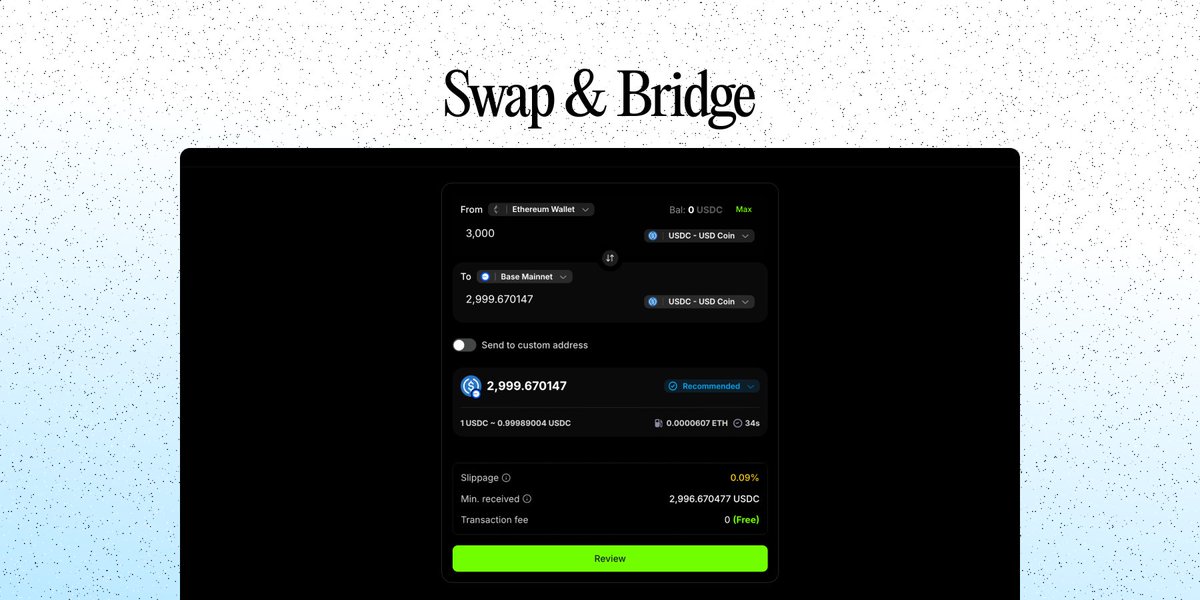
1/Your off-ramp partner settles USDC on Base, but your customer deposit arrives as USDT on Ethereum? Our Swap & Bridge API handles the cross-chain movement in a single API call. No manual bridging flows, fragmented liquidity management, or sending users to external bridge interfaces.
POST /v1/wallets/{walletId}/swap → "Swap initiated successfully"
One endpoint. Cross-chain. Cross-asset. Done.
just another toolkit tuesday.
2/ Under the hood, Blockradar automatically routes through liquidity and bridge providers to find the most efficient path across supported chains.
Configure source asset, destination chain, slippage tolerance, and settlement wallet directly via API.
Real-time webhook updates keep your treasury, reconciliation, and payout systems synchronized throughout the transaction lifecycle.
Supports major stablecoins across Ethereum, Tron, Solana, Base, Polygon, Arbitrum, Optimism, BSC, Avalanche, and more.