@WheelerMorse@realDonaldTrump Midterm success depends on more than one person. Leadership matters, but messaging, policy, and voter turnout will ultimately have a much bigger impact than blaming a single official.
@EcklundJer17820 That’s a fair point. Both people may have made poor decisions, but introducing or pointing a gun during a heated confrontation dramatically increases the risk of someone getting hurt.
Some weeks back two friends were talking about money the way most people do today and I could see the frustration in their faces.
One said,
“I can buy crypto from my phone in seconds, but when it comes to real market opportunities, I still hit the same walls all the time from market hours to borders, gatekeepers, paperwork, and products designed for people already inside the system."
The Other Replied,
“Then maybe the real problem isn’t a lack of demand. Maybe finance itself still hasn’t caught up to the internet.”
When I came across @ShiftRWA
I thought of it as an opportunity and I know it deserves more attention than it's already having and the discussion between these friends flashed back.
@ShiftRWA needs your attention not because it is just launching another token. It is also contributing to a bigger transition: bringing market access on-chain in a way that feels more global, more transparent, and more native to how digital finance should work.
A Th_re_ad 🪡🧵
@abishal_crypto@ShiftRWA I like how you explained the difference between hype and actual utility. A lot of people throw around “RWA” without explaining why it matters to everyday users🤦🏽♂️
Some weeks back two friends were talking about money the way most people do today and I could see the frustration in their faces.
One said,
“I can buy crypto from my phone in seconds, but when it comes to real market opportunities, I still hit the same walls all the time from market hours to borders, gatekeepers, paperwork, and products designed for people already inside the system."
The Other Replied,
“Then maybe the real problem isn’t a lack of demand. Maybe finance itself still hasn’t caught up to the internet.”
When I came across @ShiftRWA
I thought of it as an opportunity and I know it deserves more attention than it's already having and the discussion between these friends flashed back.
@ShiftRWA needs your attention not because it is just launching another token. It is also contributing to a bigger transition: bringing market access on-chain in a way that feels more global, more transparent, and more native to how digital finance should work.
A Th_re_ad 🪡🧵
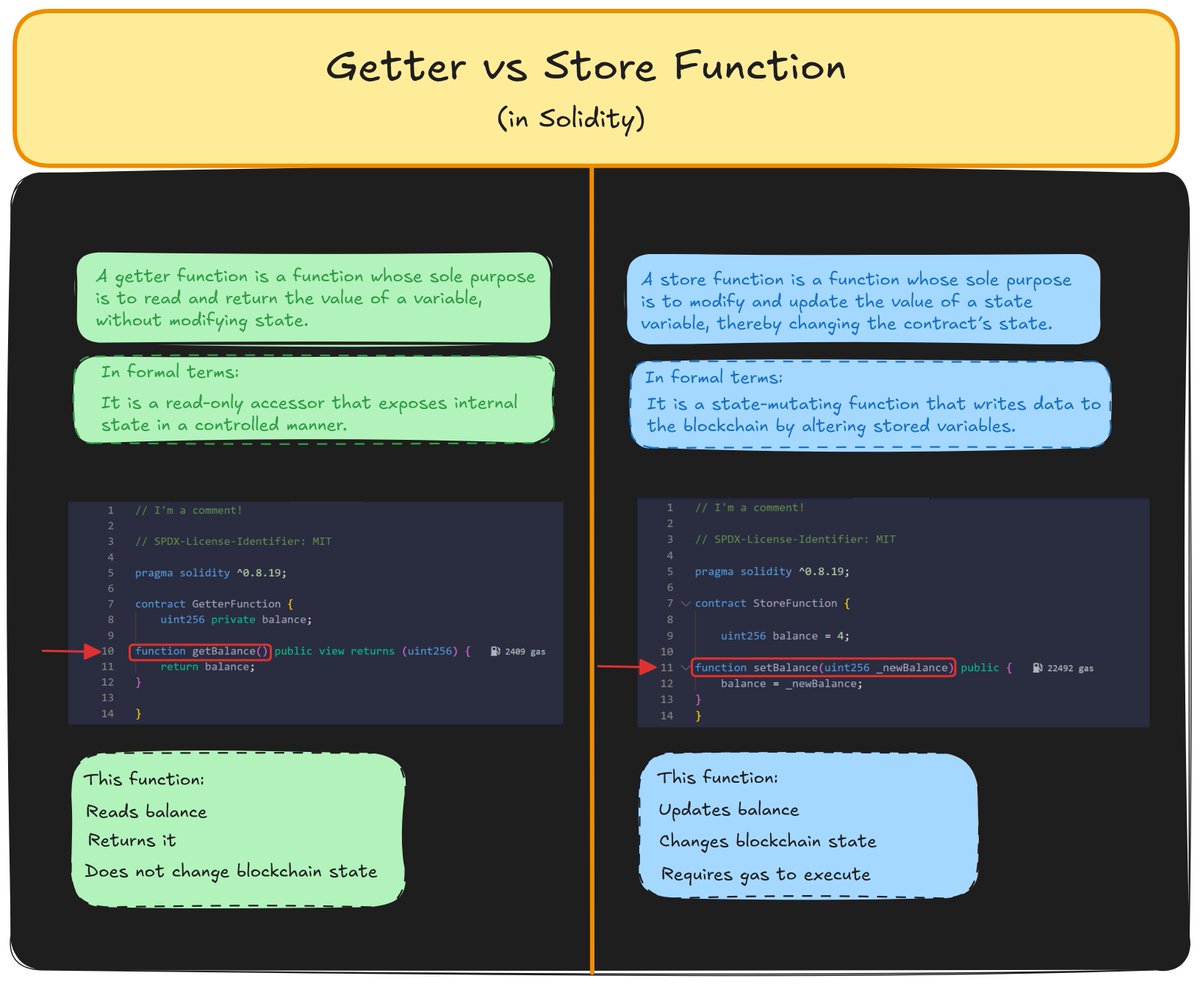
Something that confused me at first about Solidity functions:
Why does the getter function have empty () but the store function has (uint256 _newBalance) inside its parentheses?
Then it clicked — a getter doesn't need any information from you.
It already knows what to do: just go grab the value and return it.
There's nothing to pass in.
But a store function needs to know what to store.
You have to hand it the new value.
That's what lives inside the () — the data you're giving the function to work with.
Empty parentheses = "I have everything I need "
Parentheses with a type + variable = "give me something to work with"
For every time you scroll past a tweet highlighting the potential of “RWAs,”
you miss an opportunity to be part of a trillion-dollar industry.
This might feel like clickbait, until you look at the numbers.
- On defillama, in the past three months, VCs have invested over $10 million in RWA protocols, alongside payment systems and prediction markets.
- According to McKinsey, tokenized market capitalization could reach around $2 trillion by 2030, while BCG estimates roughly $16 trillion.
Regulators and institutions are paying attention too.
- Singapore’s MAS launched Project Guardian, the EU created the DLT Pilot Regime, the UK FCA is testing tokenization sandboxes, and Switzerland now has fully regulated tokenized securities.
- BlackRock, HSBC, Citi, Franklin Templeton, and UBS have all run pilots showing that tokenization reduces settlement times, improves operational efficiency, and unlocks new liquidity pathways.
And it’s not just numbers on paper.
In mid-2025, the on-chain RWA market surged from roughly $5–10 billion in 2022 to over $20 billion.
If you’re new to RWAs and tokenization, you might be wondering:
why is the world suddenly paying attention to putting real-world assets on-chain?
To answer that, we need to look at the problems TradFi has faced for decades.
Even in everyday markets, TradFi struggles.
Buying a commercial property or private credit often requires dozens of intermediaries, weeks of paperwork, and manual verification.
U.S. stock trades still take two business days to settle.
Every day, capital sits idle. Every day, opportunity slips away.
This is why tokenization became a practical solution.
The idea is simple: put assets on-chain, and ownership becomes transparent and instantly verifiable.
Investors can hold fractions of assets, trade them globally, and settle almost immediately.
Tokenized U.S. Treasury bills are a perfect example; they can be bought, sold, and fractioned on-chain with near real-time settlement, something traditional finance cannot match.
But recognizing the problem and having a solution aren’t the same thing.
Most RWA commentary treats tokenization like a branding exercise, as if you can just “launch them on a chain” the way you list a meme coin.
In reality, tokenizing real-world assets involves custody rules, data trails, redemption mechanics, cash-flow reporting, market-making, and operational constraints.
Moving trillions on-chain requires infrastructure built for scale.
This is where @Mantle_Official comes in.
You might hear people call it “just another Ethereum Layer 2,” but that couldn’t be further from the truth.
Mantle was designed to handle large-scale, high-value asset flows with precision and predictability.
Its modular architecture is the first thing that stands out.
Most L2s inherited Ethereum’s worst constraint:
dumping all data into calldata and hoping fees don’t spike.
That’s fine for swapping tokens, but unacceptable for storing loan ledgers, invoices, treasury snapshots, claims records etc.
Now because RWAs generate enormous amounts of data, storing that data directly on Ethereum is expensive and volatile.
Mantle decided to separate execution, data availability, and settlement.
Execution happens on its own rollup engine, settlement on Ethereum, and data availability is handled through EigenDA.
By offloading to a specialized data availability layer, Mantle gives real-world asset issuers a predictable, scalable, and auditable storage layer, while still benefiting from Ethereum’s finality.
Security isn’t an afterthought either;
by settling on Ethereum and using an optimistic rollup fraud-proof system, Mantle inherits robust Ethereum-level guarantees.
Mantle also offers tokenization as a service.
Announced at Token2049 in Singapore, they're offering issuers end-to-end support for compliant real-world asset tokenization, including licensing, KYC, legal structuring and deployment tools.
As part of its RWA push, Mantle will host the USD1 stablecoin issuance, reflecting early adoption of it's tokenization framework.
The second major fact is the treasury inherited from BitDAO.
RWA markets aren’t like DeFi summer where you can sprinkle 20% APY and watch mercenary capital pile in.
RWAs need liquidity that can withstand market cycles and redemptions.
You can’t have a tokenized treasury bill redeeming into an empty pool.
Mantle’s community-owned treasury holds over $4 billion in diversified assets, giving it significant financial backing compared to most other Layer-2 ecosystems.
Closely related is Mantle’s liquidity-first strategy.
Rather than relying on temporary incentives or scattered capital,
Mantle positions itself where liquidity naturally aggregates; in liquid staking derivatives (LSDs), liquid restaking tokens (LRTs), and top-tier DEXs.
It's treasury provides the backbone for supporting meaningful liquidity programs, making it far more likely that tokenized RWAs and other financial instruments will enter functional, deep markets from day one.
This doesn’t mean liquidity is guaranteed for every asset, but it ensures tokenized instruments have the infrastructure, incentives, and ecosystem support they need to move efficiently.
They're also collaborating with partners including Bybit and Backed to bring tokenized equities like xStocks onchain and this shows ecosystem expansion into traditional asset classes.
The native MNT token is another practical advantage.
Beyond serving as gas, it underpins governance and aligns incentives within the ecosystem.
It's staking programs allow RWAs to integrate seamlessly into Mantle's financial ecosystem, supporting both institutional participation and DeFi composability.
Here are my final thoughts on @Mantle_Official....
The bridge between TradFi and DeFi is not created by slogans about democratizing finance.
It’s created when a chain solves the dumb, stubborn problems both sides face.
TradFi suffers from slow settlement and regulatory overhead. DeFi suffers from volatility and liquidity fragmentation.
Mantle’s architecture sits right in the tension point:
Ethereum-level settlement trust without Ethereum-level costs, abundant capital without dependence on speculative inflows, transparent execution without the operational tax of handling its own data.
The RWAvolution is already here...you can't risk being on the sidelines.
shoutout to @scribble_dao, @MantleIntern_ and @Mantle_Official for the opportunity.
@PerrieDExplorer To be very honest though RWAs are publicity stubts, they’re an infrastructure problem. Mantle is solving the hard parts , data, liquidity, compliance.
𝗧𝗵𝗲 𝗥𝗼𝗮𝗱 𝗔𝗵𝗲𝗮𝗱: 𝗣𝗼𝘀𝘀𝗶𝗯𝗶𝗹𝗶𝘁𝗶𝗲𝘀, 𝗙𝗿𝗶𝗰𝘁𝗶𝗼𝗻 𝗣𝗼𝗶𝗻𝘁𝘀, 𝗔𝗻𝗱 𝗪𝗵𝗮𝘁 𝗧𝗵𝗲 𝗟𝗮𝘇𝗔𝗜 𝗘𝗰𝗼𝘀𝘆𝘀𝘁𝗲𝗺 𝗖𝗼𝘂𝗹𝗱 𝗕𝗲𝗰𝗼𝗺𝗲
Here's the last part. Now we look forward to what @LazAINetwork could grow into, what might get in the way, and what opportunities exist for anyone paying attention.
If LazAI keeps building as it has, the next two years could unfold like this:
1. 𝗠𝗮𝗶𝗻𝗻𝗲𝘁 𝘄𝗶𝘁𝗵 𝗿𝗲𝗮𝗹 𝗲𝗰𝗼𝗻𝗼𝗺𝗶𝗰 𝘄𝗲𝗶𝗴𝗵𝘁
Testnet is the warmup. Mainnet is where AI assets gain real pricing, real revenue flows, and real collaborative ownership. A Companion DAT today could turn into a shared stake in a specialized AI agent tomorrow.
2. 𝗔 𝗱𝗲𝗲𝗽𝗲𝗿 𝗔𝗜 𝗮𝘀𝘀𝗲𝘁 𝗺𝗮𝗿𝗸𝗲𝘁𝗽𝗹𝗮𝗰𝗲
Expect to see:
• Dataset DATs containing niche, high-value data
• Model DATs for specific domains
• Agent DATs powering workflows across industries
• Tooling DATs that plug into other agents
AI assets start to behave like DeFi Lego blocks, except the Lego is intelligence.
3. 𝗣𝗿𝗶𝘃𝗮𝗰𝘆-𝗴𝗿𝗮𝗱𝗲 𝗔𝗜 𝘂𝘀𝗲 𝗰𝗮𝘀𝗲𝘀
If LazAI nails its TEE + verification stack, we get new possibilities:
• Personal AI that works on sensitive documents
• Enterprise agents running inside company data
• Finance and identity workflows with verifiable privacy
This breaks the “trust our cloud” model that dominates the industry.
4. 𝗦𝘁𝗮𝗻𝗱𝗮𝗿𝗱𝘀 𝗮𝗻𝗱 𝘁𝗵𝗲 “𝗗𝗔𝗧 𝗺𝗼𝗺𝗲𝗻𝘁”
If DATs catch on across chains, we get:
• Cross-ecosystem AI asset flows
• Shared marketplaces
• Composable AI portfolios
If they don’t, we get fragmentation. That is the risk.
𝗧𝗵𝗲 𝗰𝗵𝗮𝗹𝗹𝗲𝗻𝗴𝗲𝘀 𝘄𝗼𝗿𝘁𝗵 𝘄𝗮𝘁𝗰𝗵𝗶𝗻𝗴
1. Developers are the kingmakers
LazAI needs builders who pick Alith because it is simply the best way to ship on-chain AI.
2. UX needs to be human
Web3 plus AI can get messy fast. Mainstream users need simplicity.
3. Regulation is never optional
Anything with personal or financial data needs serious compliance frameworks.
4. Token incentives must be tuned with care
Too much hype kills substance. Too little incentive kills adoption.
5. The narrative must stay sharp
“AI assets you can own, prove, and earn from” is the core story. Stick to it.
1/2»➵➽★
𝓛𝓪𝔃𝓐𝓘: 𝓦𝓱𝔂 𝓣𝓱𝓲𝓼 𝓦𝓮𝓲𝓻𝓭 𝓛𝓲𝓽𝓽𝓵𝓮 𝓒𝓸𝓻𝓷𝓮𝓻 𝓞𝓯 𝓐𝓘 + 𝓦𝓮𝓫3 𝓜𝓲𝓰𝓱𝓽 𝓐𝓬𝓽𝓾𝓪𝓵𝓵𝔂 𝓜𝓪𝓽𝓽𝓮𝓻
I have been watching LazAI for a while now, partly out of curiosity, partly because I think it is poking at a problem most people feel but cannot name yet.
We are all feeding the AI machine with our data, our work, our vibes, and almost none of that is trackable, ownable, or rewarded back to us. Models get better, platforms get richer, users get some convenience and a vague sense of being used.
LazAI is basically asking:
What if AI agents, data, and models were treated like proper on-chain assets, with ownership, revenue sharing, and governance built in from day one?
That is the part that interests me. & not just “AI + token” for hype, but AI as an actual asset class that people can build on, share, and earn from.
So let me walk through how I see @LazAINetwork right now.↓↓↓↓
Around 2023, LazAI shows up with this idea: take Web3’s strengths, apply them to AI.
Instead of data being a black box on some company server, you get DATs(Data Anchoring Tokens).
Instead of “trust us, we used your data respectfully,” you get verifiable compute plus privacy tools.
Instead of a centralized platform deciding who benefits, you get iDAO governance.
By 2024 to 2025, that idea turns into infrastructure:
• A chain and architecture for on-chain data and AI asset management
• The Alith SDK so builders can plug in Python, Rust, Node.js and create agents
• A verified computation layer so you can run inference without leaking raw data
• Governance structure so decisions do not live with one entity
Then on 20 August 2025, they hit a real milestone: testnet launch.
Testnet is where you find out if your system works outside of a PDF. Suddenly people could:
• Submit data
• Deploy AI agents
• Run verified inference
• Mint DATs and experiment with AI-native assets
And then came @Lazpadfun and the first “Companion” DAT, @LazbubuAI. With over 90k people showing up for the whitelist tells you something simple: people are hungry for AI assets they can own, not just services they rent.
Some of that is speculation. Sure. But speculation follows intuition:
AI assets are going to matter, and people want a piece.
To be continued…