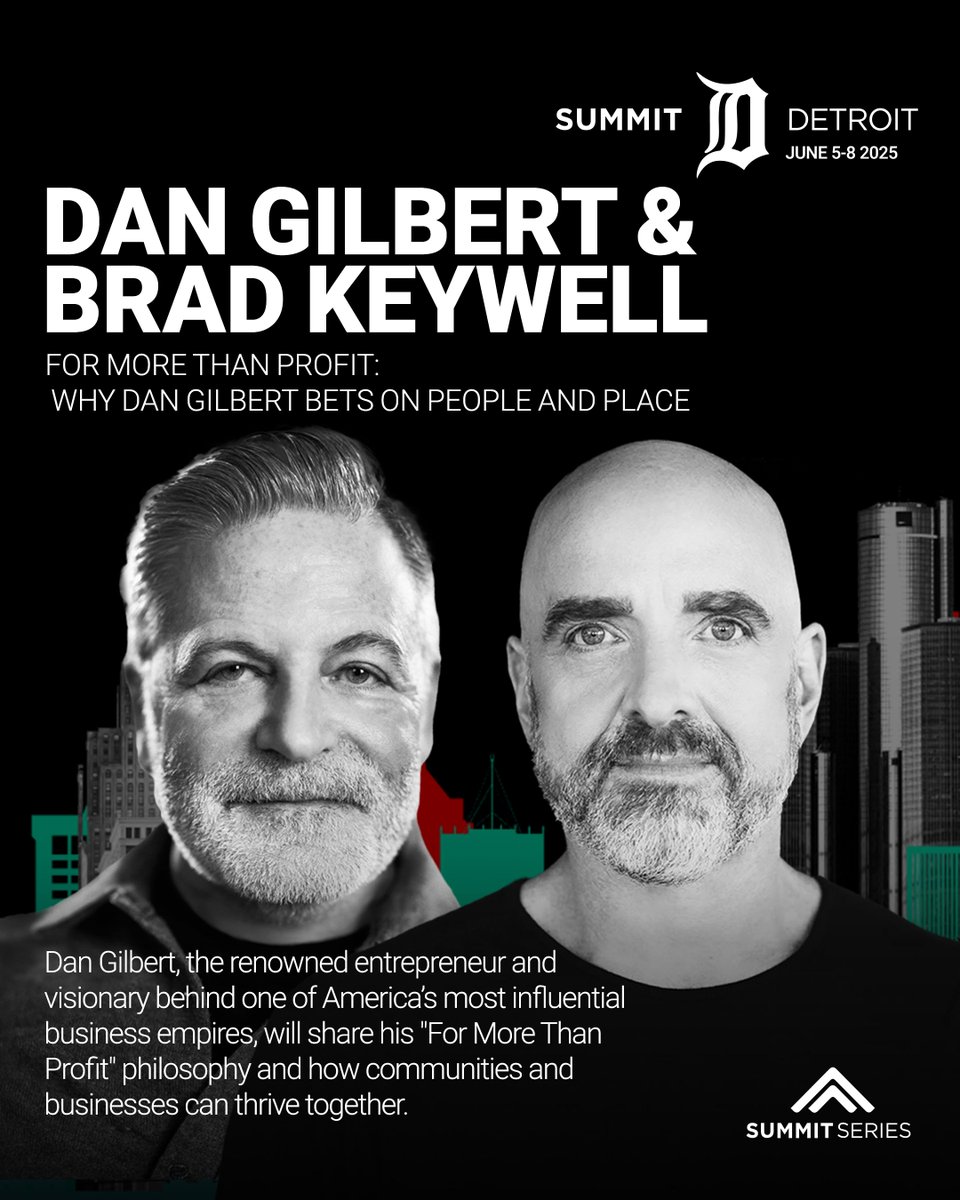
Got to share about our new Wisdom Prize @SPSwisdom with @ShakaSenghor at @SummitSeries over the weekend. Apply/Nominate someone for up to $100k grant & access to our fellowship program at https://t.co/wPEej27tX7
What happens when you honor the thinkers reshaping culture—not with likes, but with resources, recognition, and real community? This is the Street Philosopher Society. Our first chapter begins in Detroit with local visionaries whose work makes meaning out of chaos and builds legacy out of love.
Our founders @ShakaSenghor & @bradkeywell set the tone as we kick off at @summit Detroit.
Watch. Listen. Nominate the next Street Philosopher to win up to $100k.
Joseph Campbell called it the Hero’s Journey: leave comfort, face resistance, transform, return. The most successful people don’t just endure struggle—they recognize the story they’re in. That shift changes everything.
#Leadership#HeroJourney#SelfAwareness#Storytelling
https://t.co/hVDIyK1fR9
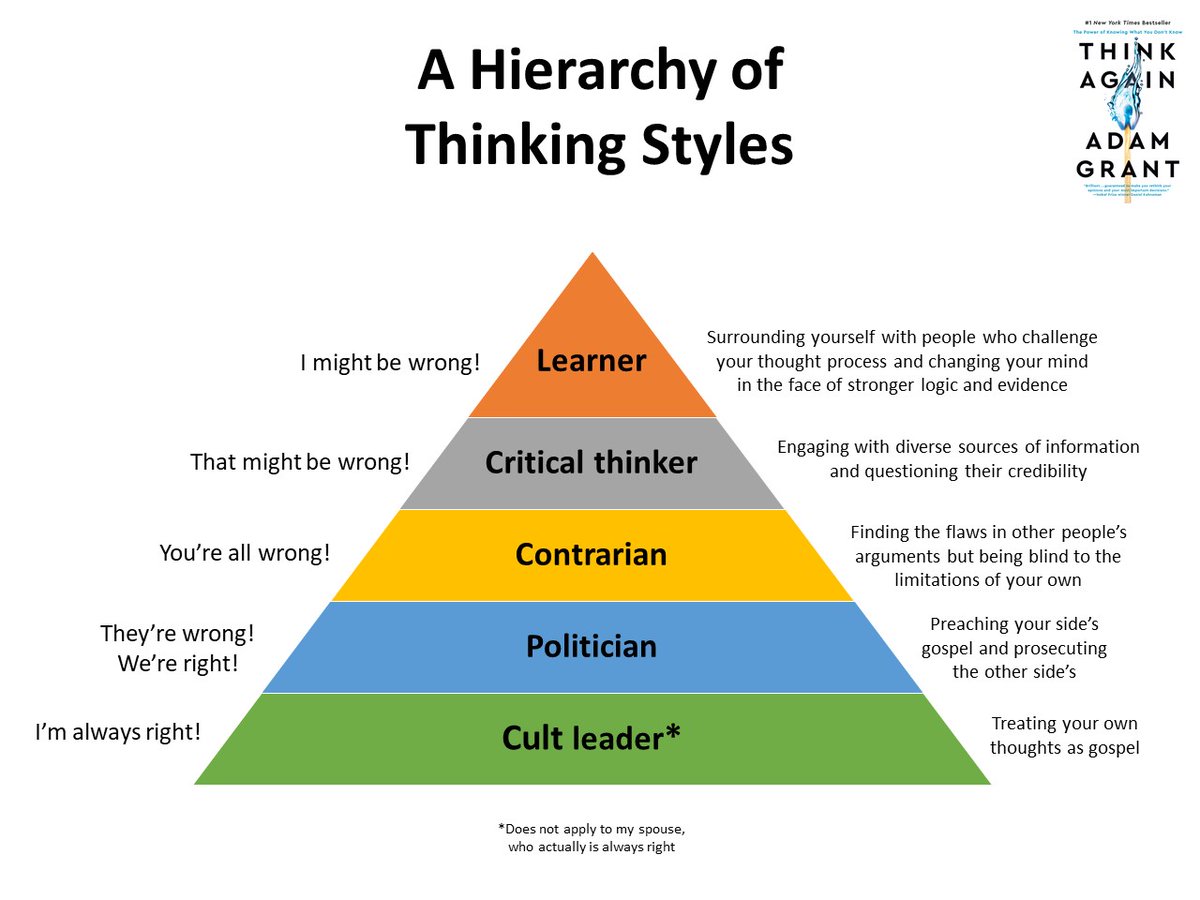
Seek Those With Whom You Disagree.
As a behavioral scientist, I find disagreement incredibly interesting. And when I hear things that I disagree with, I look at it in sort of a clinical way.
I believe many things. I know that many of them are wrong, but I don't know which.
Now, how am I going to find that out?
- By listening to other people.
- By being around people who disagree with me.
And how am I going to be able to have those conversations? By being respectful and loving toward them and by loving people with whom I disagree.
We should be grateful for the people with whom we disagree.
One of the most common beliefs about success sounds logical—but it’s completely misleading.
Let’s break it down.
We love the idea of the self-made genius—the lone visionary who changes everything.
But the truth? No one does it alone.
Research shows that the most successful people aren’t just talented or hardworking—they build strong networks, seek mentorship, and collaborate with others. Harvard Business Review found that high-achievers thrive in environments where they exchange ideas and refine their thinking with others.
In Give and Take,@AdamMGrant highlights how great leaders succeed not just because of talent, but because they surround themselves with the right people.
Steve Jobs had Steve Wozniak.
@Oprah had Maya Angelou.
Einstein collaborated with countless physicists.
The best leaders aren’t afraid to ask for help. They:
- Seek out mentors who expand their thinking
- Build teams that complement their weaknesses
- Stay humble enough to keep learning
Research shows that entrepreneurs who actively seek mentorship grow their businesses 3.5 times faster than those who go it alone.
The smartest people aren’t the ones with all the answers—they’re the ones who know where to find them.
Success isn’t about isolation—it’s about connection, collaboration, and learning from others. Now, a question for you: Who’s one person who has had a major impact on your journey? Reach out and show appreciation.
#Entrepreneurship #BusinessGrowth #PersonalDevelopment
Work used to be simple: clock in, get paid, climb the ladder.
But people are walking away from high-paying jobs—not for money, but for meaning.
Why? Because work is no longer just about survival. It’s about purpose.
Let’s explore this shift and what it means for the future of work.
Viktor Frankl, in Man’s Search for Meaning, wrote: "Those who have a 'why' to live, can bear almost any 'how.'"
This isn’t just about enduring life’s hardships—it also translates to work. Research backs this up:
- A McKinsey study found that 70% of employees define their work by its sense of purpose rather than just a paycheck.
- Companies that instill a sense of meaning experience higher employee engagement, retention, and innovation.
- Harvard Business Review studies show that people are more productive when they believe their work makes a difference.
The old model was clear:
- Work hard for 40+ years
- Accumulate wealth
- Retire and finally pursue fulfillment
Today’s workforce wants more. They seek:
- Careers that challenge and grow them, not drain them
- Work that aligns with their values and passions
- The ability to make an impact now, rather than waiting until retirement
The companies that thrive will be those that:
- Prioritize meaning alongside performance
- Foster creativity and autonomy, rather than rigid control
- Create cultures that inspire, not just demand results
A paycheck alone doesn’t create engagement. A sense of purpose does.
Organizations that focus purely on numbers will struggle to retain top talent. A 2023 Gallup report found that:
- Only 23% of employees feel engaged at work, despite rising wages
- Over half of employees are actively seeking new opportunities, largely due to lack of fulfillment
- The cost of replacing a disengaged employee is 1.5 to 2 times their annual salary
The future of work isn’t about squeezing the most productivity out of employees. It’s about creating an environment where people feel invested in what they do.
If you’re in a leadership position at work, put yourself in your employees shoes by asking yourself:
- Would I be inspired to work here?
- Does this job feel like a paycheck or a purpose?
- Are we giving people a why, not just a what?
The highest-performing teams aren’t just well-paid—they’re deeply connected to a mission that resonates.
The bottom line - The future of work belongs to those who create meaning, not just money.
The best companies won’t just offer salaries. They will offer a reason to show up every day with energy, creativity, and commitment.
So here’s a question worth asking: What makes your work meaningful?
#FutureOfWork #WorkplaceWellbeing #CareerDevelopment
Success stories always sound effortless in hindsight.
A breakout moment. A sudden rise. An "overnight success."
But here’s the truth—it never happens overnight.
Let’s break down the myth and what really leads to success.
Every "overnight success" you see was built on years of invisible work.
We celebrate the big moments—IPO announcements, viral product launches, billion-dollar acquisitions.
But what we don’t see?
The failures.
The pivots.
The late nights.
The near-quits.
Let’s talk about what really happens before success:
Groupon started as https://t.co/A2ynUUizut, a social activism platform that didn't gain traction.
The concept was simple: if enough people committed to an action—donating to a cause, supporting an initiative—it would trigger a collective movement.
But it didn’t take off.
Instead of quitting, we pivoted. We took the same group-buying concept and applied it to commerce.
The result? Groupon became the fastest-growing company of its time.
That success wasn’t sudden. It was built on failure, iteration, and resilience.
And that’s true for nearly every great company.
The years of iteration. Most great companies don’t start with their final, polished idea. Amazon began as an online bookstore. Netflix started with DVD rentals. Your first version won’t be your best—it’s a stepping stone.
The failures that fuel progress. @JeffBezos built Amazon in his garage for years before it became the empire it is today. Steve Jobs was fired from Apple before returning to build the iPhone. The path isn’t linear—it’s messy, unpredictable, and full of setbacks.
The resilience factor. Success isn’t about talent alone—it’s about perseverance. @Oprah was fired from her first TV job. Airbnb founders couldn’t get funding. Walt Disney was told he lacked imagination. The difference between those who make it and those who don’t? They kept going.
The compounding effect of consistency. We underestimate what small, daily improvements can do. Writing one page a day turns into a book. Selling one product a day turns into a business. Small wins, stacked over time, lead to massive breakthroughs.
The moment when preparation meets opportunity. Success looks sudden from the outside. But it’s just the moment when years of effort finally align with the right timing.
So what’s the takeaway?
Keep going when no one’s watching.
Work when it feels like nothing is happening.
Stay consistent—because small efforts compound into big moments.
Success isn’t about *one* breakthrough. It’s about stacking small wins over time.
Now, I’ll leave you with this:
What’s something you’re building right now that no one sees yet?
The greatest advantage in life and business isn’t what most people think.
It’s not intelligence. It’s not speed. It’s not experience.
But those who have it outperform everyone else.
Here’s what it is, why it matters, and how to cultivate it.
It’s not about having all the answers. It’s about staying relentlessly curious—challenging assumptions, questioning the obvious, and seeing what others overlook. That’s the real competitive edge.
Steve Jobs credited Apple’s success to a college class on typography.
@WarrenBuffett reads 500+ pages a day—out of curiosity.
Einstein said curiosity is more important than knowledge.
They didn’t just accept the world as it was. They kept asking:
Why is it this way?
What if it could be different?
Ayn Rand championed independent thought. Viktor Frankl believed true humanity comes from self-transcendence.
The people who change the world don’t follow the rules.
They question them.
The best minds don’t just ask, “What’s true?”
They ask:
- What if the opposite were true?
- What assumption am I making?
- What’s the deeper question I’m not asking?
The moment you stop questioning, you stop growing.
A curious mind sees possibilities where others see limitations.
Curiosity is the catalyst for innovation, reinvention, and progress.
So the next time you feel stuck, ask yourself:
What don’t I know yet?
What’s a different way to look at this?
What if I assumed the opposite?
Because the future doesn’t belong to those with the best answers.
It belongs to those who keep asking the best questions.
So I’ll leave you with this: What’s a question that changed how you think? Let’s hear it.
#Leadership #GrowthMindset #StayCurious
I've been thinking back on my trip to Antarctica and one of the most profound moments of my journey wasn't in what I saw—but in what I heard. Or rather, what I didn’t.
My most striking memory: the incredible silence while kayaking in a cove. At first, it felt almost eerie—so complete, so profound. But then, I realized it wasn’t just the absence of sound; it was the presence of something rare: clarity.
In that silence, my thoughts weren’t fighting for space. My mind wasn’t reacting—it was simply being. And in that stillness, I felt an overwhelming sense of awareness and perspective, a contrast to the relentless noise we all live with.
We don’t often experience true silence in our daily lives. We fill every gap with music, notifications, conversations, and content. But what if silence isn’t empty? What if it’s full of insight, creativity, and renewal?
Try this: carve out a moment of silence for yourself today. No phone, no distractions—just you and stillness. Listen to what your mind does when it doesn’t have to react. See what clarity emerges.
What’s the most profound moment of silence you’ve ever experienced? How did it change your perspective? Let me know—I’d love to hear your thoughts.
#SilentRetreat #NatureMeditation #Mindfulness
What if students were rewarded for asking the right questions—not just memorizing the right answers?
Think about the most impactful people in the world—innovators, entrepreneurs, artists, problem-solvers.
They weren’t the best at bubbling in multiple-choice answers.
They were the ones who:
- Challenged assumptions
- Connected unexpected ideas
- Asked the questions others overlooked
Yet, for most of us, school wasn’t designed to cultivate those abilities.
Instead, we were trained to:
1. Follow instructions
2. Seek the “right” answer
3. Play it safe
4. Avoid failure at all costs
But the real world isn’t a standardized test.
The irony? The skills that make you successful in life are almost the opposite of what schools reward.
Instead of memorization, you need problem-solving.
Instead of compliance, you need curiosity.
Instead of perfection, you need resilience.
The most successful people I know didn’t follow a pre-written script.
They wrote their own.
They questioned the rules.
They experimented.
They failed, learned, and kept going.
They didn’t just learn—they discovered.
Creativity isn’t some abstract luxury. It’s survival.
The world changes faster than any curriculum.
The ability to adapt, think critically, and approach problems with fresh eyes is the most valuable skillset you can have.
And yet, most schools still operate like they did 100 years ago:
- Standardized tests
- Rigid curricula
- Passive learning instead of active exploration
But the future belongs to the questioners, the experimenters, and the nonconformists.
So here’s the real question: How do we build an education system that values curiosity over compliance?
That rewards original thinking instead of rote memorization?
That prepares students for the unknown, instead of training them to follow instructions?
If we want the next generation to innovate, to push boundaries, to solve problems we can’t even imagine yet—then we need to start teaching differently.
We need to create spaces where learning isn’t about repeating—but about creating.
Let’s start with this: What’s one thing you wish you had been taught in school?
#CreativeLearning #InquiryBasedLearning #CriticalThinking #EdReform
Want better outcomes? Start with better questions. Let's talk about why.
Two of the strongest leaders I’ve met—Don Thompson and Martine Rothblatt—have something unique in common–relentless curiosity. They weren’t afraid to rethink the rules, challenge the status quo, and redefine what was possible.
Don Thompson, former CEO of McDonald’s, grew up in one of the toughest neighborhoods in Chicago.
He didn’t just accept the narrative given to him. He kept asking: What’s possible? What else is out there? How can I create the future I want?
That mindset shaped his journey.
Martine Rothblatt revolutionized biotech and built a billion-dollar company—but it all started with a deeply personal question:
"Why isn’t there a cure for my daughter’s illness?"
That question led her to start a pharmaceutical company with zero medical background.
The questions we ask define the problems we solve.
Small, narrow questions lead to small, narrow solutions.
Big, ambitious questions open doors to world-changing ideas.
Want to build something great? Ask bigger questions.
Want to make better decisions? Stop looking for certainty.
Instead, learn to love the questions that make you uncomfortable.
Because real growth happens in the tension between what you know and what you have yet to learn.
So I’ll leave you with this: What’s the best question you’ve ever been asked?
#Innovation #BetterQuestions #GrowthMindset
Really excited to host the dynamic @bradkeywell this week to discuss our industrial workforce - the good, the bad, and dire need for innovation. As a successful serial entrepreneur, tech trailblazer, and ecosystem catalyzer, set your reminder & tune in for some thought leadership gold
https://t.co/bGIkKaRhOb
Honored to have delivered the commencement speech to the Class of 2022 at the University of Michigan Ross School of Business -- my alma mater! https://t.co/tbHZoJvlJu #Classof2022#goblue@UMich@MichiganRoss
Super excited to pass the torch to @kaynegrau -- @Uptake's next CEO. Kayne is an extraordinary leader + operator. As Exec Chairman, I'm as engaged and committed as ever to Uptake becoming the world's leading system of industrial intelligence! https://t.co/CL0HfTY6vY
How do we ensure the hybrid work model is fair and equitable? Join Ravi Kumar, Amy Wilkinson, Adam Bryant and me this Friday 4/30 for a discussion on Balancing a Hybrid Workforce. https://t.co/mAxHFumYgT @iamravikumars@amywilkinson@AdamBBryant