Looking forward to having this small contribution to 'Reformed Baptist' identity (through dialogue with A.W. Pink's theology) being soon available. I argue that there are strong theo. and historical links that evidence the inclusion of Particular Baptists within the tradition.
I listened to this in the car today. It sounds like @richbarcellos hijacked the episode.
@andrewbdsparks, @1689Dogmatician: You are both patient brothers.
All-in-all, a good listen.
Rev. Joe Anady and Dr. Daniel Scheiderer are joined by Dr. Drew Sparks, Dr. Richard Barcellos, and Rev. Scott Meadows to preview the theme of this years of this years conference, which is chapters 12 & 13 of our confession, Of Adoption And Sanctification.
https://t.co/vwCH6p4U2f
Pastor Nick Clevely invites you to Canon & Creed 2026: Understanding the Kingdoms.
Join us in Sydney, 14–15 August, for two days of rich teaching, fellowship, and encouragement.
Attendee resource packs worth over $150 are still available.
Register here: https://t.co/zHJ4DiFzPN
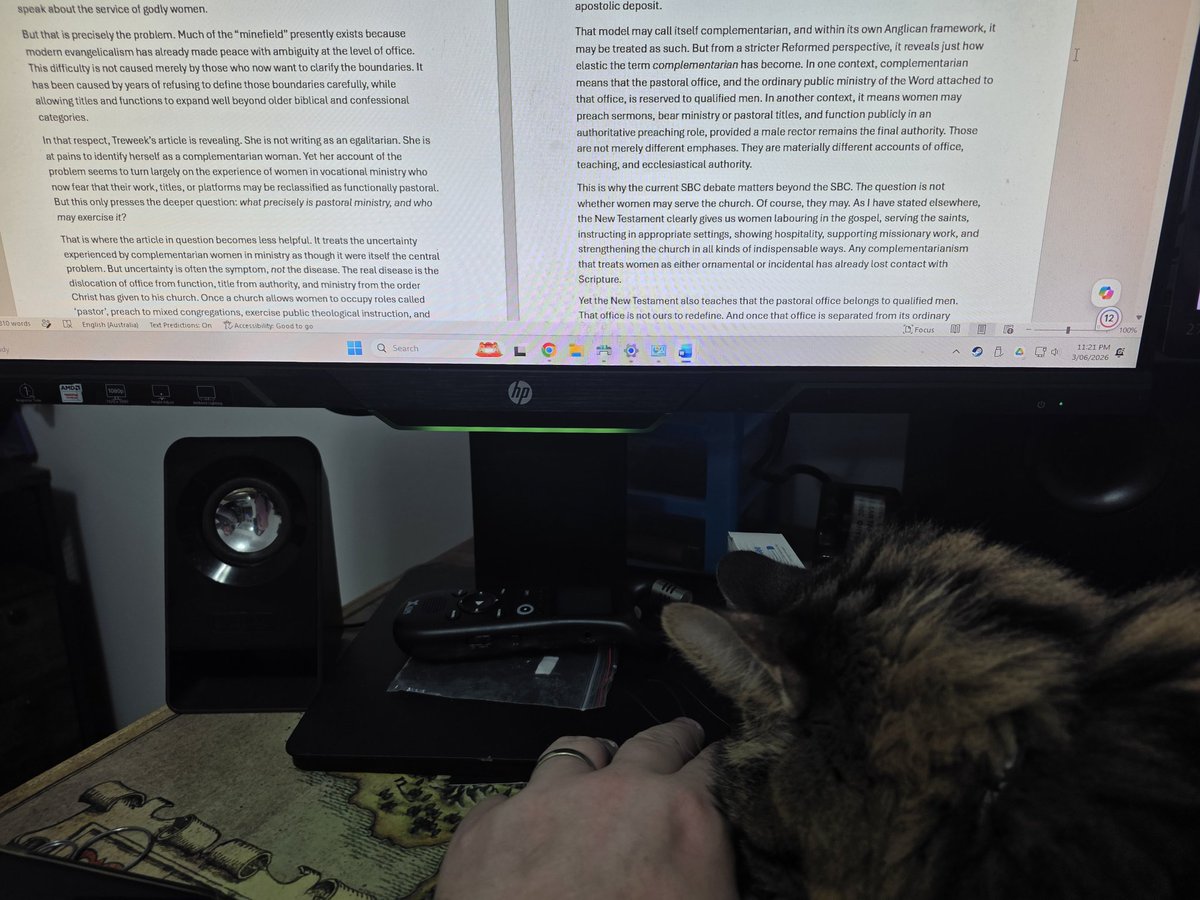
One further observation, Dani: I think your article itself illustrates part of the difficulty.
It seems to assume a broader complementarian settlement as the baseline, and then treats stricter accounts of office, preaching, and pastoral function as though they are creating the 'minefield'.
But that is precisely what is under dispute.
For my friends in the #SBC26, this may be worth considering.
From across the Pacific, Sydney Anglicanism offers one possible example of where elastic complementarianism can land: formally male office, but women as 'pastors', 'ministers', preachers, and deacons.
https://t.co/09HvSA9oGu
Dani, I don’t think I am moving the goalposts here. I think we are simply using the term 'complementarian' at different levels, which I've already stated above. That is, you seem to be using it in a more technical historical sense, tied to Danvers, the early complementarian movement, and Sydney’s later adoption of that language to describe its own pre-existing settlement.
I am using it more analytically, as a broad descriptor for non-egalitarian accounts of men, women, office, teaching, and ministry. In that sense, I am not claiming that Sydney’s 1922 ordinance was 'complementarian' in the later technical (i.e., Danvers/CBMW) sense. That would obviously be anachronistic. I am saying that, once Sydney later adopted the term as shorthand, the term was being used to describe a local settlement that was already broader than stricter and historic Reformed accounts of office and the ordinary public ministry of the Word would have allowed.
That was already conceded in my wording that you quoted. I said Sydney may call itself complementarian, and within its own Anglican framework may be treated as such. My point was then comparative: from a stricter Reformed perspective, that shows how broad or elastic the category is when it is used to cover materially different accounts of office, preaching, title, and pastoral function.
Thus, the issue is not whether Sydney has changed since Danvers, I never argued this in the article. Nor is it whether Sydney has and is defined by its own Anglican history. It plainly does. So the disagreement here is not over Sydney’s chronology, but over the coherence of the category. If 'complementarian' can describe both the Sydney settlement and stricter accounts of office, then the very term we discuss is doing a great deal of work while hiding very real ecclesiological differences. That is my point. Sydney has not necessarily just moved in the last 40ish years; the category is simply broader than many are beginning to realise.
Dani, I think we are talking past each other at one crucial point: I am not arguing that Sydney has become more elastic since Danvers, nor that Sydney’s practice was simply imported from America. As I mentioned above, I readily grant that Sydney has its own Anglican and evangelical history on this matter, including the 1922 ordinance, the later Doctrine Commission work, and the diocese’s distinctive debates over women’s ministry. My point is not genealogical but comparative.
Relative to stricter Reformed, Presbyterian, and Particular Baptist accounts of office, preaching, and pastoral function, the Sydney settlement is elastic. While the presbyteral office remains formally male, there is significant breadth around that office: women may be ordained as deacons, wear clerical attire, serve in substantial ministry roles, preach or address mixed congregations, and, in some churches, hold ministry or pastoral titles.
That breadth is the point I am trying to press. It may be perfectly consistent with Sydney’s own internal history, but it is not therefore identical with the older Reformed settlement on office, preaching, and the ordinary public ministry of the Word.,
In that respect, I also think the 1922 ordinance, which John refers to in the other thread, needs to be located carefully. It is certainly relevant to any understanding of the ministry of women within the Diocese. But it also predates the later Mowll-era consolidation of Sydney Anglicanism and sits within an early twentieth-century Protestant context in Australia where questions about women’s public ministry were already being tested in various quarters. I raise that not to dismiss the ordinance, but to note that Sydney’s present settlement was shaped by a particular local development.
So the issue in question is not whether Sydney has moved over the past forty years. Rather, it is whether Sydney’s settlement was already broader at precisely the points many in the SBC are now concerned about: title, preaching, public teaching, vocational ministry, and pastoral function. When Sydney later adopted 'complementarian' as a useful shorthand, that word was being applied to an already existing Sydney settlement, one that stricter accounts of office, preaching, and pastoral function would have regarded as broader than their own.
That is why I do not think this is merely a matter of later 'gatekeepers' narrowing the circumference. It may well be that the early use of 'complementarian' was broad enough to include arrangements that many stricter traditions would never have regarded as fully coherent with their doctrine of office and the ordinary public ministry of the Word. If that is so, and I think it is, then the real disagreement is not simply over whether Sydney has changed. It is over whether the umbrella was ever theologically stable enough to cover such materially different accounts of office, preaching, title, and pastoral function while treating them as though they were saying substantially the same thing.
That is why Sydney, arguably, remains relevant to the SBC debate. It shows one possible arrangement in which the final presbyteral office remains male, while many of the functions, titles, and forms of public ministry ordinarily associated with that office are distributed more widely. That may be internally coherent within Sydney Anglicanism, but it is precisely the sort of settlement many in the SBC are trying to avoid.
I appreciate the pushback. I'm happy to concede the point that Sydney has not moved on women as presbyters/elders. That is true. However, I don’t think my argument depends on the claim that Sydney is inevitably moving there. My concern is not simply the final formal line, but the elasticity that can develop around it.
If the presbyter/elder remains formally male, but women may preach sermons to the gathered church, hold substantial pastoral ministry roles, and in some cases carry titles such as 'women’s pastor', then I think there is at least a real question as to whether the line still governs the broader ministry culture in the way stricter 'complementarians' would expect.
So when you say there is 'no functional slippage', I suppose that is exactly where I would differ. I agree there has been no slippage on the presbyteral office in the formal sense. But I really do think there has been significant elasticity in the functions and titles that many Reformed Baptists, Presbyterians, and SBC conservatives would ordinarily understand as attached to the pastoral office.
Regarding the title 'pastor', I take your point that the terminology is contested and ecclesially loaded. But that is part of my argument. If one context uses 'pastor' functionally or vocationally, while another hears it as 'elder/overseer/shepherd', then the ambiguity is not imaginary. It is built into the word's divergent uses.
On 'unbiblical fences', I agree that some restrictions can go beyond Scripture. But I would want to say that more carefully. Within the Reformed tradition itself, there has been real debate over what women may do in the public assembly. Some have restricted women from public Scripture reading or leading elements of worship, not because they thought women were lesser, but because they understood those acts as tied to public teaching or church order. Others have treated some of these matters as adiaphora, or at least as matters of circumstance and prudence, so long as the ordinary ministry of the Word and the government of the church remain intact. However, my specific concern is as to whether preaching to the gathered church is simply another act of participation, or whether it belongs to the ordinary public ministry of the Word attached to the pastoral office.
Perhaps the difference is this: you see Sydney as an example of stable complementarian breadth. I see it as an example of formal stability at the level of office, but real elasticity around function, title, and preaching. From my conversations with those within the SBC, that's what many are worried about.
@theweeflea Both are good contributions, and I enjoyed reading both, but they are both a bit dated. I'd certainly commend grabbing the volume edited by Patrick Little!
@MusingsOnChrist@RScottClark I've really appreciated @RScottClark's scholarship. Recovering the Reformed Confession was influential on me, alongside Trueman's Creedal Imperative. Clark's work on Reformed Scholasticism has also been very helpful (Thanks Scott!)
Thanks, John, for your kind words. It's been a while since we've engaged.
I agree that Sydney has not moved on women presbyters/elders, and that absolutely matters. But my argument is not inevitability but, rather, elasticity. Sydney may show that a movement can remain formally complementarian at the level of final office while becoming much broader in its approach to title, preaching, and pastoral function.
That is exactly the point. The SBC concern is not only, 'Will this end in women elders?' but, 'Can the office remain meaningfully male if the functions and titles ordinarily associated with it are detached from it?'
And on 'unbiblical fences', that is the disputed issue. If preaching to the gathered church is part of the ordinary public ministry of the pastoral office, then restricting it is not an extra fence. It is part of preserving the office.
Dani, I’m not denying Sydney’s own 19th/20th-century evangelical history, nor claiming its practice was simply imported from America post-Danvers.
The point is not genealogical but descriptive.
“Complementarian” is now used as a catch-all, including by Sydney Anglicans, to refer to a range of positions that affirm ordered male/female ministry while restricting certain offices to men.
But Sydney also later leaned into the post-Danvers language through Equal But Different and related ministry framing. So yes, Sydney has its own local Anglican history, but it has also participated in the broader complementarian vocabulary.
My argument is that Sydney offers one possible picture of a broader complementarian settlement in practice: male presbyteral office formally retained, while titles, deacons, preaching, public teaching, and vocational ministry become more elastic.
That is the kind of ambiguity many in the SBC are trying to avoid.
From across the Pacific, I’m thankful for @albertmohler’s leadership on this issue before the SBC. The debate over women serving in the office or function of pastor/elder/overseer is not a distraction from confessional faithfulness. It is a test of whether confessional words still govern practice.
In light of what has been unfolding within the #SBC, and locally here within the Presbyterian Church of NSW, regarding the role of women as 'elders' or 'pastors', I've written an observation on the nature of office and whether it is ours to define (URL in my first reply).
An important update on the Truth & Unity Amendment to the SBC as we get ready to meet in Orlando. We need to get this done and affirm the convictional principles of the SBC.