Sui 2026 Bucket List is LIVE: https://t.co/xJDnyN6Kbc
Together with top @SuiNetwork protocols, we built your 2026 Sui Bucket List. Check which badges you’ve unlocked, complete the rest, and earn ecosystem rewards.
Start 2026 strong. More details ⤵︎
Sui makes gasless stablecoin payments possible. What comes next?
Imagine your AI agent automatically depositing idle stablecoins into Bucket’s USDB Savings to earn yield, then withdrawing when funds are needed — all within limits you set.
Your agent. Your rules. Your money at work.
Over the past 30 days, stablecoin supply fell roughly 5% across crypto.
On Sui, it grew over 10% to ~$538M.
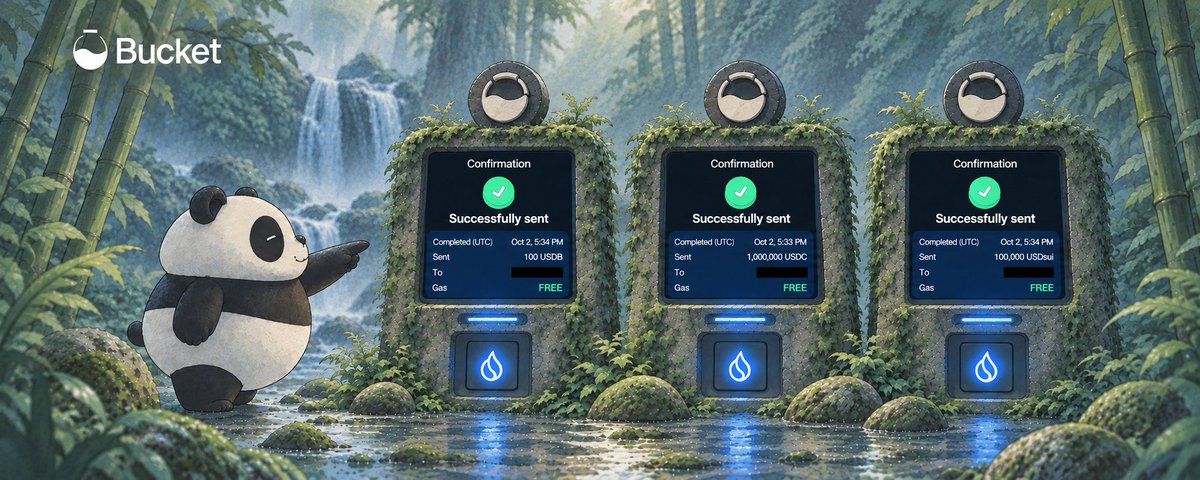
Sending stablecoins on Sui costs zero gas, built into the protocol.
Welcome to Sui, UK 🇬🇧
An easier way in with @SlushWallet
A next step for your stablecoins with Bucket.
Your wallet is ready.
Explore USDB Savings to put your stablecoins to work and earn yield on Sui, with no lockup.
Security builds trust. Trust brings users and liquidity onchain.
With Bucket, borrow USDB against your assets and put idle USDB to work in Savings.
Built on Sui.
USDC can now move across 30 blockchains with CCTP V2 on Sui.
But moving money is only the beginning.
What happens when that liquidity starts working?
On Bucket, users can turn USDC into USDB and put it to work through sUSDB Savings.
More connected liquidity. More possibilities for DeFi on Sui.
BTC is breaking higher. SUI is surging with it.
Most holders ask: “Where should I take profit?”
Bucket user asks a different question:
“How much liquidity did this rally just unlock?”
Deposit SUI as collateral. Borrow USDB. Keep your SUI exposure.
SUI in. USDB out.
SUI sold: 0.
Every dollar of that outflow left the same way: someone sold the BTC.
The Bucket takes another route.
BTC stays posted as collateral. USDB comes out against it, with the cost known upfront.
Liquidity out. BTC stays in your hand 🐼🪣
Every borrower knows their liquidation price.
But nobody cares about their idle price.
The lowest LTV feels like caution, but leaving BTC still is a decision too. It just never shows up on a screen.
What would your BTC have done this quarter?
Sponsored transactions need someone to keep paying.
A transfer that costs nothing in the first place is the version that still works after the sponsor stops, which is why moving USDB has not needed a SUI balance since May.
Gasless stablecoin transfers are at the protocol level on Sui.
Not sponsored transactions where someone else pays the fee.
@stabledash invited @louisabai, Head of Stablecoins at @Mysten_Labs, to elaborate the difference.
Full conversation.👇
2M+ testnet deposits, and none of that BTC is doing anything yet.
Programmable collateral is step one; borrowing against it at high LTV without a rate spike is where it starts paying for itself.
Bitcoin is back in every timeline, but it is still sitting idle in cold storage.
Hashi makes native $BTC programmable collateral on Sui, while the Bitcoin stays on its own chain.
2M+ deposits on testnet. Mainnet next.
Native BTC on Sui is close. 1.1M+ testnet deposits.
Day 1 the question changes. Not "can I bring BTC here" but "what can it do once it arrives."
Collateral in. USDB out. High LTV, predictable cost.
What would you do first?
👀 The interesting part isn't the $647M.
It's that this happened on the Hashi testnet.
Hashi has already seen 9,991+ hBTC enter the Sui ecosystem, representing roughly $647M in $BTC value, according to @blockvisionhq.
Native BTC hasn't even started flowing directly into @SuiNetwork mainnet yet.
So here's the question:
If $647M can show up before mainnet…
How big do you think BTC liquidity on Sui gets after native BTC goes live?
Bringing institutional BTC onchain is the first half of the problem.
The second half is what that BTC does once it arrives, and on Sui high LTV, predictable-cost borrowing has been answering that already.
JUST IN:
SUI IS BRINGING THE WORLD’S MOST DEMANDED INSTITUTIONAL ASSET ONCHAIN 🤯🤯🤯
Mysten Labs co-founder Eman Abio says HASHI is launching this year on SUI, enabling institutions to unlock yield, lending, and stablecoin liquidity from their Bitcoin without selling it.
$1 trillion in BTC sits idle.
Hashi lets BTC stay on the bitcoin network while unlocking DeFi on Sui. Institutional-grade, fully decentralized.
Testnet coming soon.
What actually matters is the terms you agreed to before things broke:
💧 Verifiable collateral: Always know what’s backing you.
💧 Fixed, predictable rates: No sudden rate spikes overnight.
💧 Custom LTV: Chosen by you, not dictated by market panic.
Credit doesn't break at liquidation.
🔎 RESEARCH: Not all crypto credit is built on the same foundations.
CeFi lending, DeFi pools, tokenized Treasuries and RWA private credit each rely on different forms of custody, collateral and enforcement.
CeFi concentrates counterparty exposure, DeFi depends on onchain collateral and liquidation, while RWA credit still rests on offchain underwriting and legal claims.
When a position fails, what matters most: the token, the collateral or the claim behind it?
Cointelegraph Research with @eightlends maps how credit exposure is structured across the crypto market.