🚨 Yamal on English football after facing Newcastle:
“You receive the ball and it feels like you’ve stolen something. Three players come immediately. I don’t know how technical players like Bruno survive there.”
🚨 Rio Ferdinand on the misunderstanding that left Yoro chasing Isak:
“Everybody’s discussing Yoro’s contact with Isak. Go back to the ball that put him in that situation.
De Ligt leaves it, expecting Yoro to deal with it. Yoro’s expecting De Ligt to deal with it. Isak carries on running.
Two centre backs makingg an assumption and a centre forward making a decision.
That’s where United got themselves into trouble.
With me and Vida, we understood what each other wanted to do. He was the aggressive one. He wanted to attack the ball, get tight to the striker, make that first contact. I was generally calmer, reading what was developing and thinking about the space behind him.
We struck a balance. If he went to attack something, I knew I had to cover. If I stepped out, he adjusted.
But that understanding didn’t mean we stopped speaking. We spoke because we understood how important it was.
‘Vida, yours. I’m covering.’
That tells him two things. Deal with the ball, and if something happens behind you, I’m there.
You don’t want both defenders charging into the same challenge. You certainly don’t want both leaving it because each thinks the other has it.
People talk about trusting your partner. Absolutely. But trust him and verify that you’re both making the same decision.
Has he called? Has he seen the striker? Is he actually in a position to deal with itt?
That takes a shout and a glance. It can save you a 40 yard chase towards your own goal.
On this occasion, De Ligt needs to follow that ball through. If Yoro hasn’t clearly taken responsibility, don’t assume the job has passed to him. Deal with it. Head it, clear it, make the situation safe.
Instead, the hesitation confuses the partnership. Isak gets through, Yoro has to recover, and now we’re discussing a red card.
Whatever your opinion of that decision, the situation before it was avoidable.
And I do question starting De Ligt in this particular game after his absencee.
Being fit enough to be selected doesn’t automatically mean you’ve recovered your match rhythm. You need that sharpness in your decisions: when to step, when to drop, how quickly the striker is moving while you’re judging the flight.
Against Liverpool, you’re testing all of that immediately.
Maguire already had minutes in his legs and rhythm in his game. For me, you keep him going and introduce De Ligt gradually. Give him the opportunity to build himself back up.
That’s protecting the player as well as the team.
Vida and I became a partnership because we made each other’s decisions clearer. His aggression gave me something to read…..my positioning gave him the confidence to attack the ball.
De Ligt and Yoro need that same clarity.
On that occasion, they each thought the other had it sorted.
Isak was the only one who knew exactly what he was doing.”
🚨 Ashley Young on Yoro’s red card and the challenge on Mbeumo:
“Apparently, Mbeumo needed to stay stronger, but Yoro needed to disappear.
That’s what I’m strugglingg with here.
Bryan’s going into the box, still involved with the ball, Jacquet makes contact and he goes down. Nothing given. We’re accepting that as defenders being physical.
Fine. But rememberr that standard, because we’re going to need it again in a few minutes.
Isak goes through, takes a heavy touch towards Lammens, Yoro makes contact behind him, and suddenly we’ve gone from allowing physical contact to sending somebody off.
Explain the difference properly.
‘There was contact.’
There was contact on Mbeumo as well. We’ve already established that contact alone wasn’t enough at that end.
You’ve got to judge what the defender actually does. Is it a fair challenge? Is it a push? Has he tripped him? You cannot just point at a player on the floor and tell me the decision explains itself.
And the red card needs another explanation entirely.
What scoring opportunity has Yoro denied if Lammens is getting to that ball first?
That’s the question I want answered. Take Yoro out of the picture. Let Isak keep running. Does he reach the ball before the goalkeeper?
If he doesn’t, you can argue about the foul, but where’s the obvious chance he’s been prevented from having?
‘Yoro was the last defender.’
And Lammens hasn’t bought a ticket to watch. He’s part of the situation. His position matters. The weight of Isak’s touch matters.
You cannot assess the red card using the chance Isak had before he took that touch. You have to look at what was still available when the contact happened.
I’ve played as a winger and a defender. I know what it’s like running at full speed with somebody right behind you. Small contact can affect your balance. That doesn’t automatically make every collision a foul, and it certainly doesn’t make every foul a red card. Especially in a situation like this where Isak no longer had control of the ball.
Those are separate decisions. Explain both.
For United supporters, the frustration is completely understandable. They’ve just watched their forward go down under a challenge and been told to get on with it. Then their defender is walking off after contact at the other end.
They’re entitled to ask why.
Don’t give them ‘football’s a contact sport’ for Mbeumo, then ‘there was contact’ for Isak.
Pick a standard. Apply it at both ends.
And before you send Yoro off for denying a chance, make sure Lammens wasn’t already taking that chance away.”
🚨 Steven Gerrard on the striking technique that makes him jealous of Szoboszlai:
“If you’ve played football, even just with your mates, you’ll have hit a ball once that came off your foot perfectly. No effort, clean contact, and you’ve watched it fly and thought, ‘Why can’t I do that every time?’
Szoboszlai looks as though he knows exactly how to find that contact again.
That’s the bit I’m jealous of.
People see the speed of his shots and talk about power. Watch how little he sometimes needs to pull his leg back. He doesn’t look as though he’s trying to kick through a brick wall. He getss himself balanced, meets the ball beautifully, and suddenly the goalkeeper has a serious problem.
‘Just hit it harder.’
That’s what you tell yourselff when you haven’t got his technique. Then you swing harder, then it doesn’t move as you thought it would or somebodyy has to fetch the ball from the car park
With him, the force goes into the strike. There’s very little wasted. And he can produce that clean contact with either foot. He doesn’t always need the extra touch to move it onto his right. If the opportunityy is there on his left, he can take it.
That makes closingg him down horrible. You think you’ve forced him away from the danger, and he still gets a shot away that makes the goalkeeper work.
And the flight is what catches your eye. Some players hit a powerful shot and you can follow its path. His can dip or move late, so the keeper’s trying to judge something that won’t quite settle.
By the time he’s worked it out, he may already be beaten.
Against United, it was the smile before the free kick that got me. The referee points to the spot, and Dominik looks pleased with where the foul has happened.
Everybody else is discussing the wall. He looks as though somebody’s just put the ball exactly where he wanted it.
‘Can he score from there?’
I was thinking, ‘Can the wall stop him?’
Because once a player with that technique gets the ball past the wall at that speed, there’s very little time left for Lammens to do anything about it.
Then he hits it, and you understand the confidence.
That’s the reward for knowing your strike. He isn’t standing there hoping he makes good contact. He trusts what he’s practised, picks what he wants to do and commits to it.
I loved striking a football. I could happily spend ages after training working on that feeling.
Watching him, I’d want to stay behind a bit longer.
‘To give him some advice?’
No. To stand beside him and ask, ‘Go on, show me that again.’”
🚨 Roy Keane on Omar Berrada’s message to United supporters that gets him upset:
“What does he think the supporters are watching every weekend? A different Manchester United?
They’re askingg why the team isn’t good enough, and he’s telling them how pleased he is with the squad. That’s an extraordinary way to reassure people who have eyes.
He had a straightforward job. ‘We haven’t been good enough. You’re right to be frustrated. We’re responsible for improving this, and we’re working to put it right.’
There. Nobody needed a presentation.
Instead, we get progresss, depth, a buzz about the place. Lovely. Can the buzz defend the back post?
Saying ‘I understand the frustration’ means very little if the next ten minutes are spent explaining why everybody should be more impressed.
The supporters aren’t confused. They’re disappointed. There’s a difference.
And this business about him saying the team has 9 defenders. Nine! We’re counting them now, are we?
Imagine that conversation in a dressing room.
‘We need to improve defensively.’
‘We’ve got nine defenders.’
‘Yes. Which four can we rely on?’
That’s the questionn. Who’s available? Who can defend one against one? Who follows a runner? Who stays switched on when the ball goes across the box?
You’re running a football club. Having enough names to fill a team sheet is hardly the achievement.
Then there’s, ‘We won’t spend for the sake of it.’
Who asked you to? Show me the supporter saying, ‘Please buy somebody useless. We just want to see a transfer fee.’
They’re asking you to identify players who improve the team, and if you can’t, the supporters have identified them for you. But that’s what the recruitment department is there for. You don’t get to present avoiding a bad signing as the successful completion of your transfer window while the position still needs fixing.
‘The right player wasn’t available.’
Then explain what you’re doing about it. Because the opposition’s right winger will be available on Saturday.
And bringing Rashford into the explanation of how the summer improved the squad…come on. The supporters know who Marcus Rashford is. They haven’t just discovered him because you’ve included his name in an interview.
This is what irritates people. Every decision gets presented as evidence that the plan is working. Even the things they can see aren’t working.
If a player gives the ball away, I expect him to acknowledge it. I don’t want him pointing out that he successfully controlled it first.
Why should the standards upstairs be any different?
Pochettino arriving should mean proper support for the work ahead. Identify what he needs. Make good decisions. Take responsibility for them. Don’t turn his appointment into another opportunity for everybody above him to congratulate themselvess.
The fans will provide the excitement. They always do. They’ll turn up wanting to believe again.
Your job is to give them a football team that rewards it.
They don’t need you to explain how to feel about Manchester United. Some of them have supported that club longer than you’ve worked in football.
Stop trying to win the argument with the supporters.
Give them something worth defending.”
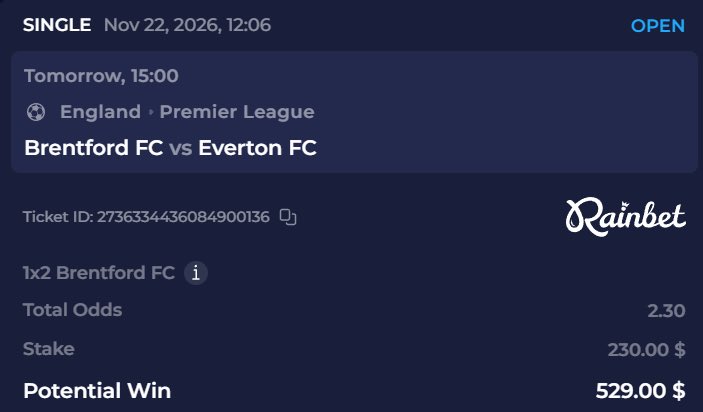
Brentford have made a habit of making bigger clubs uncomfortable at home. Everton might be in better form, but I doubt the Bees are interested in helping them extend their good run.
Brentford, you’re at home. remind Everton that good form doesn’t guarantee 3 points.
Brentford have made a habit of making bigger clubs uncomfortable at home. Everton might be in better form, but I doubt the Bees are interested in helping them extend their good run.
Brentford, you’re at home. remind Everton that good form doesn’t guarantee 3 points.
@Sage_FCB I know my gaffer is gonna find a way to fix this. Please don’t start de Ligt next game. He has to start from the bench so he gets match rhythm
🚨 Daniel Sturridge on why Ngumoha looks like Liverpool’s expensive new signing:
“If you’d been in a coma, woke up today and somebody put this match on, you’d be asking which club Liverpool bought their left winger from.
You’d watch him receive the ball, deal with the defenders and pick his next action.
‘He looks about 24!. How much did he cost?’
Then somebody tells you he’s eighteen.
‘Eighteeen? And he’s doing that against Manchester United?’
That’s the reaction his football deserves.
He plays with the confidence of somebody who’s already worked out what makes him dangerous. He doesn’t need to cram every trick he knows into one attack. A little pause, make the defender shift his weight, then accelerate. He’s creating the moment he wants.
The lovely thing is that he can embarrass somebody, hear the crowd react and still make a sensible decision afterwards.
That’s importantt. Sometimes a young player beats his man and gets so excited by it that he tries to beat the next three. Rio can do something brilliant and then give his teammate a simple pass.
He understands that the pass can finish the job the dribble started.
As a striker, I’d love playing with that. When he gets the ball, I’m moving. If his defenderr goes towards him, there might be space for me. If another defender comes across, somebody in our attack is getting free.
He gives you reasons to keep making runs.
‘But surely the occasion gets to him?’
Look at how often he wants to be involved. This is Liverpool against United, and he’s asking senior players to give him the ball so he can make something happen.
That’s some personality.
Then he gets into the position to score from Barcola’s pass. He’s been creating problems with the ball, and now he’s making himself the player somebody else can find.
Liverpool supporters are watching a teenager develop, but they’re already getting performances that help the first team now. That’s what makes it so exciting.
You’d expect to pay serious money for a winger who could come into this fixture and play with that much assurance.
Liverpool can look at their team sheet and see eighteen beside his age.
United’s defenders probably checked it twice.”
🚨 Michael Owen on Rio Ngumoha taking his record against Manchester United:
“I’d have liked to keep the record. But watching the player who’s taken it, I can hardly complain.
What impressess me is how little his age seems to affect his decisions. You expect a young winger to have pace and want to beat somebody. Rio’s got that. But he also recognises when beating the defender isn’t necessary.
If the pass is there, he playss it. If the defender gives him space, he takes it. When somebody comes across to help, he sees what that has opened elsewhere.
That’s the maturity. He’s enjoying himself without forgetting what Liverpool need from the attack.
‘Doesn’t he look fearless?’
He does, but there’s thought behind it. He’s making defenders commit before showing them what he actually wants to do. That’s different from simply running at somebody and hoping your ability gets you through.
And he keeps askingg for the ball. Imagine being the full back: you’ve just had a difficult few seconds against him, Liverpool move possession elsewhere, and you look up to find him making himself available again.
You haven’t finished dealing with the last attack. He’s ready to start another.
I remember being young and playing in this fixture. You know what it means before you step onto the pitch. Everybody around you makes sure of that. The challenge is keeping your decisions clear when everything feels bigger than a normal match.
Rio looks remarkably comfortable with that responsibility.
Then Barcola finds him and he gets his goal. By that point, he’d already given the crowd plenty to enjoy. The finish gave him something to take home from a performance that deserved it.
That’s a lovely feeling for a young player. You’ve helped the team, the supporters are singing, and suddenly a match you grew up watching has become part of your own story.
‘What would you say to him afterwards?’
Well done. Enjoy it. Then rememberr what made you so good before the goal.
Because the record tells you how young he is.
Watching him play, you could easily forget.”