Empowering Action in Complex Systems through innovative research, evidence-informed policy, and multisectoral solutions. #ComplexityScience#SystemsThinking
Why do policies fail despite strong evidence?
Because of complexity: politics, institutions, frontline discretion & feedback loops.
Sharing lessons from my Policy Evaluation course in the #ComplexityInPolicy series (Sept, 2025).
🔗 Follow @CiremHub#SystemsThinking#Policy
Webinar Invitation | Fixing the System, not the Victim: A Safe Systems Dialogue on Road Safety in Uganda
Every day, Ugandans die on roads that should protect them. According to the Uganda Police Annual Crime Report 2025, Uganda recorded 26,044 road crashes in a single year, 4,602 of them fatal (up 3.8%), 13,563 serious (up 3.3%), and 7,879 minor. These are not distant statistics. They are people.
Yet our national conversation keeps returning to the same question: what did the victim do wrong? The reckless boda rider. The careless pedestrian. The speeding driver. We blame the individual and move on.
But road crashes are not simply personal failures. They are the predictable result of systems that do not account for human error, unsafe road design, weak enforcement environments, absent pedestrian infrastructure, and policy gaps that make deaths inevitable rather than preventable. When the system fails, people die. And we call it an accident.
The @TRIADUnit at @Makerere University School of Public Health invites you to an honest dialogue on road safety in Uganda, one that confronts the questions we have long avoided:
Why do road deaths keep rising despite enforcement campaigns? Are we designing roads for mobility or for human safety? What responsibility do institutions carry when crashes occur? And what investments would save the most lives today?
Date: Thursday, 14 May 2026
Time: 12:00 – 1:30 PM
📷Register: https://t.co/o7PhqpFWTq
@MakSPH@Makerere@RhodaWanyenze@CiremHub@DICTSMakerere@MakerereAR 𝐖𝐡𝐚𝐭 𝐲𝐨𝐮'𝐥𝐥 𝐠𝐚𝐢𝐧:
→ Systems thinking and complexity for HSR
→ Research design — quantitative, qualitative, mixed
→ Political economy of health systems research
→ A mini research proposal and policy pitch
In March 2026, we participated in the Navigating Complexity webinar series hosted by @CiremHub at the Makerere University School of Public Health @MakSPH, where we introduced our Systems Informed Foresight® approach. Watch the recording👉:
https://t.co/qSRwUb9XmU
Navigating Complexity Webinar Series Tracing Change in Complex Systems: An Introduction to Ripple Effect Mapping ITuesday, 2nd June 2026 | 1:00 – 2:00 PM EAT
Health systems do not change in straight lines. Understanding how interventions produce outcomes in complex environments requires tools that go beyond conventional evaluation frameworks. Ripple Effect Mapping is one such tool, a participatory, visual approach that traces the often unexpected pathways through which change actually happens.
Organised by the @CiremHub Hub at @Makerere University School of Public Health in partnership with @UrbanForesight, this session introduces the theory and practice of Ripple Effect Mapping and its applications in public health research, programme evaluation, and policy analysis.
Who should attend:
Researchers, evaluators, programme managers, and public health practitioners working in complex health systems.
What you will gain:
A practical introduction to Ripple Effect Mapping and its application in public health evaluation contexts.
Presenter: Katie Miller, Consultant, @UrbanForesight
Moderator: Mr. Perez Ochanda, Deputy Director, CIREM Hub, MakSPH
Register here: https://t.co/qY9nL0Z9bK
Today we’re introducing Systems Informed Foresight (SIF®) at Makerere University School of Public Health @MakSPH.
An approach that integrates systems thinking and foresight to support decision-making in complex and evolving environments.
#SystemsThinking#Foresight
We’ve started.
Introducing Systems Informed Foresight (SIF®) — integrating systems thinking and foresight for decision-making in complex and evolving environments.
Live from @MakSPH with @CiremHub@LindaTKuvheya#SystemsThinking#Foresight
We’re live.
Exploring why many interventions fail — and what it really means to work within complex systems.
Introducing Systems Informed Foresight (SIF®) at @MakSPH with @CiremHub#SystemsThinking#Foresight
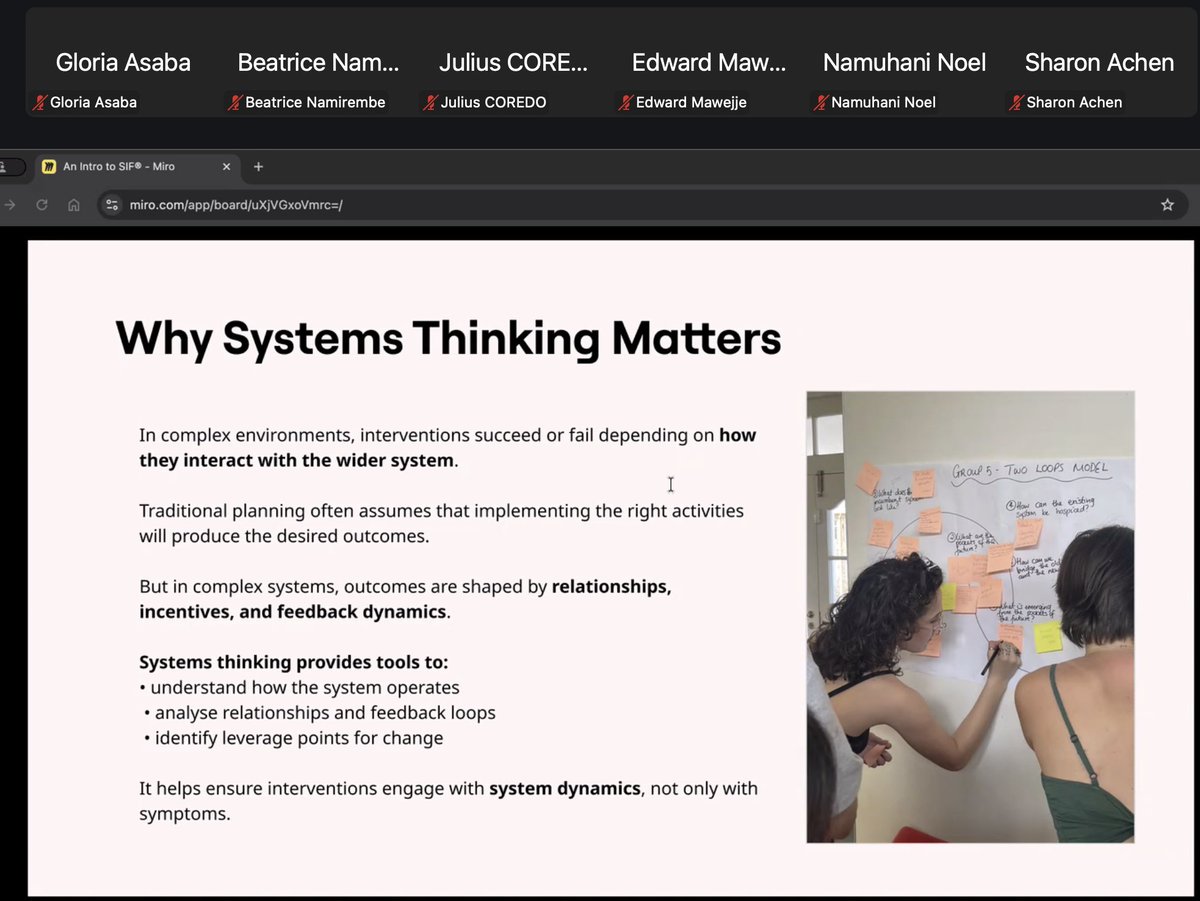
Many well-designed interventions fail, not because they are wrong, but because they do not engage how the system actually behaves.
Outcomes emerge from interactions, not just activities.
@MakSPH@CiremHub#Complexity#SystemsThinking
In complex environments, outcomes are shaped by relationships, incentives, and feedback loops, not just plans. Systems thinking helps us engage dynamics, not symptoms.
@MakSPH@CiremHub@LindaTKuvheya#ComplexSystems
Systems Informed Foresight (SIF®) enables organisations to:
• understand the system
• identify leverage points
• explore how these shift under different futures
Strategy that evolves with the system.
@MakSPH@CiremHub#Strategy#Foresight#SystemsInformedForesight
Application (Shape):
Translate system insight into action through experimentation, intervention design, and scenario exploration.
@MakSPH@CiremHub#Innovation
Yesterday at Makerere University, we unpacked Systems Informed Foresight®:
not just understanding systems, but acting within them to shape the future. Strong engagement, sharp questions, real conversations.
🎥 Watch this short intro video
@MakSPH @CiremHub