Fears of prediction markets cannibalizing sportsbooks may be exaggerated.
At least that’s the takeaway from the newly released April Prediction Market Monitor from Eilers & Krejcik Gaming.
According to its data, 69% of all sports contracts are originating in the 19 states where there is no legal online sports betting, with an eye-popping 43% of it coming from two states: California and Texas.
I'm looking for gamified UX concepts in the prediction markets and financial / crypto trading sectors. Whose apps should I check out?
Recommendations appreciated, thanks.
I’m hiring a prediction markets expert to work with our product and operations teams and monitor our market offering and liquidity. Fun role, right in the middle of everything we’re doing.
DMs are open - tell me one thing we should add or change to improve our offering.
The merging of regulated online sports betting with pure slots or a slot-like product is all but certain in the current regulatory and legislative environment in America.
People love slots. All gambling products inevitably bend in the direction of a slot machine.
@Aaron_Torres It's always been kind of a no-brainer to me: You can either participate in the revenue stream and deal with the inevitable scandals that come from betting OR you can refuse to participate in the revenue and still deal with the inevitable scandals that come from it.
The biggest prize to be won in prediction markets is ubiquity - to become the generic noun or verb for PMs.
The Q-Tip, the Google, the Jacuzzi (yes, Jacuzzi is a brand. So is Dumpster).
Here’s a good example of winning ubiquity: @Bloomberg citing @Polymarket vs aggregated data
@Nostroah What would you pencil in, Noah?
I used OCEX and Small Exchange as a v. loose baseline but, amid frothy backdrop, could see a world where earnouts / structure get this one well >$100mm.
If we assume <$100mm was spent on this, and if resultant narrative momentum returns many (or even many many) multiples of that amount to market cap (down ~$7bn in last 1.5 months), nice ROI, imo.
DraftKings Acquires Railbird to Advance Future Growth in Prediction Markets
Today, @DraftKings announced the acquisition of Railbird, a federally licensed exchange designated by the CFTC. The acquisition supports DraftKings’ broader strategy to enter prediction markets, expanding its addressable opportunity through regulated event contracts.
We also confirmed plans to launch DraftKings Predictions, a forthcoming mobile application that will allow customers to trade regulated event contracts on real-world outcomes across finance, culture, and entertainment.
Read more here: https://t.co/UBctCK2TpA
$DKNG not just partnering with Poly for quality of its plumbing but also for its stock-narrative value, imo. Another way of pushing toward fintech adjacency and, potentially, a higher multiple.
Congrats to @DraftKings on their acquisition of @RailbirdHQ.
We’re proud for Polymarket Clearing to be their designated clearinghouse as they enter the prediction market space.
1/ There was a slightly negative tint to takes in the gaming trade media on today's NFL commentary regarding the sports prediction markets offered by @cryptocom, @KalshiSports, @RobinhoodApp, and (soon) @Polymarket.
I heard the NFL comments a bit differently.
🧵
1/ What are the implications of @FanDuel’s deal with the @CMEGroup?
Most are pretty obvious, but it’s a seismic enough development that the obvious bears repeating.
A quick 🧵👇
1/ If you haven't read the Q&A related to prediction markets from @BrianQuintenz's @CFTC hearing, you should ASAP. It's the clearest statement of intent re: how the USFG intends to handle PMs (spoiler: floodgates are not just opened, but removed and put in deep storage).
A 🧵👇
FanDuel's "structural" sports betting hold is now 14.1%.
Before the spread of online sports betting following the federal wagering ban repeal in 2018, Nevada's historic sports betting hold was around 5.6%
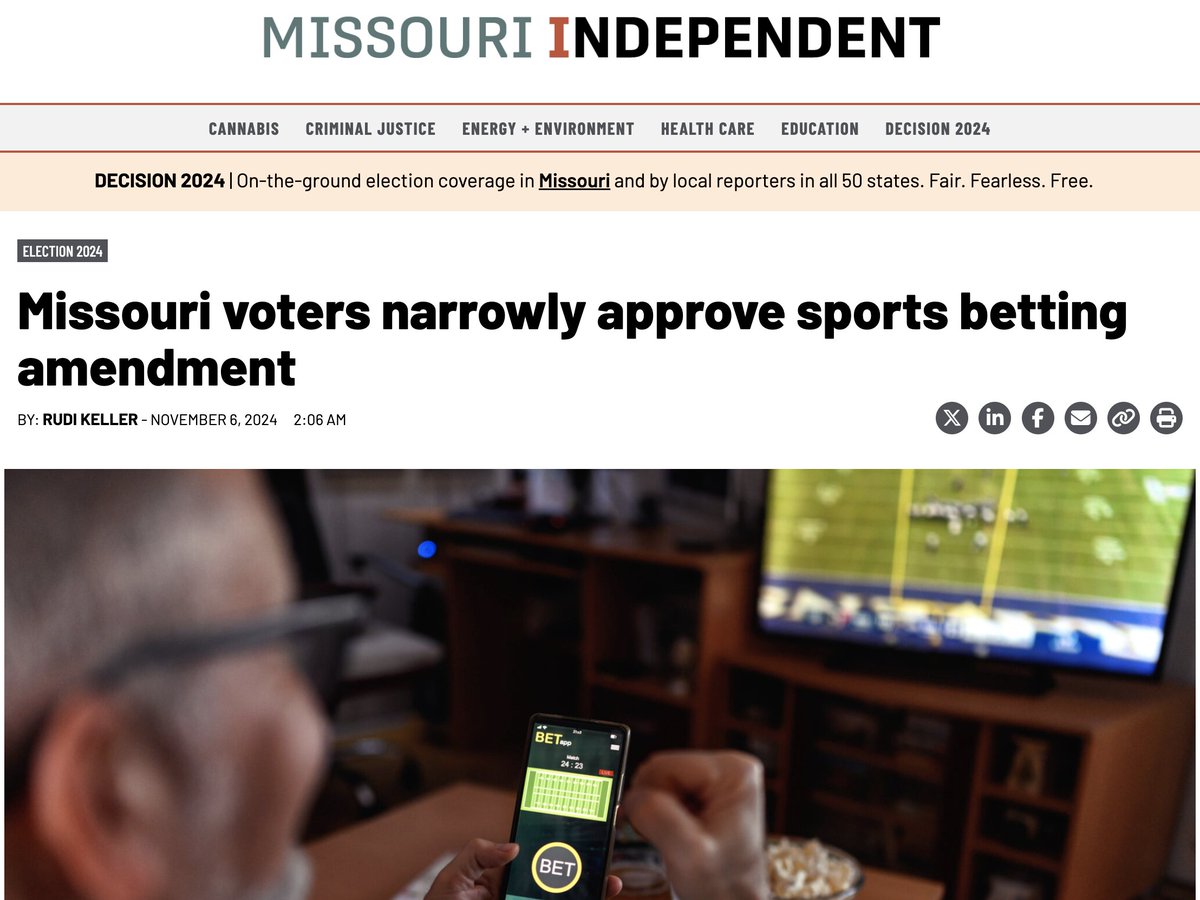
Three quick thoughts on Missouri's #sportsbetting ballot measure, which is set to usher in retail and online wagering by Dec. 1, 2025:
1. ATTRACTIVE TAM. We project a Year 5 OSB market of $548mm in GGR, implying GGR-per-adult of ~$121, which we regard as conservative. We see TAM as large enough, and fees / taxes as reasonable enough, to attract large and mid-sized operators, as well as smaller operators. Toward that end, there will be 21 online licenses.
2. ATTRACTIVE FEES AND TAXES. License fees are low ($500k initial fee, 5-year term). Moreover, using some reasonable assumptions regarding tax-deductible items (e.g., promotional credits, uncollectible receivables, federal excise taxes), we get to an effective OSB GGR tax rate of ~5.8% across Years 1-5. That's well—more like far—below the national average (~21%).
3. WINNERS. $FLUT and $DKNG are likely, in our view, to get the state's two untethered online licenses. Assuming that's the case, the very low effective GGR tax, together with the absence of market access cost (i.e., no NGR sharing with casino or sports team partners), could make Missouri one of the highest-margin OSB-only markets for both operators.
More on the $FLUT US online gambling TAM build: if you make a squish-reasonable assumption about 21+ population in 2030 (I used 275mm), you get implied OSB GGR / adult of $177 and iGaming GGR / adult of $349. That, by current comps, is pretty high.
For context, the only market currently doing anywhere near this level of productivity is NJ, where T12M OSB GGR / adult = $163 and iGaming GGR / adult = $310. But NJ is a massive outlier for so many reasons, including its relative wealth / PDI levels, below-average levels of land-based casino accessibility, proximity to a massive center of commuter demand (NYC), and so on.
FLUT, rightfully imo, is optimistic about the trajectory of the US market—and its place within that market. The implied levels of GGR / adult productivity in its updated TAM build, though, do not seem to be anchored or even proximate to any non-NJ comps—a factor I'd consider if I were diligencing FLUT.
If you take this discussion together with my previous post (a discussion of FLUT's iGaming TAM expansion assumptions), you get a TAM build that, imo, looks very, very aggressive—one I consider to be on the outermost edge of plausible.
Light & Wonder fell out of bed in a mostly green week for gaming-related stocks when a NV District Court judge granted Aristocrat $ALL a preliminary injunction relating to $LNW's Dragon Train game.
*But!* most analysts disagreed with the market reaction. More 👇