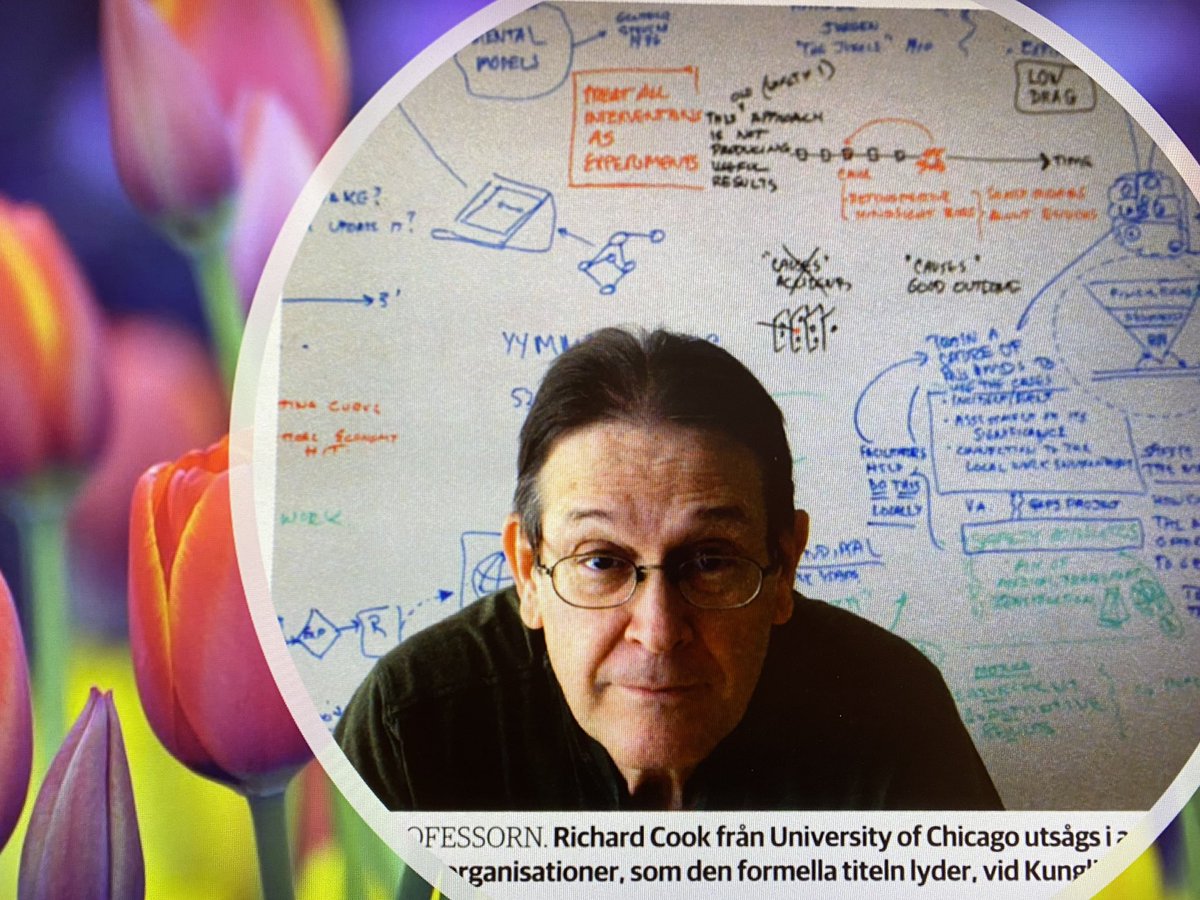
The 10th Symposium of the Resilient Engineering Association is dedicated to the late great Dr. Richard Cook, MD, whose work forever inspires this community. I’m honored to be part of the Young Talents mentorship program, which Richard founded. #rea2023@ri_cook
@NormanMacleod14@StevenShorrock@ddwoods2@ri_cook 👍 LIT uses no LOSA data that I'm aware of. 'What folks do right --> get them doing more of that' = pragmatic oversimplification (by many!) of the whole concept. 'What'= bring to bear the potential for resilient performance, 'do more'= facilitate systemic change to support that.
@NormanMacleod14@StevenShorrock Anticipating that, each data stream conducts regular internal validity checks & individualized feedback & coaching w/ observers/facilitators. Variability is monitored, explored --> informs training, program admin, data analysis. Variability = an attribute, not an outcome!
@NormanMacleod14@StevenShorrock re: @NormanMacleod14 "assumes what works now will work in the future": LIT framework assumes the opposite! Continuously changing & interacting interdependent complexities in the world & among humans + tech make "the future implausible, the past incredible" see @ddwoods2@ri_cook
@NormanMacleod14@StevenShorrock Yes, ideally, rich narratives informed by direct conversation w/ practitioner(s) involved. The observer can never know without asking. They only know their own experience + library of others' stories --> easy to make assumptions, miss the nuance of that situation, oversimplify.
@StevenShorrock@NormanMacleod14 Agree w/ @StevenShorrock, not cause/effect bc doesn't 'report' 'why' 'what' 'happened'. LIT gets to the 'how' i.e. how pilots mitigate systemic pressures, resolve goal conflicts, reprioritize goals, dynamically adapt, etc, & informs sustainable system change. Explain >> describe!
@StevenShorrock@NormanMacleod14 LIT is based on an entirely different worldview & theory than LOSA. The program is supplemented by interviews, surveys (to inform future questions, not as data points), & pattern analysis of qual data (not only thematic analysis). LIT doesn't describe, it gets towards explaining.
Y’all, I cannot express how I am excited for this next @Fall_of_Civ_Pod episode!!! @PaulMMCooper is an amazing and thoughtful storyteller of truly fascinating histories. Highly recommend all of his work!!
🐘🐘 EPISODE 17 IS NOW LIVE 🐘🐘
In this episode, we take a look at one of the most dramatic stories from the ancient world - the rise and fall of the Phoenician empire of Carthage.
Spotify: https://t.co/E1Chlqbfy9
YouTube: https://t.co/3UJAbP7bDs
Here’s the secret of Learning from Incidents…it’s not actually about the incident. The incident is a catalyst to helping your organization learn, collaborate, grow, and make better decisions.
#LFIConf23
Last week I was able to participate in the inaugural Learning from Incidents Conference in Denver.
I gave my first public talk on my thesis research, Handover Communications in Software Operations. #LFIconf23
https://t.co/eM36w9EZeP
Recordings from last week's incredible Learning From Incidents Conference #LFIconf23 are online at https://t.co/HhLUx83RLa. My firm @grtcrcl is proud to sponsor these recordings; let us help you have better incidents!