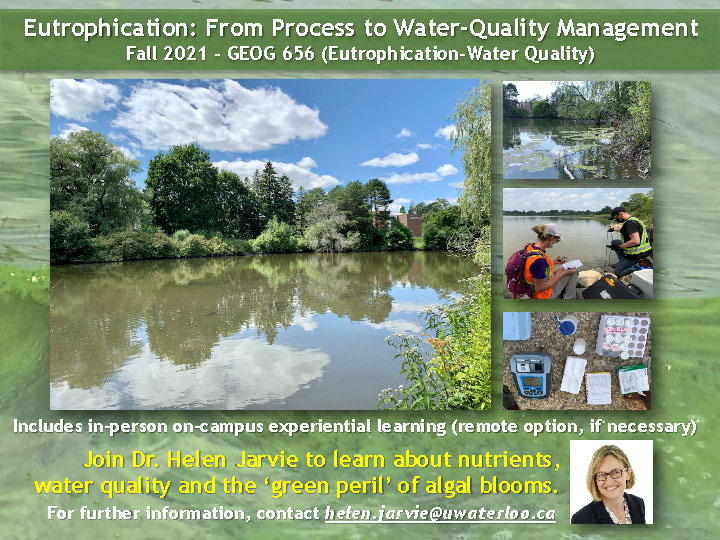
Join Dr. Helen Jarvie to learn about nutrients, water quality and the ‘green peril’ of algal blooms.
Enrollment is open! Fall 2021 - GEOG 656 (Eutrophication-Water Quality) Includes in-person on-campus experiential learning (remote option, if necessary).
@urban_sci@RougePark 100% The questions then become: 1. Can we prevent introduction of new IS (more robust import inspections, better understanding of flora used in gardening) 2. Can we identify drivers of IS spread & curtail them 3. Can we identify IS likely to naturalize, saving $$ & effort.
@urban_sci@RougePark Still nothing compared to soy, wheat, and corn if we are being honest. Granted, that is more rural, but how many acres of the above are in the Rouge, and which has the biggest impact on water quality and biodiversity?
The Lower Duffins wetlands are also a staging area for fish migrating upstream into the Duffins Creek watershed to spawn or feed including a sizeable salmon run. #SaveDuffinsCreek#YoursToProtect
A story from the fall, but an important read: "10 Calls to Action to natural scientists to enable reconciliation with Indigenous peoples" https://t.co/0bWOMzHAkm
The final version of our paper "Crops as Sensors: Using Crop Yield Data to Increase the Robustness of Hydrologic and Biogeochemical Models" is now available in JoH. Feel free to use this link for token access https://t.co/hvbVHBW0VJ
@nanditabasu2
Have you had a chance to look through WaterResearch Issue 9? Each issue contains summaries of high-impact scientific articles published by WI members to communicate the results of their cutting-edge, disciplinary and interdisciplinary research https://t.co/WVE5NapN8u
Thanks to Sevil Berenji, @V2VPartnership Graphic Designer & Media Support for creatively capturing through this logo the essence of what we are and aspire to do as a global network. https://t.co/uRazkfgwJo
If you are looking for postdoctoral opportunities and want to work on wetlands, and other things..please get in touch with me to apply. Lots of cool projects at regional and global scales..@Hydrology_AGU@AGUbiogeo@EGU_HS
https://t.co/k39paCwQSr
We all want a future with clean air & water 🇨🇦
That is why our government is establishing a new Canada Water Agency to improve freshwater management across Canada.
I encourage you to take part in the consultation 👇
https://t.co/Z15ikMP673
New research from Water Insitute member Prof. Helen Jarvie from @envwaterloo "Biogeochemical and climate drivers of wetland phosphorus and nitrogen release: Implications for nutrient legacies and eutrophication risk"
Water Institute member Monica Emelko, a professor in @WaterlooENG, is the first Canada Research Chair in Water Science, Technology and Policy.
https://t.co/ljOgoZRgLu
New research using in-situ nutrient sensors and @UKECN data: potential water quality trade-offs of #wetlands for soil and water conservation, under a changing climate.
Study led by Prof Helen Jarvie. See #openaccess paper in @JEnvironQual: https://t.co/iS1U1EohwB
Welcome CWP class/cohort of 2021!! We are very excited to have you! Water 601 & 602 await your unique talents, experience, education and more! Let's work together on some water issues! 💦😀🚿🌊☔🍻❄
We're looking forward to meeting the new group of @CWPUW students starting in Waterloo's Collaborative Water Program in January! Learn more about @UWaterloo's most interdisciplinary water graduate program: https://t.co/zhxQ3Th7JT