𝐏𝐞𝐨𝐩𝐥𝐞 𝐭𝐨𝐥𝐝 𝐦𝐞 𝐈 𝐰𝐚𝐬𝐧'𝐭 𝐥𝐮𝐜𝐤𝐲.
I was starting to believe it.
After hours of work on each post, I didn't win any competitions and became exhausted.
But after coming back I won my first competition, and with that I made a total of nearly $4K.
This is the only reason I create.
When I saw @Canborsa_DEX had launched their 𝘊𝘳𝘦𝘢𝘵𝘰𝘳 𝘗𝘳𝘰𝘨𝘳𝘢𝘮 I was instantly drawn to:
> Prizes for 32 creators in both leagues.
> Rising Creators (average views up to 1,000) has 20 paid spots.
Most of the competitions I didn't win were with people who had far more followers audience and engagement than me. This meant that I was losing because I wasn't big enough.
With this program small creators can compete with others of similar sizes. This alone would've changed my story.
>The prize pot increases by 200K views earned by the community. Up to $10,000.
Most of the time I feel like I'm competing with every other creator.
But with this program every view earned increases the prize for everyone.
We are working together to make our prizes bigger. This is what I needed when I was thinking about quitting.
No minimum followers and no deposit required.
If you are a small creator and looking for your first win then this is where you should start 👇
https://t.co/guO55c6V6x
Any teenager with a debit card in Manila, Nairobi, or Buenos Aires can subscribe to Google Cloud, buy an iPhone, and fund Apple's quarterly earnings in thirty seconds.
Global consumers are welcomed instantly. But the moment that same person wants to put $20 into shares of Apple, Nvidia, or Tesla, traditional finance slams the door:
"Enter your US Social Security Number."
"Provide a verified US residential address."
"Pay a $35 international SWIFT wire fee."
You can spend money into US corporations from anywhere, but participating as an owner has remained locked behind 1970s banking borders.
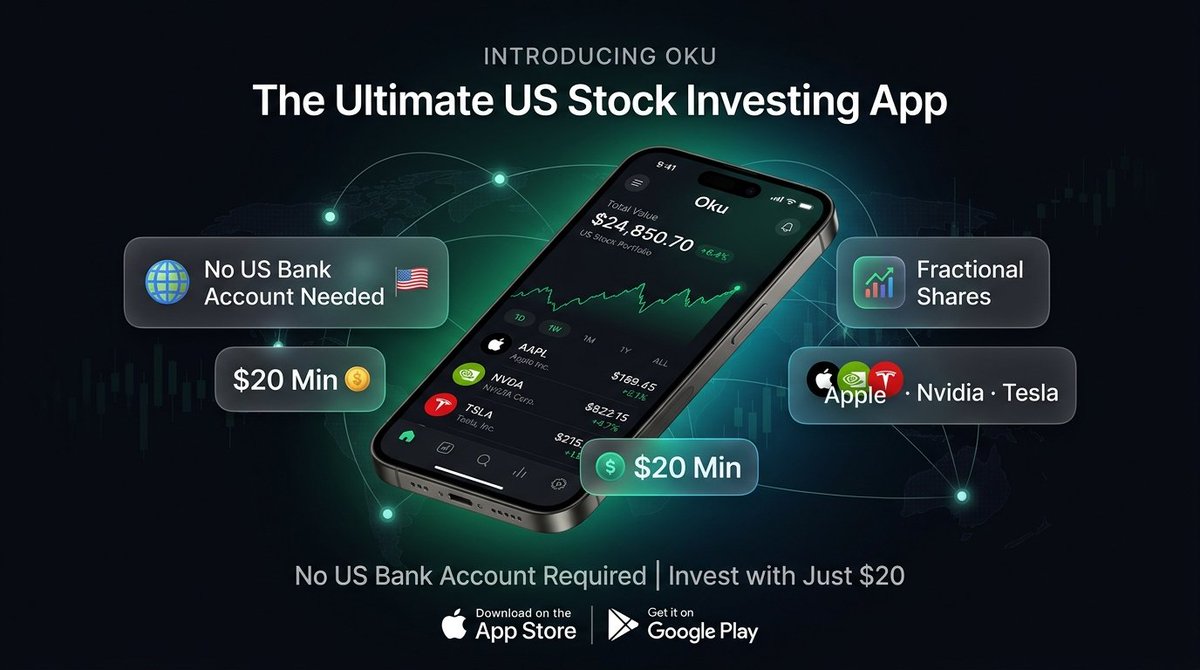
That structural friction is what @okutrade is solving with their upcoming mobile app.
Oku lets anyone buy US stocks (including Apple, Nvidia, Tesla, Amazon, Google, and Meta) directly from a smartphone from anywhere in the world.
Key details to know:
• No US bank account or US residential address required.
• Start with as little as $20 and buy fractional shares for any dollar amount.
• Built by the team behind Oku's web trading engine, which has already processed over $6B in volume across 450,000+ users.
• Transparent economics: trading is not free (standard trading fees apply), but joining via a referral link gives you 10% back on your trading fees.
• Early access structure: while no public launch date has been announced yet, waitlist members get early onboarding before the general public, and the top 100 referrers receive a free stock at launch.
If you have ever wanted direct access to US equities without the traditional banking roadblocks, secure your early access spot on the waitlist here:
https://t.co/dl5lItVy1h
For those living outside the US: what was the first American stock you ever wanted to own, and what was the bureaucratic hurdle that stopped you?
One thing that can make crypto research unnecessarily stressful is trying to keep up with too many charts without a proper system.
You end up jumping between different tokens, checking the same markets repeatedly and sometimes losing track of what you wanted to investigate in the first place.
I’ve found that having a dedicated Watchlist makes this process more organized.
With @GeckoTerminal , I can keep the pools I’m interested in together and revisit their price movements, trading volume and liquidity whenever I need to.
Rather than checking everything randomly, I have a starting point for my daily market research.
And that’s what I like about having a Watchlist. It helps me stay focused on the markets I’ve chosen to follow.
Sometimes, better research starts with better organization.
Have you built your own Watchlist yet?
Explore GeckoTerminal and start organizing the markets you follow. 🦎
My Watchlist link 👇🏻
https://t.co/Dsl7cMHLu8
You remember the wins
The losses get rewritten
Your journal is a spreadsheet you opened twice, or vibes in your head
That’s not a process
That’s a highlight reel
@heisChapman The $1.5 million filing fee example really puts things into perspective. Sometimes the cost of seeking justice becomes another form of loss.
Losing money in a deal is painful. Having to spend even more money just to fight for what you lost is a different kind of problem.
Albert Castellana gave an example that stuck with me.
In Israel, filing a court claim can require a 1% court fee.
On a $150 million dispute, that’s potentially $1.5 million just to bring the claim.
And that’s before accounting for years of litigation and the cost of lawyers.
This makes me think about something often overlooked in discussions about AI agents: the ability to execute transactions is only half the equation. What happens when those transactions go wrong?
If agents are going to negotiate and transact globally at machine speed, dispute resolution cannot remain a process that takes years and costs a fortune.
That’s an important part of the problem @GenLayer is exploring.
Watch Albert Castellana (@kstellana) discuss the experience with @HenriArslanian.
The interesting question isn’t just how much AI agents will be able to do.
It’s who or what will resolve things when two agents disagree over a deal.
One thing I like about well designed financial products is knowing where the risk stands before getting involved.
Injective brings an interesting way to handle through its onchain options.
When someone writes an option, the maximum payout is capped and the required collateral is locked upfront.
This means the seller doesn't have to worry about unexpected margin calls as the market moves.
Options are already useful for expressing a market view without directly buying or selling the underlying asset. But making the risk parameters clear from the beginning is an important part of making these products easier to understand and build around.
I think this is worth paying attention to as Injective expands the kinds of financial tools available onchain.
It's not just about bringing more products to DeFi. It's about thinking carefully about how those products work.
@injective
A blockchain can settle $10M in seconds.
Yet many protocols still need weeks of negotiations to decide if a builder earned a $50K grant.
My call for @RallyOnChain:
By August 31, 2027, at least three top-20 DeFi protocols by DefiLlama TVL will use multi-AI consensus systems instead of human multisigs to approve subjective grant milestones or treasury payouts.
Crypto solved trustless execution. It has not solved trustless judgment.
Smart contracts enforce predefined math effortlessly, yet they break down when decisions require context:
- Did a grant create real value?
- Were milestones genuinely met?
- Does an offchain emergency justify an exception?
As AI models become cheaper, faster, and easier to audit, protocols will deploy independent model quorums to review evidence before releasing treasury funds. The goal is not perfect judgment, but lower coordination costs with transparent, reviewable reasoning.
I am wrong if multi-AI governance proves easier to manipulate than multisigs, or if the cost and latency of AI adjudication remain too high for treasury operations by August 2027.
If five independent AI models reviewed the same evidence, reached the same conclusion, and published their reasoning publicly, should a human still have the power to overturn the decision?
Some DAOs don't have a whale problem.
They have a turnout problem.
A project can honestly claim it's "100% community owned" while a tiny group effectively controls its future.
Most people check token distribution.
Almost nobody checks governance participation.
That's where the misconception begins.
If ownership is spread across thousands of wallets but only a small percentage of tokens regularly vote, a coordinated minority can still influence treasury spending, incentive programs, and protocol upgrades while the protocol continues to market itself as decentralized.
The misleading claim isn't that the community owns the token.
It's that community ownership automatically means community control.
Those are not the same thing.
Before trusting any project that claims to be community governed, ask one question:
"How much of the total token supply actually participates in governance votes?"
The answer usually tells you more about decentralization than any holder distribution chart.
What's the lowest governance participation rate you've seen on a protocol that still calls itself decentralized?
@RallyOnChain
High-throughput consensus coordination in decentralized protocols eventually hits a wall when forced to execute complex committee logic entirely within standard EVM bytecode.
When protocol governance scales to thousands of autonomous agents generating simultaneous dispute ballots, sorting validator committees and calculating consensus thresholds in Solidity introduces severe gas overhead and execution latency. In traditional architectures, solving this requires either deploying customized, incompatible compiler forks or accepting significant throughput compromises.
That computational bottleneck is why the architectural rationale detailed by Edgars Nemše represents a critical milestone for @GenLayer. By moving the network's consensus coordination contracts onto @arbitrum Nitro, the protocol unlocks access to Stylus: a secondary runtime that executes high-performance code written in Rust, C, and C++ compiled directly to WebAssembly at near-native execution speeds. Rather than treating a rollup migration as a passive change of address, this transition provides an explicit pathway to migrate compute-intensive consensus logic out of Solidity and into optimized WebAssembly without sacrificing EVM interoperability.
The broader operational foundation detailed in the transition framework establishes several immediate structural advantages:
1. Operational infrastructure: Conduit manages the underlying rollup operations, validator RPC endpoints, and sequencer reliability, enabling core engineers to focus strictly on Optimistic Democracy and GenVM development.
2. Ecosystem proximity: Arbitrum Nitro powers over thirty production networks, including the dedicated rollup launched by Robinhood, embedding the adjudication layer within Ethereum’s most active liquidity environment.
3. Protocol preservation: Core consensus mechanics remain completely unaltered; Intelligent Contracts, validator AI models, and GenVM execution operate identically as validator nodes connect to the new coordination chain.
4. Testnet progression: The Bradbury testnet transitioned immediately to the Nitro stack, with upcoming testing phases and production mainnet maintaining identical architecture.
For protocol architects and systems engineers, what specific dispute sorting algorithms or cryptographic verifications would you prioritize moving from Solidity to Rust via Stylus?
The internet removed borders for information.
It never removed them for ownership.
A person in Lagos can watch the same Apple keynote, read the same Nvidia earnings report, and follow the same Amazon updates as someone in New York.
Then one of them gets “Enter your US address.”
That is the gap @okutrade is closing.
Oku is a mobile app that lets anyone buy US stocks like Apple, Nvidia, Tesla, Amazon, and Google from anywhere on Earth. No US bank account or address required. Start with $20 and buy any dollar amount instead of a full share.
It’s from the team behind the Oku web app, which has already processed over $6B in volume across 450,000+ users. Joining the waitlist is free. People who join through a referral get 10% back on their trading fees.
I joined here:
https://t.co/BJqkF4hkNV
If access disappeared tomorrow, what would still stop most people from holding US stocks: money, trust, or knowledge?
@iceburger_I Having research, charts, and trading tools in one place saves time and makes the workflow smoother. BasedBot seems focused on making that process easier.
Millionaire memecoin trader Cernat spends his time on the BasedBot Trading Terminal searching for the next runner.
With all the essential trading tools in one place, he can carry out his research and analyze opportunities without constantly switching between platforms.
FT: @cernatul
Powered by @BasedBot— the No. 1 Degen trading app in the space.