In this #GZEROEurope, @carlbildt looks at why Russia is pushing to change the subject in negotiations over Ukraine, shifting attention from a ceasefire to the future of European security.
Very unclear what happened by Baltisk in the Kaliningrad region 🇷🇺 during the night. Air defence was very active, but it’s unlikely that there was any attack. Perhaps it just illustrates how nervous operators can be in a tense geopolitical environment.
Final day of our discussions here in Warsaw 🇵🇱 . Migration, future of currencies, Baltic Sea region security and space developments are among the issues on our agenda.
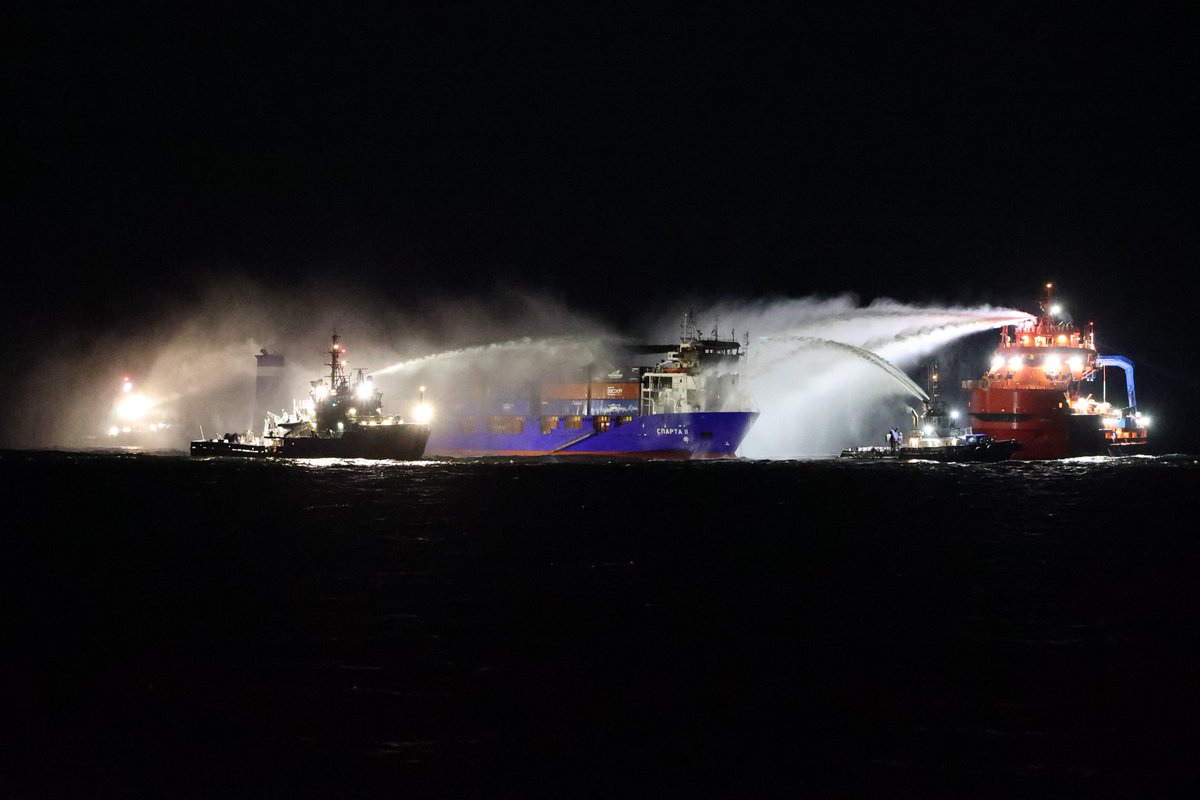
The situation with the 🇷🇺 ship on fire in the Gulf of Finland, having been attacked by 🇺🇦 drones, seems to be very skillfully handled by the 🇫🇮 authorities in obvious contact with the 🇷🇺 ones. Incidents must not turn into conflict.
After likely having been attacked by 🇺🇦 drones in the Gulf of Finland a sanctioned 🇷🇺 ship often used for military transports is on fire and drifting into 🇫🇮 territorial waters. A 🇷🇺 helicopter has violated 🇫🇮 airspace. This can quickly become very tricky.
There is a European security order: respect territorial integrity and never tolerate aggression. That’s it. What should be discussed isn’t the order, but the lack of respect for it.
While America's inept negotiators (@SEPeaceMissions and @jaredkushner) expressed openness to Russia's recent bid for talks on the European security order, Europeans rightly saw right through it, @carlbildt observes. https://t.co/yqbY8SCMoT
While America's inept negotiators (@SEPeaceMissions and @jaredkushner) expressed openness to Russia's recent bid for talks on the European security order, Europeans rightly saw right through it, @carlbildt observes. https://t.co/yqbY8SCMoT
Back to Europe and now heading to Warsaw 🇵🇱. Last night Gripen 🇸🇪 fighters were part of NATO operations to protect the 🇵🇱 airspace from what was probably stray 🇷🇺 drones and cruise missiles. The recklessness of 🇷🇺 must not be tolerated or accepted.
With superintelligence approaching - rapidly according to many - there are acute issues of strategy that the 🇺🇸 must adress. Interesting discussions in Santa Monica today, with @RANDCorporation taking a lead in many policy debates on the implications of AI. Few issues are more important. https://t.co/IFKOzQDFrX
Astonishing that @elonmusk has been duped by 🇷🇺 lies. There was no coup whatsoever in Kiev 🇺🇦 in 2014.
An agreement between President Yanukovich and the Maidan opposition had been concluded, but that very evening the President with as much riches as he could take decided to leave for 🇷🇺.
He knew that he would lose the coming elections, and probably feared consequences of the killing of a hundred demonstrators the days before.
The unity government that had been agreed was however installed the day after with the votes also of the MP’s of President Yanukovich party.
And then a new President was elected in democratic order and very broad national support.
The rapid advance of different AI tools have radically altered the cybersecurity landscape. New tools can now detect vulnerabilities much faster than they can be patched, and these tools have evidently spread. Everyone is more vulnerable.
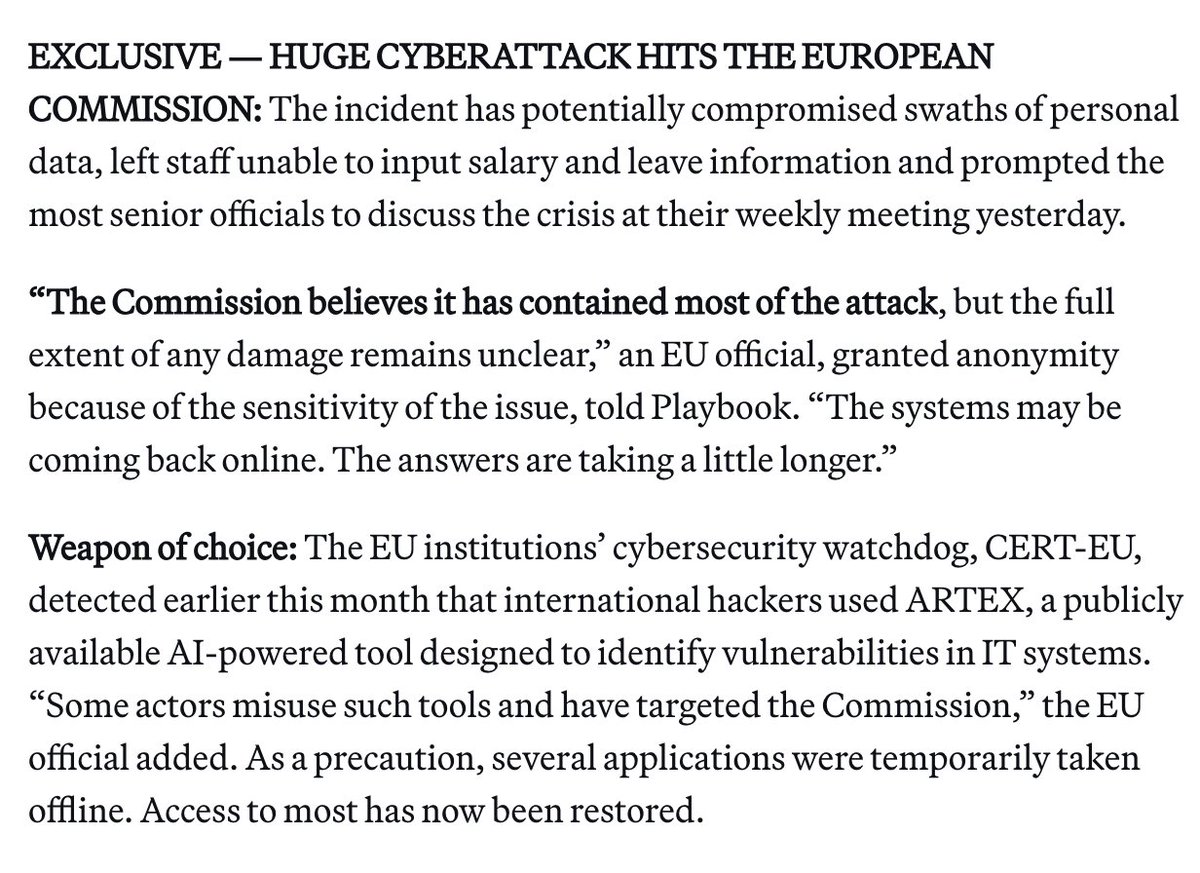
EXCLUSIVE: Hackers have hit the European Commission in a major cyberattack that may have compromised vast amounts of personal data.
Playbook has the details 👇
https://t.co/78DoyFTvxU
Now another 🇺🇦 attack has stopped also the train traffic across the Kerch bridge. Putin 🇷🇺 is furious in his comments, but the bridge remains down. I would guess the agreed prisoner exchange is now on hold.
Lots of concern in 🇺🇸 media about the numerous recent cyber incidents and outages. The situation will probably reinforce the political concern about AI issues expressed in the midterms elections.
What’s caused the numerous outages and cyber incidents in the 🇺🇸 last few days, but also affecting Europe? It looks as if the fast development of AI has changed the cybersecurity landscape and opened new vulnerabilities.
I understand why Americans are concerned about the widespread outages we’ve seen in recent days, affecting everything from banks and major technology companies to critical government systems. At this point, there is no indication that these incidents are the result of a cyberattack, foreign interference, or some coordinated effort.
What appears to be happening instead is a consequence of how quickly artificial intelligence is changing the cybersecurity landscape.
AI is making it possible to identify vulnerabilities across enormous numbers of systems at unprecedented speed, creating enormous pressure on companies and government agencies to patch those vulnerabilities immediately, often all at once, putting tremendous strain on systems that weren’t built to handle that pace of change.
While we still need to get to the bottom of these incidents, the evidence so far points toward legitimate efforts to secure our systems, not malicious activity.
Still, these disruptions should serve as a wake-up call. It feels like every day brings another reminder that AI is moving faster than our ability to manage its consequences.
This is exactly why I’ve been pushing for commonsense guardrails on AI and stronger cybersecurity protections.
Unfortunately, President Trump has shown little interest in confronting these challenges, his administration has repeatedly undermined its own credibility, and its cuts to CISA have weakened the very expertise we need to navigate moments like this.
Americans deserve clear, reliable information and a government that is prepared to respond. I’m going to keep digging into these incidents, pressing for answers, and making sure we’re doing everything possible to protect our critical systems. But based on what we know today, there is good reason to believe these disruptions are the unintended consequences of efforts to make our systems safer, not evidence of a broader attack.