New USDA data show that states may soon face a collective bill of roughly $9 billion under H.R. 1's SNAP cost shift. Explore our state-by-state estimates to see how the law could affect your state's budget. https://t.co/fmnzKXAKSC
New state-by-state estimates: Without immediate action from Congress to delay the SNAP cost shift, almost half of states are projected to face $100 million or more in new costs to continue SNAP.
https://t.co/RBJ12w3rvL
More than 457,000 Arizona residents have lost SNAP benefits since adopting new requirements. As @Katie_Bergh explains, after implementing the new standards before any other state, Arizona has faced significant administrative challenges via @Reuters. https://t.co/i7GXkA6ARZ
In case you are wondering why an error rate cost shift requirement on states means eligible families are losing SNAP is because denying eligible families is NOT an error. See our SNAP caseload https://t.co/FldBF7WIst
New USDA data confirm as many as 36 states will soon face massive new costs to continue SNAP – increasing the risk that even more struggling families could soon lose food assistance & some states could even end SNAP altogether. Congress must delay this cost shift for all states.
The fed govt isn't supposed to issue a rule unless its benefits outweigh its costs. So what to do about the terrible policy that takes away health coverage from people not meeting a work requirement? Ignore key research, make unrealistic assumptions https://t.co/11fP6lKHLb
More than 4 million people have already lost SNAP since H.R. 1 was enacted. @TyJonesCox explains that the Senate Ag Committee's farm bill proposal fails to address the growing hunger crisis facing low-income families. https://t.co/oBTUwI82Af
@CenterOnBudget And in case you are curious SNAP has been vital to sustaining farm and rural economies, as I wrote about last year. https://t.co/wZH3I044ol
It really seems like it should be a bigger deal that 11% of states who responded to this survey identified *withdrawing from SNAP entirely* as a potential risk of the massive cost shift that's about to hit state budgets thanks to H.R. 1. https://t.co/RbsY9LNdLv
This plan's reported failure to address the emergency unfolding across the country is unconscionable. 4+ million people (including 800k kids) have already lost SNAP, far more than many expected. Congress must delay H.R. 1’s huge shift cost shift to states. https://t.co/cgbS9GYWXu
The bipartisan housing bill that is nearing final passage takes important steps to make housing more abundant and affordable. To solve the housing affordability crisis, we’ll also need to expand rental assistance so that everyone can afford housing.https://t.co/5nWpmQKit4
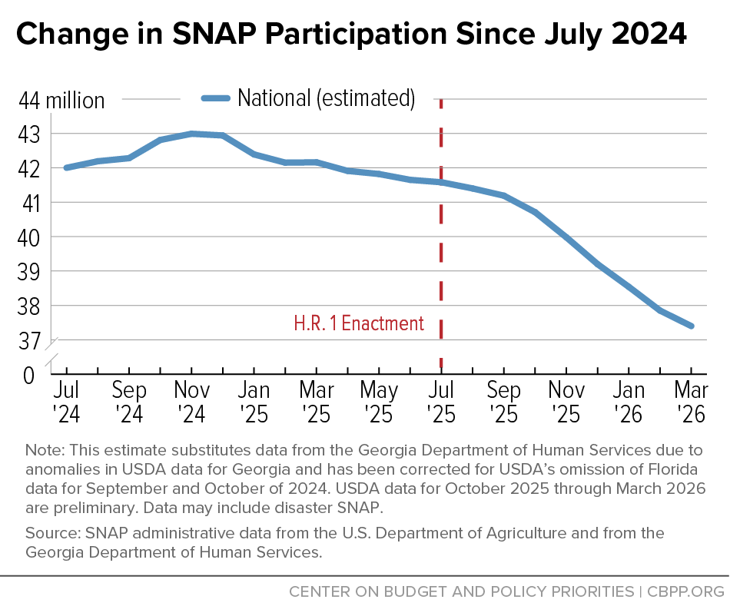
🚨New data: In the 8 months after H.R. 1 enacted the deepest SNAP cuts in history, the number of people receiving SNAP fell by 4+ million (-10%) nationwide.
In just the 13 states with available data, 800,000+ fewer kids are receiving SNAP.
https://t.co/HUPBlPSUTa
To some, enacting an automatic CR may sound like a solution to government shutdowns, but it could weaken Congress' power over federal funding and allow a president to effectively, and indefinitely, shut down programs that millions of families rely on: https://t.co/jSPCn2lEhq
New CMS guidance related to H.R. 1 will add to state Medicaid agencies' workloads, stifle innovation, and will likely result in further cuts to Medicaid funding for states. https://t.co/ptoYsj5wCy
Federal grantmaking processes are meant to be fair and free of political favoritism or retaliation – but a new Trump Admin rule would allow corruption & politicization of grant award decisions, creating an outsized risk of abuse & coercion.
The richest 1% of Americans now hold nearly a third of the nation's wealth, a share that could grow further under the Trump Admin's tax and economic policies. As @ChuckCBPP notes via Stateline, those policies disproportionately benefit wealthy households. https://t.co/ZPcXa1aNtT