One of the most powerful symbols of India’s unbroken civilizational continuity!
Discovered at Mohenjo-daro in undivided India this steatite seal, about 4,300-year-old, shows a seated figure in yogic posture (widely seen as Shiva-Pashupati) seated in Mulabandhasana, surrounded by animals.
While ancient sites may lie across modern borders, India remains the living custodian of this heritage. The yogic posture, Shaivite symbolism, and spiritual ethos seen in the Pashupati Seal continue to thrive in India’s temples, daily worship of Shiva, yogic traditions, and cultural life even today.
From the Vedic period to contemporary Bharat, this civilizational thread has remained alive and unbroken — deeply embedded in our philosophy, rituals, and collective consciousness.🇮🇳
#PashupatiSeal #IndusSaraswatiCivilization #LivingIndianHeritage
Post Gandhi's murder, freedom fighter Dr. Narayan Savarkar was dragged from home, the 1st mob lynching in free India & died due to stone pelting & heavy bleeding. 6000-8000 Brahmin men, women (tortured & raped), children were killed brutally. ZERO punished.
Today is his Jayanti.
You are seeing in real time why Trump companies went bankrupt so many times. Set aside your politics. This guy is incapable of making a deal or meaningful decision and it follows the same cycle. Big flashy announcement (Epic Fury). Adversity hits (Hormuz closed). Defraud stakeholders (promise two week solution). Freeze up (endless two week cycle loop). Compound the problem (resource depletion). Final chance to save face rejected (what you’re seeing now). Bankruptcy strikes and blame others during chaos. Rinse repeat.
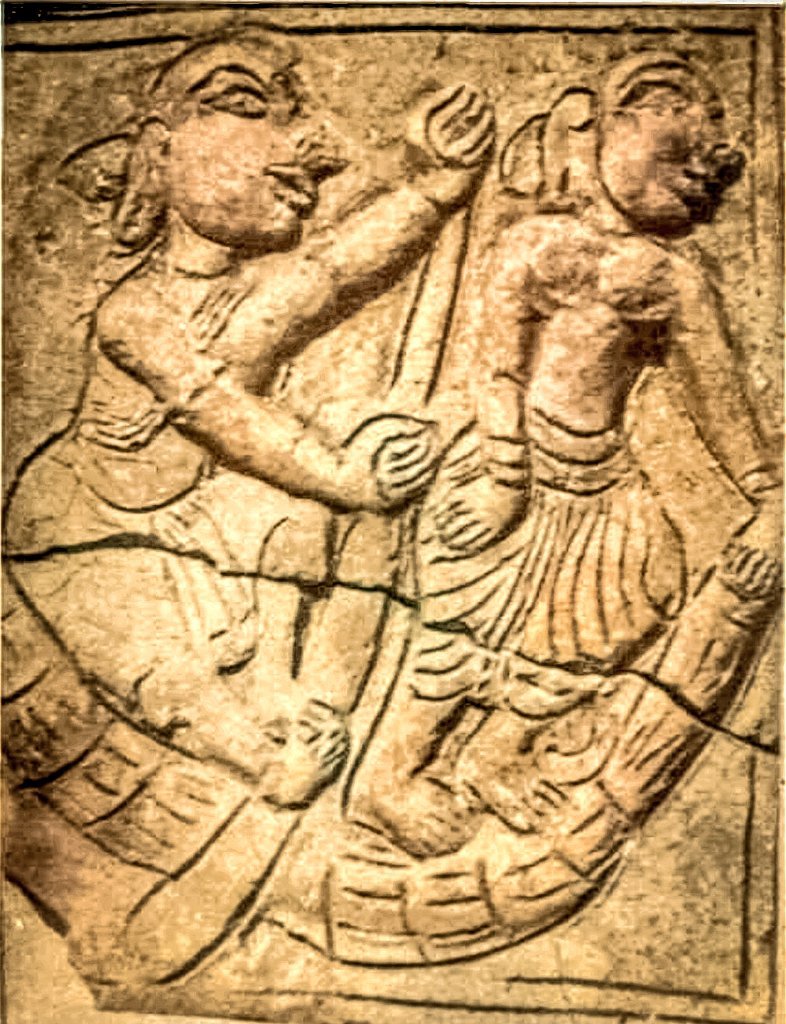
𝐀 𝐦𝐚𝐥𝐥𝐚𝐡 𝐰𝐞𝐚𝐫𝐢𝐧𝐠 𝐣𝐚𝐧𝐞𝐮.
A woman from a fishing community. Sacred thread across her spouse chest. Rowing her spouse across water.
Archaeological plate LXXXVIII, Guwahati Museum. Indian Archaeological Review 1956-57.
Today, this image breaks every rule we're told about "traditional India."
Mallah community? Lower in hierarchy.
Janeu? Reserved for upper castes.
Woman doing physical labor? Not how we imagine the past.
But here's the thing—
This wasn't rebellion. This wasn't an exception.
This was normal.
The janeu wasn't always policed. Caste wasn't always hereditary law. Communities wore what they wore, practiced what they practiced, moved between categories.
Fluid. Functional. Local.
Then the British arrived.
Census forms needed neat boxes.
Legal categories needed fixed definitions.
Administration needed frozen hierarchies.
So they froze them.
What was negotiable became permanent.
What was context-dependent became caste-determined.
What was regional became "authentic tradition."
And we inherited those lines.
Not from the Vedas. Not from ancient lawgivers.
From colonial bureaucracy.
So when you see this image and feel confused—
Ask not what's wrong with her.
Ask what was done to the system that made this normal… into something that shocks us today. 🧵
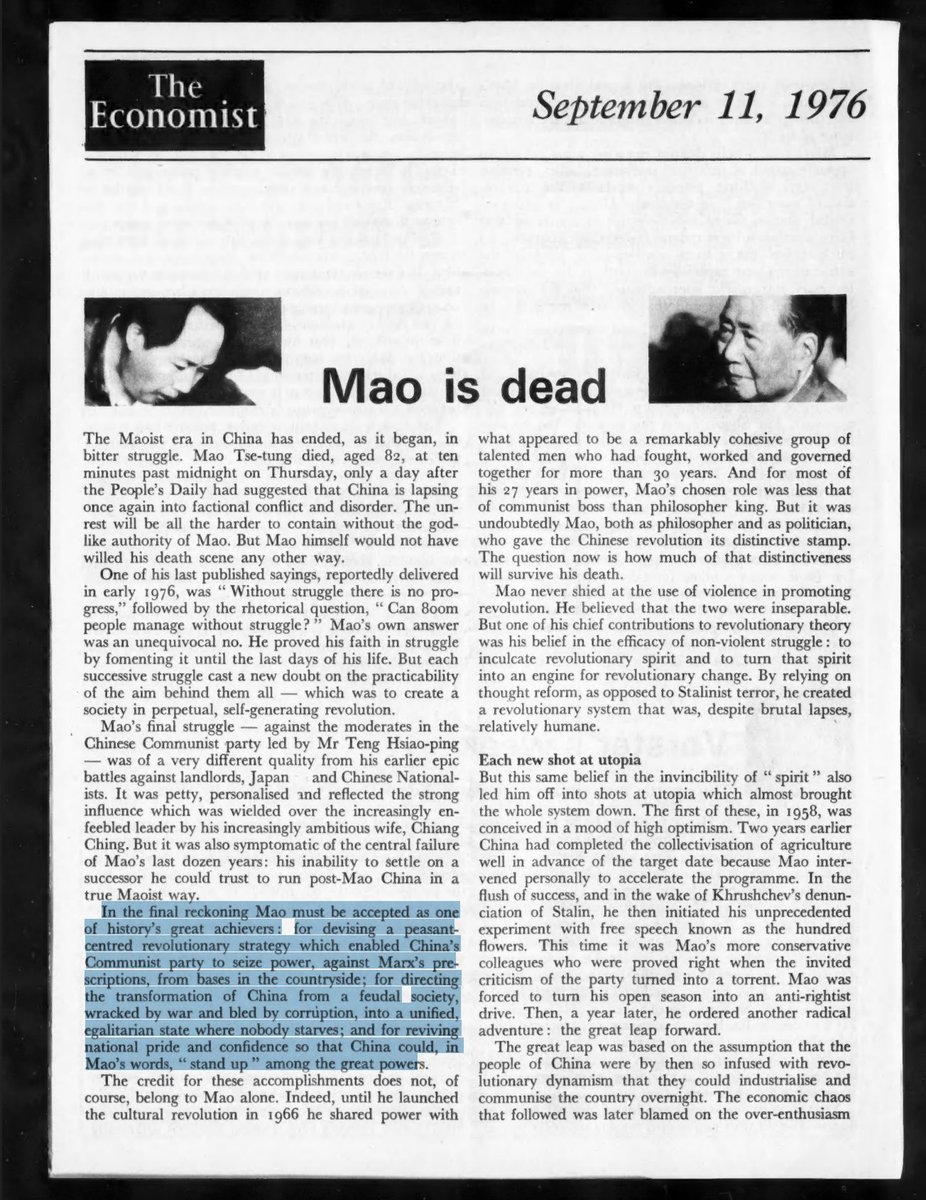
I saw some references to The Economist's glowing review of Chairman Mao in 1976 upon his death. It wasn't that easy to find the original, and no one had a PDF, however, here it is.
"In the final reckoning Mao must be accepted as one of history’s great achievers: for devising a peasant-centred revolutionary strategy which enabled China’s Communist party to seize power, against Marx’s prescriptions, from bases in the countryside; for directing the transformation of China from a feudal society, wracked by war and bled by corruption, into a unified, egalitarian state where nobody starves; and for reviving national pride and confidence so that China could, in Mao’s words, “stand up” among the great powers."
Where nobody starves.🤡 And this is an _economist_ magazine.
@avidseries Mis-representation and innumeracy.
50% of us population is covered by roughly 150 counties, this is about 4-5% of counties.
Not far fetched to say that the top 2% of counties ~62 are actually 2.5x more violent than their weight implies? Crime is not uniformly distributed.
The story of Sarla Bhat is one of those truths terrorism tried to bury beneath slogans.
A nurse from Anantnag, working at SKIMS, Soura, she was not a combatant, not a political actor, not a threat to anyone. She was a woman doing what civilised societies are supposed to honour most serving life, caring for the sick, sustaining humanity in difficult times.
And yet, during the peak years of terrorism in Kashmir, she was gang raped and murdered by JKLF terrorists.
That single crime destroys every false romance ever built around terrorism.
Because a movement that brutalises a nurse, that violates a woman’s body, that turns care into vulnerability and womanhood into a target, is not a movement of dignity.
It is not resistance.
It is not Azaadi.
It is barbarity wearing political language.
The same violent era that took Girija Tickoo also produced the horror inflicted on Sarla Bhat. And that is precisely why the mythology of terrorism in Kashmir must be confronted without sentimentality. Behind the stylised slogans, behind the posters, behind the chants and borrowed revolutionary vocabulary, there existed a far uglier truth, Women were terrorised, humiliated, assaulted and murdered.
This was not collateral damage.
It was part of the moral collapse that terrorism brought into Kashmir.
A gunman who rapes a woman is not a freedom fighter.
A terrorist who murders a nurse is not a revolutionary.
A group that uses fear against women is not defending a cause, it is exposing its own criminal soul.
And let us be blunt about what this means for all those who still try to selectively humanise that era.
Any politics under whose shadow women were raped, nurses were murdered, minorities were hunted and families were shattered has already lost every claim to moral legitimacy.
Pakistan-backed terrorism did not “liberate” Kashmir.
It brutalised Kashmir.
It degraded society.
It turned women into some of the most invisible victims of conflict, while men with guns were marketed as heroes.
That is one of the greatest frauds of the terror narrative
The terrorist was glorified,
the woman he violated was forgotten.
Sarla Bhat should be remembered not only with grief, but with clarity.
Her story is an indictment of
• terrorism,
• separatist violence,
• the abuse of women during terrorism,
• every lie that tried to dress this savagery up as politics.
Kashmir owes its women the truth.
That the terror era was not only about gunfights and slogans.
It was also about women living in fear.
About bodies turned into battlefields.
About dignity crushed by men who invoked cause while behaving like predators.
There is no honour in that history.
No sanctity in that gun.
No nobility in that violence.
Only shame.
Only cruelty.
Only a permanent warning about what terrorism really was when stripped of propaganda.
Remember Sarla Bhat.
And remember what terrorism did to women in Kashmir.
The 1889 Government of India report on British cantonment prostitution documents a horrifying colonial system that didn't just force Indian women into sexual slavery - it shows that even little girls as young as 9-10 years old were not spared by the British soldiers.
A Chakla was a state-regulated brothel attached to a military cantonment where women were registered by colonial authorities & made "available" to British soldiers stationed in the cantonments. Under the Contagious Diseases Act, the "prostitutes" were subjected to brutal medical examinations to detect venereal disease and if infected, were thrown out on the street, to starve and die from the disease.
In 1891, Elizabeth Wheeler Andrew, a British investigative journalist and Kate Bushnell, a U.S.-trained medical doctor, personally visited the British cantonments to interview Indian women in Chaklas and recorded their experiences as firsthand evidence. They testified in In April 1893 during debates to finally abolish the Contagious Diseases Act, because of growing condemnation by women's rights groups.
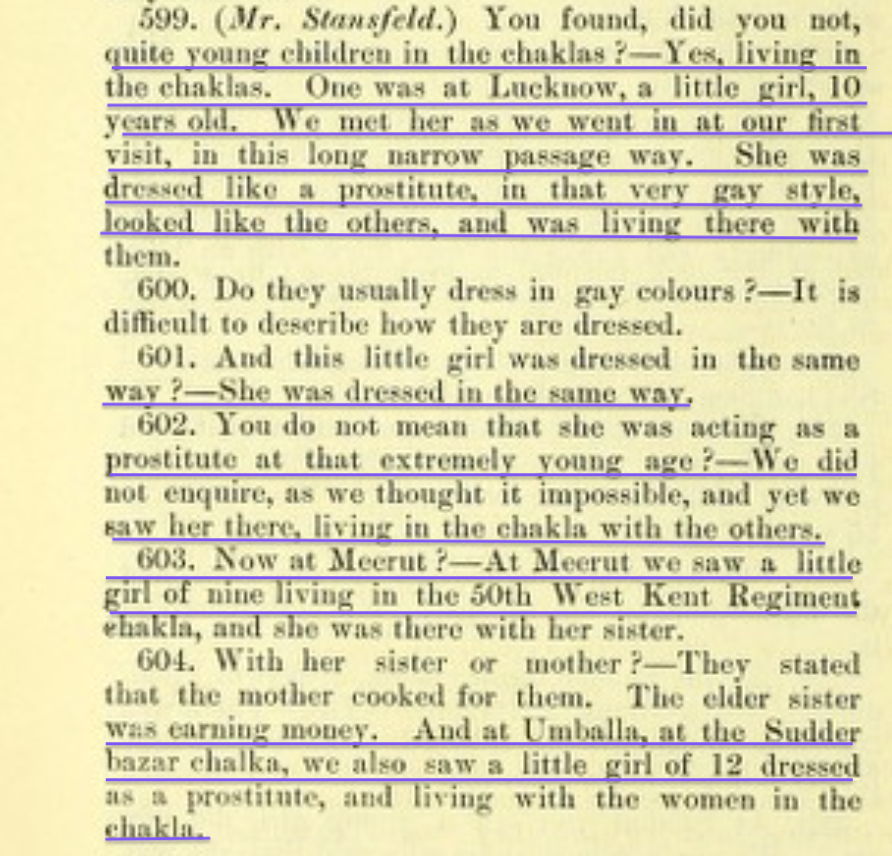
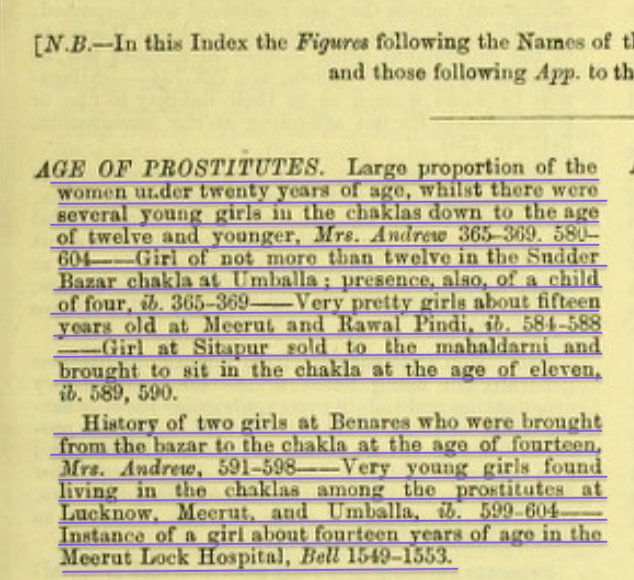
Their testimony is incredibly disturbing because it records the presence of several young girls in the Chaklas down to the age of 11-12 and shockingly even one little girl who was only 4 years old. These young children are described as decked up like prostitutes. Teenage girls ranging from 14-17 were common, and the overwhelming majority of girls were less than 20 years old.
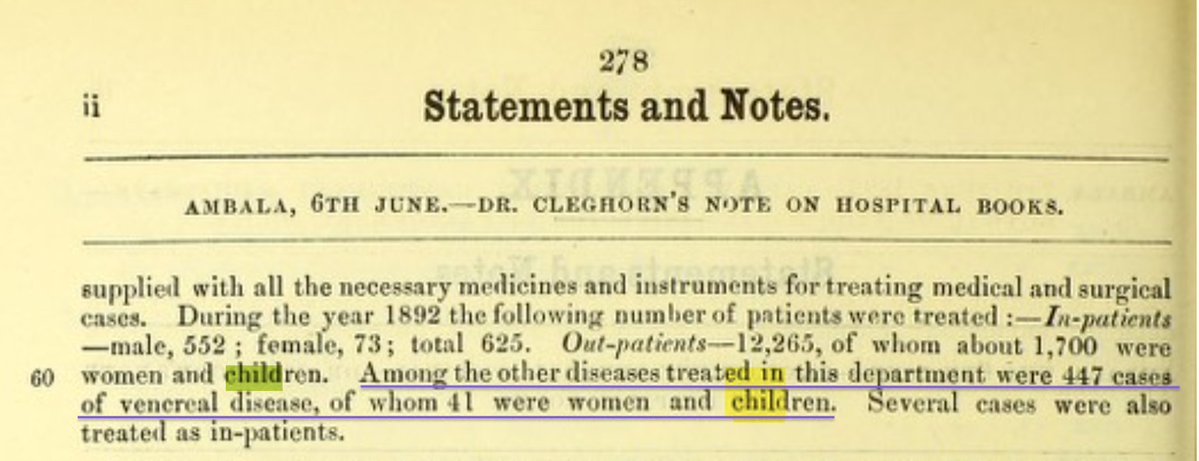
This horrifying abuse of underage children is further corroborated by the British doctor's reports about the number of cases infected by venereal diseases in the Chaklas. The report from Ambala cantonment during the year 1892 showed 447 cases of venereal disease, out of whom 41 were women and children. The explicit mention of “children” here among venereal disease cases is very disturbing, because it indicates that young children were also being exposed to transmission of sexually transmitted diseases in these cantonment brothels.
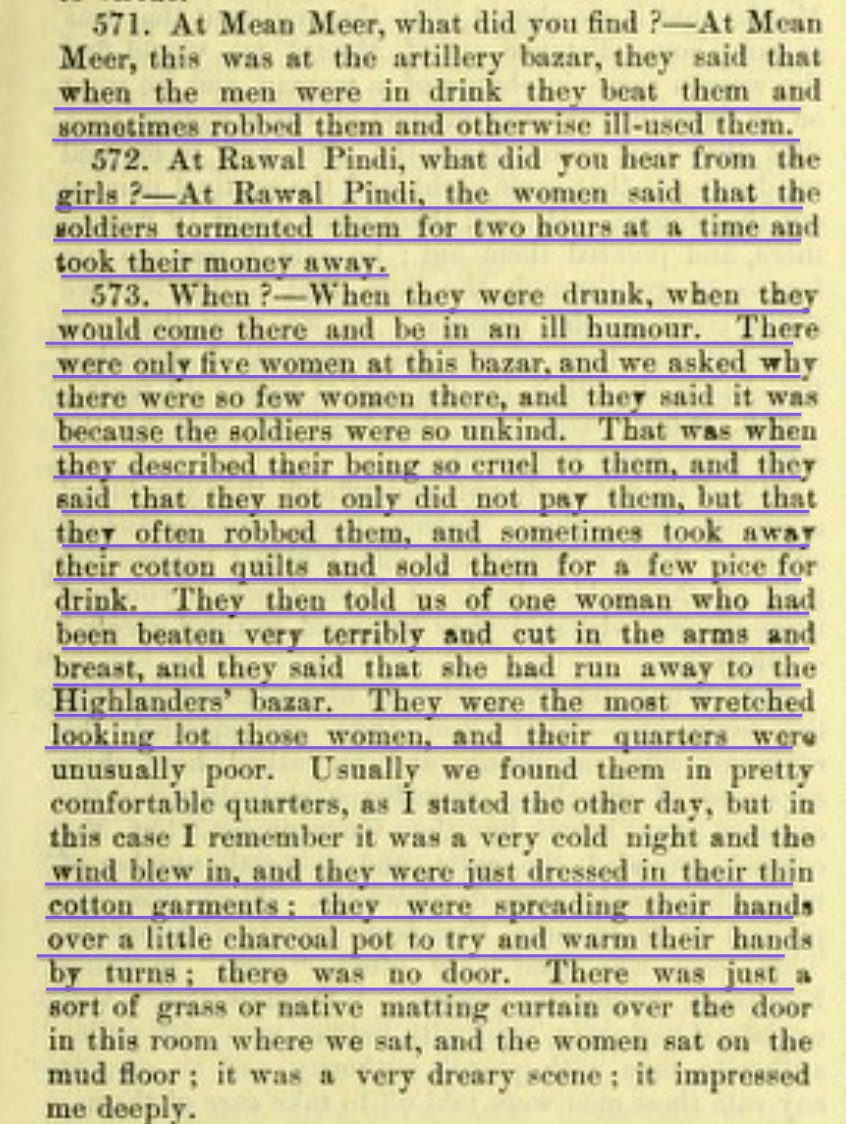
What's even more harrowing is that these victims lived in wretched conditions. Not only were they not paid for their "prostitution services", the British soldiers would rob them of their money or property and torture them physically. Often the British soldiers would get drunk and violently abuse the females, beating them up, & inflicting physical horrors like cutting their arms & breasts. They lived in pathetic conditions and suffered greatly during the winter without warm clothes or even doors to survive the freezing temperatures,
They were humiliated and forced to exist in a framework aimed only at managing the soldiers’ health not theirs. Compulsory medical inspections and confinement in “lock hospitals” for those diagnosed with disease were terrifying, as speculums were inserted into their bodies to "inspect" for signs of venereal disease, while the girls were chained to chairs, with their feet restricted by screws so that they could not escape.
Epstein Files pales in comparison to the unforgivable crimes that the British committed against Indian women and children with their cantonment prostitution policy. The most vulnerable and weakest sections of our society were violated & exploited barbarically due to their helplessness in such exploitative environments.
Time may forget such inhuman brutality but Karma never will
Source: Secretary of State for India. (1889). Report of the committee appointed to inquire into the rules, regulations, and practice in the Indian cantonments and elsewhere in India, with regard to prostitution and the treatment of venereal disease; together with minutes of evidence and appendices. London: Her Majesty’s Stationery Office.
Everyone's talking about Retatrutide as a miracle drug.
Nobody's talking about what it's chronic glucagon agonism might cost long term.
some long-term concerns that aren't getting airtime:
- Your heart runs hotter
Retatrutide raised resting heart rate by up to ~7 bpm in Phase 2 trials, peaking at 24 weeks. That's a chronotropic load your heart didn't ask for. Glucagon directly increases cAMP in cardiac tissue, raising pacemaker current.
Higher resting HR + lower HRV = a sympathetic nervous system running on overdrive. Longterm, that's a major cardiac tax.
- Your amino acids get eaten alive
Glucagon receptor activation upregulates hepatic amino acid catabolism. The liver starts burning through circulating amino acids to make glucose.
The result: hypoaminoacidemia, depleted plasma amino acids and (possibly) functional lean mass loss. In preclinical models, this was required for glucagon-mediated weight loss to work.
begs the question...should every patient on a glucagon agonist be on high-protein or amino acid supplementation?
- Your kidneys may hyperfiltrate
Glucagon dilates the afferent arteriole in the glomerulus and increases GFR. That's the same hyperfiltration pattern we see in early Diabetes type 2, the kidney working too hard before it burns out. so watching that function is paramount.
In diabetic nephropathy, glucagon receptor expression actually drops as kidney disease progresses. What happens when we push that receptor harder with chronic exogenous agonism?
- Bone health is an open question
Rapid weight loss already stresses bone density. Now layer on a glucagon component. While GLP-1 agonists show some bone-protective effects in preclinical models, the direct impact of chronic glucagon receptor agonism on osteoblast and osteoclast balance is understudied.
Especially concerning for South Asians and women post-menopause, where metabolic bone disease risk is already elevated.
- Cardiac microfibrosis
Chronically elevated cAMP in cardiac tissue doesn't just affect rate. It can drive pathological remodeling. The intersection of sustained glucagon agonism + metabolic stress + cardiac fibroblast activation is a pathway worth watching closely.
We won't see this on an echocardiogram for years. That's the problem.
The weight loss numbers are extraordinary. But with zepbound already there, nuance matters more now.
Fatty liver, resistant obesity? consider the reta.
Otherwise...not sure the benefits are there long term.
glucagon isn't GLP-1. It's a catabolic hormone. And we're agonizing it chronically in a way that human physiology has never experienced.
The right question isn't whether reata works.
It's whether we understand the full picture.
WARNING: Read next posts only if you are comfortable. This can lead to shock & trauma so be aware.
Many families were locked inside homes and burned alive while Terrorists danced outside. There are many stories of cannibalism and playing football with Hindu heads as well.
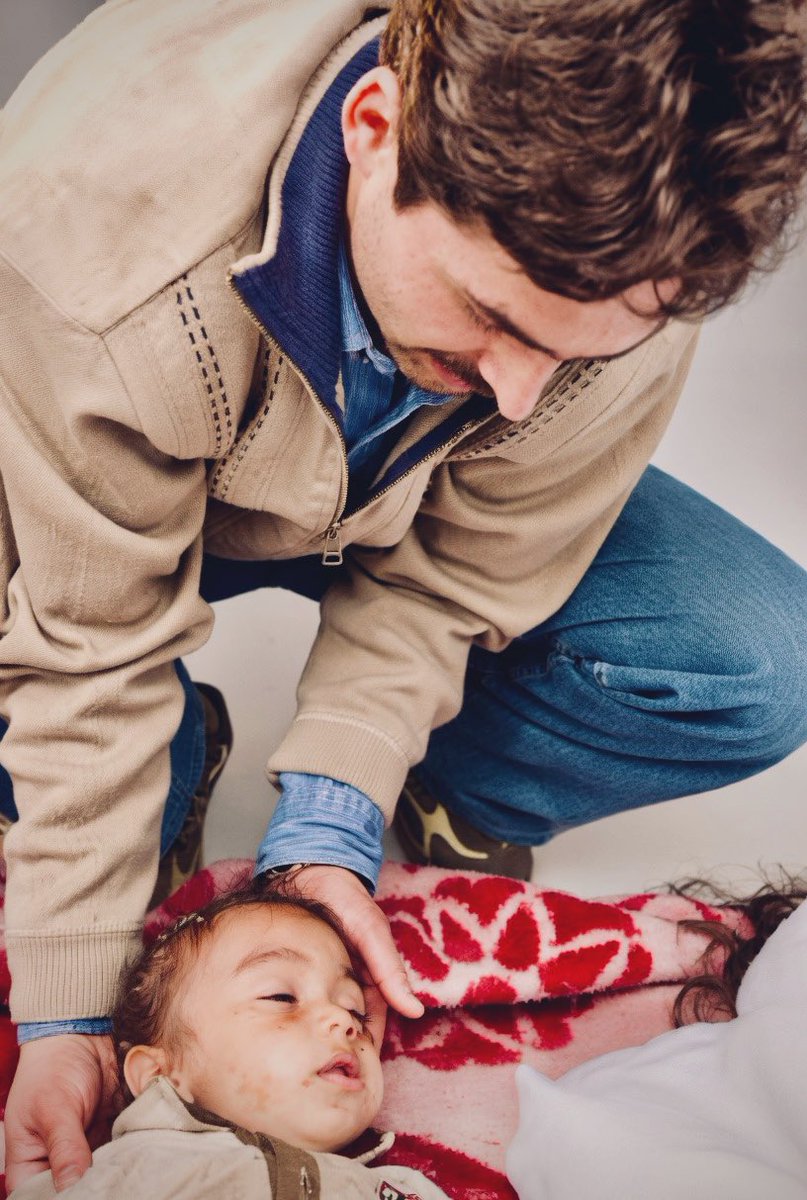
This day back in 2003, in Nadimarg, Kashmir, Pakistani Zia Mustafa lined up 23 Kashmiri Hindus and shot them point blank. As Zia was fleeing he heard a baby cry. "Ye karnawun chupe" ordered his friend. The baby became the 24th victim.
To forgive Pakistanis is to forget Indians.
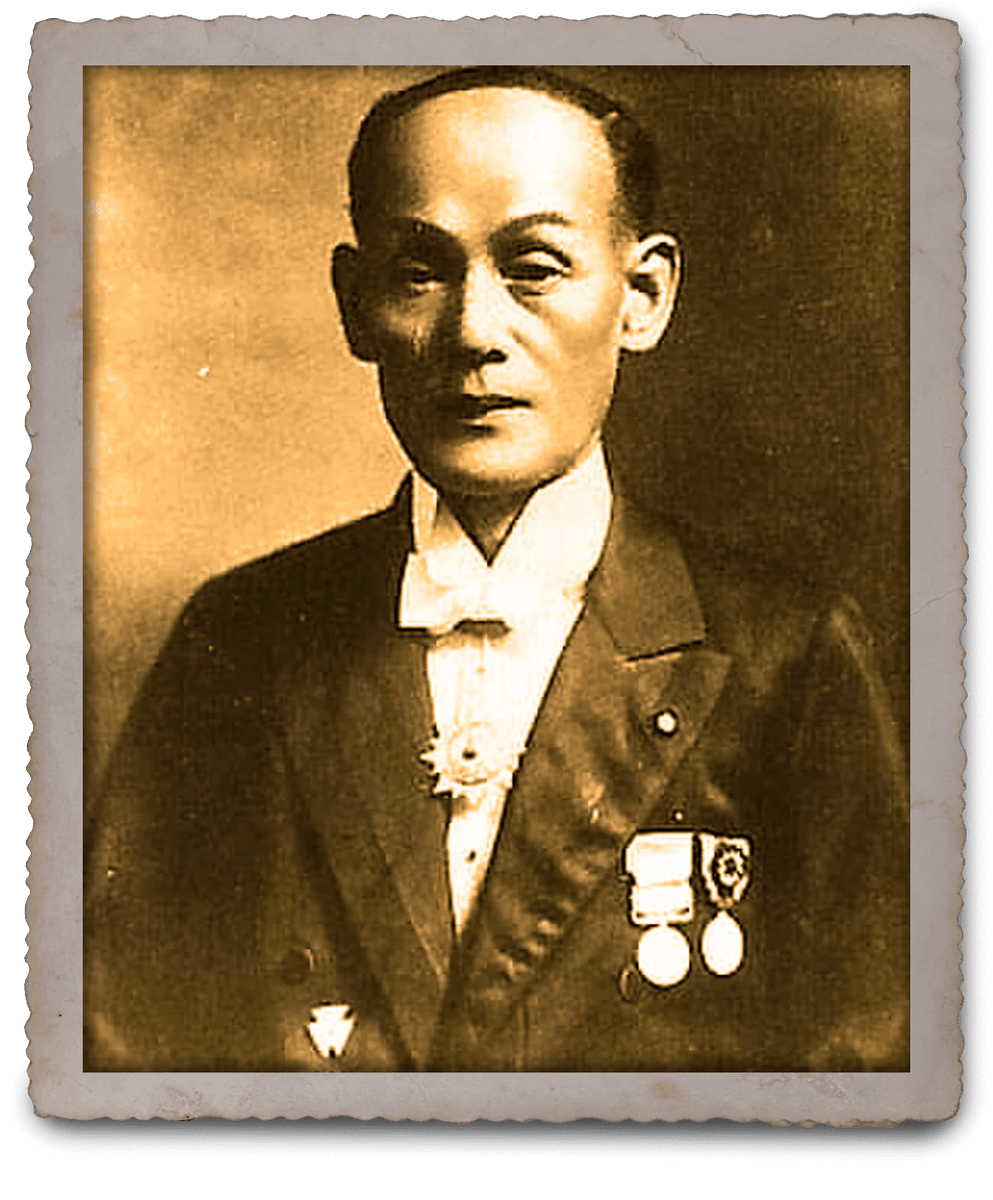
• be Torakusu Yamaha
• the son of a low-ranking samurai astronomer in 19th-century Japan
• obsessed with Western machines, you make a living repairing watches and medical equipment
• 1887: a local elementary school has a broken American reed organ. Nobody in the small town knows how to fix it.
• you take it apart, realize it’s just two broken springs, and easily repair it
• but instead of just handing it back, you realize: "If I can fix this, I can build it."
• you draw a blueprint of the inside of the organ and build the very first Japanese-made reed organ from scratch
• you show it off. People tell you it sounds terrible.
• most people would quit. You sling the heavy wooden organ over your shoulder on a bamboo carrying pole.
• you physically carry it 160 miles (250 km) on foot, trekking over the brutal Hakone mountains just to reach the Tokyo Music Institute to get real feedback from experts
• the professors play it. They tell you the mechanics are brilliant, but the tuning is completely wrong.
• you don't get defensive. You stay in Tokyo for a month, sitting in on university music theory lectures, holding a single tuning fork to your ear until you completely master the mathematics of sound frequencies
• you walk 160 miles back home
• you build a second organ. The professors test it and declare it "as good as those from abroad."
• you found Nippon Gakki Co. (which later becomes Yamaha Corporation)
• you decide to make your company logo three interlocking tuning forks to remember the pain and discipline of learning music theory from scratch
• decades later, your company uses its piano woodworking expertise to build wooden airplane propellers in WWII
• after the war, the company uses its new metallurgical expertise from the airplane engines to build motorcycles
• you accidentally create a timeline where repairing a broken elementary school organ directly leads to the creation of the Yamaha YZF-R1 superbike
• absolute, relentless horizontal integration based purely on figuring out how things work
The ultimate testament to reverse-engineering reality.