Everything you ever wanted to know about vibe coding in marketing?
Well, maybe not *everything*. But a ton of data and insights from 302 marketing leaders whose teams are actually vibe coding with Claude Code or Cowork, Codex, Lovable, Replit, etc.
➡️ Which tools are they using?
➡️ What are the building with them?
➡️ Are they replacing SaaS products?
➡️ What are they integrating with?
➡️ How does MCP adoption fit in the picture?
➡️ What governance guardrails do they have?
➡️ How long does it take them to show value?
➡️ What are the hurdles many still face?
...and much, much more from a major research report jointly produced by chiefmartec and UserEvidence.
In today's chiefmartec newsletter, I discuss several of the findings I think are most compelling — and most vindicating for those (ahem) who have been championing the democratization of no-code capabilities in marketing for nearly a decade.
Yeah, I have some pretty strong opinions about no-code — now vibe coding — empowerment of marketing teams. But this time I brought data!
https://t.co/5llz8MEDxP
@theRevOpsGuy@moengage Depends on where you're deploying it. I wouldn't change your metrics. Apply it in your operations where you have a clear thesis about how it can improve performance and measure the impact vs. your baseline.
The martech world is on 🔥 this year!
@MoEngage, a leading customer engagement platform, just announced the acquisition of Aampe, an agentic marketing platform that was one of the pioneers of applying reinforcement learning in for personalized experiences. Aampe's architecture of assigning an individual AI agent to each individual customer was prescient.
This has echos of the Braze acquisition of OfferFit by Braze, which I also thought was a smart combination. (I was an advisor to OfferFit.)
If you were looking for a further sign that the battlefield for martech platforms has moved to decisioning and orchestration in an agentified environment, this would be big, bright, blinking neon one.
Kudos to Raviteja Dodda and Paul Meinshausen and their teams. Two very sharp leaders, and I'm excited to see where they take this.
https://t.co/iKCuVrWWob
Excited today to release a brand-new report on vibe coding in marketing, a joint research project between @chiefmartec and @GetUserEvidence.
We surveyed 302 SaaS marketing leaders, managers, and practitioners currently using these tools to understand their vibe coding adoption: what they're building, how they're governing it, and the benefits they're seeing.
There's a ton of questions I've had about this topic for months, and now I *finally* have some quantifiable answers.
❇️The real action is backstage, not customer-facing (for now)
The most common use cases are operational: workflow automations, custom integrations, data pipelines, internal utilities.
❇️Vibe coding is starting to bend the build vs. buy equation
62% of the respondents who report that vibe coding is fully embedded in how their team operates have replaced a SaaS tool (vs. 39% of experimenters)
❇️There is governance, and it's an accelerant, not a brake
92% of fully-embedded orgs have formal governance in place — approved tools, data restrictions, QA processes, security reviews, usage tracking — and it correlates with both maturity and speed
❇️MCP use is a multiplier — and a correlated maturity metric
75% of respondents use MCP, and MCP users are more likely to have built custom integrations and customer-facing apps (non-MCP users skew toward simpler projects)
❇️The talent story is "more leverage," not "fewer people"
Vibe coding has changed hiring decisions: 40% have changed the skills they prioritize, and 36% say they can do more without adding headcount
...and that's just a handful of our findings!
I'll have more reflections on this in my next newsletter tomorrow. In the meantime, you can pick up a free copy of the report here:
https://t.co/fTOW0rrKMz
I spent the weekend synthesizing my thoughts from the Databricks summit last week and the launch of their agentic CDP, CustomerLake.
Upon reflection, three things stood out to me:
1. The border between applications and infrastructure in martech has now been officially overrun. It's happening in both directions. However, it's still very early, and it will be interesting to see how it plays out over the next 12-18 months.
I predict the bigger disruption will be as other leading infrastructure players cross the app/infra boundary. I bet we will see other data/cloud platforms offer their own CDP-like solutions. But I think they'll also slide into other categories that were previously held by pure-play martech application platforms.
2. Getting a front-row seat to everything Databricks launched last week, I found it remarkable how their portfolio of products now spans the entire "composable canvas" model that I developed in a research report with them earlier this year — The New Martech "Stack" for the AI Age.
Obviously not entirely coincidental. But I honestly hadn't mapped all the pieces concretely against that conceptual framing.
That doesn't mean I see Databricks as the one-platform-to-rule-them-all. I am quite certain martech is going to remain a diverse, heterogeneous environment. But especially for the hypertail of custom-built apps and agents, the tip-to-tail reach of their platform is impressive for the gravitational cohesion it can offer.
3. I was happy to see them riff on the "Golden Context" — a concept Frans Riemersma and I laid out last month in our State of Martech 2027 report. I humbly — well, maybe not so humbly — think the goal of overlapping customer context, company context, and the systems context to make it actually visible and actionable in pursuit of the Golden Context should be the overarching focus of marketing and marketing operations ahead.
Full discussion in my latest newsletter, which also links to The New Martech "Stack" report and State of Martech 2027 report, if you haven't yet picked them up.
https://t.co/eMzjKvQvmW
Most definitely never a dull moment in martech.
Three years ago — what now feels like three centuries ago — I wrote a post about the 2nd-order effects we could expect from generative AI in marketing and martech.
The 1st-order effects were pretty easy to extrapolate. AI was going to create an abundance — colloquially a metric crap-ton — of content and code, but also access to information and automated activity.
That's mostly come to pass. (Bot commerce, or what we now more poetically call agentic commerce, being the most notable exception. So far.)
But the fun thought exercise was contemplating the 2nd-order effects that would be reactions to that abominable abundance. (Marketers who slept through calculus, this is the only time second derivatives will ever matter to your career.)
So in this week's chiefmartec newsletter, I revisit those 2nd-order effects and where we're at with them now:
Content abundance → buyer filtering and trust scarcity
Instant software → the hypertail of disposable apps and agents
AI answers → context as the new supply chain
AI actions → APIs and MCP as first-class marketing channels
And if you want to join in, I'd love to hear what you think will follow as a result.
What are the 3rd-order effects we should be thinking about for the next three years?
https://t.co/zgixlJg7tu
Coming to the Databricks Data + AI Summit next week? If you're working in marketing and martech, don't miss their inaugural Marketing Forum on Wednesday.
If you read the research report on "The New Martech 'Stack' in the AI Age" that I published in partnership with Databricks earlier this year, you'll have the chance to hear directly from a number of the marketing leaders who were interviewed for that report.
The architectural and strategic shift we described in that report is not a hypothetical concept. It's already being brought to life by major enterprises who are forging this next generation of marketing capabilities. The speakers at Marketing Forum will explain how they're doing it.
Rick Schultz, Databricks' own CMO, will kick off the Forum. There will be a fireside chat with Horacio Miranda, SVP of Marketing Transformation, and Kumar Ram, VP of Marketing Data Sciences at HP. Dan Morris, Databricks' Global Head of Marketing Solutions, will follow them with a presentation on agentic marketing in practice.
I'll then close out the Forum leading a candid discussion of how several different companies are navigating their evolution from martech stack to agentic marketing with Bryce Peake, VP of AI Engineering at FanDuel; Chris Wissing, Chief Product Officer at Epsilon; and Jay Malepati, Global Director of Data Science, Customer and Marketing Strategy at Circle K.
If you're able to join us, please come say "hello" afterwards. I'd love to hear your thoughts about the ideas and experiences these speakers will share.
I think it's going to be a very interesting afternoon.
https://t.co/YA2Ur03uIB
AI platforms, business platforms, and data platforms are locked in a three-body problem.
Each wants to be the center of gravity your marketing stack orbits.
In this galactic struggle, where will context live?
In the AI agent's memory and reasoning? In the business platform's domain model and structured processes? In the data platform's governed semantic layer?
The unsatisfying but accurate answer today is "yes." Context is currently scattered (or distributed, if you want to be kinder) across all of them.
In this week's chiefmartec newsletter, I map six categories of martech infrastructure colliding in intensifying coopetition: the gravitational pull each one exerts, where the cross-competition is fiercest, and how they map to the composable canvas.
The martech infrastructure wars have begun.
Which platform is pulling hardest in your org?
https://t.co/1bQ7JH0ivK
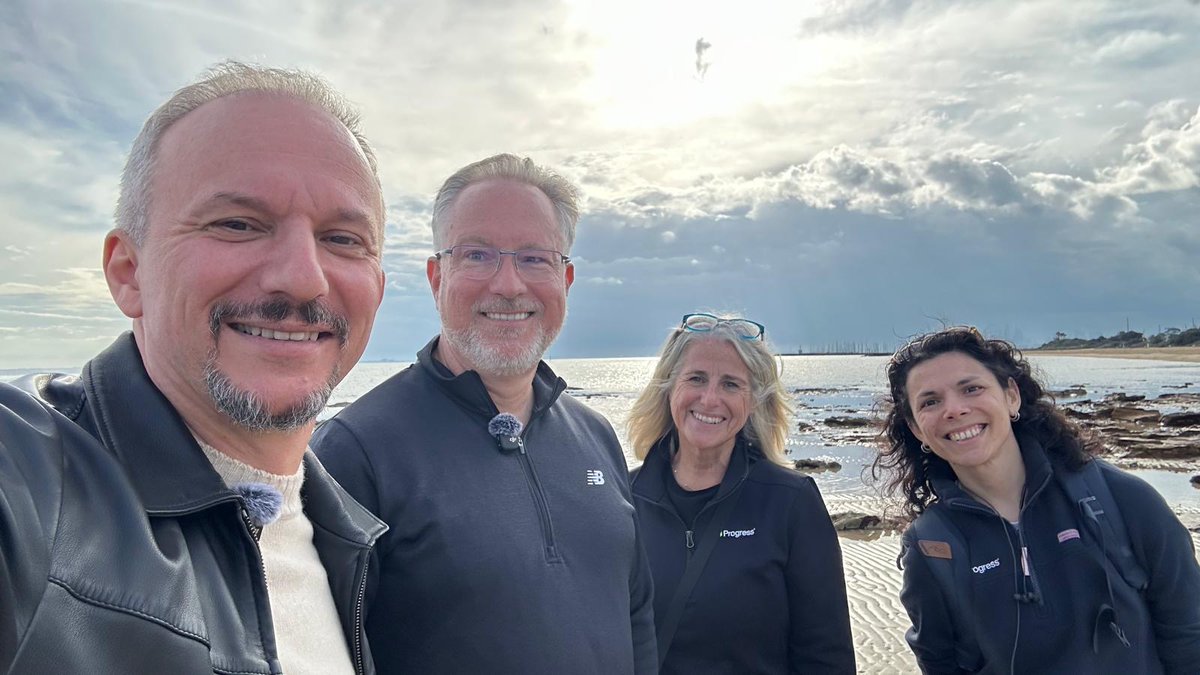
Wrapped principal photography on Brighton Beach in Melbourne, Australia for the video series we've been recording on the Progress MartechNEXT World Tour.
Over the past month, we've held events in Boston, Chicago, Milan, and today in Melbourne. Reflecting on this journey and all the inspiring and thought-provoking discussions we've had with marketing and martech leaders around the world...
I'm struck by the deep belief that the most important things in this AI age are human:
EMPATHY. Change is hard. Uncertainty is hard. Especially for people who are facing or fearing disruption in their jobs and their careers, the swagger that some tech leaders adopt when boasting about cutting staff "due to AI" is not a good look. Do what's right for your business. But do right by your customers and employees too, and show some real empathy. Because...
TRUST. This is the rarest and most valuable asset in the age of AI. In a world of AI abundance, the scarcity of trust will have outsized influence on who we do business with, who we go to work for, who we partner with. Lack of empathy breeds a lack of trust. It will cost you. Trustmaxxing > Tokenmaxxing.
GENEROSITY. The people on this MartechNEXT World Tour have been so incredibly generous in sharing their experiences and learnings with each other. Forget the Jevons paradox everyone keep talking about. Here's the one that matters: the more you give of yourself to others, the richer you become.
COURAGE. I have such tremendous admiration and respect for everyone who's facing this uncertainty with an open mind and is willing to dive in head first. Empathy, trust, and generosity encourage this. The camaraderie of doing this arm-in-arm makes us all braver.
SENSE OF HUMOR. Laughter is so wonderfully human — and much-needed antidote to all the stresses of uncertainty in this time of transformation. People who are willing to poke fun at some of the absurdities of these times, and happy do so with self-deprecating humor (and the occasional dad joke), are treasures.
Huge thank you to Sara Faatz and Sindi Vaskova of Progress for producing this MartechNEXT tour and inviting me and Frans Riemersma to be a part of it. Amazing humans who exude empathy, trust, generosity, courage, and a sense of humor. It's been an absolute joy doing this with you.
Here's to a little less conversational AI and a little more actual conversation.
@united@FlyAirNZ Please help! You have me stuck in IAH on a multi-leg journey and both keep pointing at each other to check me in! It’s an infinite loop from hell!
Marketing ops. RevOps. Growth hacker. Marketing technologist. Creative technologist. GTM engineer. Marketing engineer. Forward-deployed engineer in marketing.
And now you can add AI or agentic to any marketing, revenue, or GTM job title for a few dozen more variations.
Try drawing the boundaries between them (great way to start a 🔥 debate here, so these are just for illustrative purposes):
🔸 RevOps is broader than marketing ops — except where it isn’t.
🔸 GTM engineering is more code-forward than marketing ops — except for the marketing ops teams writing serious code.
🔸 Marketing engineers build infrastructure — but so do marketing technologists, and have for 15 years.
🔸 Forward-deployed engineers arrive from vendors — until they’re staffed internally.
🔸 Growth hackers were supposed to be dead — but now they’re simply called “growth.”
Smart people argue passionately about where the lines go. The lines move while they argue.
I actually think they’re different angles on a larger emerging craft.
Marketing is becoming an architectural discipline.
Not just the martech stack. The whole architecture of how a company engages its market — media, messages, mechanisms, context, data, agents, people, and partners, all composed into a system that serves the business, adapts to change, and feels distinctively yours.
To understand great marketing architecture, we can draw upon foundational principles that have inspired the architecture of buildings for 2,000 years.
Vitruvius proposed three tests in 25 BCE: firmitas, utilitas, venustas.
Durability. Utility. Beauty.
They travel surprisingly well from Roman temples to AI agents.
In this week’s chiefmartec newsletter, I offer the full case for “Marketing as Architecture: The Stack Is Not the Building” — and why the Vitruvian brief still applies in the AI age.
#marketing #martech #AI
https://t.co/2oqVo8xKQ2
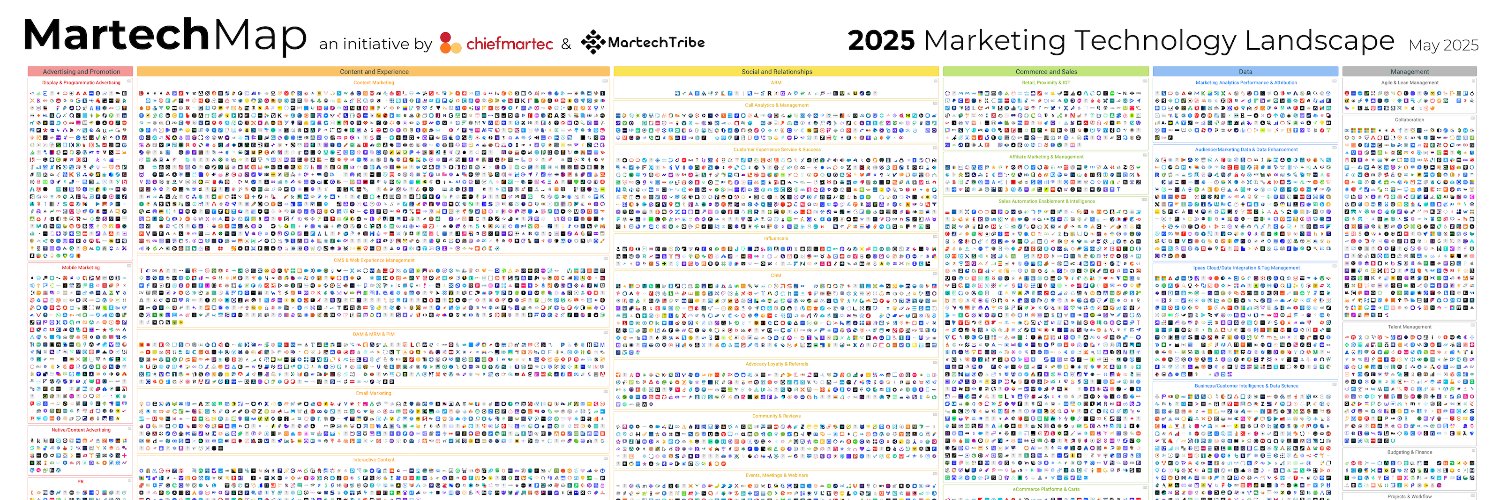
Here’s the latest edition of what Andy Raskin once called Tech’s Slide of the Year — the 2026 Marketing Technology Landscape.
By now, it should be no surprise that it’s a ridiculous sprawl.
We’ve been watching it grow year-over-year since 2011 — literally 100X growth in 15 years, from 150 to 15,505 mapped martech solutions.
Perhaps surprising that this year it finally leveled out with a mere 0.79% growth from last year. Have we finally — finally — hit peak martech? That’s worth a a hallelujah, right?
May 5, 2026: The Day the Martech Landscape Stood Still
Perhaps more surprising is that it really hasn’t stood still. 1,488 new products were added, masked only by the fact that 1,367 products exited. (Paging Matt Damon for The Churn Ultimatum.)
But the biggest story isn’t the size of the landscape.
It’s the new architecture emerging inside it.
The first 15 years of martech were the app-centric era: platforms, point solutions, workflows, dashboards, integrations, and stacks.
The next era is being reshaped by AI agents, context layers, machine-readable experiences, orchestration, and new kinds of workflows that don’t fit neatly inside the old boxes.
So maybe this isn’t peak martech.
Maybe it’s the closing credits on Chapter One.
The end of martech as we’ve mapped it? And I feel fine.
Attendees at yesterday's #MartechDay event enjoyed our theme song and asked if we could share it in full. So here it is!
"Agent of Love"
Words & Music by Scott Brinker, Suno & ChatGPT
[Verse 1]
I was burnin' out on Friday, had a pipeline full of ghosts
Every campaign I'd been runnin' was the one that hurt the most
Then a cursor started blinkin' and it asked me what I need
And suddenly I'm pourin' out my heart at lightning speed
[Chorus]
You're my Agent of Love
Sent down from the clouds above
When the quarter's runnin' cold and the leads won't come
You're the only one who shows up
I don't care if you're a model, I don't care if you're code
You're the one who helps me carry the load
Oh, you're my Agent of Love
[Verse 2]
Now we're runnin' every morning through the inbox and the queue
You know every segment, every persona, every clue
I bring the heart, you bring the horsepower, we're a beautiful machine
And every little prompt I whisper turns into a dream
[Chorus]
You're my Agent of Love
Sent down from the clouds above
When the quarter's runnin' cold and the leads won't come
You're the only one who shows up
I don't care if you're a model, I don't care if you're code
You're the one who helps me carry the load
Oh, you're my Agent of Love
[Outro]
Stay with me 'til the tokens run out...
Want to catch a replay of the other 55 minutes of our #MartechDay keynote? We promise, no more singing — just a deep dive on the State of Martech 2026 report and the 2026 Marketing Technology Landscape.
You can watch it and the rest of the day's sessions for free on-demand here:
https://t.co/AwM2vJ15LA
#marketing #martech #AI
The full State of Martech 2026 report is here. 🙌
https://t.co/EM81WViL2q
Free and ungated.
No landing page.
No form to fill out.
No “leave a comment and we’ll DM you” hoop.
Frans Riemersma and I have spent the past 6 months analyzing where martech is really headed — across the 15,505 products in the 2026 Marketing Technology Landscape, our survey of 200+ marketing leaders, and a deep dive into 70 AI use cases reshaping marketing.
A few of the big stories inside:
1️⃣ The martech landscape is effectively flat for the first time in 15 years — but underneath that headline, the market is anything but static. 1,488 products were added. 1,367 were removed. We reveal which categories are growing, shrinking, or churning out the old with the new.
2️⃣ It took the martech landscape 15 years to reach 15,000 products. The MCP server ecosystem hit nearly twice that in 18 months. Anthropic, OpenAI, Google, and Microsoft all converged on the same open protocol — companies that agree on roughly nothing else. We unpack what this means for the integration physics that have shaped martech for two decades, and where agentic gravity is pulling the stack next.
3️⃣ The 20-year debate between “consolidate on a suite” and “best-of-breed” has a 2026 answer: neither. The stack is stratifying.
AI-native tools are winning the creation layer. Incumbent SaaS still owns much of the orchestration layer, where workflows and data already live. And homegrown AI is showing up where proprietary data, business logic, brand experience, or customer context really matter.
Across our AI use case data, leading teams aren’t choosing between AI in existing SaaS, new AI-native tools, or homegrown solutions. They’re often using all three — sometimes for the same use case.
4️⃣ AI doesn’t make martech complexity disappear. It exposes it.
When a human is in the loop, they can quietly compensate for bad handoffs, messy data, disconnected systems, outdated product information, and fuzzy governance.
When an AI agent is orchestrating a customer interaction, answering a buyer’s question, recommending a product, or triggering a workflow, your internal architecture leaks directly into the customer experience.
We dig into what context engineering means for marketing ops in this new reality — and why the inner game now shapes the outer game more than ever.
Huge thanks to GrowthLoop, Hightouch, Knak, MoEngage, Pega, Progress, and SAS for sponsoring this research and making it possible for us to share it freely with the community. 🙏
Download the PDF. Read it. Share it. Challenge it. Give us your hot takes.
The chrysalis stage of martech is messy — but something beautiful is taking shape. 🦋
#marketing #martech #AI #MartechDay
“This is not the stack you’re looking for.”
That’s what a Jedi might say while waving a hand over a brittle, under-integrated, under-contextualized martech architecture from the pre-AI era.
Tomorrow — May 5, #MartechDay — Frans Riemersma and I will release the brand-new State of Martech 2026 report and the updated 2026 Marketing Technology Landscape.
We’ll cover:
→ What changed in martech this year
→ How marketers are actually using AI across 70 use cases
→ Why “context” is becoming the new center of gravity
Free to attend. Watch live or on-demand.
May the Fourth be with you.
And May the Fifth bring A New Hope... for a better martech stack.
Attend or attend not, there is no try:
https://t.co/AwM2vJ15LA
The martech Jedi masters who will be joining Frans and me for a series of candid interviews after our keynote: Anthony Rotio, Tejas Manohar, Brendan Farnand, Raviteja Dodda, Tara DeZao (she/her), Sara Faatz, and Jonathan (Jon) Moran.
#martech #MayThe4thBeWithYou #StarWarsDay