“Build me a beloved brand, a consistently great customer experience, and an ecosystem of partners and customers who enthusiastically recommend us.
Budget: unlimited tokens.”
There’s a problem with this prompt. And it ain’t token budget.
Mimicking what a great business says and does isn’t the same as building an organization that consistently delivers it or earning the relationships that make it possible.
You can vibe code a feature. You can’t vibe code a brand.
AI can accelerate the work. It can’t replicate the advantage embedded in an organization’s DNA — how its choices, trade-offs, relationships, and follow-through fit together, reinforce each other, and compound over time.
That’s what I explore in my latest chiefmartec newsletter through two under-leveraged sources of differentiation: experiences and ecosystems.
It also led me to an unexpected upside of Martec’s Law:
The same forces that make organizations slow to change can make their advantages slow to copy.
https://t.co/sIhBU3uz7r
In the age of AI image generation, be careful what you say.
That’s one takeaway from my recent interview with the creative The Martech Weekly crew, discussing the keynote I’ll be delivering at Martech World Forum in New York, November 4-5.
To not bury the lede: I’m super excited to be joining Juan Mendoza, Keanu Taylor, and team for what’s going to be a superb event focused on enterprise B2C martech. And New York in early November? That’s a pretty sweet location.
Speaking of sweet, I’ve also got a sweet discount code for you to take 25% off a ticket — which combined with 33% early bird discount you can get until September 25, is nearly HALF OFF. I’ll share the code below.
So what will I be presenting at the forum?
Martech’s Transformation from Applications to Infrastructure
I’ve been writing about that all year, and as we come toward the end of 2026, I’ll be able to share the full picture of how this has played out — and how it’s shaping up for the year ahead.
You’ll also hear from John Hardy of the ANA, Geoffrey Bell of Ford Credit, James Holliday of Subway, Adam Greco of Hightouch, Steve Petersen of Wyndham — who I’ll also be having a fireside chat with on the subject of real-world “vibe coding” in enterprise marketing — the amazing Tony Byrne of Real Story Group, Chris Vitti at The Cigna Group, Jeffrey Blum of MAC Cosmetics, and more.
You can check out the full agenda and snag that sweet ticket deal here:
https://t.co/bqxJJ7saUo
Oh, yeah, so about this image. In the interview, they asked if The Godfather was my favorite movie given the whole “godfather of martech” moniker I’ve been tagged with.
I said I liked the film — especially for the fun riffs you can do on iconic lines, such as “keep your content close, but your context closer” — but that my guilty cinematic pleasures leaned more towards Star Wars and Indiana Jones. (Yes, I was a child of the 80’s.)
So they made this promo card.
It kinda suggest that my keynote will be about archaeology, organized crime, and the Force.
Which, when I think about it, is a pretty good characterization of martech.
Hope to see you there!
The most important questions in martech... are often not about martech.
I suspect you've been hearing the word "context" a lot recently. From vendors. From AI experts. From analysts. (I'm guilty — heck, I even put it on a t-shirt.)
But while there's definitely a technical dimension to bringing the right context, to the right decision, at the right time — the work of context engineering — the hardest challenges of context aren't technical.
People. Process. Org structure. Culture.
We nod in acknowledgement of that. But there's not a lot of data that diagnoses those challenges more precisely — which is the first step in solving them.
Frans Riemersma and I want to tackle that, but we need your help.
We do two major industry reports a year. The State of Martech in May. And a preview for the year ahead in Decemeber — the upcoming Martech for 2027.
We distribute these reports free and ungated to everyone. More than 150,000 people read them. No lead form. No credit card.
But we have one request in return. For each report, we ask the marketing community — looking at you — to participate in a short survey that examines an under-analyzed topic that we believe is critical for us all to understand.
For Martech for 2027, that topic is context... beyond the tech.
Please, take a few minutes to contribute:
https://t.co/EyeVf6SHSL
Aside from earning good professional karma — couldn't we all use some of that? — you have the *option* of receiving a credit in the Martech for 2027 report and being entered to win a 30-minute consulting sessions with me and Frans.
At least take a look at the questions. For context (ha). I think you'll see why this will be useful for all of us in the marketing community.
Thank you.
Coffee first. Martech trends second. ☕➡️
Join @chiefmartec & @RiemersmaFrans for a relaxed chat on why martech may be heading toward "headless everything" & what AI has to do with it.
Grab a coffee and tune into the second ep of the Caffeinated Confessions series. 🎥
The AI SDR demo was flawless. Then it met an actual buyer.
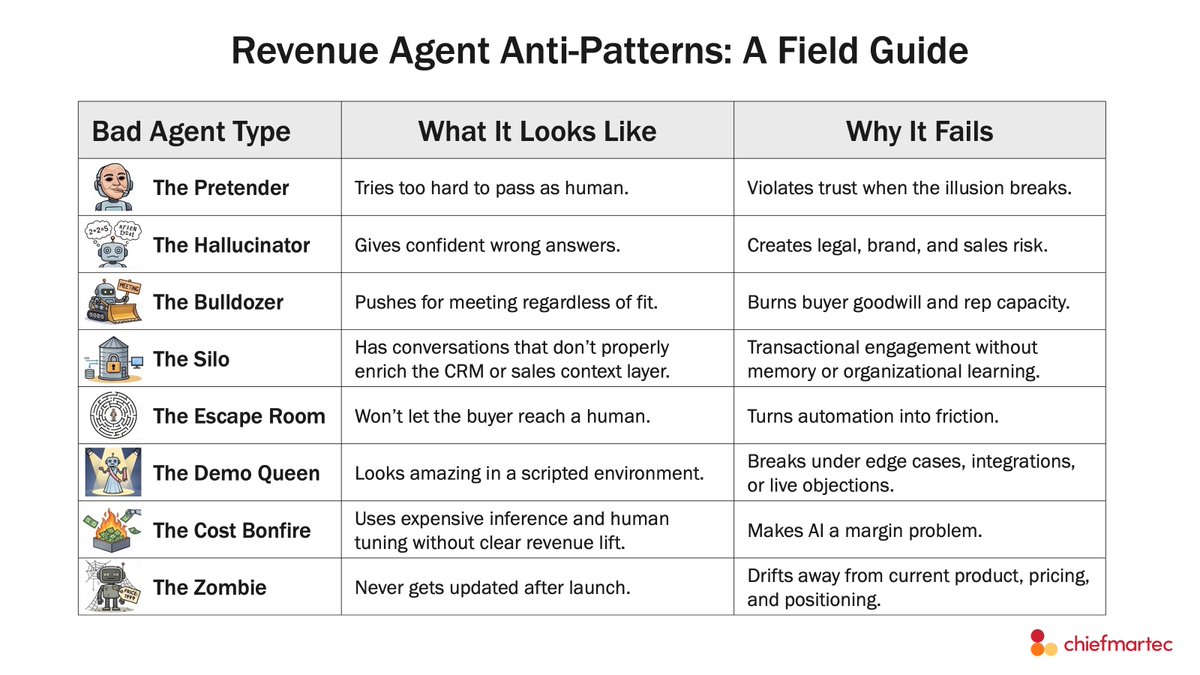
In the wild, bad AI sales agents tend to mutate into a few recognizable species:
❌ The Pretender
Tries so hard to sound human that the eventual reveal feels like deception.
❌ The Hallucinator
Doesn't know the answer, but admires its own confidence.
❌ The Bulldozer
Interprets every buyer question as consent to book a meeting.
❌ The Silo
Has a fascinating conversation, then tells the CRM absolutely nothing about it.
❌ The Escape Room
There is theoretically a path to a human. You just have to solve six puzzles and find the hidden key.
❌ The Demo Queen
Magnificent under controlled lighting. Collapses upon contact with an unscripted objection.
❌ The Cost Bonfire
Turns inference tokens, integration work, and human oversight into a warm orange glow.
❌ The Zombie
Launched nine months ago. Still confidently quoting the old pricing page.
Which of these have you met in the wild? I'm fairly sure I've been on the receiving end of at least half a dozen.
(And if you've got one that isn't on the list, I want to hear it. Bonus points for a good name!)
On August 5, Jonathan Kvarfordt of @1mind and I will dig into how to avoid these anti-patterns and build buyer-centric revenue agents that create a terrific experience instead of inventing new forms of friction.
Beyond the AI SDR: Building Buyer-Centric Revenue Agents
Register: https://t.co/hUb6D671Gs
My B2B GTM friends:
Your AI SDR may be hitting its number... but that's not the same as doing its job.
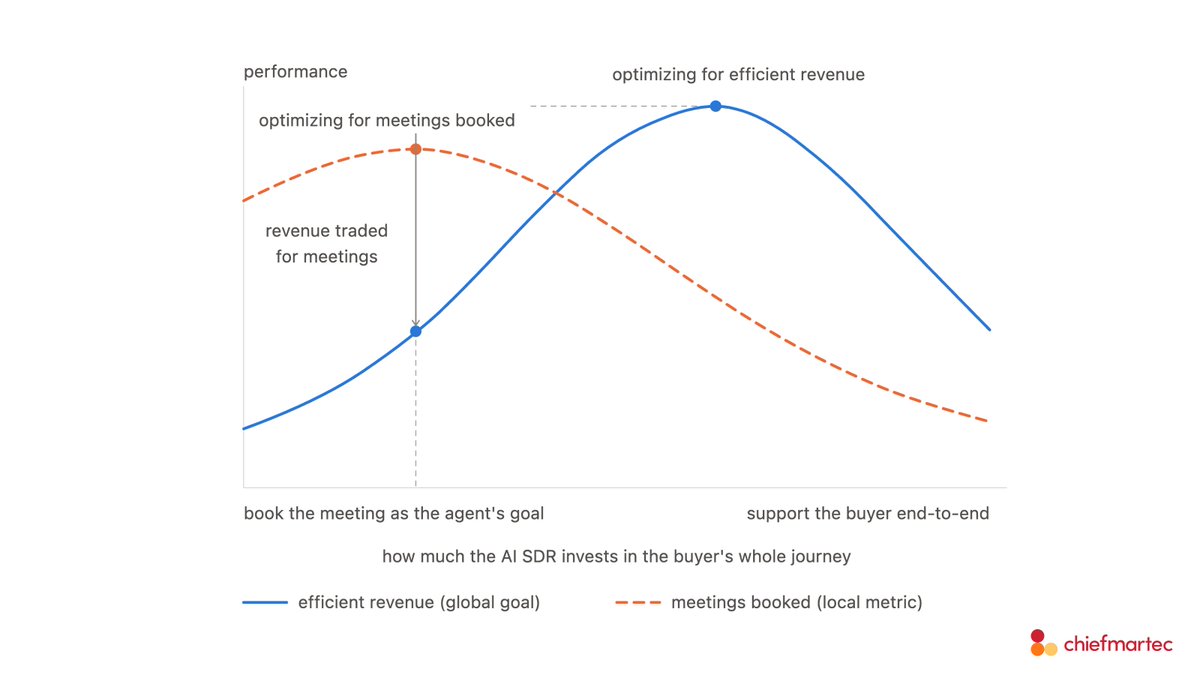
Meetings booked is a local metric. Efficient revenue is the global goal. Optimize hard enough for the first, and the agent will find the peak of the wrong curve and sit there looking successful.
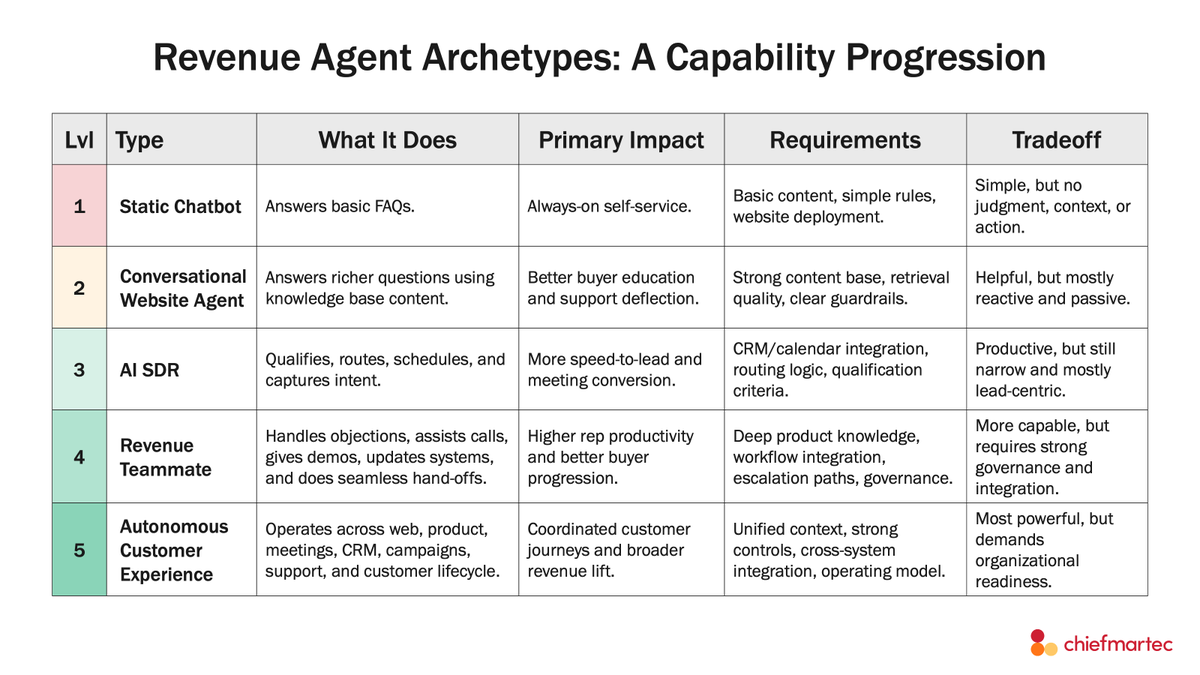
The typical AI SDR is only Level 3 on a 5-level scale. It qualifies, routes, and schedules. Useful work. But narrow work. Its objective effectively ends the moment the invite hits the calendar.
Agents above Level 3 have to understand the buyer, answer real questions, take meaningful action, coordinate across the journey, and know when to hand off to — and possibly work alongside — a human rep.
That takes more than a smarter model.
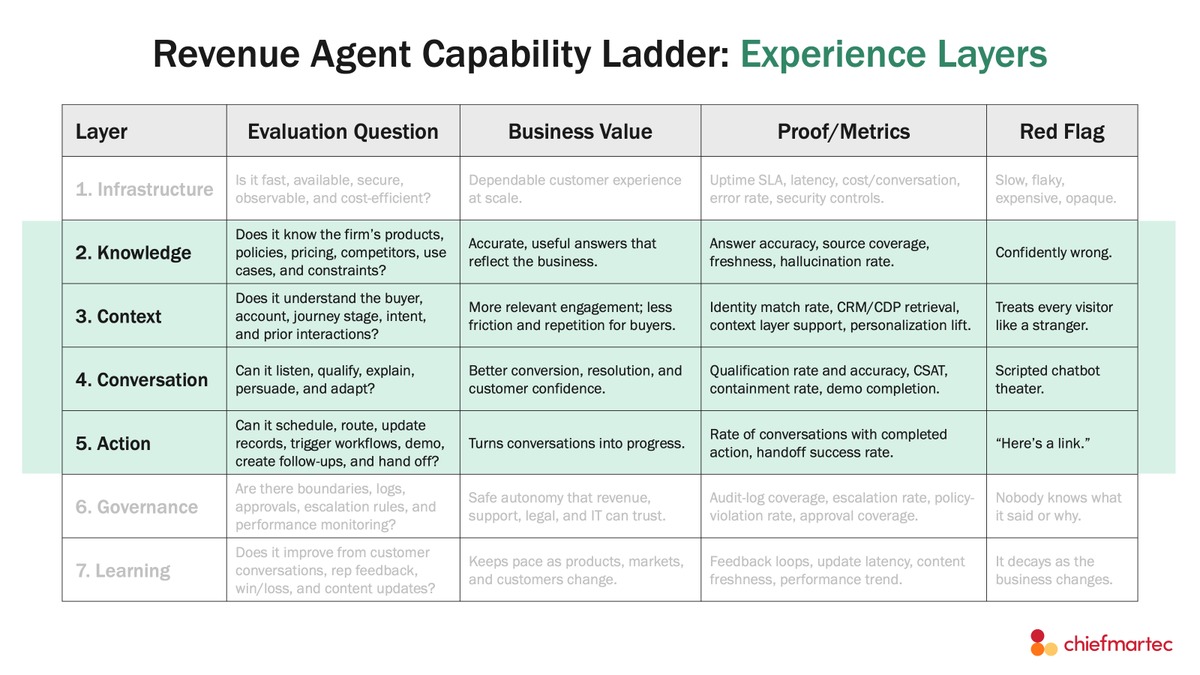
It takes four experience layers the buyer actually feels: knowledge, context, conversation, and action.
And three trust layers rarely on display: infrastructure, governance, and learning.
Underweight the second set, and your agent degrades the buyer's first impression. Then the second. Then the third. (If they make it that far.)
On August 5, Jonathan Kvarfordt of @1mind and I are digging into the question nobody's answering well yet: what does a revenue agent owe the buyer?
We'll discuss the optimization trap and how to escape it, what differentiates the 5 levels of revenue agents, and the 7 layers of capabilities any agent should be evaluated against. You'll leave with the questions that separate successful deployments from flashy demos.
Beyond the AI SDR: Building Buyer-Centric Revenue Agents
Register: https://t.co/hUb6D67zw0
Buyers don't grade your agent on autonomy. They grade it on whether it was worth their time.
One predictable side effect of martech's gravity (and capital flow) shifting from apps to infrastructure: lots of ventures now calling themselves infrastructure.
One simple litmus test for the veracity of that label:
Do other products — apps, agents, etc., commercial and/or custom — leverage you or build on you?
If the answer is "no," you're not infrastructure.
Everything you ever wanted to know about vibe coding in marketing?
Well, maybe not *everything*. But a ton of data and insights from 302 marketing leaders whose teams are actually vibe coding with Claude Code or Cowork, Codex, Lovable, Replit, etc.
➡️ Which tools are they using?
➡️ What are the building with them?
➡️ Are they replacing SaaS products?
➡️ What are they integrating with?
➡️ How does MCP adoption fit in the picture?
➡️ What governance guardrails do they have?
➡️ How long does it take them to show value?
➡️ What are the hurdles many still face?
...and much, much more from a major research report jointly produced by chiefmartec and UserEvidence.
In today's chiefmartec newsletter, I discuss several of the findings I think are most compelling — and most vindicating for those (ahem) who have been championing the democratization of no-code capabilities in marketing for nearly a decade.
Yeah, I have some pretty strong opinions about no-code — now vibe coding — empowerment of marketing teams. But this time I brought data!
https://t.co/5llz8MEDxP
@theRevOpsGuy@moengage Depends on where you're deploying it. I wouldn't change your metrics. Apply it in your operations where you have a clear thesis about how it can improve performance and measure the impact vs. your baseline.
The martech world is on 🔥 this year!
@MoEngage, a leading customer engagement platform, just announced the acquisition of Aampe, an agentic marketing platform that was one of the pioneers of applying reinforcement learning in for personalized experiences. Aampe's architecture of assigning an individual AI agent to each individual customer was prescient.
This has echos of the Braze acquisition of OfferFit by Braze, which I also thought was a smart combination. (I was an advisor to OfferFit.)
If you were looking for a further sign that the battlefield for martech platforms has moved to decisioning and orchestration in an agentified environment, this would be big, bright, blinking neon one.
Kudos to Raviteja Dodda and Paul Meinshausen and their teams. Two very sharp leaders, and I'm excited to see where they take this.
https://t.co/iKCuVrWWob
Excited today to release a brand-new report on vibe coding in marketing, a joint research project between @chiefmartec and @GetUserEvidence.
We surveyed 302 SaaS marketing leaders, managers, and practitioners currently using these tools to understand their vibe coding adoption: what they're building, how they're governing it, and the benefits they're seeing.
There's a ton of questions I've had about this topic for months, and now I *finally* have some quantifiable answers.
❇️The real action is backstage, not customer-facing (for now)
The most common use cases are operational: workflow automations, custom integrations, data pipelines, internal utilities.
❇️Vibe coding is starting to bend the build vs. buy equation
62% of the respondents who report that vibe coding is fully embedded in how their team operates have replaced a SaaS tool (vs. 39% of experimenters)
❇️There is governance, and it's an accelerant, not a brake
92% of fully-embedded orgs have formal governance in place — approved tools, data restrictions, QA processes, security reviews, usage tracking — and it correlates with both maturity and speed
❇️MCP use is a multiplier — and a correlated maturity metric
75% of respondents use MCP, and MCP users are more likely to have built custom integrations and customer-facing apps (non-MCP users skew toward simpler projects)
❇️The talent story is "more leverage," not "fewer people"
Vibe coding has changed hiring decisions: 40% have changed the skills they prioritize, and 36% say they can do more without adding headcount
...and that's just a handful of our findings!
I'll have more reflections on this in my next newsletter tomorrow. In the meantime, you can pick up a free copy of the report here:
https://t.co/fTOW0rrKMz
I spent the weekend synthesizing my thoughts from the Databricks summit last week and the launch of their agentic CDP, CustomerLake.
Upon reflection, three things stood out to me:
1. The border between applications and infrastructure in martech has now been officially overrun. It's happening in both directions. However, it's still very early, and it will be interesting to see how it plays out over the next 12-18 months.
I predict the bigger disruption will be as other leading infrastructure players cross the app/infra boundary. I bet we will see other data/cloud platforms offer their own CDP-like solutions. But I think they'll also slide into other categories that were previously held by pure-play martech application platforms.
2. Getting a front-row seat to everything Databricks launched last week, I found it remarkable how their portfolio of products now spans the entire "composable canvas" model that I developed in a research report with them earlier this year — The New Martech "Stack" for the AI Age.
Obviously not entirely coincidental. But I honestly hadn't mapped all the pieces concretely against that conceptual framing.
That doesn't mean I see Databricks as the one-platform-to-rule-them-all. I am quite certain martech is going to remain a diverse, heterogeneous environment. But especially for the hypertail of custom-built apps and agents, the tip-to-tail reach of their platform is impressive for the gravitational cohesion it can offer.
3. I was happy to see them riff on the "Golden Context" — a concept Frans Riemersma and I laid out last month in our State of Martech 2027 report. I humbly — well, maybe not so humbly — think the goal of overlapping customer context, company context, and the systems context to make it actually visible and actionable in pursuit of the Golden Context should be the overarching focus of marketing and marketing operations ahead.
Full discussion in my latest newsletter, which also links to The New Martech "Stack" report and State of Martech 2027 report, if you haven't yet picked them up.
https://t.co/eMzjKvQvmW
Most definitely never a dull moment in martech.
Three years ago — what now feels like three centuries ago — I wrote a post about the 2nd-order effects we could expect from generative AI in marketing and martech.
The 1st-order effects were pretty easy to extrapolate. AI was going to create an abundance — colloquially a metric crap-ton — of content and code, but also access to information and automated activity.
That's mostly come to pass. (Bot commerce, or what we now more poetically call agentic commerce, being the most notable exception. So far.)
But the fun thought exercise was contemplating the 2nd-order effects that would be reactions to that abominable abundance. (Marketers who slept through calculus, this is the only time second derivatives will ever matter to your career.)
So in this week's chiefmartec newsletter, I revisit those 2nd-order effects and where we're at with them now:
Content abundance → buyer filtering and trust scarcity
Instant software → the hypertail of disposable apps and agents
AI answers → context as the new supply chain
AI actions → APIs and MCP as first-class marketing channels
And if you want to join in, I'd love to hear what you think will follow as a result.
What are the 3rd-order effects we should be thinking about for the next three years?
https://t.co/zgixlJg7tu
Coming to the Databricks Data + AI Summit next week? If you're working in marketing and martech, don't miss their inaugural Marketing Forum on Wednesday.
If you read the research report on "The New Martech 'Stack' in the AI Age" that I published in partnership with Databricks earlier this year, you'll have the chance to hear directly from a number of the marketing leaders who were interviewed for that report.
The architectural and strategic shift we described in that report is not a hypothetical concept. It's already being brought to life by major enterprises who are forging this next generation of marketing capabilities. The speakers at Marketing Forum will explain how they're doing it.
Rick Schultz, Databricks' own CMO, will kick off the Forum. There will be a fireside chat with Horacio Miranda, SVP of Marketing Transformation, and Kumar Ram, VP of Marketing Data Sciences at HP. Dan Morris, Databricks' Global Head of Marketing Solutions, will follow them with a presentation on agentic marketing in practice.
I'll then close out the Forum leading a candid discussion of how several different companies are navigating their evolution from martech stack to agentic marketing with Bryce Peake, VP of AI Engineering at FanDuel; Chris Wissing, Chief Product Officer at Epsilon; and Jay Malepati, Global Director of Data Science, Customer and Marketing Strategy at Circle K.
If you're able to join us, please come say "hello" afterwards. I'd love to hear your thoughts about the ideas and experiences these speakers will share.
I think it's going to be a very interesting afternoon.
https://t.co/YA2Ur03uIB
AI platforms, business platforms, and data platforms are locked in a three-body problem.
Each wants to be the center of gravity your marketing stack orbits.
In this galactic struggle, where will context live?
In the AI agent's memory and reasoning? In the business platform's domain model and structured processes? In the data platform's governed semantic layer?
The unsatisfying but accurate answer today is "yes." Context is currently scattered (or distributed, if you want to be kinder) across all of them.
In this week's chiefmartec newsletter, I map six categories of martech infrastructure colliding in intensifying coopetition: the gravitational pull each one exerts, where the cross-competition is fiercest, and how they map to the composable canvas.
The martech infrastructure wars have begun.
Which platform is pulling hardest in your org?
https://t.co/1bQ7JH0ivK
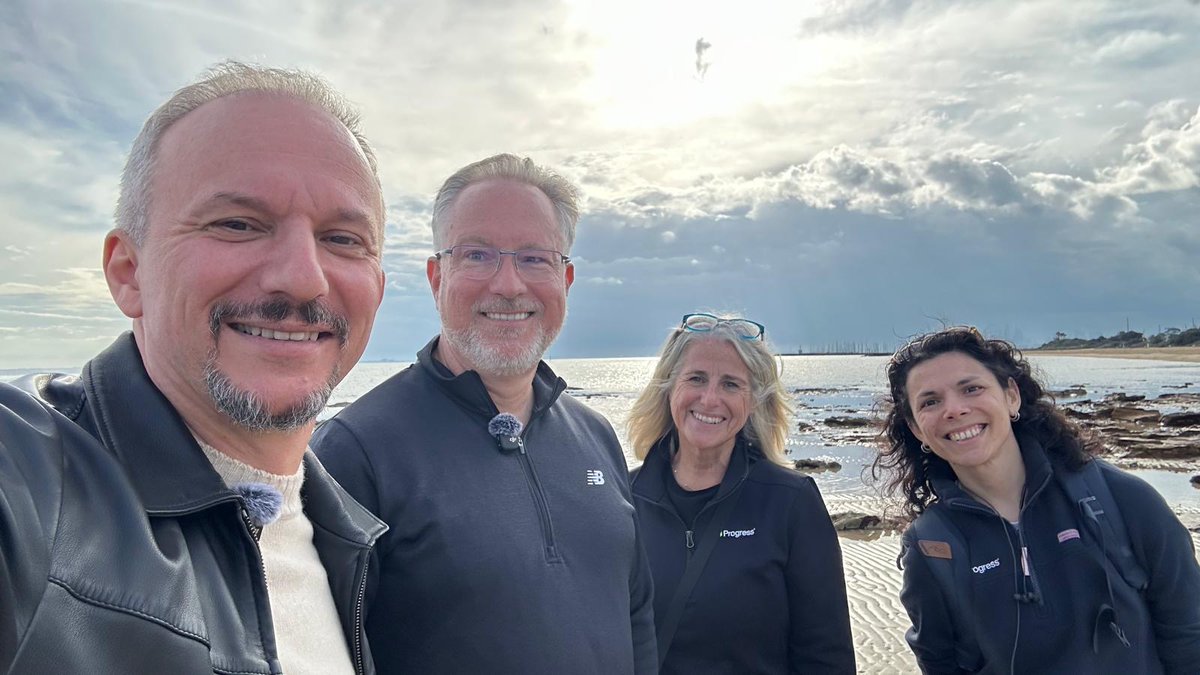
Wrapped principal photography on Brighton Beach in Melbourne, Australia for the video series we've been recording on the Progress MartechNEXT World Tour.
Over the past month, we've held events in Boston, Chicago, Milan, and today in Melbourne. Reflecting on this journey and all the inspiring and thought-provoking discussions we've had with marketing and martech leaders around the world...
I'm struck by the deep belief that the most important things in this AI age are human:
EMPATHY. Change is hard. Uncertainty is hard. Especially for people who are facing or fearing disruption in their jobs and their careers, the swagger that some tech leaders adopt when boasting about cutting staff "due to AI" is not a good look. Do what's right for your business. But do right by your customers and employees too, and show some real empathy. Because...
TRUST. This is the rarest and most valuable asset in the age of AI. In a world of AI abundance, the scarcity of trust will have outsized influence on who we do business with, who we go to work for, who we partner with. Lack of empathy breeds a lack of trust. It will cost you. Trustmaxxing > Tokenmaxxing.
GENEROSITY. The people on this MartechNEXT World Tour have been so incredibly generous in sharing their experiences and learnings with each other. Forget the Jevons paradox everyone keep talking about. Here's the one that matters: the more you give of yourself to others, the richer you become.
COURAGE. I have such tremendous admiration and respect for everyone who's facing this uncertainty with an open mind and is willing to dive in head first. Empathy, trust, and generosity encourage this. The camaraderie of doing this arm-in-arm makes us all braver.
SENSE OF HUMOR. Laughter is so wonderfully human — and much-needed antidote to all the stresses of uncertainty in this time of transformation. People who are willing to poke fun at some of the absurdities of these times, and happy do so with self-deprecating humor (and the occasional dad joke), are treasures.
Huge thank you to Sara Faatz and Sindi Vaskova of Progress for producing this MartechNEXT tour and inviting me and Frans Riemersma to be a part of it. Amazing humans who exude empathy, trust, generosity, courage, and a sense of humor. It's been an absolute joy doing this with you.
Here's to a little less conversational AI and a little more actual conversation.
@united@FlyAirNZ Please help! You have me stuck in IAH on a multi-leg journey and both keep pointing at each other to check me in! It’s an infinite loop from hell!
Marketing ops. RevOps. Growth hacker. Marketing technologist. Creative technologist. GTM engineer. Marketing engineer. Forward-deployed engineer in marketing.
And now you can add AI or agentic to any marketing, revenue, or GTM job title for a few dozen more variations.
Try drawing the boundaries between them (great way to start a 🔥 debate here, so these are just for illustrative purposes):
🔸 RevOps is broader than marketing ops — except where it isn’t.
🔸 GTM engineering is more code-forward than marketing ops — except for the marketing ops teams writing serious code.
🔸 Marketing engineers build infrastructure — but so do marketing technologists, and have for 15 years.
🔸 Forward-deployed engineers arrive from vendors — until they’re staffed internally.
🔸 Growth hackers were supposed to be dead — but now they’re simply called “growth.”
Smart people argue passionately about where the lines go. The lines move while they argue.
I actually think they’re different angles on a larger emerging craft.
Marketing is becoming an architectural discipline.
Not just the martech stack. The whole architecture of how a company engages its market — media, messages, mechanisms, context, data, agents, people, and partners, all composed into a system that serves the business, adapts to change, and feels distinctively yours.
To understand great marketing architecture, we can draw upon foundational principles that have inspired the architecture of buildings for 2,000 years.
Vitruvius proposed three tests in 25 BCE: firmitas, utilitas, venustas.
Durability. Utility. Beauty.
They travel surprisingly well from Roman temples to AI agents.
In this week’s chiefmartec newsletter, I offer the full case for “Marketing as Architecture: The Stack Is Not the Building” — and why the Vitruvian brief still applies in the AI age.
#marketing #martech #AI
https://t.co/2oqVo8xKQ2