@junkbondinvest 5 months ago, a once in a century technology did not exist in its current form and was not clear to anyone including the top experts in the field
@PythiaR Knowing which ones obv the hard part, but they’re absolutely out there. How can there not be some incumbent accelerating as ‘token resellers’. Think a basket approach makes a lot of sense. If your hit rate is 50% - 3-5x on a few, hopefully flat from here on others, doing great
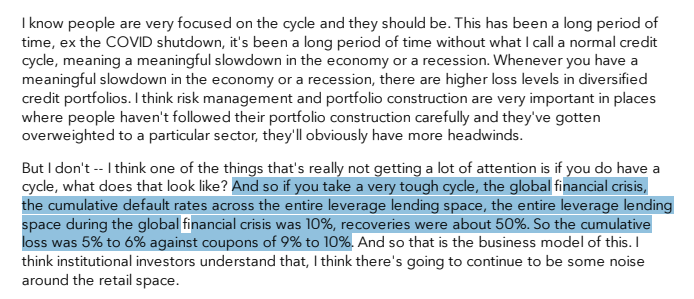
Goldman's David Solomon providing some much needed rational thought around private credit:
- GFC saw defaults peak at 10%
- recoveries were 50%
- trough cumulative loss of 5%-6% vs coupons of 9%-10%
For context, listed BDCs are currently pricing in defaults of more than 20%
@IlliquidInsight This is easy to say in the moment but it has empirically, unequivocally been the best performing sector the last decade. Why else would it have grown to the scale it has in PE/PC? Facts have just changed on the ground due to a once in a century technology
See below. Defaults rising is a theoretical boogeyman from AI disruption to SW books. By the way, these are historic lows. No one is saying there won’t be higher defaults in a sub IG asset class. The point is it’s incentivized doomerism perpetrated by clicks, substack and capital sellers, while performance is still better than what you can get in public credit. And the redemptions…they are in a small sliver of the industry (wealth). 90% of the capital is in institutional drawdown funds and SMAs where there is no redemption dynamic to speak of - and interest there isn’t waning
Refi’s a potential issue for PE but not really for PC. They’ll demand more sponsor equity or spreads or walk. Loans are 3 yrs avg remaining and SW retention rates are extremely slow moving even if AI disrupts - plenty of time for PC firms to pivot. So PE has the harder challenge but also has the asymmetry that a few big AI winners that can paper over losses. Overall, no one is saying SW is not going to be tricky - but it’s <10% of these Alts AUM and risks are ridiculously overblown, esp on credit front
Yeah, we know exactly what’s going on, which is this is the silliest, most overblown media driven hysteria yet. Outside the narrow sliver of PC wealth products, which represent <5% of industry AUM, fundraising is accelerating. Even in PC, institutions seem to be leaning IN even more to take advance of already 100-200bps higher spreads. EBITDA is generally accelerating, and defaults are declining as of now, so there’s no imminent cycle. A few loose players like $OWL will weaken but more disciplined players like $ARES and $APO will just massively capture lost share. The theoretical 2029 SW boogeyman will never show up, bc thanks to the fear mongering, everyone’s already proactively washing out SW exposure. I’m very sorry but the private markets freight train is just too institutionalized and powerful for Gundlach or any other share losers to stop
@Richard89022768@junkbondinvest Have you met any of these managers or looked at the track records? Most put Ares in a league even above KKR, BX on lending chops. Last firm to be worried about
@west4thstreet Ha totally agree - wouldn’t touch OWL (or FOUR) w a 10 foot pole. For OWL, most of this is self-inflicted and they don’t have longevity w LPs to absorb this easily. I mean ARES KKR etc which are so incredibly much better but like anything get shot without nuance in the ST
Yea I think this is easy to say in the moment but would strongly disagree with this take, at least for the larger Alts. They are so incredibly institutionalized and the whole private markets is so entrenched with incentives up and down, from allocators to advisors to talent, all aligned to continue to power growth, Alts will double, triple AUM again in 5 years. There are so many growth vectors out there, from capital pools to new strategies. Time will tell. Also OWL is...flat on this news - if you're still short, should really pay attention.
Shouldn't the bigger managers be a massive beneficiary of this, especially someone like $ARES and maybe $APO? Top (especially loose) competitor out of the market so you capture their AUM flows and less competition for deals. Spreads are already wider by 100-200bps. What are we missing?
Shouldn't the bigger managers be a massive beneficiary of this, especially someone like $ARES and maybe $APO? Top (especially loose) competitor out of the market so you capture their AUM flows and less competition for deals. Spreads are already wider by 100-200bps. What am I missing?