Ciroos has joined the Open Weights and American AI Leadership Coalition alongside companies like Microsoft, NVIDIA, and Meta.
At Ciroos, we use a mix of closed and open weight models because we believe customers deserve choice over a walled garden. Open weight models are critical to how we build our AI teammates for a few concrete reasons:
• They allow us to run inference entirely within a customer’s own environment for strict data sovereignty.
• They remove the single-point-of-failure risk of relying solely on proprietary APIs.
• They allow for specialized fine-tuning that generic models can't match.
We believe the future of AI infrastructure must remain open and competitive. Read more about why we joined the coalition here: https://t.co/ERDhyH0Usz
When you're building an AI teammate for SREs, you want to make sure you're solving the actual problems—not just the theoretical ones.
That's why we're incredibly excited to welcome Niall Murphy as Distinguished Engineer to the Ciroos executive leadership team.
If you work in reliability, you probably already know Niall. He literally wrote the book on it (co-author of the original Site Reliability Engineering book) and has spent decades keeping the lights on at scale for Amazon, Google, and Microsoft.
He's joining us to bridge our product roadmap with the pragmatic realities of modern incident management—ensuring that as we build the future of AI in SRE, we're doing it in a way that actually supports human engineers instead of just adding noise.
Welcome to the team, Niall! We're thrilled to have you building with us.
#AISRE #SRE #Reliability
Read the full announcement here: https://t.co/hAc7V1nNbJ
Ciroos is excited to share we are the first and only AI SRE platform on the ServiceNow Store. Certified, listed, live.
It's one line item in a longer list — 50+ integrations across observability, cloud, identity, and ITSM. These deep integrations provide incredible value: your alert becomes a ticket, Ciroos investigates across every domain in real time, and the answer shows up where your team already looks. Not a new tab. The same one.
More tools isn't the differentiator. Fewer places to look is.
https://t.co/wdcrunZ6Ed
You can't optimize your way out of a broken model.
In his latest piece for RTInsights, Ciroos CEO Ronak Desai argues that teams chasing better alerting, faster runbooks, and smarter dashboards are solving the wrong problem. Reactive SRE—managing reliability by fighting fires after they happen—isn't broken because of execution. It's broken because of structure.
Optimization only reduces per-incident costs. It never reduces the number of incidents. In distributed systems at scale, complexity outpaces human teams. The real solution? Shift the intervention point earlier with proactive, AI-driven reliability that catches emerging problems before they become incidents.
Read Ronak's full breakdown here: https://t.co/20rVs1ViEM
We’re proud to share that the Ciroos AI SRE Teammate has been named a Finalist in the 2026 CODiE Awards! This recognition celebrates our commitment to building a world where enterprise systems are reliable by design — not by heroics. Winners will be announced July 15! Learn more: https://t.co/CrRZZO0yuw #CODiEAwards #AISRE #Reliability #ITOps
We used to think velocity was the bottleneck to enterprise innovation. It's not. Reliability is.
In his latest byline for APMdigest, Ciroos CEO Ronak Desai breaks down why the next massive leap in enterprise software isn't just about writing code faster—it's about fundamentally changing how we run it using agentic AI.
As long as SRE teams are forced to act as reactive firefighters, innovation will always hit a wall. You can't ship new features at the speed of the market if your engineering org is drowning in alert storms, false signals, and manual incident response.
Read Ronak's full breakdown here: https://t.co/GIjUti4x99
Alert fatigue is one of the most persistent challenges in enterprise operations. When a single infrastructure incident triggers a cascade of simultaneous alerts, operations teams are left drowning in an "alert storm" rather than investigating the actual root cause.
Today, we’re introducing Ciroos Signal Intelligence™ to solve this problem.
As the critical first stage of the Ciroos AI SRE pipeline, Ciroos Signal Intelligence™ algorithmically groups, deduplicates, and correlates incoming alerts from 50+ enterprise tools into high-fidelity signals—all without requiring operators to author a single rule.
By leveraging our real-time Knowledge Graph to understand the contextual relationships within your infrastructure, it reduces alert noise by up to 70%.
The result? Operations teams—and our multi-agent Reasoning Core—can immediately focus on enriched, actionable signals instead of redundant raw events. No configuration marathon required.
Read the official press release here: https://t.co/zDSZ3uby01
Explore the Ciroos Signal Intelligence™ architecture: https://t.co/Ih4IWVS7CA
Everyone is exploring AI for operations. But building a secure, reliable, and cost-efficient solution for complex enterprise environments requires more than just an API key.
Frontier models are powerful, but they are only as good as the context they are given. You cannot simply insert an LLM into a fragmented, cross-domain architecture and expect it to resolve incidents. Real reliability requires deep system understanding, secure data retrieval, and deterministic workflows to feed those models the right data.
We built Ciroos to solve the context problem.
Join us on May 20th for a live product walkthrough where we will demonstrate the Ciroos AI SRE Teammate handling a real incident. You will see exactly how Ciroos navigates complex telemetry, traces root cause, and builds an actionable timeline without ever moving your underlying data.
If you are exploring how to actually deploy AI for SRE in your environment, you will want to see the Ciroos difference.
https://t.co/Ir73ft9WIb
#SRE #AIOps #Observability #SiteReliabilityEngineering #ArtificialIntelligence
20 years of dashboards. 20 years of war rooms.
One of our most recent hires, Brian Spaulding, spent two decades in network ops and observability across HP, Cisco, and Dynatrace. He’s seen exactly where traditional monitoring tools reach their operational limits.
Read his perspective on why it’s time to move past chasing symptoms and start building true operational understanding. 📷
https://t.co/jLUMtP8qsf
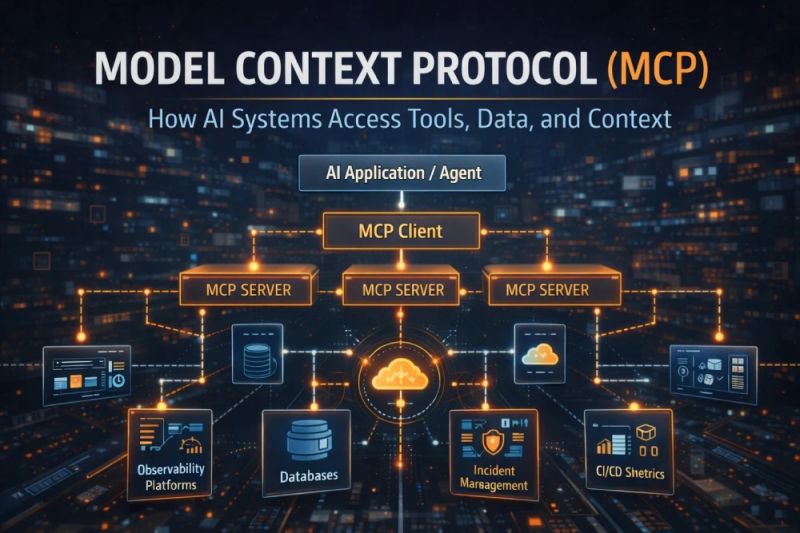
Everyone is talking about AI agents reading logs. Very few people are talking about how those agents actually connect to your data without forcing you to copy it into a massive, expensive centralized data lake first.
If you haven't looked into the Model Context Protocol (MCP) yet, you're missing a critical architectural shift in AI tooling.
It's the open standard that allows Ciroos to query across your existing infrastructure and observability stack in real-time, federating the context without requiring massive data duplication.
Here is our technical breakdown of exactly how MCP works in production. Learn more via the link in the comments.👇
hashtag#ModelContextProtocol hashtag#SRE hashtag#AIAgents hashtag#Observability
https://t.co/sEZzCGTuo7
The SRE industry is stuck in the "Screwdriver Era."
At 3 AM, your engineers are manually grepping logs and cross-referencing five dashboards just to find the root cause.
AI isn't here to replace the carpenter. It's the power drill that replaces the manual screwdriver.
Read FDE Kyle Shelton’s raw take on why SREs need power tools, not replacements 📷
https://t.co/CpQysuMQle
#AISRE #SiteReliability #DevOps #Observability
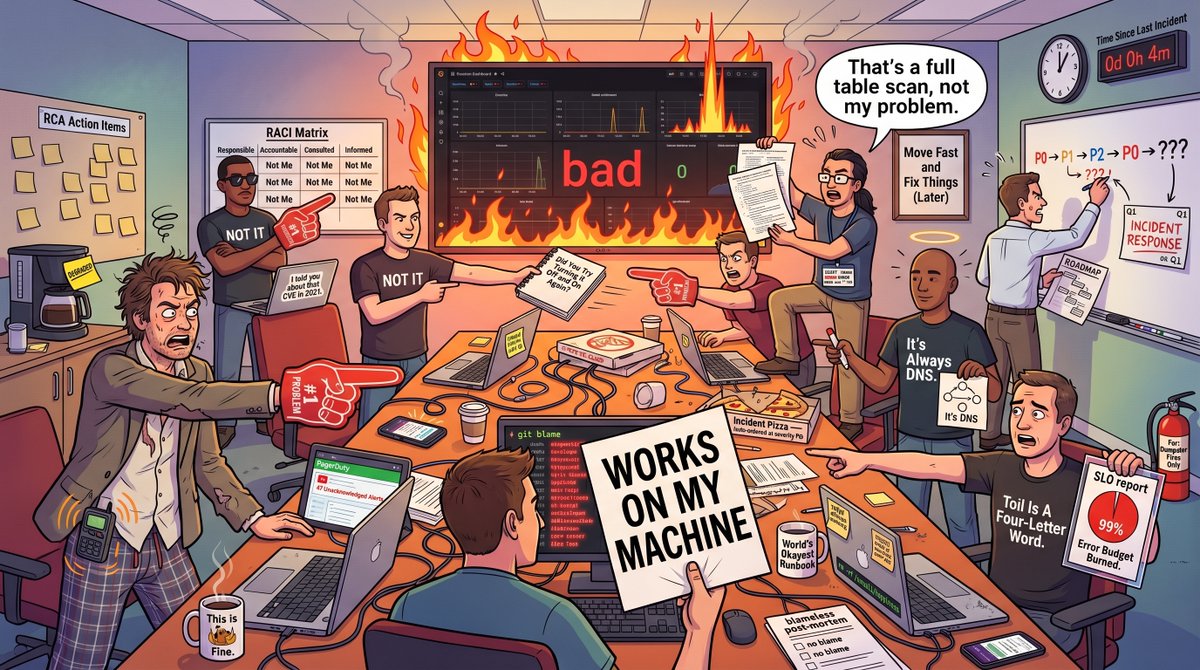
You've heard of MTTR. But what's your MTTB? Mean Time to Blame.
Take the quiz. 5 questions. 60 seconds. Find out if your org fixes incidents or just finds someone to pin them on.
(Yes, it's our April Fools' site. Yes, the results are fictional. But if it made you think twice about blame culture, that was the point.)
👇
#SRE #DevOps #IncidentManagement #Postmortem #MTTR #BlamelessCulture
https://t.co/53rsAbM43u
The era of blind trust in AI for Site Reliability Engineering is over.
Over the past year, the market has been flooded with new "AI SRE" platforms that look flawless in curated, brightly-lit demos. They promise instant root cause analysis. They promise seamless automation.
But demos don't carry pagers.
When these tools met the messy, fragmented reality of enterprise infrastructure, they didn't just fail—they actively eroded trust. They generated confident guesses with opaque reasoning. They optimized for the demo, not for the 2:00 AM incident.
If you are evaluating AI for your production operations this year, you need a framework that reflects reality, not hype.
Read the full breakdown on the Ciroos blog:
https://t.co/Vu4JTTGqHL
"The question isn't whether your test passed. It's whether your system is reliably capable."
Our co-founder and CEO Ronak Desai (@rodesai) was quoted in a recent https://t.co/7aM6UF1LLW piece on how agentic systems are breaking traditional reliability frameworks -- and why the way we think about testing needs to fundamentally shift as AI moves into production.
Worth a read for anyone operating in complex environments.
🔗 Full article here: https://t.co/TtoALdYMLR
SREcon26 Americas is a wrap. 👋
Through every conversation this week, one thing was clear: the SRE community is thinking hard about what comes next, and the need for AI that actually works in real enterprise complexity has never been more urgent.
That reinforced exactly why we're building Ciroos. Being in a room full of people who live this every day reminded us that operational understanding isn't a nice-to-have. It's foundational. As systems grow more complex and change faster than any single team can track, AI isn't optional. It's the path to reliability that scales.
We left more convinced than ever that the future of AI SRE isn't about just automation or speed. It's about systems that truly understand your environment and get smarter over time.
To everyone who stopped by, grabbed a Human Teammate tee, and pushed our thinking -- thank you.
Ciroos is now a Cloud Native Computing Foundation (CNCF) Silver Member.
98% of organizations run cloud native and 82% run Kubernetes in production. As infrastructure scales, so does the need for AI-powered reliability and operational understanding across it.
That's the problem we're built for.
Proud to join the @CloudNativeFdn community -- link to the announcement here: https://t.co/st9SB84KMR
Reactive SRE will always be expensive. Here's why.
The cost isn't just downtime. It's the engineering hours spent on alert triage, log parsing, and manual investigation -- work that never ends because the model never changes.
Faster tools, better runbooks, smarter alerts -- these optimize the fire department. They don't stop the fires and the firefighting tax stays.
Proactive SRE changes the economics entirely. Fewer incidents, engineers who can actually build, and infrastructure that gets more resilient over time -- not just better at recovering.
For the first time, AI makes this shift genuinely possible. The question isn't whether to move from reactive to proactive. It's when.
Full breakdown in our latest blog: https://t.co/QmVS6bIAiS
Evaluating AI SRE in 2026 looks very different than it did a few years ago.
Expectations are higher. Skepticism is earned. And the bar for trust has never been higher.
We wrote a practical buyer's guide to help reliability and engineering leaders cut through the noise -- covering what to assess, what to avoid, and what success actually looks like in production.
Inside:
• An honest look at why early AI SRE pilots failed — and what's changed
• Why speed without understanding accelerates risk — not reliability
• How to evaluate AI SRE in real conditions, not curated demos
• What successful adoption changes beyond incident response times
• A readiness diagnostic to assess where your SRE organization stands today
Link to access the guide: https://t.co/LdAMBz3MR7
We'll be at #SREcon26 Americas in Seattle next week (March 24–26) - and we'd love to see you there.
Ciroos is built for the reality SREs actually operate in: environments too complex for any single team to fully understand. Stop by to see how we're helping teams reach true operational understanding at scale.
Here's what we have going on:
📍 Booth #106, Fifth Avenue - live demos all conference
🎁 Raffle at the booth to win a Mac Mini or Flipper Zeros
🍻 Off-Call Hours, Wednesday evening - drinks and dinner with the SRE community (limited spots, entered to win a Flipper Zero)
Check out our full activities here: https://t.co/tS8MLWlyAQ
See you in Seattle.
Seeing everything is not the same as understanding everything.
Most modern SRE environments are deeply instrumented. The signals are all there.
And yet your best engineers are still spending entire shifts answering one question: what just happened?
That's not a tooling gap. That's a structural cost problem -- and it gets worse as systems scale.
Latest blog by Chris Heggem on why AI SRE fails to deliver ROI - and what has to change: https://t.co/BqaHlFJR15
#AISRE